

ViaCyte Secures $80 Million in Series D Funding to Advance Stem Cell-Derived Islet Replacement Therapies for Diabetes
Recently, VCBeat (WeChat Official Account: vcbeat) learned from foreign media reports that ViaCyte, a clinical-stage regenerative medicine company, announced the completion of an $80 million Series D financing round. The round was led by Bain Capital Life Sciences, with participation from TPG and RA Capital Management.
ViaCyte, founded in 1999 and headquartered in California, USA, is a private regenerative medicine company. The company primarily develops novel cell replacement therapies as potential long-term treatments for diabetes, aiming to regulate patients’ blood glucose levels and reduce the risk of hypoglycemia and diabetes-related complications. Its leadership in this field is reflected in its intellectual property portfolio, which includes more than 700 patents issued worldwide and a nearly equal number of pending applications.
ViaCyte is a pioneer in stem cell-derived cell replacement therapies, focusing on the treatment of insulin-dependent diabetes. The company was the first to describe the directed differentiation of human pluripotent stem cells into pancreatic cells and the first to demonstrate in preclinical models that these cells can produce insulin in response to elevated blood glucose levels. ViaCyte has shown that human pluripotent stem cells can differentiate in vivo into all constituent cell types of normal human islets.
ViaCyte’s candidate products are derived from pancreatic progenitor cells sourced from stem cells, and these differentiated cells can be implanted into durable, retrievable cell delivery devices. Once matured post-implantation, these cells secrete insulin and other pancreatic hormones in response to blood glucose levels. ViaCyte currently has two stem cell-derived islet replacement therapy candidates in clinical development: PEC-Direct and PEC-Encap.
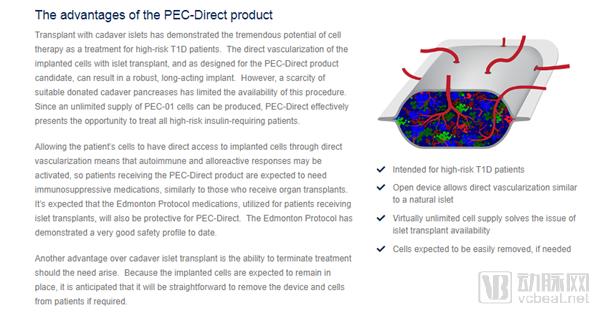
Image from ViaCyte’s official website
The PEC-Encap candidate product is a non-immunoprotective device designed to deliver pancreatic progenitor cells. It is specifically developed for patients with type 1 diabetes who suffer from impaired hypoglycemia awareness, extreme glycemic instability, and recurrent severe hypoglycemia. Currently, clinical trials for this product have entered Phase II.
Another candidate product is PEC-Encap (also known as VC-01), which is being developed for patients with type 1 and type 2 diabetes who require insulin therapy. This product delivers the same pancreatic progenitor cells within an immune-protective device. Enrollment in the PEC-Encap clinical trial (known as STEP ONE) has been suspended, as ViaCyte is collaborating with medical device company W.L. Gore & Associates to improve the product.
ViaCyte has also developed immune-evasive “universal donor” stem cell lines from its proprietary CyT49 cell line, which have the potential to further expand the availability of cell therapies for diabetes and other potential indications.
The financing will be completed in two tranches, with further details undisclosed. ViaCyte stated that the proceeds will be used to further advance its novel stem cell-derived islet replacement therapies. These therapies have the potential to provide a functional cure for patients with type 1 diabetes and also represent an important option for patients with type 2 diabetes who rely on insulin to manage their condition.
Dr. Heath Lukatch, a Partner at TPG, stated: “TPG is committed to investing in companies developing treatments for chronic diseases. We believe ViaCyte’s cell therapy represents a pioneering approach to diabetes treatment, with the potential to significantly reduce both the immediate burdens and long-term complications of the disease. The long-term positive impact of ViaCyte’s candidate products is central to our investment thesis, and we look forward to collaborating with the company’s management team and co-investors to bring ViaCyte’s powerful novel therapy to market, benefiting insulin-dependent patients with diabetes.”
“We have achieved significant scientific advances in both PEC-Direct and PEC-Encap. The majority of this financing will be used to support our ongoing clinical development efforts,” said Paul Laikind, President and Chief Executive Officer of ViaCyte. “In addition, we have begun collaborating with CRISPR Therapeutics to jointly discover, develop, and commercialize gene-edited allogeneic stem cell therapies.”
About Bain Capital Life Sciences
Bain Capital Life Sciences Fund is a new life sciences investment fund announced by the private equity firm Bain Capital in June 2017. The fund plans to invest in five to seven life sciences companies annually, with a primary focus on companies across various stages in the biopharmaceutical, medical device, and diagnostics sectors. Its parent company, Bain Capital, was founded in 1984 and is headquartered in Boston, Massachusetts, USA, managing over $75 billion in capital.
About TPG (Texas Pacific Group)
TPG, founded in 1992, is one of the world’s largest private equity investment firms, currently managing over $50 billion in assets through a series of private equity funds under its management. TPG has extensive experience in private equity investment activities such as leveraged buyouts, minority equity investments, joint ventures, corporate spin-offs, and business restructuring. The firm specializes in corporate acquisitions and controlling stake investments in European and American markets, while focusing on minority equity investments in emerging Asian markets. TPG operates 17 offices across 10 countries worldwide.
About RA Capital Management
RA Capital Management, founded in 2001, is a venture capital firm based in Massachusetts, USA, primarily investing in the life sciences and drug development sectors. The team comprises professionals with training in biology, chemistry, and medicine, who possess extensive industry and business development experience.