

PulseWear Medical Cuts Gait Analysis Time from 90 Minutes to 10, Achieves 2mm Precision with Odonate System
This report was supported by the Shanghai Rehabilitation Assistive Devices Industrial Park. Centered on the “intelligent” manufacturing of assistive devices, the park has laid out the upstream and downstream industrial chain for rehabilitation assistive devices, creating an integrated incubation and acceleration service platform.
VCBeat (WeChat ID: vcbeat) partners with industrial parks to support startups by providing free inaugural coverage for entrepreneurial enterprises within these parks. For inquiries, please contact VCBeat via WeChat (ID: xiaopeiling185052).
Appropriate rehabilitation exercises are beneficial for the recovery of bodily functions. In modern rehabilitation medicine, rehabilitation equipment serves as the foundation for ensuring the smooth progress of rehabilitation, while rehabilitation assessment equipment constitutes the fundamental infrastructure for exercise rehabilitation, permeating the entire rehabilitation process.
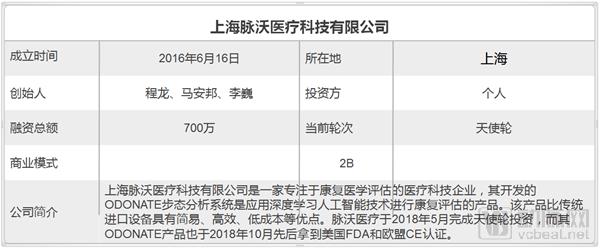
Maiwo Medical, established in June 2016, specializes in the field of medical rehabilitation assessment. The company has launched Odonate, a novel gait analysis device that is miniaturized, high-precision, and user-friendly, developed through its independent R&D efforts. Leveraging advanced technologies such as AI-based image recognition and deep learning, Odonate reconstructs high-fidelity 3D models of human motion, offering enhanced operational simplicity.
VCBeat (WeChat: vcbeat) has learned that since its official launch in November, Odonate has established collaborations with Renji Hospital, Peking Union Medical College Hospital, and Anhui Provincial Hospital, reaching cooperation agreements with more than a dozen hospitals.
Miniaturized, High-Precision, and User-Friendly Gait Analyzer
Gait analysis quantifies the motor function of the musculoskeletal system and the regulatory control function of the nervous system by acquiring parameters such as spatiotemporal and kinematic data, thereby reflecting rehabilitation outcomes. Currently, gait analysis is the most common and effective method in the field of rehabilitation assessment.
Cheng Long, founder of Maiwo Medical, stated that the gait analysis system has served over 50 million patients. During lower limb rehabilitation, patients must undergo regular rehabilitation assessments (at least once a month) to help physicians better monitor their progress and formulate more effective rehabilitation plans. Furthermore, visible progress in rehabilitation can also serve as a source of encouragement for patients.
However, traditional gait analysis requires three conditions: a laboratory of approximately 60 to 100 square meters; patients must be undressed and have 50 to 60 reflective markers attached to their bodies; the average preparation time for each patient to complete a gait analysis session is around 1.5 to 2 hours. In addition, it requires professional analysts to spend considerable time performing operational analysis.
Based on this, Maiwo Medical has launched the new Odonate Gait Analyzer after three years of research and development. Leveraging depth perception technology, Odonate utilizes color and depth cameras to measure distances and perform 3D modeling. Powered by deep learning algorithms, it automatically extracts patient models, further identifies joints, body segments, and bony landmarks, thereby generating a time-based human motion model.
Furthermore, compared with traditional gait analysis equipment, Odonate offers several advantages. First, patients can walk freely within the camera’s depth-of-field range while fully clothed, achieving an accuracy of 2 mm. Second, Odonate occupies less than 1 m² of floor space and is suitable for diverse settings, such as consultation rooms, patient wards, and corridors. Third, Odonate is portable and easy to operate; the detection process takes less than 5 minutes, and an automated data report is generated, resulting in a total turnaround time of 10 minutes.
Notably, the Odonate system features high-end configurations and research capabilities. Furthermore, its price is approximately 20% lower than that of existing large-scale gait assessment devices.
Penetrate the Rehabilitation Medical Market by Focusing on Lower Limb Rehabilitation Assessment
Although Odonate is priced 20% lower than existing devices, cost constraints limit its adoption primarily to tertiary hospitals and above with well-established gait analysis capabilities, as well as Grade A tertiary hospitals with clear research needs.
Regarding market expansion, Cheng Long stated that Maiwo Medical will adopt a three-step strategy:
Step One, which is currently underway: Following the closure of a RMB 7 million angel round in May this year, we will continue to promote Odonate across major Grade-A tertiary hospitals.
In the second step, Maiwo Medical will develop a low-spec version of the gait analyzer targeting secondary hospitals and Class II Grade A hospitals, achieving extensive coverage across these institutions;
In the third step, Maiwo Medical will prioritize the home-care market by simplifying the configuration of its existing devices and integrating software such as rehabilitation guidance tools and therapeutic exercise games, thereby expanding rehabilitation use cases in home settings. Cheng Long stated that Maiwo Medical’s gait analysis system is primarily designed for patients with stroke, pediatric cerebral palsy, Parkinson’s disease, and those who have undergone joint replacement surgery. As these patients require long-term rehabilitation training, the application scenarios should not be confined to hospitals; rather, the home setting will become a significant growth driver in the future rehabilitation market.
Regarding future plans, Cheng Long stated that although Maiwo Medical currently focuses solely on rehabilitation assessment for the lower limbs, it is also developing electroencephalography (EEG) and electromyography (EMG) technologies, with the aim of fully entering the rehabilitation medical market in the future.