

2019 Healthcare Industry Trends: Insights from S&P, WIRED, Cleveland Clinic and More
As the year draws to a close, many renowned consulting firms and media outlets have begun releasing their industry forecasts. These insights can serve as barometers for industrial development, offering valuable guidance to practitioners.
Previously, VCBeat (WeChat: vcbeat) translated an industry report by Frost & Sullivan (see: “98% Accuracy! These Developments Will Shape the Healthcare Industry in 2019”), which received positive feedback.
This time, we have gathered insights from four sources: S&P Global, Healthcare Global, WIRED, and the Cleveland Clinic. These trend reports approach the subject from either a technological or an industry perspective, striving to provide a systematic and comprehensive interpretation of industry trends.
Key excerpts are as follows:
1. Key Insights: Examining the 2019 Changes from Technological, Industrial, and Policy Perspectives;
2. Risks and Opportunities: Cross-industry integration, challenges brought by new entrants;
3. Key assumptions: The pay-for-performance model is rolled out, while M&A integration slows down;
4. Key Takeaways: The downgrade trend for listed companies persists, particularly among healthcare service providers;
5. Lessons from Abroad: Global Trend Reports Provide Guidance for the Development of China’s Health Industry.
Below are the predictions for 2019 healthcare industry trends from various organizations
WIRED
Digital medical devices not only assist us, but also empower us.
Information about our bodies, including all their anomalies, is becoming easier to collect using ubiquitous devices such as smartphones. To date, the scope of this technology has remained relatively limited; however, wearable devices are poised to revolutionize the healthcare industry in 2019 by capturing psychological and physiological data and providing personalized solutions. “We already rely on mobile technology to accomplish many of our daily tasks and goals, but we will soon also depend on digital technologies to optimize our bodily functions,” says Pattie Maes, Professor of Media Technology at the MIT Media Lab.
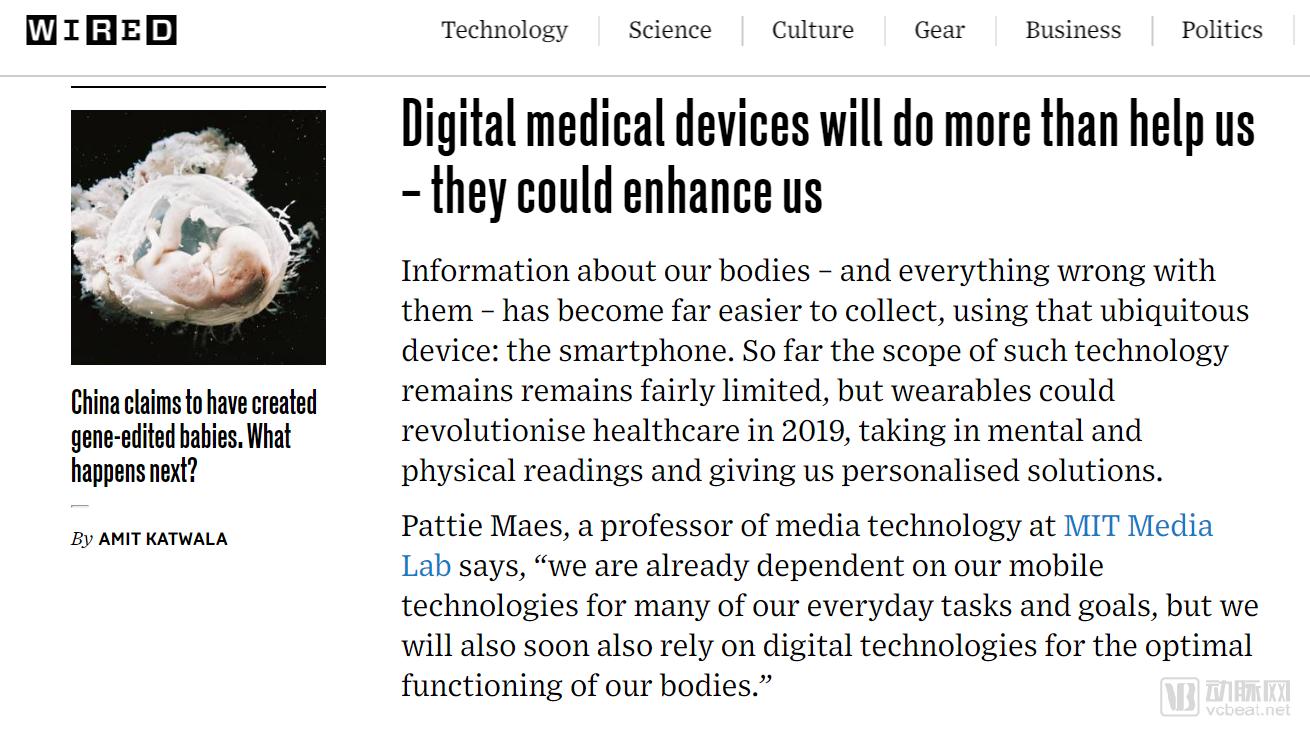
Screenshot of the original WIRED article
Cleveland Clinic
The Cleveland Clinic is one of the world’s most renowned medical institutions, integrating healthcare, research, and education. Each October, the Cleveland Clinic releases its annual list of the Top 10 Medical Innovations. The 2019 list included:
Alternative Therapies for Pain;
Artificial Intelligence;
Expanding Trends in Acute Stroke Intervention;
Advances in Immunotherapy or Biologic Therapy for Cancer Treatment;
Patient-specific products via three-dimensional (3D) printing;
Virtual and Augmented Reality (VR/AR);
Scanner (Visor) for prehospital hemorrhage scanning;
Surgical Robots;
Percutaneous—Transcatheter Therapy—Replacement and Repair of the Mitral and Tricuspid Valves. These valves open and close rapidly to allow blood to flow into the ventricles of the heart.
RNA-Based Therapies.

Image source: Cleveland Clinic
Healthcare Global
Top 10 Healthcare Innovations of 2019
10. Telemedicine
The telemedicine market is booming. As lifestyles become increasingly busy, up to 60% of people prefer digital services. Delivering clinical care remotely enhances accessibility and eliminates potential delays, empowering patients with greater control, improving patient satisfaction, and boosting overall engagement.
09 Mobile Technology
Consumers have grown accustomed to accessing their data through various digital tools, with the usage rate of mobile and tablet health apps rising from 13% in 2014 to 48% currently.
08 Artificial Intelligence
Artificial intelligence (AI) applications, such as predictive analytics for patient monitoring, offer significant financial savings. Applications targeting hospitals and healthcare institutions include patient monitoring and transcription of electronic health records (EHRs). By 2020, the European Union planned to invest $24 billion in artificial intelligence (AI) to catch up with Asia and the United States, which have heavily invested in AI and cloud services. This year, Google announced plans to leverage artificial intelligence and machine learning across a wide range of consumer technologies, particularly in the healthcare sector. “If AI is to shape healthcare, it must comply with healthcare regulations. In fact, I believe this will be one of the most impactful areas over the next 10 to 20 years,” Google’s CEO previously stated.
07 Blockchain
By the end of 2025, the blockchain market is estimated to exceed $560 million, although its growth still hinges on the ability to conveniently, cost-effectively, and securely record and store information across different applications and systems. By providing transparency, eliminating third-party intermediaries, and streamlining processes, blockchain can reduce healthcare costs exponentially. It unlocks providers’ capacity to deliver value-based healthcare systems and enhance patient engagement. By 2025, blockchain could save between $10 billion and $150 billion annually in costs related to data breaches, IT, operations, and support functions.
06 Wearable Devices
With the rise of lifestyle-related diseases such as diabetes, an increasing number of consumers are turning to health-focused wearable devices that monitor glucose levels, heart rate, physical activity, and sleep to gain better insights into their health status. Since the introduction of the first Bluetooth headset in 2000, interest in wearables has grown steadily, and the monitoring of health metrics and data has become standardized. These data can be analyzed using sophisticated algorithms to facilitate long-term diagnosis and support. For instance, Fitbit, a leading health wearable company, is collaborating with Google to explore the development of consumer and enterprise health solutions. Meanwhile, Twine Health has enhanced its clinical services by acquiring a HIPAA-compliant health platform and introducing a coaching platform, empowering individuals to achieve better health outcomes.
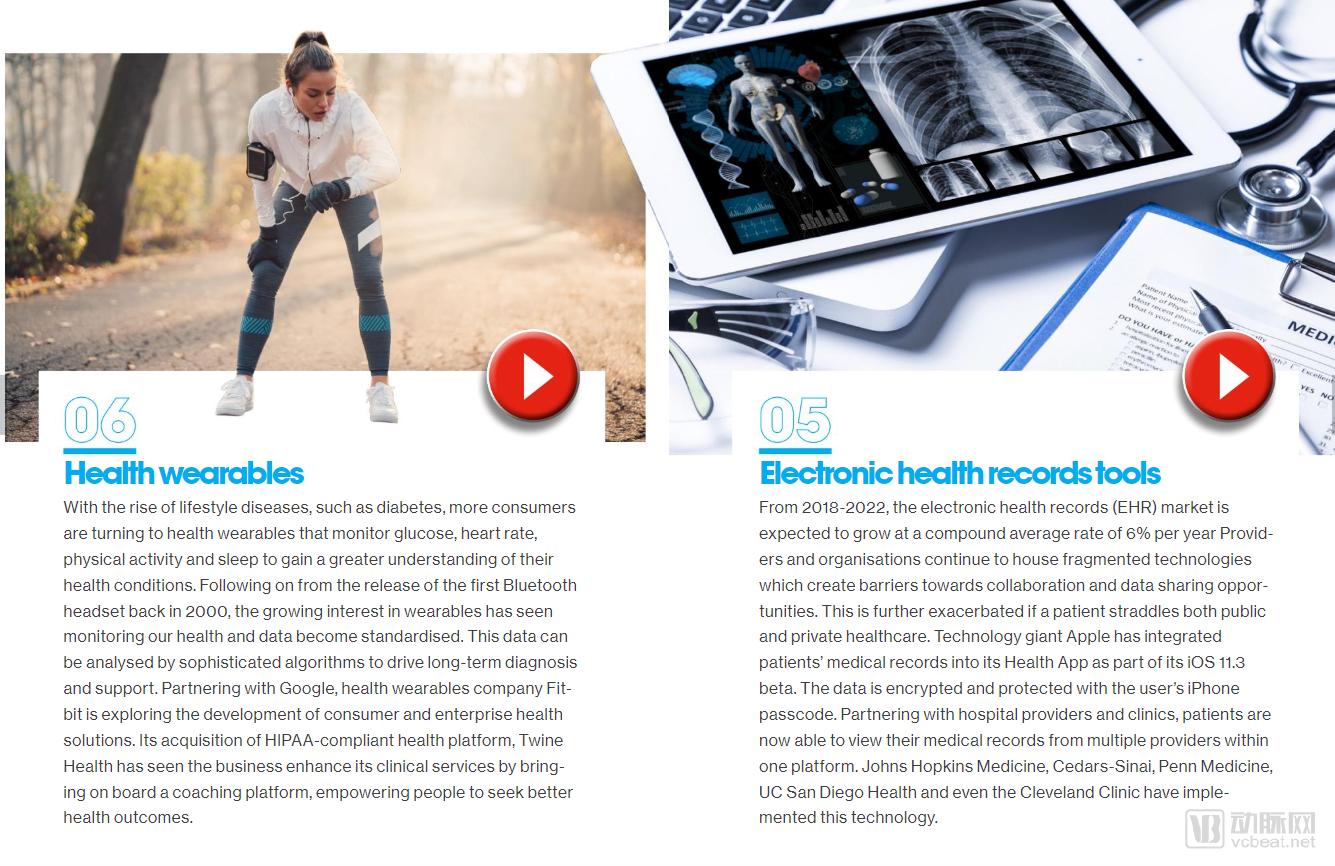
Image source: Healthcare Global
05 Electronic Health Records
From 2018 to 2022, the electronic health record (EHR) market is projected to grow at a compound annual growth rate of 6%, a trend that will be further intensified as patients navigate across both public and private healthcare sectors. Tech giant Apple has integrated patients’ medical records into its Health app as part of iOS, encrypting and securing the data using the user’s iPhone passcode.
04 Medical Transportation
Non-emergency medical transportation remains a critical issue worldwide, preventing patients from attending doctor’s appointments. Twenty-five percent of low-income patients miss or reschedule appointments due to lack of transportation, costing the U.S. healthcare system up to $150 billion annually. Consequently, transportation companies such as Lyft and Uber are entering the market through partnerships with state governments to reduce these costs and provide personalized patient care.
03 3D Printing
Healthcare providers are set to become the second-largest sector in 3D manufacturing. The U.S. Food and Drug Administration (FDA) has decided to release its first comprehensive framework providing guidance for manufacturers of 3D-printed medical products, highlighting the technology’s growing impact. Currently, over 100,000 knee replacement surgeries are performed annually using 3D-printed materials. Through 3D printing technology, the strength, weight, and material usage of surfaces and structures can be optimized. This technology also enhances communication between surgeons and patients, enabling the customization of products to better meet individual patient needs.
02 Genomics
As consumers become increasingly engaged in health management, consumer genetics and research companies are growing in both popularity and scale. Driven by the public’s desire to gain deeper insights into their genetic makeup, 23andMe, a leader in personal genomics and biotechnology, has become one of the largest consumer-facing organizations globally. Notably, this year, the company has entered into a four-year collaboration with GSK to develop new therapies. Pharmaceutical companies aim not only to develop treatments by analyzing human genetics but also to eliminate the genetic mutations responsible for hereditary diseases. In 2017, human embryos were successfully “edited” using the gene-editing tool CRISPR (Clustered Regularly Interspaced Short Palindromic Repeats), eradicating hypertrophic cardiomyopathy in 42 embryos.
01 Vertical Integration
Driven by healthcare providers’ aims to enhance transparency, foster collaboration, and curb rising patient costs, 2018 witnessed a surge in vertical integration. A prime example is CVS Health’s $68 billion acquisition of the health insurer Aetna. Within the supply chain, this move will grant CVS significant negotiating leverage to reduce costs for payers and patients, develop personalized solutions, and improve overall outcomes. It will also help eliminate process delays by removing third parties inherent in traditional business models. Other notable integrations include Optum’s acquisition of DaVita Medical Group, as well as the mergers of Humana with Kindred Healthcare and Cigna with Express Scripts. Reports indicate that over the past five years, not only has the number of healthcare transactions more than doubled, but deal sizes have also grown—a trend expected to continue.
Most readers are undoubtedly familiar with S&P Global, a world-renowned financial analytics firm headquartered in New York City, USA. Founded by Henry Varnum Poor in 1860, the company provides investors with services such as credit ratings, independent analytical research, and investment advisory. These offerings include a range of indices, notably the S&P Global 1200 Index, which reflects global equity market performance, and the S&P 500 Index, which tracks the U.S. market. Moody’s, S&P, and Fitch are widely recognized as the three major international credit rating agencies.
Due to the length of S&P’s report, we have provided a full translation; the last three subsections constitute S&P’s report.
1. Payer Space Disruption: Pressure from Vertical Markets and New Entrants
CVS/Aetna, Cigna/Express Scripts, and UnitedHealthcare acquired three healthcare service companies in 2018, with potentially more acquisitions to follow. The formation of these healthcare conglomerates has enhanced their negotiating power over the pricing of healthcare products and services, which will have a significant impact on the industry. Players that demonstrate superior value or outcomes by leveraging healthcare data will benefit. The healthcare industry is moving into a phase of horizontal integration, with cross-sector mergers among major pharmacy retailers, health insurers, and healthcare service providers. This trend not only increases their influence within the industry but also lays the foundation for integrating and utilizing healthcare data.
2. Non-Traditional Players Enter the Arena
By partnering with Berkshire Hathaway and JPMorgan Chase, and by acquiring the specialty pharmacy PillPack, Amazon has entered the healthcare industry, bringing further uncertainty to the sector. Although detailed information about Amazon’s plans remains scarce, its moves could present significant opportunities for some players while negatively impacting others.
3. Promote pricing transparency and value-based measures
The ongoing debate over banning U.S. drug rebates to enhance transparency could have significant implications for the pharmaceutical and healthcare industries. The key question is whether it will actually lower costs for patients and lead to potential shifts in market share. The continued adoption of value-based measures will also transform the industry, although these measures are still evolving, lack standardization, and require substantial data support. Companies leading this change stand to benefit the most, and mergers and acquisitions may increase as firms reposition themselves to achieve greater scale and efficiency in meeting new value-based requirements. Additionally, a growing number of state-level bills in the U.S. are targeting drug manufacturers, pharmacy benefit managers (PBMs), and payers to reduce pricing and improve transparency. While not all such legislation will pass, we expect the number of enacted laws to steadily rise.
4. The Opioid Crisis
The United States is grappling with an opioid crisis, in which opioids have become the leading cause of death among individuals under the age of 50 and a major source of uncertainty for the healthcare industry. Opioid manufacturers and pharmaceutical distributors are the targets of various lawsuits. Beyond potential financial losses, what additional regulations may be introduced, and how will they impact the healthcare industry?
According to the World Health Organization, opioids are psychoactive substances derived from poppies or synthetic analogs, such as morphine and heroin. Opioids can lead to drug dependence, characterized by an intense craving for their use. Due to their pharmacological effects, high doses of opioids can cause respiratory depression and death. In recent years, the United States has implemented strict controls on opioids.
1. Value-based payment will slow sales and profit growth
S&P believes that the transition from a fee-for-service model to value-based pricing will gain greater traction. Driven by cost pressures, payer consolidation, the entry of non-traditional players such as Amazon, and healthcare demands arising from an aging population, quality- and outcome-focused pricing models are poised to become a major turning point in the healthcare industry. This shift may exert pressure on sales growth and profits, while creating new winners and losers.
Traditional healthcare payment models rely on fee-for-service, which incentivizes medical institutions to increase revenue by prescribing more medications and ordering excessive tests. Adopting alternative payment methods—such as capitation, diagnosis-related groups (DRGs), or pay-for-performance—or implementing managed care practices would help control healthcare expenditures.
Greater efforts by payers to control utilization, the shift from traditional Medicare to Medicare Advantage, and the continued rise of consumerism have also led to a general softening in patient payment trends.
As the final quarter of 2018 approached and the industry transitioned into the new year, S&P anticipated that greater emphasis would be placed on payment and delivery reform initiatives. As incentives within value-based systems expanded slowly but gained increasing traction, expectations grew for enhanced collaboration between payers and providers to address the next phase of market development, with a heightened focus on leveraging big data following the expansion of electronic health records (EHRs). Such collaboration may arise through acquisitions, joint ventures, and partnerships, creating more touchpoints as consumerism—typically defined as engaging patients more actively in their healthcare through spending and decision-making—gains momentum.
The combinations of CVS/Aetna and Cigna/Express Scripts, along with UnitedHealth’s expanding Optum service offerings, will further pressure healthcare providers, pharmaceutical companies, and medical device manufacturers. The emergence of non-traditional players (potential disruptors) in the sector, such as the Amazon/Berkshire Hathaway partnership and JPMorgan Chase, may also spur vendor collaboration or prompt changes in their operational models.
2. Regulatory Risks/Increasing Industry Scrutiny
The “America First Patients” proposal to prohibit drug tax rebates, uncertainty surrounding opioid litigation, and intensifying competition in the generic drug market may have a negative rating impact on the pharmaceutical industry.
We do not expect President Trump’s “America First Patients” proposal, with its broad range of initiatives, to have a significant impact on ratings in the short term. However, we anticipate that these measures, if implemented, will exert moderate pressure on pharmaceutical companies’ profit margins over the coming years. The “blueprint” for the pharmaceutical industry outlined by President Trump aims to enhance transparency in drug pricing, introduce reference pricing based on prices in other countries relative to Medicare Part B, and accelerate the approval of low-cost generic drugs and biosimilars. While the potential elimination of drug rebates may initially improve patient affordability, it could also intensify competition and potentially negatively affect profit margins over time.
3. Slowdown in Industry M&A
S&P assessed that M&A activity among healthcare companies was relatively low in 2018, despite expectations that pharmaceutical firms would leverage overseas cash reserves to bolster their product pipelines following U.S. tax reforms. After major acquisitions in recent years, medical device companies such as Abbott Laboratories, Becton, Dickinson and Company, and Medtronic PLC remained focused on deleveraging. Meanwhile, many healthcare services companies were effectively net sellers, as they reconfigured their businesses in a more challenging environment.
In 2018, M&A activity in the healthcare services and products sector remained relatively moderate, with S&P expecting M&A within its rated universe to stay lukewarm in 2019. Consequently, it anticipates that overall leverage will decline across each subsector, including healthcare services, pharmaceuticals, and medical devices.
Given the high acquisition multiples observed in healthcare and the limited additional debt capacity of many companies, much of the M&A activity is effectively driven by sellers’ increasing emphasis on strengthening competitiveness in existing markets, exiting weaker ones, and managing highly leveraged balance sheets. Large hospital operators such as Tenet Healthcare, Community Health Systems, and Quorum Health have already been divesting assets. Mergers and acquisitions among other healthcare services companies often focus on expanding scale or diversification as they seek to better position themselves in a rapidly changing market.
S&P expects that acquisition activity will increase once companies complete restructuring or downsize their operations, and given the limited debt capacity of many firms, credit ratings may face further pressure. In the pharmaceutical and medical device sectors, M&A activity has also been relatively modest, particularly considering our expectation that the post-U.S. tax reform environment will create a more positive outlook for mergers and acquisitions; cash-rich U.S. companies will have greater liquidity, and the new tax law will make U.S. pharmaceutical assets more attractive.
In contrast, we have seen a more conservative stance, with few transactions exceeding $25 billion. This stands in comparison to 2017, when Johnson & Johnson acquired Actelion for approximately $30 billion and Abbott Laboratories acquired St. Jude Medical for $25 billion, as well as 2016, when Shire PLC acquired Baxalta for $32 billion. Recall that M&A activity remained robust during 2014–2015.
S&P Global believes that pharmaceutical companies are hesitant to pursue mergers and acquisitions due to the high valuation multiples of the few attractive assets available, uncertainty surrounding the financial performance of products and pipelines amid intensifying competition for favorable formulary placement, as well as political and regulatory uncertainties.
For well-capitalized professional pharmaceutical companies, a more challenging political environment has made strategies reliant on price increases risky. Furthermore, some of these companies, such as Bausch Health Companies Inc. (formerly Valeant Pharmaceuticals International, Inc.) and Endo International PLC, are striving to divest themselves of prior acquisitions. Nevertheless, S&P believes that mergers and acquisitions financed by increased debt may become more widespread, as pharmaceutical companies seek to enhance their product portfolios and pipelines in the face of mounting pricing pressures.
A Less Negative Story, but Rating Deterioration May Continue: Downgrades of Healthcare Companies Continued to Outpace Upgrades in 2018, at a Ratio of 3:2. The Outlook for Healthcare Company Ratings Remains Stable, with the Distribution of Non-Stable Views Showing Reduced Negative Bias. The Downgrade Portfolio Also Shifted Toward the Pharmaceutical Industry as S&P Lowered Ratings for Some Generic and Specialty Pharmaceutical Companies.
Rating actions reflect ongoing challenging conditions and lower-than-expected deleveraging headroom following recent acquisitions. For healthcare services companies, the distribution of rating outlooks has been less negative than in prior years; nevertheless, S&P believes healthcare ratings may continue to decline. Reimbursement pressures, an accelerated focus on value and quality, and a rapidly evolving competitive landscape that has led to declining hospital patient volumes continue to exert pressure on the industry and its ratings.
Steady Growth and Slightly Improved Margin Outlook for 2019: Revenue is expected to grow within the 2%–5% range, while EBITDA (earnings before interest, taxes, depreciation, and amortization) will remain relatively flat. Certain subsectors may experience further margin compression; S&P identifies services, pharmaceuticals, and medical devices as the three primary subsectors facing this trend. Payer pressure will constrain growth, particularly in the services sector. The overall slowdown in merger and acquisition activity also contributes partially to expectations of moderated growth. Margins are projected to remain stable, as companies focus on cost reduction and efficiency improvements to offset an increasingly challenging pricing and reimbursement environment.
Rapidly Evolving Payer Landscape: Healthcare payment is gradually shifting toward value-based contracts, enhancing transparency in healthcare services and products. Commercial payers have been able to exert pressure through plan design, such as tiered networks and the use of copayments and deductibles, to steer patients toward lower-cost providers. In certain disease categories, payers are increasingly leveraging outcomes-based contracts, offering higher pricing for effective drugs. Through mergers and acquisitions forming “healthcare groups,” commercial payers are becoming more powerful to increase their negotiating leverage.
Although the aforementioned report primarily uses the development of the U.S. healthcare industry as a reference framework, its trend forecasts still offer valuable insights for healthcare practitioners in China. First, the U.S. healthcare sector accounts for a significantly high proportion of its national economy, ranging approximately from 16% to 20% depending on the statistical methodology. As China strives to develop its broad health industry toward an “8 trillion yuan” target, the evolutionary patterns of the U.S. industry hold considerable reference value. Second, in the era of globalization, the impact of one country’s industrial policies can easily transmit globally through trade linkages. This is particularly true for countries with substantial global influence. Therefore, studying their industrial policies is a crucial means of capitalizing on the dividends of globalization and mitigating policy-related risks.
Some of these industrial trend predictions also hold true in China. For instance, the pharmaceutical industry has faced stringent price controls, particularly after the establishment of the National Healthcare Security Administration (NHSA). With a unified management body for healthcare insurance funds, drug prices are now adjusted through payment mechanisms. Recent policies such as national reimbursement drug price negotiations and volume-based procurement serve as clear evidence of this shift. Furthermore, reforms in healthcare payment methods, including diagnosis-related group (DRG) payments and capitation, have posed additional challenges to drug pricing. Meanwhile, policies encouraging the development of innovative drugs, implementing priority review and approval, and enforcing consistency evaluations are enhancing the overall quality of drug supply. By simultaneously reforming both the payment and supply sides, China can not only eliminate outdated production capacities and inefficient enterprises but also maximize the value derived from each unit of healthcare insurance fund expenditure.
In the healthcare services sector, the situation is slightly different. China’s public-hospital-dominated healthcare delivery system will not change in the short term. Although policies promoting the entry of private capital into the healthcare industry have been in place for a long time, private medical institutions still lag far behind the public system in both patient volume and revenue. In the future, the moderate development of private healthcare will remain a long-term, ongoing theme, particularly in areas such as third-party clinical laboratories, diagnostic testing, medical imaging, health check-ups, and ophthalmology hospitals.
Cross-industry players have also emerged in China, where internet healthcare companies led by Alibaba and Tencent have penetrated the industry more deeply than Amazon. Their strategies include building in-house capabilities, making investments, and forming partnerships. For instance, the Alibaba ecosystem features its flagship platform, Ali Health, with core affiliates such as Ant Financial, Alibaba Cloud, and DingTalk, while its investment portfolio includes BGI Genomics and iKang Healthcare Group. Tencent, meanwhile, has established a presence in medical AI, health insurance, and health information content. Beyond these giants, companies like Meituan, JD.com, and Xiaomi have also implemented systematic layouts in the sector.
Cross-industry integration may be a novel concept for Chinese enterprises, as the domestic healthcare industry is still in a phase of incremental growth, where expanding scale is the primary objective rather than leveraging synergies through the integration of upstream and downstream segments of the industry value chain. Once this phase of consolidating existing resources concludes, cross-industry integration trends are likely to emerge, such as the convergence of insurance with medical services and pharmaceutical retail, or the combination of pharmaceutical manufacturing with diagnostic operations.
In an era of rapid change, staying sharp is the key to success; this is precisely where the value of forecasting industry trends lies.