

Hair Loss Epidemic: Can Hair Transplantation Become a Billion-Dollar Business in China?
Editor’s Note: This article is republished from 36Kr, authored by Shi Yaqiong. VCBeat has been authorized to repost it.
In the renowned subway systems of first-tier cities, on public buses in second-tier cities, along Hupu’s pedestrian streets, within Bilibili’s “guichu” videos and Douyin short clips, and even in the hit drama *Story of Yanxi Palace*, hair transplant advertisements have either intensified their exposure or quietly launched.
Meanwhile, the hair transplant industry, after two decades of development, has seen its two largest investments in the past two years: Yonghe Hair Transplant and Biliansheng received investments of RMB 300 million and RMB 500 million, respectively. Meanwhile, new chain brands and outpatient clinics such as Xinsheng have sprung up like mushrooms after rain.
As leading companies in the sector have reached revenue scales of hundreds of millions of yuan and come under the control of private equity (PE) firms, and as new players continue to emerge and gradually scale up, how can one successfully navigate this “new business”?
“After Yonghe Hair Transplant and Biliansheng secured investment, many investors approached us, asking whether we planned to open new clinics,” said Xu Xia, founder of Sino-German Hair Transplantation and Plastic Surgery Hospital. Prior to this, she had been engaged in China’s hair transplantation industry for over 20 years and had managed the Sino-German Hospital for more than a decade.
Zhongde Hair Transplant and Plastic Surgery Hospital is not an isolated case. The author has learned from industry insiders that since Biliansheng received investment at the beginning of this year, more than a dozen large and medium-sized private equity (PE) firms have entered the market, conducting due diligence on several well-known hair transplant institutions, including Kefayuan, Ruilishi, Xinsheng, and Zhongde.
It is hardly surprising that capital has taken notice. According to information obtained by several industry players, multiple companies—including Biliansheng and Yonghe Hair Transplant—have basically achieved doubled growth in recent years and remain optimistic about their future development and expansion.
In May this year, Zhang Yu, founder of Yonghe Hair Transplant, publicly stated that the company’s revenue had doubled annually over the past five years: approximately RMB 30 million in 2013, RMB 60 million in 2014, RMB 120 million in 2015, and RMB 240 million in 2016. Revenue for 2017 was projected to exceed RMB 500 million, with this year’s figure expected to approach RMB 1 billion. According to industry sources accessed by the author, Biliansheng’s figures are broadly similar. Recent data from So-Young indicates that during this year’s Double 11 shopping festival, licensed hospitals across China alone sold 13,300 hair transplant procedures.
It is precisely the young people experiencing “sudden baldness” that have turned hair transplantation into a business garnering significant attention.
Data from the World Health Organization indicates that one in six people in China experiences hair loss, with approximately 200 million individuals affected by this condition. The demographic experiencing hair loss in China is increasingly shifting toward younger age groups, with the prevalence among those born in the 1980s and 1990s exceeding 35%. Compared to individuals born in the 1970s or earlier, younger generations from the 1980s and 1990s place greater emphasis on physical appearance, demonstrating a stronger willingness to undergo hair transplantation and no longer feeling ashamed to discuss the procedure. For instance, Hu Xinshu, a well-known self-media influencer, once published an article detailing her own hair transplant experience on her public account.
Rising disposable income has strengthened young people’s willingness to pay, while the widespread adoption of installment plans and medical-aesthetics consumer finance has further lowered the threshold for user decision-making. Typically, the average transaction value for hair transplantation procedures exceeds RMB 10,000, and income growth creates opportunities for consumption upgrading. According to data from the National Bureau of Statistics, China’s national per capita disposable income reached RMB 25,974 in 2017, representing a real increase of 7.3%. Currently, hospitals commonly offer installment payment services, including interest-free options. Meanwhile, medical-aesthetics consumer finance platforms, such as Mimi Financial Services, provide young consumers with additional payment channels.
The rapid increase in female users has created new growth opportunities for the industry, driven by emerging hair restoration services such as hairline contouring, eyebrow transplantation, and artistic beard implantation. Historically, the primary demographic for hair transplant procedures consisted of men aged 25 to 28 who were seeking employment or romantic partners. However, in recent years, the proportion of female patients has risen significantly. According to Zhang Yu, ten years ago, more than 95% of Yonghe Medical’s clientele were male, whereas this figure now stands at approximately 70%. Zheng Wei, Chief Marketing Officer of Yonghe Medical, stated that female patients currently account for nearly 40% of the company’s user base.
The new “hair transplant” projects are also attracting young people. Li Meiying, co-founder of Xiduo Medical Aesthetics, previously mentioned in an interview that treatments for extensive male pattern baldness account for 70% of its revenue, while artistic hair transplantation—including eyebrow transplants, hairline reconstruction, hair density enhancement, artistic beard styling, and artistic sideburn design—accounts for approximately 30%, with the proportion of artistic hair transplantation increasing year by year.
Driven by these favorable factors, China’s hair transplant industry has experienced rapid growth in recent years. Data show that the market size of China’s hair transplant industry reached approximately RMB 9.7 billion in 2017, and the potential market space for hair transplants and related industries could reach RMB 50–100 billion in the coming years. In fact, if we take into account the hair loss rate of around 42% observed in developed countries in Europe and America, and apply it to China’s population of 1.3 billion, the prospects for this market may be even more optimistic.
After two decades of development, the hair transplant industry has entered a bonus period of rapid market growth. Following the two largest investments in the industry’s history, new hair transplant chain brands and clinics have sprung up like mushrooms after rain. Will this be a good business?
Before dissecting this sector, let us first identify the key players and analyze the cost structure of this business.
After more than two decades of development, the hair transplant sector has gradually consolidated around several key player categories: first, hair transplant departments within public hospitals; second, national private chain hair transplant institutions represented by Biliansheng, Yonghe Hair Transplant, Kefayuan, and Xinsheng; third, hair transplant departments within private medical aesthetic and plastic surgery institutions, such as Yimeier and Xiduo; and fourth, non-chain private institutions exemplified by Hengbo. Currently, capital markets are focusing heavily on the latter three categories.
Industry information indicates that hair transplant procedures are currently priced based on the number of follicular units implanted. The typical cost for scarless hair transplantation (FUE) ranges from 8 to 12 yuan per unit, with density-enhancement procedures being slightly more expensive. The actual transaction price per procedure generally averages around 25,000 yuan, exceeding 30,000 yuan in certain economically developed regions. Additionally, some companies have begun offering premium products, with average transaction values several times higher. In contrast to Li Yapeng’s hair transplant, which cost 600,000 yuan many years ago, current prices for hair transplant surgery have become relatively affordable due to intense market competition.
In the hair transplant industry, which appears to command high average transaction values, profit margins vary slightly among different players. Lao Xu, founder of Hao Toufa (Good Hair), believes that public hospitals’ hair transplant departments achieve the highest profit margins, approximately 60%–70%; private hospitals follow, with margins of 35%–40%; while large chain clinics have profit margins of only around 20%. This significant disparity is primarily driven by differences in the number of outlets and marketing costs.
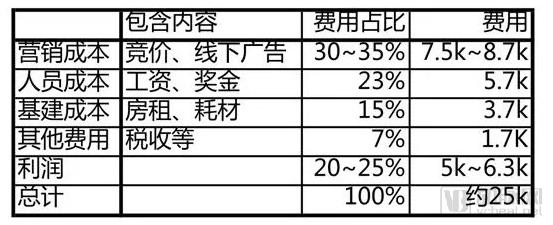
Image from Lao Xu, founder of Hao Toufa
For these players, labor costs for medical staff and marketing expenses are the two most significant cost components. Lao Xu once conducted an analysis using a large chain institution with approximately 500 employees, more than 15 branch clinics, and an average revenue per customer of RMB 25,000 for hair transplantation services as an example. In this case, marketing costs accounted for approximately 30–35%, while labor costs represented around 23%.
The expansion of surgical volume must be built upon an increase in the number of physicians; physician supply capacity is critical, and insufficient physician supply is one of the factors limiting the company’s rapid growth.
Generally, a hair transplant procedure requires the collaboration of multiple medical professionals over several hours. To date, no specialized medical school in China has established a dedicated major in hair transplantation; most physicians in this field come from other specialties and backgrounds. Xu Xia believes that “hair transplant surgeons need experience in cosmetic plastic surgery and microsurgery. Currently, there are only a few thousand practitioners engaged in hair transplantation, and fewer than one in ten are qualified to perform the surgery.”
Currently, the industry primarily relies on in-house training, which generally takes at least six months to a year. Liu Zheng, CEO of Biliansheng, told the author that Biliansheng focuses on recruiting physicians with many years of experience. In such cases, the medical and nursing teams typically undergo six to nine months of training, which is longer than the industry average of approximately three months. Li Meiying stated that it generally takes at least one year to train a lead surgeon.
In the United States, many hair transplant clinics have employed robotic systems to assist physicians; however, this approach is unlikely to resolve the labor shortages facing China’s hair restoration industry. Zheng Wei has studied hair transplant robots, including those developed by Restoration Robotics, but concluded that they are poorly suited to China’s specific market conditions. On one hand, the cost of using such machines is approximately $5 per graft, with each procedure typically exceeding RMB 50,000—significantly higher than the cost of manual hair transplantation in China, making it difficult to gain patient acceptance. On the other hand, patients’ aesthetic expectations for hair restoration have risen, and current robotic systems struggle to meet these demanding requirements.
This means that for the hair transplant industry, labor costs are unlikely to decrease rapidly in the short term and may well be a significant constraint on its expansion.
Marketing costs represent another major expense in the hair transplant industry. Currently, there is no publicly available financial data for the hair transplant sector. However, referencing the data from Yestar Plastic Surgery, which submitted its prospectus this year, this ratio is likely not low. In 2017, Yestar Medical Aesthetics’ sales and marketing expenses amounted to RMB 305 million, accounting for a high 55% of its gross profit for the same period. In 2015 and 2016, Yestar Medical Aesthetics’ sales and marketing expenses as a percentage of gross profit both exceeded 60%.
Bid-based advertising is currently one of the most predominant marketing strategies. A previous report by iResearch indicated that marketing approaches in the hair transplant industry are relatively homogeneous, with approximately 70% of marketing expenditures allocated to bid-based advertising. According to calculations by Lao Xu, each click on Baidu’s bid-based ads costs around RMB 100, and it takes approximately 40–50 clicks to generate a single patient visit to the clinic. An industry joke suggests that one-quarter of every payment made by hair transplant patients goes toward Baidu advertising.
Moreover, a readily observable phenomenon is that advertisements for Yonghe Hair Transplant, Kefa Yuan, and Xinsheng are visible on nearly all major subway lines in first-tier cities such as Beijing.
Subtle shifts are also emerging, with the importance of content marketing on the rise. As consumers become increasingly rational, they often conduct research to support their decision-making after encountering advertisements. Consequently, platforms such as Zhihu are becoming new marketing channels and strategies. Currently, under the “hair transplant” topic on Zhihu, there are over 1,280 questions and more than 300 featured posts, some of which originate from stakeholders within the hair transplant industry. Meanwhile, advertising expenditure on Baidu has correspondingly decreased. Taking Yonghe Hair Transplant as an example, its proportion of advertising spending on the Baidu platform dropped to approximately 30% in 2017.
The initial market education for the hair transplant industry has been completed, but marketing expenses will not decrease as competition among brands intensifies. This assessment has been confirmed by multiple industry insiders.
If the two most significant costs in the industry cannot be reduced in the short term, can this still be considered a viable business? And who is capable of excelling in this business?
High labor and marketing investments indicate that the hair transplant industry is well-suited for chain operations, which help amortize marketing costs and manage fluctuations in service demand through the flexible deployment of medical staff. This has essentially become an industry consensus. To some extent, this also explains why the two largest investment flows in the hair transplant sector have been directed toward chain clinics.
In fact, hair transplant procedures are relatively standardized and less technically demanding, making the chain business model well-suited for the hair restoration industry. On one hand, compared with other medical aesthetic or even general medical procedures, hair transplants are relatively simple and easy to perform, offering high replicability. The customer base is predominantly male, which facilitates more standardized and transparent pricing. On the other hand, compared with other surgical interventions, hair transplant surgery involves lower technical difficulty and a lower incidence of adverse events, while commanding a relatively higher average transaction value. Moreover, customers tend to seek services locally. Furthermore, in a chain operation model, factors such as advantages in equipment procurement, brand effects, sharing of back-office resources, and amortization of advertising costs all contribute positively to business growth.
In the United States, the feasibility of the chain business model has been validated by industry leaders, including Bosley, the largest hair transplant chain in the country. According to publicly available information, Bosley currently operates 73 clinics and has performed over 250,000 hair transplant procedures in the past four decades, generating annual revenue between $100 million and $500 million.
Currently, Biliansheng and Yonghe Hair Transplant, the two companies in China that have secured over RMB 100 million in major financing rounds, are widely regarded as the first tier in this sector. According to public information, Biliansheng has established 23 directly operated branches in major cities across China, with nine additional cities slated for upcoming store openings; Yonghe Hair Transplant currently operates 30 flagship stores.
Furthermore, Keyuan Hair Transplant, a relatively well-known player in the industry, has currently opened branches in 20 cities, while Xinsheng Hair Transplant has established hair restoration bases in more than 30 cities. Smaller-scale institutions, such as Xiduo Hair Transplant, have already opened eight clinics, with an additional seven under preparation.
For the chain industry, site selection and management are crucial. As for specific site selection criteria, none of the companies have made them public. However, it is certain that most companies have likely established their own internal evaluation standards. Considering that the average transaction value for hair transplant services often exceeds RMB 10,000 to 30,000, current store locations remain concentrated in first- and second-tier cities, as well as other cities with higher income and consumption levels.
It is easy for a single store to be profitable, but difficult to sustain profitability after expansion. Generally, the financial model of chain operations tends to deteriorate over time. The operational data and financial performance of stores opened in later expansion phases are often inferior to those of earlier ones. Considering specific store investments and consumer decision-making habits, city selection is more critical in the short term, while site selection within a city has limited impact on competitive dynamics.
Given the industry characteristics and cost structure, the hair transplant chain sector is considered to be more akin to the dental clinic chain industry. Currently, medium-to-large dental chains, including Bybo, Huamei Dental, Zhengfu Holdings, and Keen Dental, have reported consecutive losses following their expansion. The outlook for the hair transplant industry may not be optimistic either.
Mr. Xu believes that, taking chain hospitals as an example, although the profit margin may reach 20%, there might be little to no earnings in the early stages. This is because establishing each hair transplant hospital costs approximately RMB 8 million. If 10,000 procedures are completed within a year with a gross profit margin of around 20%, the net profit could reach approximately RMB 50 million. However, if six new clinics are opened in the same year, the capital expenditure would amount to RMB 48 million, which, when combined with other operational expenses, could likely result in no net profit.
Given the high capital investment, long ramp-up period, and slow pace of building facilities from scratch, would acquisitions or joint ventures be viable alternatives? Xu Xia had also considered the joint-venture model through franchising; however, for surgical procedures, ensuring surgical quality and safeguarding the institution’s reputation are critical. Zheng Wei believes that acquisitions cannot be ruled out in the future, likely occurring in regions not yet covered by Yonghe Hair Transplant.
Beyond site selection, the ability to acquire customers at low cost is also key to this business.
Xing Shuobo, Senior Vice President of Investments at Huagai Medical Fund, once shared the investment rationale behind backing Biliansheng, stating, “China has the largest internet user base in the world, and Biliansheng was the first enterprise in the hair transplant industry to achieve full coverage of online customer acquisition channels. Its CEO, Liu Zheng, previously held marketing roles at Dell and Kingsoft, bringing extensive internet industry experience. During the early stages of the mobile internet boom, he implemented an integrated online-offline marketing strategy for Biliansheng.”
Mr. Xu believes that the cost of online marketing is currently on a steady annual rise. Once the bonus period of online promotion ends, hospitals that previously relied on Baidu’s bidding system will gradually lose their competitiveness, leaving only super-large hair transplant institutions with the capital to remain in the game.
So the question arises: For investors who seek to “buy right without overpaying,” is this a sector worth investing in? What kind of players are worthy of investment?
Before addressing this question, we might first answer another: Where lies the ceiling of this sector?
Currently, the annual revenue of top-tier players may not have actually reached RMB 1 billion, and the market size is considered to be at the level of tens of billions of yuan. However, it is widely accepted that the hair transplant industry chain has the potential to reach a scale of hundreds of billions of yuan.
Xing Shuobo believes that the hair transplant industry is not a seemingly traditional sector. According to forecasts by the Huagai Medical team, the hair transplant industry and its related supply chain are expected to evolve into a market worth hundreds of billions of yuan. This trend is further corroborated by the revenue and profit growth of Biliansheng: from 2012 to the present, Biliansheng has maintained a compound annual growth rate (CAGR) of over 50% in both revenue and profits.
However, behind the industry’s “glamorous” facade lie doubts about the sector’s growth ceiling. Although two companies in this niche have secured RMB 300 million and RMB 500 million in financing respectively, their valuations remain modest, with both being majority-controlled. This indicates that even the leading players in the sector are valued at no more than RMB 1 billion. For benchmarking purposes, Bosley, which operates 73 clinics and has been in business for 40 years, generates annual revenue of only around USD 100–500 million.
An analysis of the cost structure of this business reveals that labor and marketing expenses, which constitute the largest proportions, are unlikely to decrease significantly in the short term, leaving limited room for cost optimization. Consequently, this does not appear to be a “good business.” Furthermore, publications such as *Medical Aesthetics Observer* have questioned whether the aggressive expansion of hair transplant institutions in recent years is depleting the market stock accumulated over the past few decades, with the likelihood that this residual demand will be largely exhausted within five years or more.
Unlike other sectors, the hair transplant sector rarely benchmarks against the United States. Liu Zheng believes that U.S. hair transplant technology and operational efficiency are inferior to those in China. This makes it highly likely that China will develop hair transplant chains superior to Bosley.
Meanwhile, players in the sector are also expanding their boundaries, with most having already established or planning to build a full industry chain centered around hair, adding services such as hair care, hair protection, wigs, and pharmaceuticals. Biliansheng mentioned such plans in an interview with the author this year. Yonghe Hair Transplant acquired Shiyunxun Hair Care in 2017 to expand into scalp care-related businesses. Currently, this is likely where the future growth potential for players in this sector lies.
Due to inadequate regulatory policies, the current hair transplant industry remains a mixed bag, rife with chaos and irregularities. Nearly every hair transplant clinic—including those mentioned in this article as well as those not—has associated “negative news” online. Issues range from failed hair transplant cases and founders accused of falsifying academic credentials, to false advertising that exaggerates results, the promotion of “pseudoscientific products” through deliberate obfuscation, and arbitrary or excessive pricing. However, this does not represent the entirety or the future of the industry. In fact, the sector is becoming increasingly transparent and standardized.
From the perspective of commercial competition, the tier structure of the hair transplant industry has basically taken shape. Biliansheng and Yonghe Hair Transplant are regarded as the first-tier players, while Kefayuan is generally classified into the second tier. In addition, there have been many new entrants in recent years, including Xinsheng.
So, should one invest in “large companies” or “new companies” in this sector? Despite a 20-year development history, the hair transplantation industry has seen only two financing and investment transactions: CITIC’s RMB 300 million controlling stake in Yonghe Hair Transplant, and Huagai Capital’s RMB 500 million controlling stake in Biliansheng. It can be said that both private equity firms chose to invest in “large companies.”
Meanwhile, well-known hair transplant clinics that underwent due diligence this year do not appear to have reached any financing or investment intentions with capital firms. An industry veteran, Liaowang (pseudonym), told the author that there are two main reasons: first, these companies may currently have non-compliant financial practices and significant hidden risks; second, their current profit levels do not align with market valuation expectations. For instance, Kefayuan’s profits may have already fallen below those of previous years, Ruilishi has minimal profits, and Xinsheng is likely operating at a loss.
So, do “new companies” still have a chance when facing “large corporations”?
In interviews, the two “major players” expressed relative optimism about future competition. Liu Zheng believes that the current hair transplant market is likely valued in the tens of billions of yuan, with each company’s scale still relatively small, allowing room for multiple participants. As hair transplantation is a surgical procedure, although the state has not yet announced specific qualification requirements, new entrants must obtain certain licenses and invest time in cultivating teams of doctors and nurses, making rapid expansion difficult. Going forward, as industry competition intensifies, price wars among lower-ranked companies are inevitable, likely causing some firms to struggle for survival and creating acquisition opportunities for Biliansheng.
Zheng Wei holds a similar view. He believes that new chain brands still have opportunities, but they will ultimately likely be acquired by targeting market segments that Yonghe Hair Transplant has not entered.
An investor based in Hangzhou offered a different perspective: “This sector is marketing-driven and lacks technological barriers. However, we would still consider it if the team and valuation are appropriate.”
Yet it cannot be ignored that competition is intensifying for both “large companies” and “new companies.”
Currently, most hair transplant hospitals have been forced into a phase of fierce competition. Online, Baidu, as the primary entry point, has become a battleground for intense rivalry. Offline, advertisements in subways, on airplanes, and in buildings have also become focal points of industry competition. VBInsight informed the author that over 95% of hair transplant hospitals are experiencing varying degrees of profit decline, with 80% seeing their profit margins approach zero.
As the number of players in the sector continues to grow, the barriers to entry and survival will rise further. Over the next two years, the industry is likely to enter a period of consolidation, where only truly competitive companies will be able to survive.
Outlook predicts that from 2019 to 2020, many hair transplant clinics will face bankruptcy or acquisition, mirroring the fate of bike-sharing services and group-buying websites. The mid-stage landscape of the hair transplant industry will also take shape, with enterprises valued at tens of billions emerging...