

Vision Medicals CEO Chen Hao: 'A Long-Distance Runner in AI-Driven Healthcare'
Amid heavy snowfall in Chicago, the Radiological Society of North America (RSNA) annual meeting is in full swing, drawing top global medical imaging equipment manufacturers and artificial intelligence companies. Known as “the bellwether conference for radiology,” it has focused the attention of life science observers worldwide.
This marked the first time Chen Hao led the Imsight team to McCormick Place in Chicago, where Imsight secured a top-five finish in the RSNA Pneumonia Detection Challenge, becoming the only Chinese company to earn this distinction.
This year, the company, which has been in operation for only one year and eight months, has secured nearly RMB 100 million in financing and become one of the first domestic enterprises to submit a Class III medical device application for pulmonary nodules to the National Medical Products Administration (NMPA). Strategically, Imsight Technology has rapidly deepened its layout in intelligent medical imaging, strengthened collaborations with research institutions and companies affiliated with renowned universities both domestically and internationally, and initiated market expansion efforts in Southeast Asia.
Shortly after the conference concluded, VCBeat interviewed Chen Hao, who was still engaged in academic exchanges in the United States, aiming to gain insights into the development of artificial intelligence in the new year through the lens of Imsight Technology.
Reflecting on his experience at RSNA, Chen Hao summarized his key takeaway in two words: “collaboration.” On one hand, the collaboration between physicians and enterprises will continue next year to accelerate the clinical implementation of AI products. On the other hand, partnerships between AI companies and medical device manufacturers or PACS vendors are becoming an inevitable trend.
“At the RSNA annual meeting, we observed that medical device manufacturers such as GE and Siemens, along with numerous health IT software vendors specializing in PACS, were highly eager to engage with companies like ours that develop AI-assisted diagnostic solutions, seeking breakthroughs for their traditional products. They aim to create a platform akin to an ‘App Store,’ enabling a diverse array of AI applications to operate on their platforms.”
On the other hand, radiologists’ embrace of AI has reached a new peak. In an interview with the Daily Bulletin following the opening ceremony of RSNA 2018, Vijay M. Rao, MD, President of the RSNA, stated: “AI and machine learning applications have effectively demonstrated their value in radiology, but we have only scratched the surface of these technologies. Current AI applications liberate physicians from repetitive tasks, enabling them to work with greater efficiency; patients benefit from shorter wait times due to technological advancements, thereby enhancing transparency across the field of radiology.”
Today, China’s artificial intelligence technology has achieved a globally recognized leading position. Chen Hao told VCBeat that during his few days in Chicago, many foreign companies approached Imsight Medical to discuss international collaborations. This interest stems partly from recognition of Imsight Medical’s products and partly from the vast Chinese data market, which provides excellent opportunities for domestic companies to expand overseas.
Even so, Chen Hao believes that expanding into the North American market will still take time. Imsight’s strategy is not to target a specific region for rapid rollout, but rather to focus on existing partners, delivering the best possible AI product services and maximizing “effective” market share.
“Currently, Imsight’s AI products have been implemented in 53 hospitals, with negotiations underway with another 100 hospitals. However, we are not in a hurry to deploy our products in more hospitals; instead, while expanding our market presence, we are striving to enhance the quality of our products and services in existing markets to increase the utilization rate of our AI solutions in hospitals.” Chen Hao stated, “The greatest value of artificial intelligence lies in whether AI products can improve physicians’ efficiency in clinical practice, rather than in the number of hospitals where AI has been deployed—value is our ultimate pursuit.”
Following this strategy, Imsight has expanded outward from its Hong Kong hub, gradually incorporating Hong Kong, Macao, Taiwan, Southeast Asia, and Australia into its international development roadmap. Throughout this expansion, Imsight has actively engaged with overseas experts and industry partners in relevant fields, making targeted adjustments to its product direction. In addition to obtaining domestic approval from China’s National Medical Products Administration (NMPA), Imsight has proactively prepared documentation and submitted applications to meet the FDA or CE certification requirements of overseas markets. Furthermore, by collaborating with domestic entities of foreign manufacturers, Imsight has leveraged these partnerships as platforms to establish its presence in international markets.
Currently, Imsight’s products and services span three major fields: radiology, pathology, and radiation oncology, encompassing the Imsight Research Platform and the Imsight AI-Assisted Diagnosis and Treatment System. Imsight’s products and services can be applied to government information platforms, hospitals, independent imaging and testing centers, remote diagnosis platforms, equipment manufacturers, and more. To date, Imsight’s products serve over 5,000 patients daily.
At this year’s RSNA Annual Meeting, in addition to listening to international perspectives, Chen Hao and his team also brought Chinese AI products to Chicago.
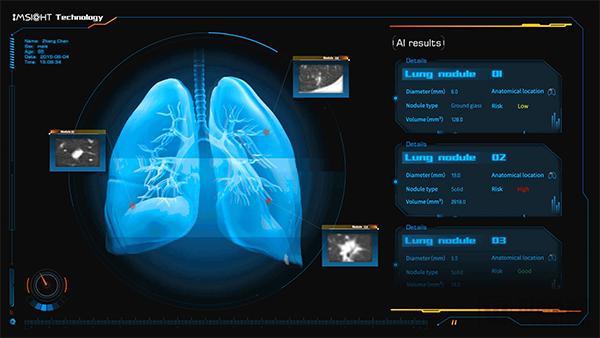
Lung Sight: Intelligent Diagnostic System for Chest CT Imaging
Lung Sight can rapidly and accurately detect nodules, perform automatic lung segmentation, and localize nodule positions. It calculates over 100 radiomic features, classifies nodules based on the Asian consensus, provides medical evidence for physicians’ diagnosis, offers follow-up comparisons to track changes in nodules, and predicts the benign or malignant nature of nodules.
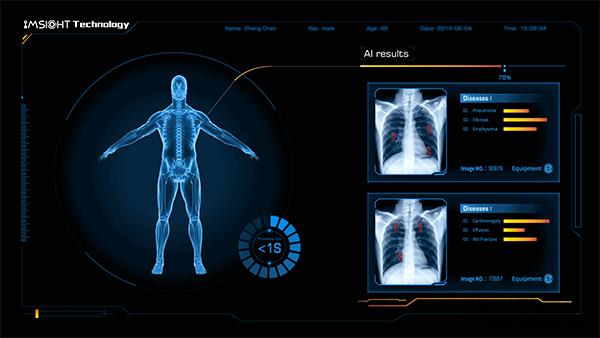
Dr. Sight Chest X-ray Intelligent Diagnostic System
Dr. Sight can differentiate over 20 types of thoracic diseases, precisely localize lesions, and complete image interpretation within seconds.
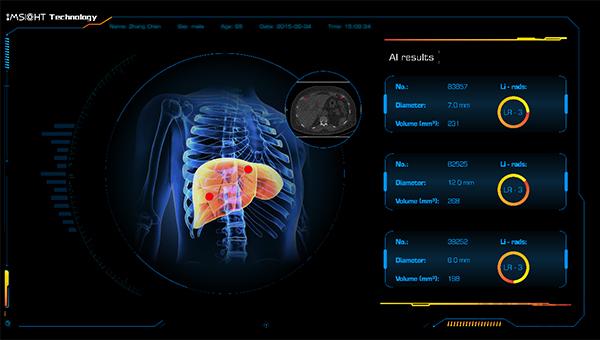
Liver Sight: Multimodal Intelligent Diagnostic System for Liver
Liver Sight is capable of analyzing multimodal imaging data and performing liver segmentation, providing comprehensive guidance that encompasses lesion detection, liver segmentation, liver volume calculation, surgical planning, and prognosis prediction.
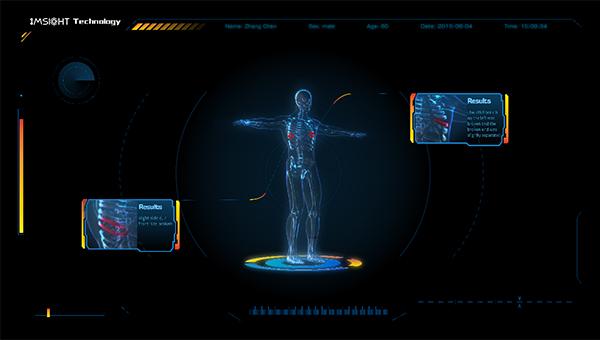
RibSight CT Intelligent Diagnostic System for Bone Diseases
Rib Sight can automatically locate fracture sites, interpret fractures, analyze anatomical positions, and automatically generate structured reports, significantly reducing the rate of missed diagnoses and facilitating disability assessment within the validity period.
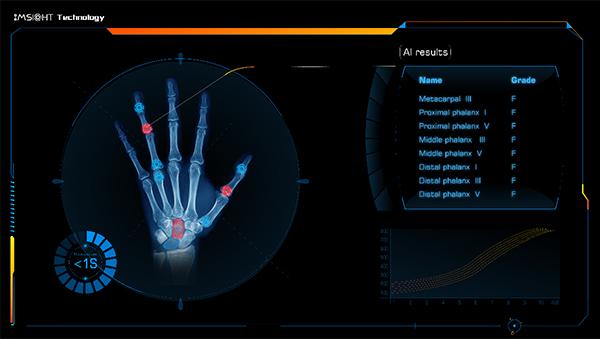
Bone Age Sight DR Intelligent Diagnostic System
Bone Age Sight can rapidly process medical images and deliver results within seconds. It supports the analysis of massive image datasets. Bone age assessment results are precise to the month, enabling accurate evaluation of children’s developmental status.
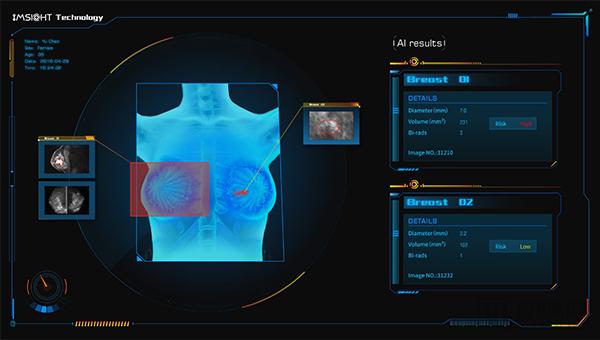
BreastSight: Intelligent Diagnostic System for Breast MRI
Breast Sight can automatically recognize multi-phase images and perform fused analysis of images from different phases. By integrating pathological data, it classifies lesions according to the international BI-RADS standard, thereby standardizing diagnostic criteria and prognostic prediction.
In addition to the aforementioned six products, Imsight has also directed its attention toward pathological analysis. Its AI-powered intelligent screening product for cervical cancer Pap smears has been submitted to the China Food and Drug Administration (CFDA) for approval, marking a key collaborative project between Imsight and medical device manufacturers.
The barrier to entry for artificial intelligence technology is not particularly high; therefore, to achieve a leading position in the AI field, it is essential to establish proprietary technical barriers. Consequently, recruiting top-tier talent to strengthen the team’s R&D capabilities is indispensable. Over the past year, Shenzhen Imsight Medical Technology Co., Ltd. has undergone rapid expansion, growing its team from 8 to 88 members, with numerous highly experienced professionals joining along the way.
Recently, the core team of Imsight Technology welcomed two more industry leaders. Its CTO, Wu Xiaohua, holds a Ph.D. in Physics from Northwestern University in the United States and previously served as Director of Multimedia Systems and Analytics at the Hong Kong Applied Science and Technology Research Institute (ASTRI). He has directly led multiple R&D teams, contributing to the development of technologies and applications including medical imaging equipment, medical image analysis, remote image interpretation platforms, VR and AR systems, robotic SLAM, video analytics, biometrics, and handwriting recognition.
In terms of market expansion, the newly appointed CMO, Xu Jun, graduated from the Fourth Military Medical University with a major in Biomedical Engineering and later earned an MBA in Business Administration from the University of International Business and Economics. Xu previously held various positions at Siemens, including General Manager of Business Units and Regional General Manager. With over 20 years of experience in the medical industry, he has a deep understanding of the core strategies for medical market development and is well-positioned to rapidly lead Shenzhen Imsight Medical Technology Co.Ltd in translating its technological advantages into market success.
Chen Hao, Founder and CEO of Imsight Technology, also holds a Ph.D. in Computer Science from The Chinese University of Hong Kong. He has published dozens of papers in top-tier conferences and journals, and has led his team to repeatedly defeat competitors from Google and MIT in numerous international medical image analysis and recognition challenges. His extensive experience enables him to rapidly propose solutions tailored to specific medical objectives.
The other team members also possess extensive experience in medical research and development. The team has accumulated profound expertise across multiple domains, including pathology, radiology, radiation oncology, endoscopy, and ultrasound. It has secured championships by defeating strong competitors from leading enterprises and research institutions in sixteen international medical imaging AI recognition challenges. Furthermore, the team has published more than 50 papers in top-tier journals and conferences such as CVPR, ICCV, AAAI, MICCAI, and MIA, receiving the Best Paper Award three times.
In addition to its team advantages, Imsight is actively supporting scientific research projects. Currently, Imsight has simultaneously secured government funding for four AI-related research initiatives, continuously accumulating expertise in artificial intelligence technologies and clinical data through extensive collaborations to further enhance its existing products.
“We have always positioned ourselves as long-distance runners focused on AI in healthcare. Throughout this marathon, we must never lose sight of the social value that AI technology brings to clinical practice,” said Chen Hao firmly. “Today, many pioneers in medical AI come from non-medical backgrounds. Their fearlessness, born of ignorance, may lead them to dive in without fully understanding the core challenges faced by hospitals. While this approach is not necessarily a bad thing, years of medical experience have taught us that we should always maintain a sense of reverence for this field.”
This is why Imsight focuses on “effective” market share: only effective services can deliver value to the healthcare sector.
Therefore, in its future development, Imsight Medical will, on the one hand, continue to deepen research into its existing AI products, ensuring that AI technology benefits doctors, patients, and hospitals, while simultaneously exploring commercialization both domestically and internationally to achieve self-sustainability as early as possible. On the other hand, Imsight Medical will actively promote the establishment of approval standards for artificial intelligence, accelerating the advent of an era where AI is universally accessible.