

The Golden Age of China's Biopharmaceutical Industry: How Capital is Fueling the Return of Overseas Talent
In the secondary capital markets, there is a prevailing saying: “When the stock market falters, one must ‘take medicine,’” meaning investors should buy stocks in the pharmaceutical sector, implying that pharmaceutical stocks offer counter-cyclical appreciation and value preservation. In reality, the primary market for biopharmaceutical investments also demonstrates robust vitality.
China boasts a massive market demand for biopharmaceuticals, attracting an influx of both domestic and foreign capital. With the introduction of a series of talent attraction policies, a large number of high-level overseas professionals are accelerating their move to China. The biopharmaceutical industry has clearly become one of the most dynamic areas for exchange among academic, capital, and corporate communities in China and the United States.
VCBeat (WeChat ID: vcbeat) has learned that the 2018 SAPA China Annual Conference, themed “Opportunities and Challenges in the Development of China’s Biopharmaceutical Industry,” was grandly held at the Zhongguancun Life Science Park in Beijing on November 30–December 1, 2018. The event was hosted by the Sino-American Pharmaceutical Professionals Association – China (SAPA-China) and guided by the Changping District People’s Government of Beijing.
This article summarizes the insights shared by industry leaders during the SAPA Annual Conference’s roundtable forum and exclusive interviews, yielding the following core viewpoints:
1. The most exciting time to be in China’s pharmaceutical industry is now;
2. Running a business inevitably involves enduring hardship;
3. The return of highly experienced overseas talent will support the development of China’s biopharmaceutical industry over the next decade;
4. China's biopharmaceutical industry is still in its early stages, and investment has entered a plateau phase;
5. Compared with the license-in model, capital favors the development model of independent innovation more;
6. Over the next decade, foreign companies, domestic generic drugs, and domestic innovative drugs may form a tripartite balance in China’s biopharmaceutical market;
7. Only innovative drugs that are novel globally, rather than merely new to China, possess true viability.
Centering on themes such as the ecosystem of China’s pharmaceutical and biotechnology development, strategies for promoting drug innovation, and cutting-edge scientific technologies, the conference hosted a series of activities including high-level forums, thematic sessions, project matchmaking, financing promotions, and corporate exhibitions. This international academic summit connects the entire pharmaceutical industry chain—from basic research and applied research to clinical studies and strategic planning in new drug development—serving as an premier platform for the integration of capital and projects.
At the high-level roundtable forum, seven leading figures from China’s biomedical investment sector—including Mr. Xu Xiaolin, Founder of Huagai Capital and the inaugural rotating chairman of H50; Mr. Lin Lijun, Managing Partner of Zhengxingu Innovation Capital; Mr. Yuan Quanhong, Managing Partner of CCB Capital and a director of H50; and Mr. Zhang Jiang, Managing Partner of Ping An Ventures and the current chairman of H50—shared extensive insights and practical expertise. Subsequently, VCBeat conducted exclusive interviews with Mr. Yuan Quanhong, Managing Partner of CCB Capital, and Dr. Cui Jisong, Founder of InnoCare Pharma and President of the SAPA China Chapter.The following is the main text:
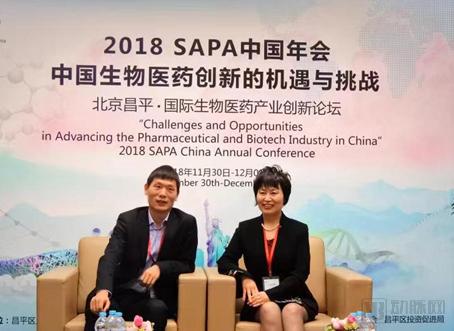
Mr. Yuan Quanhong and Dr. Cui Jisong. Photo provided by the conference.
The Return of Highly Experienced Overseas Talent Will Support the Development of China's Biopharmaceutical Industry Over the Next Decade
During the wave of state-sponsored overseas study in the 1980s and 1990s, a large cohort of Chinese students went to the United States and other developed countries to receive advanced education in biomedicine and subsequently remained there to work. Many of them have since entered the management ranks of top-tier global pharmaceutical companies, accumulating extensive experience across the entire new drug development lifecycle.
As the domestic market has become more open and dynamic, Chinese international students of advancing age have begun to consider returning home to start businesses or seek employment. The first wave of overseas talent returned around the millennium to launch ventures, at a time when China’s biopharmaceutical industry was dominated by generic drugs and technology transfer. These returnees chose to enter the market through service-oriented models, seeking to transfer advanced foreign drug R&D and manufacturing technologies to China and initiating contract research and manufacturing operations (CRO/CMO). WuXi AppTec, now a leading player in China’s biopharmaceutical sector, was established during that period. Nearly two decades later, WuXi AppTec has undergone multiple public listings, and its founder, Ge Li, has achieved remarkable success.
In recent years, an increasing number of highly experienced overseas talents have returned to China. Among the more than 6,000 members of the SAPA China Chapter, nearly 2,000 have come back to work in the country. Dr. Cui Jisong estimates that the overall rate of overseas talent returning to China currently stands at 30%–40%.
Dr. Cui Jisong believes that over the next decade, innovative development in China’s biopharmaceutical sector will rely primarily on experienced returnees from overseas. The barriers to entry in biopharmaceuticals are exceptionally high, requiring many years of accumulation, with each stage demanding highly experienced talent. On one hand, the return of overseas-trained professionals can promote the development of China’s domestic biopharmaceutical industry; “truly globally leading new drugs require individuals who have worked abroad for many years and accumulated extensive experience.” On the other hand, their return can accelerate the cultivation of domestic talent. As local professionals work alongside returnees, they can learn and master the most advanced biopharmaceutical technologies. In ten years, this may lead to a landscape in which domestically trained talent takes the lead in biopharmaceutical R&D.
Mr. Yuan Quanhong told VCBeat that, against the backdrop of returning overseas-educated talent, investment institutions are not only providing capital to support corporate growth but also promoting the development of a biomedical innovation and entrepreneurship ecosystem. Among the projects invested in by CCB Capital since its establishment, 80% are in the biomedical sector, including more than 20 startups founded by returnees; InnoCare Pharma is a typical example. Meanwhile, CCB Capital has established extensive connections with industrial parks such as Changping Life Science Park and SAPA, as well as academic organizations, fostering a robust ecosystem that includes local governments, new drug R&D enterprises, and investment institutions.
China’s biopharmaceutical industry remains in its early stages, and investment has entered a plateau phase.
Mr. Yuan Quanhong believes that domestic biomedical investment in China has currently entered a plateau phase. He points out that, from the perspective of industrial development, China’s biomedical sector is still in an emerging stage, with domestic innovative drug companies being at a very early initial phase. The current overall landscape of the domestic pharmaceutical industry is dominated by generic drugs; among the more than RMB 1 trillion market capitalization of prescription drugs, approximately over 80% consists of generics, while around 20% comprises originator drugs. The majority of originator drugs available in the domestic market are essentially imported products.
Capital flows in the biopharmaceutical industry are cyclical. In 2015, driven by the benefits of new pharmaceutical policies, a significant influx of talent and capital entered the biopharmaceutical sector, leading to a rapid increase in valuations for companies within the industry, with some going public on secondary markets. Now, market participants are adopting a more rational approach, carefully evaluating which technologies and teams warrant investment and which investors are better suited to navigate the biopharmaceutical capital market.
Mr. Yuan Quanhong believes that capital focused on biopharmaceutical investments will enter an adjustment period. Biopharmaceuticals is a long-cycle investment sector, demanding a high level of professionalism from both entrepreneurs and investors. During this adjustment phase, both investors and startups will undergo significant reshuffling.
Despite his optimistic outlook on the overall trend of biopharmaceutical investment, Mr. Yuan Quanhong believes that investors need to enhance their professional expertise to direct capital toward companies with the strongest innovation capabilities. This poses a significant challenge for investors, yet it is essential for their survival. Meanwhile, biopharmaceutical startups should strive to become internationalized enterprises, genuinely engage with international capital markets, collaborate with global industry leaders, and introduce their products to developed overseas markets.
“Even excellent teams encounter challenges, requiring the introduction of different talent and capital at various stages to address distinct difficulties,” emphasized Mr. Yuan Quanhong. “However, this process strengthens their capacity for learning and evolution, enabling the enterprise to thrive progressively.”
Mr. Zhang Jiang also stated at the roundtable forum that many great companies were born during market downturns; for example, Baidu, Alibaba, and Tencent all emerged in the aftermath of the dot-com bubble burst. “Companies thrive because they have endured significant hardships.”
Compared to license-in models, capital favors the development model of independent innovation.
Regarding the selection of development models in the biopharmaceutical sector, there are currently two mainstream approaches. One is a fully independent innovation model, represented by BeiGene; the other is a platform-based development model, namely license-in, which involves introducing high-quality drug candidates from the United States or other regions into China.
Mr. Yuan Quanhong introduced that the majority of portfolio companies invested in by CCB Capital are characterized by fully independent innovation. He pointed out that for license-in projects, particularly those where only domestic commercialization rights for innovative drugs have been acquired, it is essential to carefully consider comparative advantages, given that China does not hold a dominant position in R&D investment. Mr. Yuan believes that the primary advantages for Chinese pharmaceutical companies engaging in license-in deals may lie in a favorable regulatory environment and a faster pace of development driven by the country’s large population base.
However, due to the frequent changes in China’s biopharmaceutical policies in recent years, the advantages derived from the policy environment are unstable. “The license-in model presents opportunities, but it also poses significant challenges.” Companies opting for the license-in model must enhance their capabilities in clinical trials and market promotion in the future.
Mr. Lin Lijun and Mr. Zhang Jiang also expressed similar views. Mr. Lin Lijun believes that promising biopharmaceutical companies must adopt a long-term perspective and cultivate strong internal capabilities, noting that “license-in is an opportunity, not a capability.” While license-in deals can help establish a foothold, companies must still strengthen their own core competencies. The Chinese biopharmaceutical industry has left many gaps; only those companies that have endured hardship are poised to seize these opportunities.
Mr. Zhang Jiang stated that the future policy landscape for license-in deals remains uncertain, which will have a significant impact. On one hand, with the establishment of the powerful National Healthcare Security Administration, cost containment has become an enduring theme, yet detailed implementation rules across various provinces are still under formulation. On the other hand, although clinical trials can still be conducted relatively quickly amid China’s imperfect clinical trial approval system, sudden adverse events may accelerate the refinement of regulatory frameworks, as seen in the recent infant gene-editing scandal. “Therefore, when developing innovative drugs, it is crucial to leverage your unique competitive advantages.”
Furthermore, Mr. Zhang Jiang believes that, from the perspective of risk management in new drug development, the infant gene-editing incident may actually be a positive development. “It could drive the standardization of new drug development management. As the nation places greater emphasis on innovation, opportunities for truly original breakthroughs will become increasingly abundant.”
China’s Biopharmaceutical Industry May See a Tripartite Division
However, Mr. Yuan Quanhong pointed out that over the next 5–10 years, the platform-based model and the independent innovation model will coexist in China’s biopharmaceutical industry, with independent innovation yet to become mainstream. “Developing novel innovative drugs for the global market requires first-class scientists, visionary investment institutions, professional entrepreneurs, and high-caliber regulatory authorities; none of these elements can be dispensed with.” This is precisely the fundamental reason why CCB Capital is committed to fostering a biopharmaceutical innovation and entrepreneurship ecosystem.
Therefore, Mr. Yuan Quanhong believes that in the short term, China’s biopharmaceutical industry will see a tripartite division of the market. The first force comprises top global pharmaceutical companies, which are introducing innovative drugs to the Chinese market. The second consists of domestic generic drug manufacturers transitioning toward innovative medicines, such as Hengrui Medicine and Chia Tai Tianqing, both of which have already achieved notable success. The third force is primarily made up of innovative biopharmaceutical startups founded by overseas-returning entrepreneurs and backed by venture capital. “I believe the third force holds significant potential and could carve out its own share of China’s biopharmaceutical market within 10 to 20 years, possibly even surpassing the other two.”
At the conclusion of the roundtable forum at the SAPA Annual Conference, moderator Mr. Xu Xiaolin invited prominent investors to share their messages with overseas returnees embarking on entrepreneurial ventures. The experts collectively expressed a cautious yet optimistic outlook.
Mr. Yuan Quanhong pointed out that both industrial policies and the market in China support the local development of biopharmaceuticals. For entrepreneurs, on one hand, it is advisable not to disperse their entrepreneurial efforts across borders, so as to avoid constraints arising from barriers to cross-border exchanges; on the other hand, they should cultivate adaptability to China’s unique cultural and social environment and adjust their operational strategies accordingly.
Mr. Li Kechun stated that entrepreneurs should seek advice from others, particularly those who have experienced failure. Mr. Cai Daqing emphasized the need to make advance considerations regarding intellectual property protection.
Furthermore, industry leaders unanimously believe that entrepreneurs should focus on global innovative drugs rather than being confined to “China-new” drugs. Mr. Zhang Jiang summarized this viewpoint in eight Chinese characters: “Global Innovation, China’s Momentum.”