

Yunshi Software Launches Smart Pharmacist Business to Empower Retail Pharmacies in Capturing Prescription Diversion Opportunities
Recently, VCBeat learned that CloudSino Software, an IT service provider for the life sciences industry, has begun to expand its smart pharmacist business and has invited Mr. Chen Chongguang, former Senior Director of the COE (Commercial & Operational Excellence) department at Xi’an Janssen, to join and lead this initiative.
As a technology innovator empowering life sciences enterprises through cloud computing, big data, and artificial intelligence, why did Yunshi Software launch its Smart Pharmacist business? What is the underlying logic, and what are the specific implementation pathways? To address these questions, we interviewed Mr. Chen Chongguang, who provided a systematic explanation of Yunshi Software’s vision for its Smart Pharmacist business.

Mr. Chen Chongguang
Before joining Cloud Power Software, Mr. Chongguang Chen held several prestigious positions, including General Manager of Janssen Hong Kong, Senior Director of the Center of Excellence (Commercial & Operational Excellence) at Xi’an Janssen, and President of Xi’an Janssen University. He is highly respected within the industry. As the leader of Xi’an Janssen University, often referred to as the “Whampoa Military Academy” of the pharmaceutical sector, Mr. Chen successfully transformed it from a training department into a corporate university, dedicated to achieving the optimal integration of training, business operations, and performance.
Regarding how the partnership with Yunshi Software came about, Mr. Chen Chongguang stated that Yunshi Software, as a technology innovation company serving the life sciences industry, has earned a strong reputation within the sector. On the “Smart Pharmacist” initiative, “both parties shared aligned visions.” Mr. Chen had previously provided training to the pharmacy industry, primarily targeting chain pharmacies, at a time when pharmacy chain operations were just emerging and many enterprises required management and operational training. More recently, Yunshi Software also recognized the opportunity for pharmacies to enhance their capabilities amid the trend of prescription outflow from hospitals. Thus, the two parties quickly reached an agreement.
Focusing on the trend of prescription outflow, Mr. Chen Chongguang stated that this phenomenon originated from the separation of medical services and pharmaceutical sales, as well as adjustments to the proportion of drug revenue in hospitals. For off-hospital pharmaceutical retail enterprises, this represents a significant development opportunity that will drive transformation within the pharmacy industry. However, there remains a gap in competency between pharmacists in community settings and those in hospitals; therefore, off-hospital pharmacists must enhance their professional capabilities to meet the requirements associated with prescription outflow.
Prescription outflow has emerged as a hot topic in the pharmaceutical industry in recent years. It refers to the shift from the traditional model—where patients received diagnosis, prescriptions, and medications all within hospitals—to a new paradigm where restrictions on prescription circulation are lifted, medications are dispensed by retail pharmacies, and medical services are separated from drug dispensing. The driving force behind prescription outflow is the dismantling of the "drug-revenue-dependent healthcare" mechanism, aiming to refocus hospitals on their core medical functions and reduce their "monopoly" over prescriptions. Policies such as medical insurance cost containment, zero-markup pricing for drugs, and controls on the proportion of drug revenue have provided hospitals with strong incentives to release certain prescriptions. Thus, prescription outflow serves both as a "political mandate" and a mechanism subject to "market regulation."
A series of policies are facilitating the gradual realization of prescription outflow. For instance, hospitals are prohibited from restricting prescription outflow, allowing patients to choose freely between purchasing medications at hospital outpatient pharmacies or at retail pharmacies with a valid prescription. Pilot programs for tiered management of retail pharmacies have been introduced to encourage the development of chain pharmacies, while exploring the interconnectivity and real-time sharing of information among medical institutions’ prescriptions, medical insurance settlements, and pharmaceutical retail transactions. In terms of electronic prescription pilots, regions such as Xi’an, Guangdong, and Chongqing have successively issued pilot policies to trial the sale of prescription drugs at retail pharmacies based on electronic prescriptions.
Mr. Chen Chongguang believes that retail pharmacies are highly suitable entities for handling the outflow of prescriptions. First, chain pharmacies are numerous and have high coverage, serving as the frontline venues for health services. Second, many pharmacies, especially large-scale chain pharmacies, have already begun preparing to handle prescription outflow, including upgrades to their systems and staffing.
However, overall, retail pharmacies are not yet fully prepared to absorb the outflow of prescriptions from hospitals. They require improvements across multiple dimensions. Empowering pharmacies represents a significant opportunity amidst this trend of prescription outflow.
Mr. Chen Chongguang stated that the capability of pharmacies to handle prescription outflow is built on three pillars: foundational capabilities, informatization capabilities, and professional management capabilities. Only by possessing these capabilities can pharmacies appropriately manage prescription outflow and gain recognition from regulatory authorities, hospitals, and pharmaceutical companies.
In terms of foundational capabilities, this includes regulatory compliance, pharmacy scale, hardware facilities (such as cold-chain storage), and staffing of qualified professionals. Information technology capabilities begin with ensuring data authenticity through data collection and analysis, which can help pharmacies adjust business strategies and formulate internal incentive measures. Against the backdrop of prescription outflow, it is also necessary to integrate electronic prescription systems to ensure the authenticity and accuracy of prescription information, thereby facilitating regulatory oversight. The third aspect is professional management capability, such as prescription review, patient education, and medication therapy assessment. These are primarily related to medication safety and accuracy, encompassing medication supervision and management as well as patient health management. Community pharmacists must play a pivotal role in the process of accepting external prescriptions.
“Pharmacies have previously conducted staff training, but the content primarily focused on over-the-counter (OTC) medications and sales techniques. Against the backdrop of prescription outflow, pharmacies need to build a high-caliber workforce capable of meeting business demands—such as receiving specialized training in oncology medications and biological products—while placing greater emphasis on interaction and communication with patients to understand their medication needs and establish comprehensive patient medication records,” said Mr. Chen Chongguang.
Within this competency framework, Yunshi Software has developed a targeted plan to enhance pharmacy capabilities, focusing on improving the skills of pharmacy staff. This initiative is divided into two components: professional knowledge and soft skills. Professional knowledge encompasses pharmaceutical care management, including medication dispensing and delivery, medication counseling and guidance, and patient management. Soft skills primarily involve recognizing patients’ behavioral styles and emotions, communication techniques, and collaboration among pharmacy staff.
Smart Pharmacist Training Curriculum System
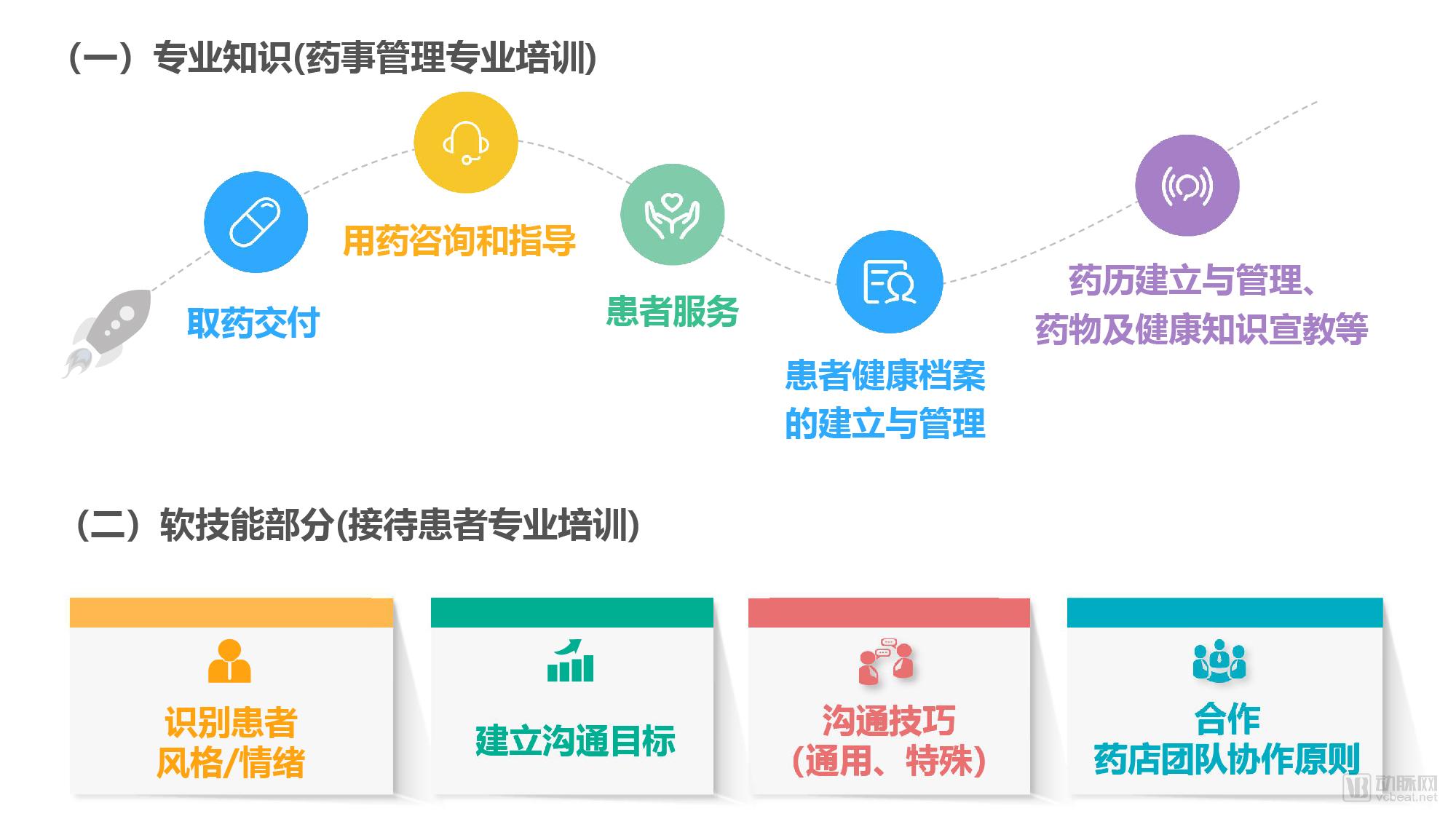
Mr. Chen Chongguang stated that the curriculum for the staff capability enhancement course was designed with reference to the requirements of the Licensed Pharmacist Examination and the standards for pharmacists in model DTP (Direct-to-Patient) pharmacies. Interviews were also conducted with pharmacists at selected pharmacies to understand their needs. “The program primarily focuses on enhancing pharmacists’ professional competencies, such as knowledge of medication efficacy, side effects, and precautions for patients with different diseases. It also includes training in communication skills to foster a greater sense of approachability and trust among customers.”
The establishment of a professional, high-caliber team of pharmacists enables pharmacies to effectively absorb outpatient prescription outflows and build a patient-centric, medication-need-driven service system. Meanwhile, through patient adherence education and continuous medication monitoring, a rational drug use system can be established to ensure medication safety. Once pharmacies have developed comprehensive systems for prescription fulfillment and prescription drug services, they are more likely to gain favor from regulatory agencies, payers, and pharmaceutical companies, thereby enhancing their operational capabilities.
Since its establishment in 2012, Yunshi Software has been deeply engaged in providing informatics services to the life sciences sector. Leveraging core technologies such as big data, artificial intelligence, and cloud computing, the company delivers solutions for key business areas including sales and marketing, clinical trials, and new drug discovery. Against the backdrop of prescription outflow from hospitals, Yunshi has identified opportunities to empower pharmacies—a strategic move closely aligned with its data-operation-centric capability framework. The Smart Pharmacist initiative, operating as a new department, holds significant potential for future synergy with Yunshi Software’s data insights business.
Against the backdrop of the separation of prescribing and dispensing, the outflow of prescriptions from hospitals has become an inevitable trend. New specialty drugs and long-term medications for chronic diseases will be the first to shift out of medical institutions, with retail chain pharmacies and DTP (Direct-to-Patient) pharmacies being the primary beneficiaries. Yunshi Software’s Smart Pharmacist solution empowers pharmacies to effectively manage this influx of external prescriptions, presenting both opportunities and challenges.