

CreateCare Medical Secures Tens of Millions in Funding Led by BGI Miracle Light Fund, Marking Largest Microfluidic Chip Investment in China
VCBeat (WeChat ID: vcbeat) has learned that Shenzhen Chuanghuai Medical Technology Co., Ltd., a domestic provider of microfluidic chip sensors and systems, has completed a new round of financing. This round was led by Miracle Light Fund, under the BGI Group, with co-investment from Zhejiang Xianghui Capital. Currently, this represents the largest single financing deal in China’s microfluidics industry. The previous round of investment came from Xiantong Capital.
Zhuang Bin, CEO of Shenzhen Chuanghuai Medical Technology Co., Ltd., stated that the funds raised in this round will be primarily used for product registration and research and development. He further revealed that within the next six months, the company plans to establish the world’s largest production and R&D center for biochips. To support this initiative, on October 10, 2018, the China Investment Association under the National Development and Reform Commission signed a long-term strategic investment and cooperation agreement with Shenzhen Chuanghuai Medical Technology Co., Ltd. The agreement encourages and supports the nationwide promotion of Chuanghuai Medical’s advanced chip-based technologies for primary healthcare, integrating them into the national strategy for the convergence of medical and health services.
Zhao Weiwen, Vice President of Miracle Light at BGI Group, stated: “We chose Chuanghuai for two main reasons. First, Chuanghuai holds significant advantages in defining future industry standards for microfluidics, as well as in its technological accumulation and market capabilities. Second, regarding collaboration with BGI, the prenatal screening business of BGI Genomics, a subsidiary of BGI Group, can seamlessly integrate with Chuanghuai’s segment focused on families preparing for pregnancy, paving the way for deepened cooperation.”Third, MGI Tech, a subsidiary of BGI Group, develops advanced diagnostic instruments and holds promising prospects for collaboration with Chuanghuai’s microfluidic diagnostic chips.
Dr. Zhang Biao, Investment Director at Xianghui Capital, stated that the investment in Shenzhen Chuanghuai Medical Technology Co., Ltd. is based on a high recognition of the company’s globally innovative medical testing technologies and products, as well as strong confidence in its future growth potential. In the future, both parties will engage in deeper cooperation across broader areas.
Microfluidic chips, known as "labs-on-a-chip," can miniaturize tests that previously required large-scale laboratories onto a small chip. With the advantages of high automation and integration, microfluidics enables rapid and accurate detection of inorganic ions, organic substances, nucleic acids, proteins, and other biochemical components by constructing miniature reaction and analysis units on the surface of solid-state chips.
Microfluidic chips can significantly reduce sample processing time and maximize the utilization efficiency of reagents and consumables through precise control of fluid flow. They integrate the functions of an entire laboratory—including sampling, dilution, reagent addition, reaction, separation, and detection—onto a single microchip, which can be reused multiple times. Also known as “lab-on-a-chip,” microfluidics is widely applied in numerous fields beyond in vitro diagnostics (IVD), such as biomedical research, drug synthesis and screening, environmental monitoring and protection, health quarantine, and forensic identification.
Looking across the entire microfluidics landscape, few companies have gained significant traction. This is because the industry faces high technical barriers, as microfluidic chip technology requires the integration of three distinct disciplines: semiconductor technology, biosensor expertise, and precision injection molding manufacturing. Indeed, manufacturing microfluidic chips is akin to people speaking different languages attempting to build the Tower of Babel together.
Zhuang Bin happens to possess backgrounds in all three of these disciplines. After returning to China, he worked at Mindray and the Chinese Academy of Sciences (CAS), where he was responsible for related technology R&D and participated in the development of Mindray’s first five-part differential hematology analyzer in China. The core team also includes many researchers from multinational corporations, universities, and research institutes.
In the field of microfluidic chips, it is essential to build barriers using core technologies, but at the same time, how to choose a commercialization path to achieve product implementation is equally important.
It is reported that the global market size for microfluidic chips was approximately USD 2.8 billion in 2015 and reached USD 5.8 billion in 2018, representing a compound annual growth rate (CAGR) of over 27%. Within the domestic market context, the primary future market for microfluidics is expected to lie in primary healthcare settings, where there is substantial unmet demand for diagnostic testing. Furthermore, ongoing policy signals—such as the implementation of tiered diagnosis and treatment systems and the family doctor program—underscore that the current round of healthcare reform is prioritizing primary care.
Zhuang Bin, CEO of Shenzhen Chuanghuai Medical Technology Co., Ltd., said to VCBeat: “Currently, there are 2.58 billion primary care outpatient visits in China that involve no diagnostic testing; these primary care settings mainly refer to community health centers and village/township health clinics, where patients see physicians for consultation only., prescriptions can be issued through eye-to-eye contact.”
Specifically, in China, there are 911,000 community health centers, township health centers, village clinics, and private clinics scattered across the country. (Data sourced from the Ministry of Health Statistical Yearbook.) Among them, 68% lack laboratory testing capabilities. Zhuang Bin vividly explained, “We consider facilities with ‘Hospital’ in their names to possess certain laboratory testing capabilities, whereas those named as ‘Clinics’ or ‘Stations’ generally have no such capabilities.”
How to Replenish the “Deprived” Primary Healthcare System in Line with National Policy Directions: Medicine, Pharmaceuticals, and Diagnostics as the Three Key PillarsGiven that more than half of physicians in China do not hold a bachelor’s degree, increasing investment in the “diagnostics” segment is essential to resolving structural contradictions within the healthcare system among the three key areas of medicine, pharmaceuticals, and diagnostics. At the primary care level, there is an urgent demand for routine laboratory tests, particularly complete blood count (CBC) analyses, followed by urinalysis and other inflammation markers, and then biochemical tests beyond the “three routine” panels. However, traditional hematology analyzers and large-scale biochemical instruments are difficult to deploy in primary healthcare institutions. Consequently, the future market size for compact, routine point-of-care testing (POCT) devices will be substantial.
Taking hematology analyzers required for complete blood count (CBC) testing as an example, these instruments contain several meters of internal tubing that must be cleaned and maintained after each test. They utilize dozens of wear-prone valves and pump components, and require external connections to multiple reagent and waste containers. Furthermore, specialized personnel are needed to perform frequent calibration and tubing cleaning. Large-scale biochemistry analyzers face similar challenges; they not only require supporting equipment such as centrifuges and water purification systems but also demand regular calibration and tubing maintenance by professionals. Primary healthcare institutions often lack the capacity to treat medical wastewater. Additionally, due to the dispersed nature and low utilization rates of primary care facilities, manufacturers find it difficult to provide frequent on-site after-sales maintenance and repairs. These issues represent significant pain points associated with traditional hematology and biochemistry analyzers, which can be effectively addressed by microfluidic technology.
When selecting products for commercialization, Shenzhen Chuanghuai Medical Technology Co., Ltd. initially focused on microfluidic hematology analyzers. “In the beginning, people would say that you are working on complete blood count (CBC) testing, which sounds less advanced than biochemical or immunoassay diagnostics. In reality, the technological barrier for microfluidic CBC chips is extremely high. International giants such as Beckman Coulter (USA), NASA, and Philips (Netherlands) spent over a decade without achieving success, yet we in China managed to develop it. It is not that we are incapable of developing biochemical, immunoassay, or genetic testing products; rather, I believe that CBC, being the primary test among the three routine laboratory examinations, better aligns with market demands. Other products currently offer limited value to primary healthcare institutions,” said Zhuang Bin.
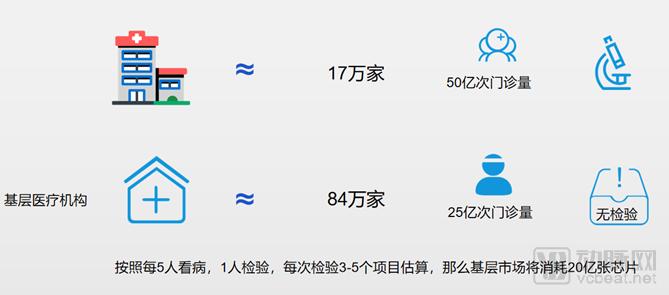
Note: Primary healthcare institutions in the figure do not include township health centers. Chart by VCBeat.
In addition to carving out a unique path in medical settings by eschewing a follower strategy, Shenzhen Chuanghuai Medical Technology Co., Ltd. has also chosen to enter the home-use market with its smartphone-based sperm analyzer (smart preconception device).
Zhuang Bin stated, “I believe that a home always has its own atmosphere; it is impossible to transform it into a medical setting with numerous instruments. However, there is a significant medical need that is best addressed at home: preconception care. For preconception care, male factors are actually more critical. A woman releases only over 400 oocytes throughout her lifetime, and their quality remains relatively stable. In contrast, men produce 100 million sperm daily, each with a unique genetic composition.”
Chuanghuai Medical’s mobile sperm analyzer (smart preconception device) employs microscopic examination. Users collect a sample and place it into a patented imaging cup (microfluidic slide), then align their smartphone camera with the device to directly visualize sperm morphology. Once the images are uploaded to the cloud server, the system analyzes sperm quality and provides preconception guidance. This preconception device, named Bemaner, has won both the 2018 German iF Design Award and the Red Dot Design Award, two of the world’s most prestigious design honors.
Zhuang Bin introduced,The imaging cup employs a variant of microfluidic technology, which Zhuang Bin himself refers to as the “Tu-series” microfluidic technology. It instantly converts cells into microscopic image signals. Users can view clear, high-magnification microscopic images of sperm directly on their smartphones using any mobile phone model, without the need for manual focus adjustment—a complex step required by traditional microscopes.
Starting with complete blood count (CBC) testing, Zhuang Bin stated, “First, this approach follows the logic of market demand; second, we aim to achieve mass production at an early stage and thereby lead industry standards. Our goal is to build an open microfluidics platform with the capability to define the market.”
Adopting this industrialization logic, Zhuang Bin was motivated by the characteristics of the microfluidics sector: high technological barriers yet low commercial maturity. Moreover, medical device giants already hold a significant market share. The challenge of emerging from the shadow of these incumbents to achieve import substitution, or even to redefine the market, has become a bottleneck for innovation in microfluidic products.
Chuanghuai Medical has also strategically positioned its products at this stage. Zhuang Bin explained to VCBeat, “In the entire biochip industry, I aim to develop four series of sensors—‘optical, electrical, colorimetric, and imaging’—which respectively convert cellular, blood, or other biological signals into optical, electrical, colorimetric, and image recognition signals. This approach unifies all laboratory medicine chips into these four series, creating an open system. Chuanghuai has already completed the first generation of chips for all four series. Complete blood count (CBC) testing is one application of the electrical series, which will soon be expanded to include HIV diagnosis. Semen analysis is an application of the imaging series, which can also be used for urine sediment analysis, among other tests. The colorimetric series includes biochemical assays, while the optical series covers immunoassays.”
Why Choose This Layout? First, it is based on the existing challenges in the industry. “The medical device industry can actually be divided into three types of professionals. One group consists of electronic engineering graduates, whose expertise lies in instrument development; another group comprises biology graduates, who tend to work for reagent companies. However, developing an analyzer requires not only instruments and reagents but also a fluidic system. The fluidic system determines where liquids are positioned within the instrument and incorporates embedded sensors that collect signals and transmit them to the instruments developed by electronic engineers.”
Zhuang Bin also pointed out that the three components originate from three distinct disciplines, resulting in a highly closed system that makes new product development difficult. Shenzhen Chuanghuai Medical Technology Co., Ltd. aims to address this challenge through an interactive fluidic system, enabling seamless integration between biochemistry specialists and electronic engineers without requiring either party to understand the other’s specific work. Biochemistry professionals need only focus on spot sampling on the chip and developing relevant reagents, while instrument companies specializing in electronic engineering can concentrate on signal acquisition from the chip, along with algorithm development and data analysis.
Finally, Zhuang Bin vividly stated, “The IVD industry landscape we ultimately hope to see is one where medical instrument electronics engineers are akin to smartphone manufacturers, our standardized microfluidic chips serve as the Android operating system, and biological engineers are equivalent to app developers. The entire industry would thus become an open ecosystem.”
In the interview, Zhuang Bin remarked, “Innovation has no teachers.” Indeed, innovation makes it difficult to retrace a path or replicate a model; one must continuously explore the right course and validate one’s capabilities and judgment.
About the BGI Miracle Light Fund
Miracle Light, a venture capital fund under the BGI Group, commenced its investment operations in late 2017, focusing on early-stage projects in the fields of genomics and life sciences. Leveraging BGI’s robust scientific research foundation and extensive experience in industrial incubation, the fund’s management team conducts professional and prudent industry research and technical assessments. It has invested in a portfolio of outstanding startups, including Junhui Biotechnology, Shenzhen Chuanghuai Medical Technology Co., Ltd., VisionCare Biotech, Yuce Bio, and Jingliang Gene. As an emerging force with a relatively short history, Miracle Light remains committed to deepening its industry expertise and, with a forward-looking perspective, aims to become a leading venture capital manager in the life sciences sector.
About Xianghui Capital
Xianghui Capital is a leading private equity investment firm in China, focusing on venture capital in new economy sectors such as innovative medical technologies. Guided by an industry-investment approach, it introduces industrial resources and leverages capital strength to empower portfolio companies, achieving mutual growth.
Reference: GTJA Capital’s In-Depth Analysis of the Domestic Microfluidics Product Market with a 27% Growth Rate
Pharmaceuticals and Biotechnology: Special Research Report on Microfluidics: Technology Gradually Maturing, Disruptive Commercial Applications Unveiled — Zhongtai Securities