

Fochon Pharmaceuticals Strengthens Small Molecule Innovation Pipeline with New Chongqing Facility at Chongqing Academy of Science and Technology
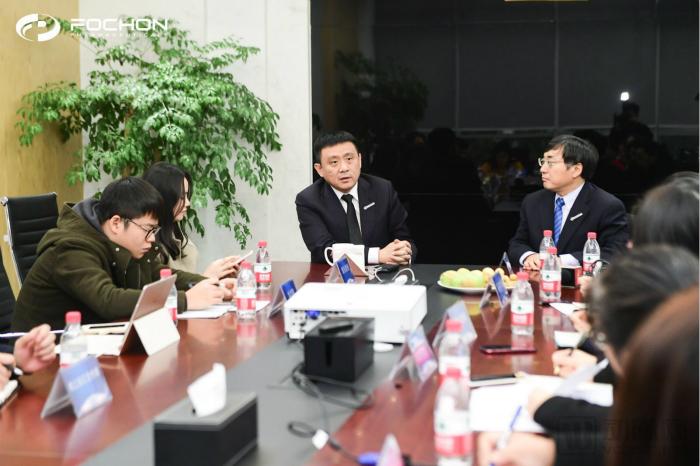
Chen Qiyu, Co-President of Fosun International and Chairman of Fosun Pharma (left), and Wang Weibo, President of Fosun Creative Medicine (right), accept media interviews
Chongqing Fuchuang Pharmaceutical Research Co., Ltd. (hereinafter referred to as “Fuchuang Pharma”) is a national high-tech enterprise dedicated to the research and development of small-molecule chemical drugs. It was established in 2009 as a joint venture by a team of overseas scientists and Shanghai Fosun Pharmaceutical (Group) Co., Ltd. (hereinafter referred to as “Fosun Pharma”) along with its member enterprises.
Over the past nine years since its establishment, Fuchuang Pharmaceuticals has undertaken the research and development of more than ten proprietary targeted small-molecule innovative drugs, with five products having received approval for clinical trials. Among these, FCN-159 tablets, primarily indicated for the treatment of advanced solid tumors, have recently been approved for clinical trials by the National Medical Products Administration (NMPA).
Recently, Fuchuang Pharma, which has just relocated to the Chongqing Academy of Science and Technology, ushered in a new milestone. “With the company’s rapid development, the original site could no longer meet R&D needs, making the construction of a new facility imperative. To better accommodate the company’s swift growth and provide stronger support for focused innovative R&D, Fuchuang Pharma relocated to the Chongqing Academy of Science and Technology this year,” said Wang Weibo, President of Fuchuang Pharma.
As Fosun Pharma’s innovative platform for chemical drugs, Fuchuang Pharma is headquartered in Chongqing and remains committed to innovative R&D. Currently, with its international footprint spanning “two countries and three locations”—Chongqing and Shanghai in China, and San Francisco in the United States—Fuchuang Pharma has implemented a 24/7 relay R&D model, thereby accelerating the progression of best-in-class small-molecule chemical drugs for the treatment of cancer and metabolic diseases into clinical trials.
Fuchuang Medicine’s new facility spans nearly 2,000 square meters, comprising chemical laboratories, biological laboratories, and office spaces, and is equipped with more advanced and comprehensive instruments and equipment. The chemical laboratories are outfitted with state-of-the-art synthesis and analytical instruments, while the biological laboratories feature an SPF (Specific Pathogen Free) animal facility that meets national standards and has obtained certification, a Class 10,000 clean cell culture laboratory, and a molecular biology laboratory, thereby providing robust support for innovative drug research and development.
At the new location, Chen Qiyu, Co-President of Fosun International and Chairman of Fosun Pharma, and Wang Weibo, President of Fosun Chuangyi Pharmaceuticals, addressed questions of concern to the media. In the following section, you will learn:
1. The “two countries, three regions” layout and the logic behind its commercialization strategy;
2. How to Build a Complete Industrial Chain in Chongqing;
3. New Drug Development: Which Hot Areas Are Worth Watching;
4. Specific Forms of Pharmaceutical Industrial Park Planning;
5. The Golden Age of Biomedicine: How to Seize the Opportunities.
The following is the main text:
Q1: Please introduce Fuchuang Medicine’s international layout across “two countries and three locations” in Chongqing, Shanghai, and San Francisco, USA, as well as its commercialization mindset, planning, and strategies?
Wang Weibo:As Fosun Pharma’s small-molecule innovative drug R&D platform, FuChuang initially focused on the discovery stage, with later stages encompassing clinical development and commercialization. We also aim to leverage FuChuang to drive the growth of Chongqing’s biopharmaceutical industry, attract more talent, and strengthen and expand the sector. Therefore, after a decade of exploration, we are now poised to gradually localize our product development and manufacturing in Chongqing.
Regarding our strategic layout across two countries and three regions, Chongqing serves as our headquarters and the primary base where we have established deep roots. On one hand, the region boasts a rich talent pool from prestigious institutions such as Chongqing University, Chongqing Medical University, West China Hospital, and Sichuan University. After several years of entrepreneurial collaboration, our Chongqing team has become highly cohesive, sincere, and dedicated. We greatly value these qualities, which offer significant advantages over coastal areas and enable us to attract top-tier talent from Southwest China.
San Francisco will be positioned at the forefront of cutting-edge technologies, whether in biotechnology or structure-based design. We will leverage the latest information and technologies from the United States to guide our strategic layout, particularly in conducting international multi-center clinical trials. Additionally, we will establish a presence in San Francisco for high-end CMOs (Contract Manufacturing Organizations) and R&D personnel in the clinical domain.
As for Shanghai, given that Fosun Pharma is headquartered there and the city hosts numerous CROs, we will also establish a presence. Fosun leverages China’s momentum to integrate global resources, and Fosun Innovation follows the same approach—developing new drugs with the most effective resources, the fastest speed, and the lowest cost.
Chen Qiyu:Fuchuang Pharma’s team was not particularly large in the past, as it focused on early-stage R&D. Indeed, its business model has been to seek partners once candidate compounds are identified.
However, as Chinese regulations continue to improve, innovative pharmaceutical companies no longer need to handle subsequent manufacturing and production in-house. Marketing also has well-established models available for collaboration. From the perspective of Fuchuang, after accumulating extensive experience in innovative drug development over such a long period, and considering China’s policy and market environments—where the government encourages rapid approval and market launch of innovative drugs, and capital markets welcome this model—Fuchuang is strategically upgrading its approach. It is shifting from the previous model, where partners were brought in at a certain stage to assume greater future investment and risk while sharing profits with Fuchuang, to a more comprehensive closed-loop model that allows Fuchuang to drive the entire process independently.
We believe that this model offers greater efficiency. By retaining control over all stages—from initial R&D to regulatory approval for market launch—except for manufacturing, which is outsourced to partners, a company can achieve optimal operational efficiency. This approach facilitates better resource coordination, enhances collaboration with clinical institutions, and supports deeper, more extensive partnerships with global stakeholders.
This strategy is beneficial to both Fosun Creative and Fosun. In the past, some transferred assets were also from Fosun Pharma’s own subsidiaries; while such arrangements may continue in the future, from Fosun Creative’s perspective, this approach helps integrate certain products and maximize their value.
Q2: Fosun Pharma has been investing and establishing its presence in Chongqing since 2002, particularly in drug R&D and manufacturing. Entities such as Youyou Pharmaceutical, Fuchuang Medicine, and the Chongqing Institute of Medical & Pharmaceutical Industry have all achieved remarkable results in innovation and internationalization. Why was Chongqing chosen as the R&D center for western China?
Chen Qiyu:Chongqing already has a solid foundation. Fosun Pharma first entered Chongqing for investment in 2002.
In the past two years, Youyou Pharmaceutical has made significant investments in R&D and team building. The company has undertaken extensive work on consistency evaluations, becoming the first in Chongqing to achieve this milestone, with many more initiatives to follow. Historically, Youyou Pharmaceutical has specialized in liver diseases and antibiotics. Recently, it completed the strategic integration of Hunan Dongting Pharmaceutical, a company focused on psychotropic medications.
Fosun’s pharmaceutical industrial layout in Chongqing is designed to meet international standards. This applies to the research and development (R&D) and manufacturing of active pharmaceutical ingredient (API) intermediates, including those produced by Fosun Pharma’s subsidiary, Kailin Pharmaceutical, all of which adhere to global standards for worldwide supply. In terms of generic drug R&D capabilities, the company has passed consistency evaluations, and Fosun Pharma itself is certified under the U.S. Food and Drug Administration (FDA) system. Furthermore, regarding innovative drug R&D, the “two countries, three locations” model ensures that while primary production takes place in Chongqing, the products still meet global standards.
Therefore, Fosun Pharma’s innovation hub remains in Chongqing. With the inauguration of its new facility today, the platform’s capacity and capabilities have been significantly enhanced. Chongqing boasts a mature ecosystem for building complete pharmaceutical innovation and industrialization value chains. We already have an R&D team of several hundred professionals here, which will be further strengthened in the future to establish Chongqing as Fosun Pharma’s high-efficiency, high-level, full-value-chain innovation center. Going forward, the integration of various Fosun enterprises in Chongqing will inevitably foster a comprehensive, multi-dimensional industrial system aligned with global standards.
Q3: In September, the anti-cancer drug FCN-159 was accepted by the National Medical Products Administration (NMPA) for clinical trial registration review. Fosun Pharma and Fochon Pharma will initiate Phase I clinical trials of this new drug once conditions are met. What is the current progress and pipeline status?
Wang Weibo:Why is it called FCN-159? “F” stands for Fosun, and “CN” represents China, signifying a Chinese invention. Combination therapy is essential in cancer treatment, an area where Fosun holds significant advantages. Fosun Creative can develop its own combination regimens, with the aim of effectively treating refractory conditions such as rectal cancer in the future. We are currently strategically positioning ourselves in this field. This provides an overview of FCN-159.
Regarding our current product portfolio strategy, our primary objective is to address unmet needs in the field of small-molecule therapeutics. Currently, oncology represents the most significant area of demand. Whereas a cancer diagnosis was once considered hopeless, scientific advancements have gradually transformed cancer into a chronic disease. Consequently, our strategic focus remains centered on oncology.
Another area is Alzheimer’s disease, for which demand is substantial given increasing human longevity. Where qualified and capable, Fuchuang will continue to venture into developing novel, original drugs that address unmet patient needs and tackle challenging therapeutic areas. We are committed to breaking through in these difficult domains and competing with major international pharmaceutical companies in terms of original innovation.
Strategically, Fuchuang will rapidly follow up on existing targets, optimize molecules, and develop superior products compared to those of other companies.
There are also ongoing efforts to develop therapies targeting diabetes, which we are closely monitoring and actively tracking. However, diabetes drug development presents a significant challenge, particularly in the United States, where concerns about cardiotoxicity are prominent. This necessitates large-scale clinical trials, entailing substantial investment and considerable risk. We must therefore carefully evaluate our capacity and risk tolerance when determining our strategic approach. Our overall portfolio strategy is guided by these considerations.
Q4: The pharmaceutical industry is one of the pillar industries for the future development of Chongqing Liangjiang New Area. As Fosun Pharma’s innovative platform for chemical drugs, Fuchuang Pharmaceutical is based in Chongqing and located within the Liangjiang New Area Industrial Park. What are its future functions and positioning, including key focus areas and projected output value?
Wang Weibo:Regarding site selection, we are honored to be located in the prime area of the Chongqing Academy of Science and Technology (CAST) within the Liangjiang New Area, which is indeed highly suitable for scientific research. Our facility currently spans 2,000 square meters, including a nearly 600-square-meter chemical zone that meets international first-class standards. Downstairs, there is a supply optimization room as well as the most advanced biological screening center in the Chongqing region. This center comprises three sections: a molecular biology laboratory, a cell culture laboratory, and an animal laboratory.
Our cell laboratory operates at near-Class 10,000 cleanliness levels, adhering to exceptionally high standards. Fuchuang possesses over 50 rare cancer cell lines, which are either independently engineered in-house or sourced from international suppliers. Our animal laboratory is arguably the best in Chongqing. In terms of both whole-animal models and cellular-level technologies, we are aligned with international standards and rank among the world’s leading facilities.
More than 90% of Fuchuang’s employees hold master’s degrees. We aim to gradually attract talent in the biopharmaceutical sector and build a stronger platform, including the introduction of overseas R&D teams and institutions. Each year, Fuchuang rotates employees and research teams to work in San Francisco for a period, a process that helps align the capabilities of local talent with international standards.
Drug development requires the collective intelligence of many individuals. As we proceed with clinical trials and international business collaborations, we need to attract global talent to Chongqing. Furthermore, in areas such as AI-driven drug design, one of our core technological advantages—structure-based drug design—involves computer simulations of proteins and small molecules, which, in a sense, also relies on artificial intelligence algorithms. We are actively engaging in international cooperation, which is an integral part of our strategic layout.
Chen Qiyu:In China, there are over 4 million new cancer patients annually. Currently, the prices of innovative oncology drugs in clinical practice generally range from tens of thousands to 200,000–300,000 RMB. As these agents are predominantly precise targeted therapies—for example, those for non-small cell lung cancer (NSCLC)—they are designed for well-defined patient populations upon market launch, targeting products with substantial market demand.
In principle, each new drug should generate at least several hundred million RMB in sales; this is a relatively conservative estimate. For innovative oncology drugs in the Chinese market, single products launched by multinational corporations can typically achieve sales of RMB 2–3 billion or even higher.
Once our products are launched, their potential will be immense. Given the sheer size of the Chinese market alone, and considering that we have independently developed these products and hold global intellectual property rights, there is significant opportunity for expansion. Currently, China accounts for only 5%–10% of the global market share for innovative drugs; in other words, the global market presents an opportunity 10 to 20 times larger than the Chinese market. Going forward, we will scale up our output capacity through various approaches, including co-development and licensing partnerships with multinational corporations, as well as independent advancement, leveraging a combination of these models.
Q5: The biopharmaceutical industry has become one of the most promising and dynamic sectors within the modern industrial system. With numerous policies introduced by the state in the pharmaceutical field, is this the golden age for biopharmaceuticals? If so, how long is it expected to last?
Chen Qiyu:Chinese pharmaceutical companies have entered a highly favorable period for the development of innovative drugs, including biologics and small-molecule therapeutics, as well as complex, high-difficulty drugs—a phase that is expected to last for at least 20 years.
One factor is determined by the drug development cycle. R&D takes 8–10 years, and once the product is launched, it enjoys patent protection for at least 10–15 years. Therefore, this wave of Chinese pharmaceutical companies innovating in new drugs will benefit from the combined advantages of cost efficiency and market access unique to Chinese enterprises.
With a market of this magnitude—boasting over 4 million cancer patients—if Chinese enterprises can overcome the R&D hurdle, we will be able to meet domestic demand with high-cost-performance solutions. Building on this foundation, we can also export high-efficacy, affordable innovative drugs to the global market.
From this perspective, as China continuously develops a large pipeline of innovative drugs in the future, its pharmaceutical industry will exert a significant impact on the global pharmaceutical innovation chain. The cost structure, market dynamics, and business models of global drug innovation will undergo substantial changes, with China’s capital markets also providing robust support for innovative drug development.
Once these drugs are launched, the subsequent decade will represent their prime window. Therefore, given that innovative pharmaceuticals are a relatively long-cycle industry, the investment horizon spans at least 20 years, and potentially even 30 to 40 years.
Q6: Fuchuang is the only company in the Chongqing region focused exclusively on innovative small-molecule drugs. Over the nine years since its establishment, Fuchuang Pharma has undertaken R&D for more than ten targeted innovative drugs with independent intellectual property rights, and five of its products have received approval for clinical trials. Given the large number of companies in China pursuing innovative drug development, what are Fuchuang’s competitive advantages?
Chen Qiyu:Innovation fundamentally relies on top-tier talent. This is especially true for pharmaceutical innovation, which is a highly complex science that must balance therapeutic efficacy with minimal risk, given its direct application in humans. Innovative drugs compete in the global marketplace against international pharmaceutical companies; since regulatory approval and the evaluation standards for efficacy and safety are aligned with international norms, the industry demands world-class talent.
Furthermore, the team must be able to endure solitude and withstand the test of time. It has been nine years since Fuchuang was founded, and we still have only five products in Phase I clinical trials. There is a long road ahead, so we must have the resilience to persevere.
Third, it is essential to have suitable investors. Whether investors can remain committed depends on their underlying motivations; a purely profit-driven approach is unsustainable. Therefore, the composition of the investor base is critical. For Fosun Pharma, Fochon is not merely a financial investment but an integral part of our strategy and business operations. As such, we are committed to seeing this through. Regardless of fluctuations in the capital markets or the external environment, we will steadfastly drive this initiative forward.