

Subtle Medical Announces FDA Clearance of SubtlePET and U.S. Market Launch
Subtle Medical
Medical Imaging Software Developer
Medical imaging technologies, represented by PET and MRI, provide physicians with critical information, making modern healthcare more precise. However, these devices are expensive and time-consuming to operate, limiting their benefits to only a subset of patients. As AI technology moves toward practical application, this field is undergoing a revolutionary transformation.
VCBeat learned that,SubtlePET, the first product from Subtle Medical, a Silicon Valley company founded by Chinese entrepreneurs, has just received FDA clearance.. Subtle Medical thus became the first AI medical imaging company with Chinese roots to obtain this certification, marking its products’ genuine entry into the U.S. market.
“Through SubtlePET and future products currently in development, we aim to deliver AI-powered medical imaging that is low-cost, time-efficient, and high-quality, with a commitment to serving a broader patient population,” said Gong Enhao, founder of Subtle Medical and holder of a Ph.D. in Electrical Engineering from Stanford University, in an interview with VCBeat.
As its name suggests, SubtlePET is an AI-powered imaging processing platform designed for PET (positron emission tomography), enabling hospitals and third-party imaging centers to perform PET scans (including PET-CT and PET-MR) more rapidly and serve more patients within a single day. PET is a commonly used imaging modality in oncology, neurology, and cardiology that visualizes patients’ functional status at the molecular level by detecting emitted radiation from radiotracers. In the United States, the average cost of a PET scan is approximately $3,000 or higher, and the procedure typically takes 30–60 minutes.
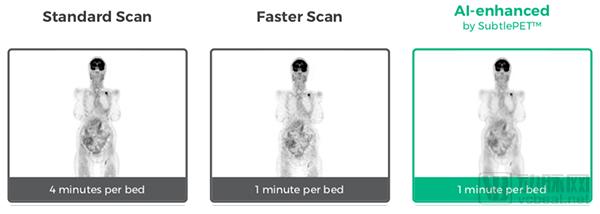
Schematic Diagram of Subtle Medical Technology
SubtlePET underwent early testing at Hoag Hospital. Michael Brant-Zawadzki, MD, FACR, the hospital’s leader, stated, “SubtlePET accelerates PET scans by up to fourfold while still delivering medical images of equivalent quality. This significantly enhances the efficiency of PET scanning, improves the patient experience, and does so without adding any extra steps or burden to clinical workflows. The adoption of SubtlePET has quickly brought economic value and enhanced competitiveness to our hospital. I look forward to seeing more groundbreaking technologies from the Subtle Medical team.”
Subtle’s technology is primarily based on deep learning algorithms, enabling seamless integration with scanning machines from any device manufacturer and with PACS (Picture Archiving and Communication Systems). It enhances image quality during the scanning process without interrupting or affecting the medical image acquisition workflow. This means that SubtlePET can significantly improve the quality of images obtained from short-duration scans, a feature that is particularly important for children who cannot remain still during testing and for patients who frequently undergo PET scans.
Unlike other companies that focus on intelligent analysis of medical images, Subtle Medical, founded by a team from Stanford University, prioritizes enhancing the imaging speed of medical equipment and reducing radiation doses.
Imaging technologies such as MRI and PET are both expensive and time-consuming, with 90% of the costs and a significant amount of time actually incurred during the machine imaging process. Subtle Medical’s technology targets this very stage, leveraging AI to enhance image quality, thereby enabling healthcare institutions to examine more patients in less time while reducing radiation exposure.
Subtle Medical showcased its AI-powered imaging processing platform at RSNA. Imaging data flows directly from the acquisition devices into Subtle Medical’s system, where it is processed and then sent to PACS workstations for physician use. It is reported that Subtle Medical can currently accelerate MRI and PET imaging processes by 4–10 times using AI technology, while maintaining diagnostic-level accuracy.
In addition to leveraging AI to enhance imaging speed and quality, Subtle Medical’s founder, Gong Enhao, and his team published research on reducing MRI contrast agent usage, which received the RSNA Scientific Achievement Award and was selected as one of the 10 official RSNA highlighted studies.
During MRI imaging, patients are required to receive an injection of a contrast agent (such as gadolinium) to help improve image quality. Gadolinium is a heavy metal used in MRI examinations and is generally eliminated from the body after the imaging procedure is complete. However, recent studies have found that trace amounts may remain in the human body following imaging with certain types of gadolinium-based contrast agents. The clinical implications of such residual deposition are currently unclear; nevertheless, it is essential to minimize potential risks to patients while maximizing MRI image quality.
Gong Enhao’s research demonstrates that AI can reduce the gadolinium dosage used in MRI scans. By employing a novel deep learning algorithm during the imaging process, the study showed that MRI images obtained with a lower gadolinium dose were not significantly different from those acquired with a full dose.
There are many yet-to-be-recognized clinical applications for the use of lower doses of contrast agents, and AI-driven approaches can undoubtedly yield further insights.
Subtle Medical was founded in 2017. Its founder, Dr. Enhao Gong, holds a Ph.D. in Electrical Engineering from Stanford University, specializes in AI-based medical imaging research, and is a successful serial entrepreneur. Co-founder Greg Zaharchuk is a Stanford professor and renowned radiologist who holds multiple patents. The founding team also includes Dr. Tao Zhang, a Ph.D. graduate of Stanford’s Department of Electrical Engineering and former MRI scientist at GE Healthcare, as well as Dr. Liren Zhu, who earned degrees from Caltech and the University of Washington and brings extensive experience in biomedical imaging technology research.
Within its first year of establishment, Subtle Medical completed its seed and Pre-A financing rounds. Investors included the established U.S. venture capital firm Bessemer Venture Partners, the U.S. big data fund Data Collective, ZhenFund, renowned Silicon Valley investor Jim Breyer, BV (Baidu Ventures), and the emerging Silicon Valley fund Fusion Fund, among others.
SubtlePET is the first product among the various new AI technologies under development by Subtle Medical to receive FDA clearance and is poised for clinical use. Meanwhile, SubtlePET has also obtained European CE (Conformité Européenne) certification. The “CE” mark is a safety certification mark regarded as a mandatory pathway for manufacturers to access and enter the European market.
“As the first AI solution for medical image enhancement applications to receive FDA clearance, this achievement validates our team’s strength, the significant investment from our partners, and our focus on image processing and workflow integration. These characteristics clearly differentiate us from other AI companies that primarily focus on computer-aided diagnosis or post-processing,” said Gong Enhao. “This FDA clearance and CE marking represent an important milestone for Subtle Medical, but they are only the first step. We will continue to enhance our technology and products to become the go-to solution for clinical imaging in hospitals.”
It is reported that SubtlePET has been deployed in clinical settings at several university hospitals and medical imaging centers in the United States and abroad. Gong Enhao revealed that the near-term market focus for SubtlePET will be on U.S. hospitals and imaging centers. Subtle Medical’s PET and MRI products have established collaborations with more than ten leading hospitals, including Stanford, UCSF, and MD Anderson, to conduct clinical trials, with plans to further optimize AI algorithms through additional data. Meanwhile, Subtle Medical is also partnering with third-party imaging center alliances such as RadNet to enhance image quality and clinical examination efficiency.
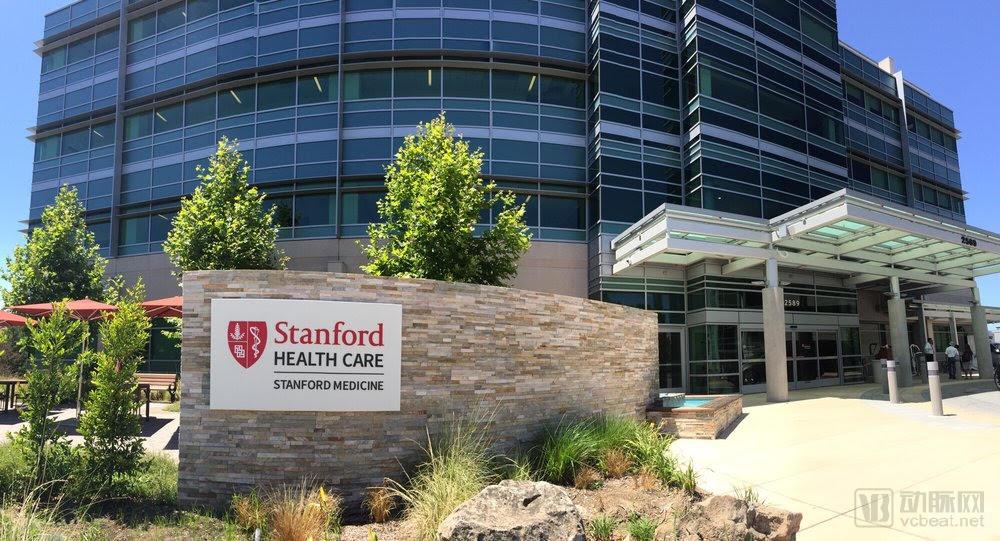
Stanford University Hospital
Subtle Medical is also progressively establishing collaborations with hospitals in China, Europe, and South America, as well as with medical imaging enterprises. For instance, in China, it has partnered with companies such as Neusoft Medical to integrate its AI technology with imaging equipment. Furthermore, the Subtle Medical team is engaged in clinical research collaborations with leading domestic hospitals, including the Chinese PLA General Hospital (301 Hospital) and Beijing Tiantan Hospital.
In addition to SubtlePET, Subtle Medical is also developing other products slated for FDA submission, including SubtleMRI and SubtleGAD for magnetic resonance imaging (MRI) scans, to further accelerate medical image processing and reduce the required dosage of contrast agents.
Subtle Medical is an AI medical imaging company based in Silicon Valley. Starting from “AI + Medical Imaging,” it combines deep learning and image reconstruction technologies to enhance the quality, efficiency, and safety of medical imaging and its workflows.
Since its inception, Subtle Medical has secured two rounds of financing. The seed round was led by investors including the U.S.-based big data fund Data Collective, ZhenFund, BV (Baidu Ventures), Qingyuan Venture Capital, and Wisemont Capital.
In March this year, Subtle Medical won the NVIDIA Inception “Global Healthcare AI Startup” Award, standing out from more than 3,000 startups worldwide. Subtle Medical was also selected as the first AI+healthcare project in Bessemer Venture Partners’ “Deep Healthcare China-Funded Projects.” At the RSNA (Radiological Society of North America), a major U.S. radiology conference previously covered by VCBeat, Subtle Medical received the RSNA Scientific Research Award and was named one of the 10 research projects officially promoted by RSNA.
In May, Subtle Medical completed a $5 million Pre-A financing round, led by the established U.S. firm Bessemer Venture Partners and the U.S. big data fund Data Collective. Participating investors included seed-round backers, Jim Breyer—Facebook’s investor often hailed as the “world’s top VC”—and the emerging Silicon Valley fund Fusion Fund.
Introduction to the Founding Team
Founder and CEO Gong Enhao: Ph.D. in Electrical Engineering from Stanford University, with a dual background in medicine and engineering, is a serial entrepreneur from Stanford. During his doctoral studies in Electrical Engineering at Stanford, the laboratory where he conducted research had decades of experience in combining industrial research, serving as the birthplace for the application of traditional rapid sampling techniques such as compressed sensing in the field of medical imaging. His research focuses on deep learning and medical imaging, primarily exploring the applications of deep learning technologies in medical image post-processing, image reconstruction, and assisted diagnosis. He has received multiple research awards from the International Society for Magnetic Resonance in Medicine and the Radiological Society of North America, and was named to the Forbes China 30 Under 30 list in 2018.
Co-founder Greg Zaharchuk: A professor at Stanford University School of Medicine, renowned radiologist, and neuroimaging specialist. With decades of clinical practice in the United States, he has received numerous awards, including the Distinguished Investigator Award from the Radiological Society of North America (RSNA), and holds multiple patents.
Dr. Tao Zhang: Ph.D. in Electrical Engineering from Stanford University; former Magnetic Resonance Imaging Scientist at GE Healthcare and Visiting Professor at MD Anderson Cancer Center. He has over ten years of research experience in the field of medical imaging. Dr. Zhang has published more than 20 papers in top-tier medical imaging journals and over 50 conference papers, and holds more than ten patents licensed to major medical imaging companies such as General Electric, Siemens, and Philips. His paper on rapid pediatric magnetic resonance imaging received the International Society for Magnetic Resonance in Medicine’s Annual Young Investigator Award (W.S. Moore Award) in 2015.
Dr. Zhu Liren: He graduated from the laboratory of Professor Wang Lihong, a renowned Chinese-American scientist and member of the U.S. National Academy of Engineering, at the California Institute of Technology. He received his Ph.D. in Biomedical Engineering from Washington University in St. Louis in 2017 and has been engaged in research on biomedical imaging technologies for over a decade. He has published more than 10 papers in top-tier academic journals, including Science Advances, Nature Biomedical Engineering, and Nature Communications, as well as over 10 conference papers. His co-first-authored paper on photoacoustic imaging technology was selected as one of the Top 10 Papers of 2017 by Nature Biomedical Engineering and was awarded the Best Paper of 2017 at the premier academic conference SPIE Photons Plus Ultrasound: Imaging and Sensing.