

RSNA 2018 Reflection: Think Now, Act For Future
Author: Yang Jun
As in previous years, RSVA returned to its familiar venue and time slot. What remained unchanged were Chicago’s temperature, strong winds, and snowfall; what has changed is how radiologists are rethinking a future empowered by artificial intelligence (Conference Theme: How emerging technology will empower tomorrow’s radiologists to provide better patient care). You do not wait for the future, because it’s already here.
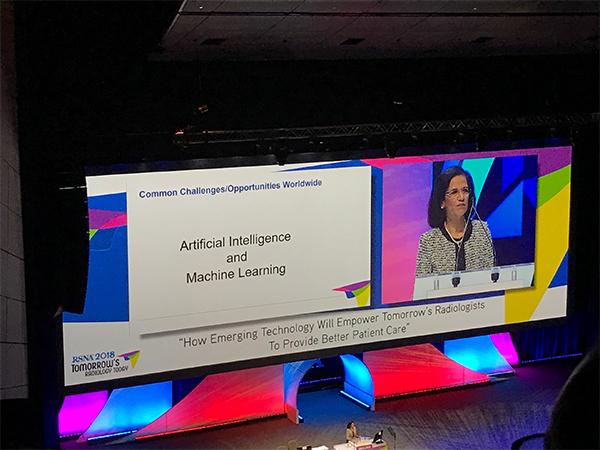
At the opening ceremony, the Arie Crown Theater was packed to capacity on Sunday morning, resembling a bustling hospital. RSNA President Dr. Vijay M. Rao delivered the keynote address, describing what a typical day in radiology might look like in 2043 if her granddaughter were to become a radiologist 25 years from now, highlighting the integration of intelligent technologies. She argued that advanced technologies available today, particularly data analytics and artificial intelligence (AI), can help radiologists optimize workflows, enhance diagnostic accuracy, and enable them to provide comprehensive patient care plans.
Over the years, having moved from an image algorithm laboratory in Canada to GE Healthcare’s Department of Clinical Advanced Application Research, and then into the AI healthcare industry, I deeply resonate with Dr. Rao’s perspective (I am also engaged in interdisciplinary research collaboration spanning neuroscience and medical imaging). This resonance extends beyond merely acknowledging the potential value that future technologies may offer; it also encompasses a shared commitment to empowering radiologists to continuously integrate into multidisciplinary clinical diagnosis and treatment workflows, thereby delivering superior medical solutions and advancing the frontiers of medical research. Radiologists must not remain mere “image readers”; rather, they must cultivate clinical reasoning skills to truly provide “total patient care.”
As a clinical scientist bridging technology and practice, if I were to distill the essence of Dr. Rao’s vision, it would be to leverage cutting-edge technologies developed today—including database analytics and AI—to enhance the clinical education of the next generation of physicians. This approach enables radiologists to engage more extensively and comprehensively in patient care during their practice, while creating greater opportunities to conduct scientific research that advances medicine. In doing so, we continuously realize the radiologist’s positioning as “doctors’ doctors,” truly going beyond imaging rather than serving merely as image readers. All these elements constitute a complete system for medical education and professional growth (education-practice-research-achievement), into which new technologies are integrated—this is Act For Future.
In terms of physician education, this year’s “Machine Learning Showcase Platform” was co-hosted by Google Cloud and Arterys. Google Cloud focused on algorithmic frameworks and foundational research, presenting the latest advancements and its open platform to interested physicians and technical professionals. Arterys showcased two FDA-approved products—an AI platform for cardiac structure analysis and another for liver imaging—as well as cloud-based AI solutions for medical imaging. Prominent vendors and research institutions presented their latest work at the conference. Regarding training and education, GPU chip manufacturer NVIDIA held a week-long “Learning Classroom,” providing physicians with enhanced opportunities to learn about practical AI applications and gain hands-on experience with algorithms.
In the field of image recognition, deep learning research on breast cancer mammography, digital breast tomosynthesis, and lung cancer CT lesion detection accounted for one-third of the designated presentations. Meanwhile, radiomics research, which was highly popular in the previous two years, has significantly declined. Beyond directly aiding in the recognition of various images and lesions, AI technology has played a new role in upstream raw image processing and improving image reconstruction techniques. For instance, GE Healthcare’s Deep Learning Image Reconstruction (DLIR) achieves noise reduction effects comparable to the previous-generation Adaptive Statistical Iterative Reconstruction (ASIR) technique, but with substantially shorter reconstruction times. Gong et al. from Stanford University utilized 3D U-Net for learning and reconstructing contrast-enhanced brain MR images. They compared the image quality and diagnostic utility of deep learning-reconstructed images acquired with reduced gadolinium contrast agents against those obtained with standard full-dose gadolinium, demonstrating non-inferior performance. In academic publishing, Dr. Rao officially announced the launch of the journal Radiology: Artificial Intelligence, marking the first peer-reviewed academic journal dedicated to artificial intelligence in the medical field, underscoring its significance.
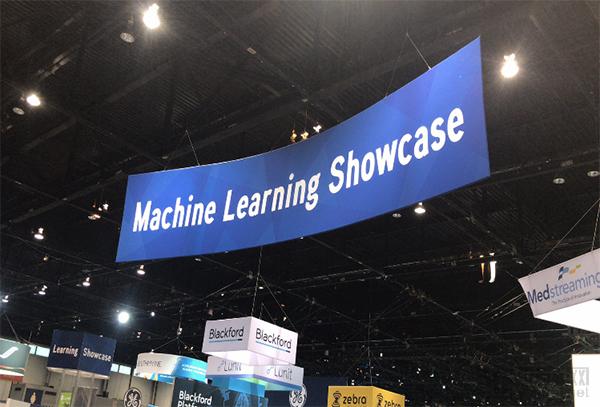
Machine Learning Showcase at RSNA 2018
Amid the sweeping wave of AI, I have developed several reflections on scientific translation and product development. Deep learning has already achieved high coverage in the analysis of breast imaging, pulmonary nodules, and lung cancer; however, as indicated by international research trends presented at conferences, these technologies have not yet been integrated into clinical decision-making. The primary reasons include concerns over whether the evidence provided to clinicians is sufficient and how well the conclusions align with the stability of gold-standard diagnoses. On the other hand, in practical implementation and application scenarios (including those already approved or pending FDA approval), image-based applications for ophthalmic diseases, cerebrovascular conditions, and cardiovascular diseases have yielded certain achievements. In the analysis of images for other high-incidence tumors, fractures, and bone age assessment, preliminary research trends involving AI have also emerged, though further validation through robust multi-center trials is still required.
From my perspective, AI’s entry point into the terminal stage of healthcare—namely, diagnosis and treatment—remains insufficiently targeted and lacks depth. The U.S. FDA’s current de novo classification for intelligent systems has, to some extent, lowered the regulatory approval threshold for AI-based medical products, thereby establishing a favorable initial ecosystem for this emerging field. This facilitates the development of clinical products that are genuinely aligned with decision support in treatment, rather than merely remaining at the level of so-called “image readers.” The emergence of any new technology is invariably accompanied by improvements or innovations in prior technologies and diagnostic workflows. In a highly knowledge-intensive and experience-driven field like medicine, which is constantly breaking new ground, we must prepare ourselves with both enthusiasm and patience, ensuring that our efforts are truly rooted in medical science and returned to clinical practice, acting for the future.
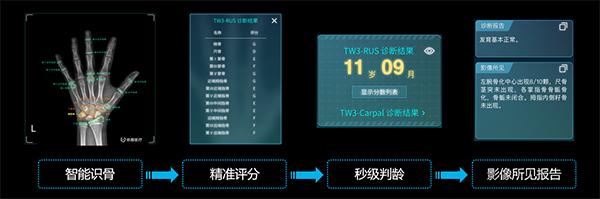
Pediatric Bone Age Assessment System of a Chinese Unicorn Medical AI Company Under Review
From this year’s RSNA, it is evident that the medical imaging community is embracing the development of artificial intelligence with unprecedented enthusiasm. The practical usability of actual products, along with medical education and scientific research on new technologies, will be critical factors for future clinical implementation. Imaging should not be regarded as our ultimate goal; rather, it is a diagnostic tool. Our advanced image/data processing and AI technologies can help physicians leverage this tool in a more quantitative and effective manner. These technologies are expanding the capabilities of digital diagnosis in ways never seen before, redefining radiologists’ role in total patient care and enabling more comprehensive participation in the formulation of multidisciplinary clinical strategies.