

Xiangxi Health Commission Leads AI in Dermatology: 'SmartSkin' Platform Empowers County-Level Hospitals and Strengthens Primary Care
On December 8, 2018, the First Xiangxi Prefecture Primary Care Dermatologists Forum, the “Smart Dermatology” Promotion and Exchange Meeting for Primary Care in Xiangxi Prefecture, and the Free Clinic Campaign by the Dermatological Expert Team from the Second Xiangya Hospital in Primary Care Areas of Xiangxi Prefecture were successfully held at Yongshun County People’s Hospital. The event was jointly hosted by the Medical Association of Xiangxi Tujia and Miao Autonomous Prefecture and the Second Xiangya Hospital, co-organized by the Artificial Intelligence in Dermatology Development Alliance, and undertaken by Yongshun County People’s Hospital.
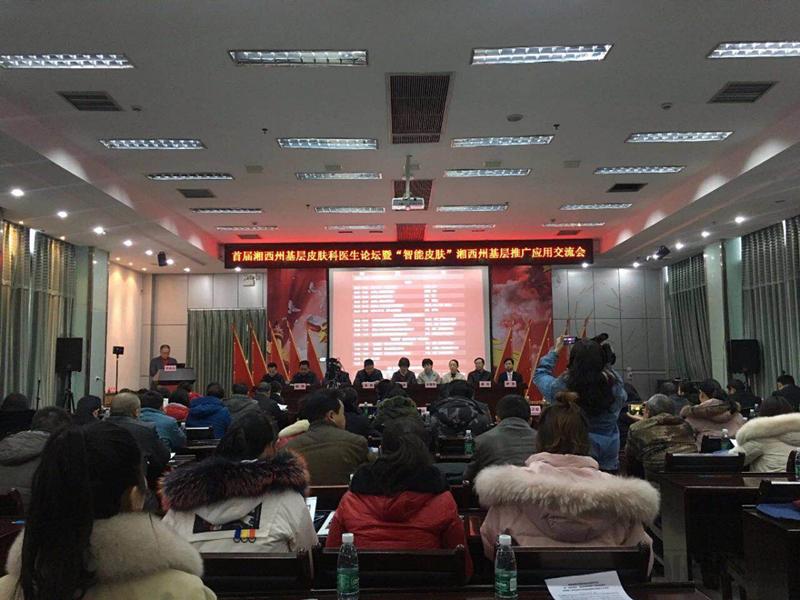
Tang Cheng, Head of the Science and Education Section of the Xiangxi Prefecture Health and Family Planning Commission and Secretary-General of the Prefecture Medical Association; Zhang Yong, Deputy County Mayor of Yongshun County People’s Government; Tian Ming, Director of the Health and Family Planning Bureau; and other officials attended the conference. Together with Yin Heng, a dermatology expert from the Second Xiangya Hospital of Central South University and lead for the development pathway of the Artificial Intelligence in Dermatology Alliance Platform, they jointly explored pathways for the development of primary healthcare.
Tang Cheng, Head of the Science and Education Section of the Xiangxi Prefecture Health and Family Planning Commission and Secretary-General of the Prefecture Medical Association, stated in his opening ceremony address that the event aims to implement the medical “targeted poverty alleviation” policy, advance the implementation of the tiered diagnosis and treatment system, promote the development of dermatology prevention and control specialties in primary healthcare institutions across the prefecture, and facilitate the adoption of new technologies and knowledge.
In November 2013, General Secretary Xi Jinping visited Huayuan County in the Xiangxi Tujia and Miao Autonomous Prefecture of Hunan Province, where he first proposed the concept of “Targeted Poverty Alleviation.” General Secretary Xi emphasized that the key to achieving targeted poverty alleviation lies in proceeding from actual conditions, adapting measures to local circumstances, identifying appropriate approaches, and establishing sound institutional mechanisms. In recent years, healthcare conditions in dermatology departments at primary-level hospitals in Xiangxi Prefecture have improved to some extent; however, persistent shortcomings and bottlenecks hindering the development of health services in the region include insufficient quantity and uneven distribution of high-quality medical resources, shortages of medical professionals, and limited technical capabilities.
To implement the spirit of the CPC Central Committee’s “Targeted Poverty Alleviation” initiative, deepen healthcare system reform, further improve local medical infrastructure, and stabilize and optimize the physician workforce, the Health and Family Planning Commission of Xiangxi Tujia and Miao Autonomous Prefecture has taken the lead. In collaboration with the Xiangxi Prefecture Medical Association, the Yongshun County Health and Family Planning Bureau, and other entities, it has broadened its approach to jointly explore pathways for the development of primary healthcare. By introducing advanced internet technologies into Xiangxi, this forum aims to achieve sustainable development of medical resources within the region, including the dissemination of diagnostic and treatment experience and technical expertise. It will effectively advance the tiered diagnosis and treatment policy, reduce the financial burden on patients seeking medical care, and further alleviate persistent challenges at the grassroots level such as difficulty accessing healthcare and high medical costs, thereby benefiting the general public.
Going forward, with the support and collaboration of the Artificial Intelligence Alliance for Dermatology, “Smart Skin” will further help enhance the dermatological diagnosis and treatment capabilities of medical institutions at all levels within the autonomous prefecture. Meanwhile, as “medical artificial intelligence” continues to deepen its penetration at the grassroots level, “Smart Skin” will benefit more primary-care patients in the future, providing more efficient and higher-quality medical services.
At the forum, Xiangya Second Hospital dispatched an expert team comprising Professor Zhang Guiying, Professor Li Yaping, and Dr. Yin Heng from the Department of Dermatology. They delivered on-site lectures addressing diagnostic and therapeutic challenges that often perplex primary care dermatologists, such as drug eruptions, pregnancy-associated dermatoses, and clinical management strategies for common neonatal and pediatric conditions. Chen Huan, Deputy Chief of the Department of Dermatological and Leprosy Control at the Hunan Provincial Center for Disease Control and Prevention, presented on the current status and control strategies for leprosy in Hunan Province, tailored to local realities.
Under the guidance of the National Health and Family Planning Commission, The Second Xiangya Hospital actively responded to the call of the CPC Central Committee and the State Council by collaborating with Yongshun County People’s Hospital to conduct free dermatology clinics. Nearly one hundred residents from Xiangxi Tujia and Miao Autonomous Prefecture came specifically to receive on-site diagnosis and treatment from experts. To extend the benefits of high-quality medical resources to a broader population, The Second Xiangya Hospital introduced “Smart Skin,” a leading comprehensive AI-assisted diagnostic and therapeutic platform established by the Dermatology Artificial Intelligence Development Alliance, into the Xiangxi region. This platform was provided free of charge to all primary care physicians engaged in dermatological practice in Xiangxi Prefecture. Through on-site training and guidance, these physicians learned to apply the system correctly, ensuring that “Smart Skin” took root in Xiangxi and that targeted poverty alleviation through healthcare was effectively implemented.
“Smart Skin” is China’s first comprehensive AI-assisted diagnosis and treatment platform for dermatology patients. It leverages image recognition to aid physicians in diagnosis, while providing integrated support for case management, professional education, and patient management, thereby assisting doctors in clinical practice. Since its launch in April this year, more than 7,000 certified physicians have adopted the platform, which has supported over 27,000 assisted diagnoses. The platform achieves an overall accuracy rate exceeding 86% for nearly 100 types of skin diseases, ranking first in the industry in both the number of identifiable conditions and diagnostic accuracy.
Dr. Yin Heng, an attending physician in the Department of Dermatology at the Second Xiangya Hospital of Central South University and the head of the professional pathway for the Artificial Intelligence Alliance for Dermatological Diseases Platform, introduced that the introduction of “Intelligent Dermatology” to Xiangxi will not only assist physicians in enhancing their learning and clinical practice—making diagnostic and therapeutic activities more standardized and efficient—but also rapidly elevate the overall level of primary care dermatology services in the short term, thereby benefiting public health.