

Investment and Financing Overview of the Gene Testing Industry in China (January–October 2018)
Editor’s Note: This article is reprinted from Huoshi Chuangzao, authored by Mu Yi. VCBeat republishes it with authorization.
As of October 2018, there were a total of 45 corporate financing deals in the genetic testing industry. Among these, 17 deals explicitly disclosed their funding amounts, totaling approximately RMB 2.545 billion, with an average of RMB 150 million per deal. There was one deal worth hundreds of millions of yuan, 12 deals worth tens of millions of yuan, and two deals worth millions of yuan.
Compared to the same period last year, the number of financing cases in 2018 increased by 73.1% year-on-year; the average amount per financing transaction rose by 141.9% year-on-year.
Eleven companies, including Huidu Medical, Sansure Biotech, and Genetron Health, secured financing rounds exceeding RMB 100 million each—5.5 times the number of such deals recorded in the same period last year. The total financing amount reached approximately RMB 2.219 billion, representing an eightfold increase year-on-year.
Table 1. Financing Cases in the Genetic Testing Industry with Funding Exceeding RMB 100 Million (January–October)
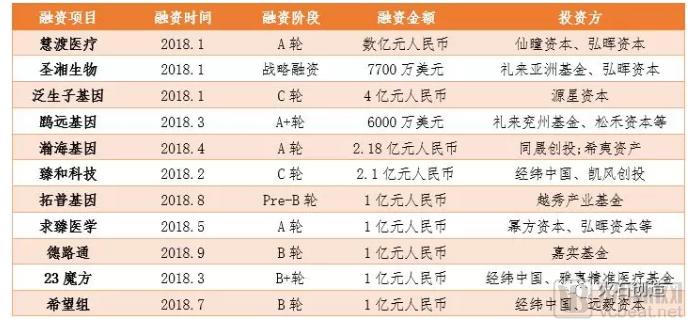
Data Source: Huoshi Innovation Investment and Financing Database
Financing in the genetic testing industry has entered a growth phase. In 2018, financing cases in the growth and mature stages accounted for 44% of the total. Although early-stage financing (Series A and earlier) still represented 56% of cases, the distribution of financing stages within the industry is gradually shifting toward later stages compared to previous years.
Figure 1. Number and Proportion of Companies by Financing Stage (January–October)
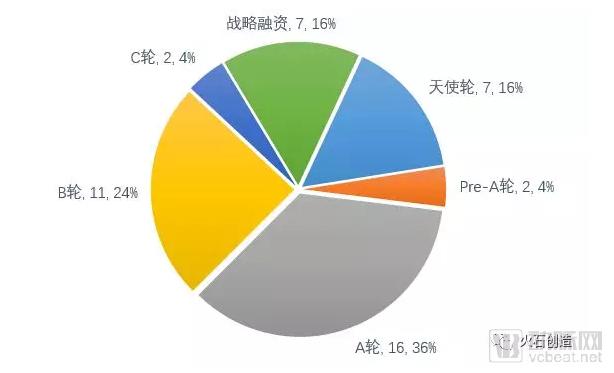
Data Source: FireStone Creation Investment and Financing Database
A summary of industry financing reveals that genetic testing remains one of the key investment hotspots in the healthcare sector, with a progressively pronounced concentration of capital among top-tier players. Investment institutions are increasingly favoring companies with clearly defined application scenarios, evident trends in technological innovation, and rapid R&D progress.
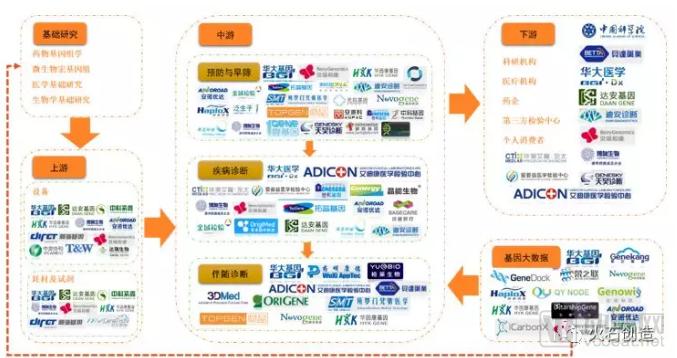
From the perspective of the industry chain, the upstream, midstream, and downstream segments of the genetic testing industry are as follows:
Upstream: Production of equipment and reagent consumables, and R&D of information software and platforms;
Midstream: Genetic testing services for end users, which provide genetic testing services to downstream clients by purchasing equipment and supporting reagents produced by upstream companies;
Downstream: Institutions and individuals requiring genetic testing services, including medical institutions, research organizations, pharmaceutical companies, and individual users.
Figure 2. Industry Landscape of Genetic Testing
The midstream segment is currently the most concentrated area for corporate financing. From January to October 2018, there were 37 financing deals in the midstream sector, with a total funding amount of approximately RMB 2.532 billion, representing 3 times the number of financing cases and 2.2 times the funding volume of the upstream sector.
Financing activity in the upstream sector has increased significantly. From January to October 2018, there were 12 financing deals in the upstream sector, with a total funding amount of RMB 1.132 billion, representing year-on-year increases of 20% and 223%, respectively.
Figure 3 Number of Upstream Industry Chain Companies Receiving Financing and Total Financing Amount (January–October)
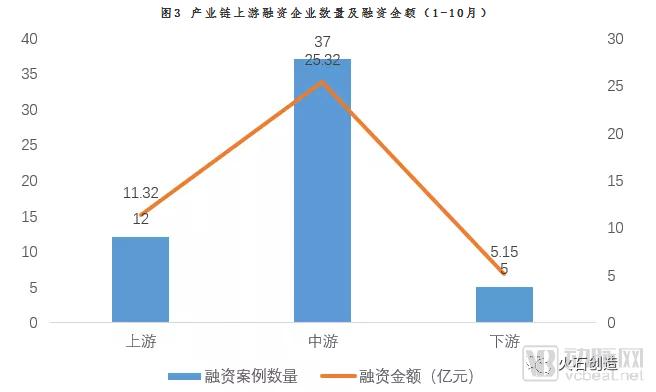
Data Source: Huoshi Creation Investment and Financing Database
Equipment and supporting reagents in the upstream sector form the foundation of the genetic testing industry. Companies in this sector generate revenue through the sale of equipment such as sequencers and digital PCR instruments, while deriving profits from the sales of complementary reagents associated with these devices.
From January to October 2018, the companies in the upstream sector that secured financing mainly included Hanhai Gene, Genetron Health, Sansure Biotech, Sinocelltech, Desheng Bio, Hanchen Guangyi, Jifan Biology, Ruixun Biology, Wanzhong Yixin, Meili Nano, Ustar Biotechnologies, and Baiconcore.
Hanhai Genomics announced in April this year that it had completed an RMB 218 million Series A financing round, led by Tongsheng Capital, with participation from five other institutions including Xiyi Asset. Previously, Hanhai Genomics had completed its Pre-A financing round in November 2016. Dedicated to the research and development of genetic testing equipment and reagents, the company has significantly reduced sequencing costs by breaking through core technologies in upstream instruments and reagents. In 2017, Hanhai Genomics successfully developed the prototype of Asia’s first third-generation single-molecule gene sequencer, achieving world-leading standards. The proceeds from this financing round will be primarily used to construct Asia’s first production line for third-generation gene sequencers and associated reagent kits in Luohu, Shenzhen.
Beijing Genetron Health Gene Technology Co., Ltd. completed a Series C financing round of over RMB 400 million in April this year, led by CICC Kangrui, with follow-on investments from institutions such as Vertex Ventures China and Shenzhen Commercial Xingye Fund. Previously, the company secured hundreds of millions in Series A and B funding in 2013, 2015, and 2016, respectively. Currently, Genetron Health has established a comprehensive product portfolio spanning from research to clinical applications, and from testing services to IVD kits, covering the entire cancer care continuum and multiple cancer types. The company operates dual R&D centers in China and the United States, four clinical medical laboratories, and internationally advanced, comprehensive, and diversified testing platforms, along with a leading bioinformatics analysis platform. The proceeds from this financing round will be allocated to technological R&D, product line expansion, market education, and big data accumulation, with a particular focus on promoting the application of liquid biopsy technology in tumor diagnosis and early screening.
The midstream genetic testing service sector is the segment of the genetic testing industry chain with the highest concentration of startups and the most intense overall competition. Leading companies such as BGI Genomics and Berry Genomics hold a competitive advantage in genetic testing samples.
From January to October 2018, the companies in the midstream sector that secured financing mainly included Saifu Gene, Qitian Gene, Maijing Gene, Compsen, Siqin Medical, Jifan Biology, Kunyuan Gene, Zhenhe Technology, TopGene, QuestMed, Delutong, 23Mofang, HopeGen, Rendong Medicine, Gewei Gene, Shengmei Biotech, Qiji Biotech, Amygen, ZhiNuovisi, Yuce Bio, Yunying Medical, Ruian Biotech, ChenAn Biotech, Changqing Biotech, Novogene Health, Jiabao Renhe, and Baokangxin.
23Mofang announced in March this year that it had completed a RMB 100 million financing round, led by Matrix Partners China, with participation from Yahui Medical, Hanwang Technology, and Deshang Qidian. Since its inception, 23Mofang has completed five rounds of financing, totaling nearly RMB 200 million. It is reported that the company has accumulated 150,000 testing users and is growing at a rate of over 100% per quarter. This growth in user base provides 23Mofang with the foundation to conduct more in-depth genetic and anthropological research, and to develop new research projects better suited for the Chinese population. The funds from this round will be primarily used to increase testing capacity and reduce costs, as well as to support project research and marketing efforts.
In March this year, KuanYuan Genomics announced the completion of a $60 million Series A+ financing round, led by Sinovation Capital and Jingxu Venture Capital, with continued participation from existing and new investors including Pioneer Medical Investment, Jointown Pharmaceutical Group, and Lilly Asia Ventures. Previously, the company had completed financing rounds of RMB 50 million in 2015 and $20 million in 2016. As a next-generation gene sequencing technology service provider, KuanYuan Genomics is dedicated to developing detection and diagnostic products for common diseases, including cancer diagnosis and personalized therapy, non-invasive prenatal testing (NIPT), preimplantation genetic screening (PGS), and diagnostics for other genetic disorders. Following this round of financing, the company will strengthen the research, development, validation, and commercialization of its early cancer screening and diagnostic products.