

YiFuzhen Files for IPO: Powering China's Prescription Sharing Platform Revolution Amid Healthcare Reform
Prescription outflow has been one of the hottest topics in the pharmaceutical sector in recent years. Particularly against the backdrop of policies such as the separation of prescribing and dispensing, and volume-based procurement, prescription outflow has not only restructured the original hospital drug distribution channels but also unlocked hundreds of billions in incremental growth potential in the out-of-hospital pharmaceutical market, offering immense prospects for future development.
As relevant policies were rolled out, various stakeholders actively explored solutions for the outflow of prescriptions. Consequently, the third-party prescription-sharing platform model blossomed across China, driven by policy support and followed by industry adoption.
How Does the Prescription-Sharing Platform Model Work? How Does It Address the Pain Points of Various Stakeholders in the Industry Chain, Including Regulators, Hospitals, Pharmacies, Pharmaceutical Companies, and Patients? Will It Give Rise to New Business Models and Spawn New Industry “Unicorns”? VCBeat (WeChat: vcbeat) aims to provide a detailed explanation of the prescription-sharing platform model through real-world industry case studies.
The underlying cause of prescription outflow is the dismantling of the “drug-revenue-dependent healthcare” mechanism, enabling hospitals to return to their core medical functions and weakening their “exclusivity” over prescriptions. Policies such as health insurance cost containment, zero-markup drug pricing, and controls on the proportion of drug expenditures serve as the primary drivers motivating hospitals to release certain prescriptions. Prescription outflow thus represents both a “political mandate” and an outcome of “market-based adjustment.”
Prescription Outflow: What is being transferred is the prescription itself. Previously, patients completed consultations, received prescriptions, and obtained medications all within the hospital. Now, with restrictions on the free flow of prescriptions lifted, medications are provided by community pharmacies, thereby separating medical consultation from drug dispensing.
In terms of policy, the origins can be traced back to the “Guiding Opinions on the Reform of the Urban Medical and Health System” issued by the State Council’s Office for Healthcare Reform in 2000. This document first stipulated that pharmaceuticals and medical services should be “accounted for separately, managed independently, with revenues uniformly remitted and reasonably returned,” thereby formally proposing the implementation of “separation of pharmaceuticals from medical services.” In 2009, the “New Healthcare Reform” policy further advocated advancing the separation of pharmaceuticals from medical services and actively exploring various effective approaches to gradually reform the mechanism of subsidizing healthcare with drug profits.
In 2017, the General Office of the State Council issued Document No. 13, which further pointed out that the separation of prescribing and dispensing should be promoted; medical institutions shall prescribe medications by their generic names and proactively provide prescriptions to patients. Outpatients may choose to purchase medications either at medical institutions or at retail pharmacies, and medical institutions shall not restrict outpatients from purchasing medications at retail pharmacies with their prescriptions. In May of the same year, it was further explicitly proposed to explore the interconnectivity and real-time sharing of prescription information from medical institutions, medical insurance settlement information, and drug retail consumption information.
In the past, patients received paper prescriptions from hospitals, which were inconvenient to carry, identify, and store, and were highly susceptible to forgery. These issues hindered regulatory oversight, making out-of-hospital prescription dispensing a low-frequency event that lacked orderly guidance, thereby impeding the effective flow of prescriptions outside hospital settings. With advancements in internet technology, the emergence of electronic prescriptions and online medical consultations has created the necessary conditions for the orderly dispensing of prescriptions outside hospitals.
The outflow of prescriptions relies on the support of electronic prescriptions. In April this year, the General Office of the State Council issued the "Opinions on Promoting the Development of 'Internet + Medical Health'," which mentioned allowing the development of internet hospitals based on medical institutions. Medical institutions can use internet hospitals as their secondary name and, on the basis of physical hospitals, utilize internet technology to provide safe and appropriate medical services, allowing online follow-up consultations for some common diseases and chronic conditions. After physicians have access to patients' medical records, they are permitted to issue online prescriptions for certain common diseases and chronic conditions. The regulations regarding internet diagnosis and treatment management released in September this year continued these provisions.
In fact, electronic prescriptions and prescription-sharing platforms represent proactive explorations of solutions amid the major trend of prescription outflow from hospitals. In addition to strong promotion by national-level policies, pilot programs have been successively launched in various regions. For instance, relevant documents issued by the Xi’an Food and Drug Administration stipulate that electronic prescription services should be implemented across drug retail chain enterprises and eligible standalone retail pharmacies in the city. Qualified drug retailers may, based on their actual circumstances, partner with third-party medical service institutions possessing the necessary network technologies and hardware infrastructure to jointly establish remote physician consultation and electronic prescription application platforms.
From a regulatory perspective, remote physicians must hold valid practicing physician qualifications and be registered with legitimate medical institutions. Electronic prescriptions must comply with the relevant regulations issued by health and family planning authorities and bear the physician’s electronic signature. Electronic prescriptions issued by remote physicians are equivalent to conventional paper prescriptions; they must be retained at enterprise retail outlets for inspection purposes, with retention periods identical to those for conventional prescriptions. This framework effectively serves as the official “template” for third-party prescription-sharing platforms. Following Xi’an’s lead, food and drug administration authorities in Chengdu, Chongqing, Tangshan, and other cities have also issued documents endorsing this model.
From official “templates” to concrete practice, there is no shortage of pioneers, such as the Yifuzhen third-party prescription sharing platform, the community comprehensive reform project involving Shanghai Pharma Cloud Health, Alibaba Health’s online hospital model, Tencent’s pilot program at Liuzhou Workers’ Hospital in Guangxi, JD.com’s internet hospital plus e-commerce model, and WeDoctor’s “pharmacy-clinic-store” prescription outflow initiatives. These projects are primarily differentiated by the sources of prescriptions and the providers of medications, each falling into two categories: physical hospitals/internet hospitals, and pharmacies/pharmaceutical e-commerce platforms.
Shanghai Pharma Cloud Health leverages Shanghai Pharmaceuticals’ pharmaceutical distribution network to connect with medical institutions at all levels, obtain prescriptions, and provide medication delivery services for patients. Tencent, Liuzhou Workers’ Hospital, and Guangxi Liuzhou Pharmaceutical Co., Ltd. have established a partnership, enabling patients to freely choose between picking up their medications within the hospital or at designated pharmacies outside the hospital after their consultation.
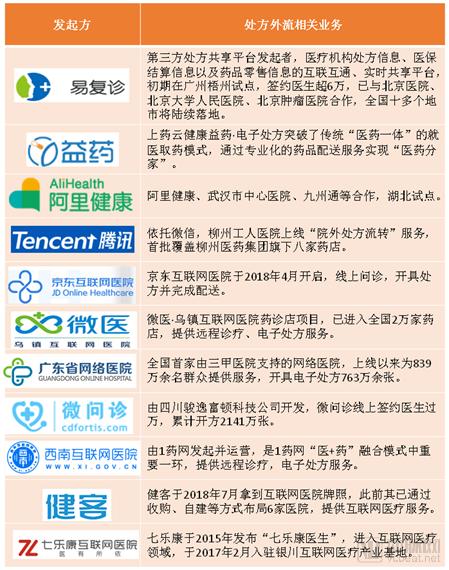
An Overview of Various Models for Prescription Sharing and Outflow, Chart by VCBeat
In the third-party prescription sharing platform model, Yifuzhen is a proponent and practitioner of this model. As early as November 2017, Yifuzhen pioneered the successful creation of the “Wuzhou Model,” establishing an efficient connectivity system among hospitals, medical insurance, and pharmacies, and enabling reimbursement for chronic disease pooled accounts at retail pharmacies.
The China Pharmaceutical Commerce Association has submitted a key report to the Ministry of Commerce and relevant national healthcare security authorities on the demonstrative achievements of the “Wuzhou Model,” proposing it as a template for nationwide promotion. Yifuzhen has successively partnered with national benchmark hospitals, including Beijing Hospital, Peking University People’s Hospital, and Beijing Cancer Hospital, while also advancing the implementation of more than ten prefecture-level projects in cities such as Shenyang and Dalian.
Unlike remote prescribing, prescription sharing platforms integrate hospital and medication prescription information. The Yifuzhen third-party prescription sharing platform directly connects to the Hospital Information System (HIS). After an in-person consultation, physicians can issue extended prescriptions based on patient needs. Upon review and approval by hospital pharmacists, the prescription data is uploaded to the “Prescription Information Sharing Platform.” The platform immediately pushes the prescription details to the patient via SMS. Within 24 hours, the patient can use this SMS to independently choose any pharmacy within the prescription sharing network to complete the offline purchase of medications.
From the perspective of industry insiders, the various stakeholders on Yi Fuzhen’s third-party prescription sharing platform have clearly defined rights and responsibilities, achieving a “win-win” outcome: hospitals provide authentic and compliant prescriptions, which are shared through the platform to ensure that they flow to regulated pharmacies under government oversight, while also striving to lower drug prices and enable end-to-end supervision. After standardized separation of prescribing and dispensing is achieved through the third-party platform, it will not only effectively reduce hospitals’ pharmaceutical service costs but also provide technical and data support for China’s healthcare reform.
The current bottlenecks in prescription outflow lie in prescription sources, drug supply assurance, pharmaceutical care service capabilities, and medical insurance support. Specifically, under the policies of zero markup on drugs and strict control over the drug-to-revenue ratio, outpatient pharmacies have become cost centers for hospitals, giving hospitals the incentive to extend part of their drug supply externally. For hospitals, external prescription fulfillment allows physicians to offer a broader range of medication options for treatment plans without being constrained by the drug-to-revenue ratio and global budget controls. Following the separation of prescribing from dispensing, physicians can focus on diagnosis and treatment, while pharmacists can enhance professional pharmaceutical care services, thereby extending patient services and strengthening the hospital’s capacity for continuous patient care.
For retail pharmacies and online pharmaceutical platforms, accepting outpatient prescriptions not only ensures the legal and compliant sale of prescription drugs, facilitates the development of professional pharmacies, and enhances pharmacists' service levels, but also drives increased patient foot traffic, boosts sales revenue, and secures a competitive market position.
With medical insurance serving as the primary payer, ensuring the authenticity, compliance, and accuracy of externally dispensed prescriptions determines whether this model will receive support from medical insurance funds. In the case of internet hospital prescriptions, issues such as territorial management of physicians and prescriptions may arise, hindering coordinated planning. In contrast, the prescription-sharing platform model primarily serves local areas, facilitating regulatory oversight; furthermore, the medical insurance accreditation of participating entities, such as pharmacies, serves as a significant guarantee of credibility.
Prescription-sharing platforms are also “empowering” regulatory oversight. Some companies have integrated blockchain technology into these platforms to ensure that externally dispensed prescriptions are traceable and tamper-proof. Amid the prevailing trend of prescription outflow from hospitals, the development of third-party prescription-sharing platforms will help reshape the existing hospital pharmaceutical market landscape and unlock hundreds of billions in incremental growth in the out-of-hospital drug market.
Specifically, chain pharmacies hold significant potential as the primary recipients. This is because retail pharmacies possess a solid business foundation, enabling them to systematically meet patients’ demands for medications and pharmaceutical care services. Secondly, the high coverage rate of retail pharmacies across China positions them naturally as the preferred choice for residents purchasing medicines. Thirdly, bolstered by digital tools and prescription circulation platforms, the competitiveness of retail pharmacies is strengthening, allowing them to provide residents with more diversified and precise medical, pharmaceutical, and health management services.
Currently, although news about pilot programs for electronic prescriptions continues to emerge from various regions, only a small fraction have ventured into this new territory. Of the 450,000 pharmacies nationwide, fewer than 50,000 may be participating in the circulation of electronic prescriptions. Retail pharmacies should adopt a more proactive approach in accepting electronic prescriptions and embrace the conveniences brought by information technology.
From an investment perspective, as one of the ancillary tools facilitating the outflow of prescriptions, third-party prescription-sharing platforms will continue to exist alongside the ongoing separation of prescribing and dispensing. Their business models can be explored from angles such as pharmacy information services, operational empowerment for pharmacies, and patient follow-up management.
In summary, the outflow of prescriptions will continue to be promoted. Third-party prescription-sharing platforms are the policy-endorsed solution. New specialty drugs and long-term medications for chronic diseases will be the first to flow out of medical institutions, with retail pharmacies located near hospitals and Direct-to-Patient (DTP) pharmacies being the primary beneficiaries. In the process of accommodating prescription outflow, relevant stakeholders should optimize their operational structures and cultivate service capabilities to adapt to medical insurance cost containment measures and patient demands. Prescription outflow will cultivate a new blue ocean in the pharmaceutical market.
Despite the overarching trend of prescription outflow, market standardization is paramount to truly reaping its benefits. According to Ma Guanglei, Deputy Secretary-General of the China Pharmaceutical Commerce Association, achieving such standardization requires establishing a regulatory-compliant information-sharing platform, thereby steering the prescription outflow market from disorder toward a policy-driven, lawful, and compliant trajectory.