

YaoshiBang Secures $133 Million in Series D Funding Led by Tiger Global, H Capital, and DCM
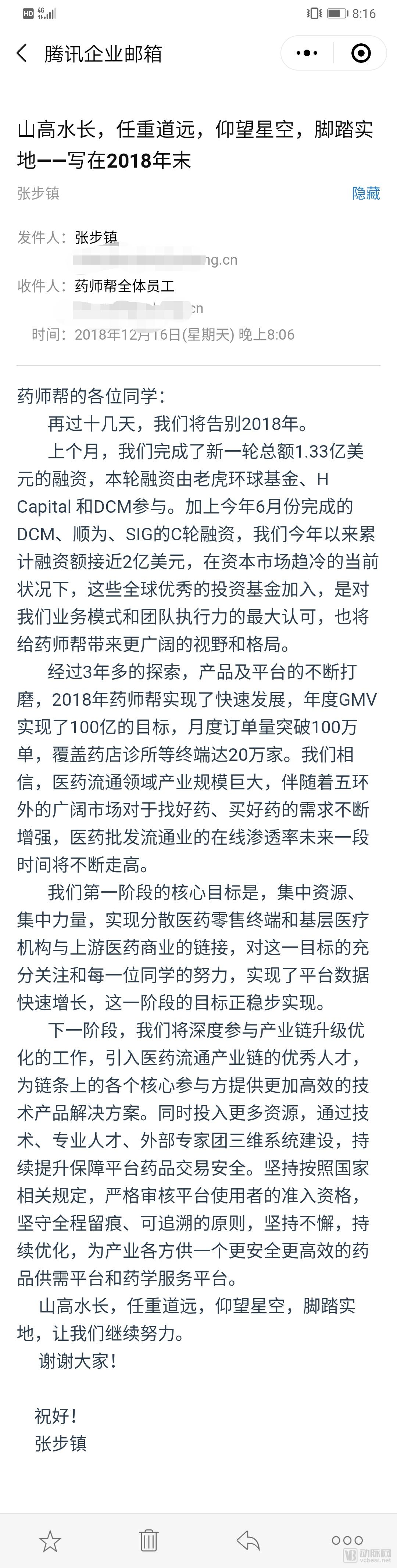
VCBeat (WeChat: vcbeat) has learned that on December 16, 2018, Yaoshibang announced the completion of its latest round of financing in November. This round was participated in by Tiger Global Management, H Capital, and DCM, with a total amount of $133 million. Chongying Capital served as the financial advisor for this investment round.
Previously, in June 2018, Yaoshibang completed a C-round financing totaling RMB 420 million, with participation from DCM, Shunwei Capital, and SIG. This year, Yaoshibang has raised nearly USD 200 million in cumulative financing. Its Series A and Series B rounds were led by Fosun Pharma and Sinopharm Capital (Songhe Capital), respectively.
Zhang Buzhen, Founder and CEO of Yaoshibang, stated, “After more than three years of exploration and continuous refinement of our products and platform, Yaoshibang achieved rapid growth in 2018. We reached an annual GMV target of RMB 10 billion, with monthly orders surpassing one million, covering 200,000 terminal outlets such as pharmacies and clinics. We believe that the pharmaceutical distribution sector boasts a massive market size. As demand for accessing and purchasing quality medicines continues to grow in the vast markets beyond first-tier cities, the online penetration rate of the pharmaceutical wholesale and distribution industry is poised to rise steadily in the coming period.”
In the first phase, Yaoshibang focused its efforts on connecting fragmented pharmaceutical retail terminals and primary healthcare institutions with upstream pharmaceutical distributors. With rapid growth across various platform metrics, the fundamental objectives of this phase are being steadily achieved. In the next phase, we will engage more deeply in upgrading and optimizing the industry chain, continue to attract top-tier professional talent, and provide more efficient technical product solutions for all core stakeholders along the supply chain. Meanwhile, we will allocate additional resources to continuously enhance the security of pharmaceutical transactions on the platform by building a three-dimensional system encompassing technology, professional talent, and external expert panels. Adhering strictly to national regulations, we will rigorously vet user access qualifications, uphold the principles of full-process traceability and audit trails, and persistently optimize our services. Our goal is to provide all industry participants with a safer and more efficient platform for pharmaceutical supply and demand, as well as pharmaceutical care services.
Attached is a screenshot of the email sent by Zhang Buzhen, founder of Yaoshibang, to all employees.
Since 2014, pharmaceutical B2B enterprises have attracted significant capital attention. A cohort of top-tier healthcare investors, including Sequoia Capital and Fosun, began placing bets on B2B pharmaceutical e-commerce, thereby igniting growth in the sector. Building upon drug transaction services, B2B pharmaceutical e-commerce platforms have expanded along the upstream and downstream segments of the industry chain, integrating resources across drug supply, distribution, and procurement. An evaluation of the competitiveness of major B2B pharmaceutical e-commerce players reveals that most companies primarily focus on providing drug transaction information services to facilitate deals and bridge information asymmetry, while also offering value-added services such as SaaS solutions and logistics distribution.
According to statistics from VCBeat, since 2016, B2B pharmaceutical platforms such as Yaoshibang, Drug Terminal Network, Weiming Penguin, Yao Pianyi, Yaodou.com, and Yaoyaohao have secured multiple rounds of financing, with the cumulative amount exceeding RMB 1 billion. Investors include prominent institutions such as Matrix Partners China, Chengwei Capital, GGV Capital, Ivy Capital, Fosun Pharma, and SoftBank China.
According to data from the National Medical Products Administration (NMPA), as of August 20, 2017, there were 48 enterprises holding Class A licenses. Earlier this year, before the cancellation of Class B licenses, more than 400 companies held such licenses; following their abolition, the number of companies entering this sector may have increased. Combined, the total number of players in the B2B pharmaceutical e-commerce sector may exceed 500.
Since 2015, the Market Statistics Department of the Ministry of Commerce has included a dedicated section on “pharmaceutical e-commerce” in its annual report on the pharmaceutical distribution industry, compiling statistics on the number of pharmaceutical e-commerce enterprises, their market size, and their share of the overall pharmaceutical distribution industry.
According to its data, based on incomplete statistics, the total sales volume of pharmaceutical e-commerce enterprises with direct reporting reached RMB 61.2 billion in 2016. Among this, B2B business sales amounted to RMB 57.6 billion, accounting for 94.2% of the total pharmaceutical e-commerce sales; B2C business sales were RMB 3.6 billion, representing only 5.8% of the total. The number of active users on B2B platforms reached 270,000, with an average transaction value of RMB 3,652 and an average of 791 transactions per customer. The daily outbound order fulfillment rate for B2B was 98.4%, and the average expense ratio was 16.5%, significantly exceeding the industry average.
As industry consolidation continues to intensify, technologies mature, and market penetration deepens, the growth prospects for B2B pharmaceutical e-commerce remain promising.