

Mission Bio Secures $30 Million Series B Funding to Advance Tapestri, the Industry's First Targeted Single-Cell DNA Sequencing Platform
Recently, VCBeat (WeChat Official Account: vcbeat) learned from foreign media reports that Mission Bio, a life sciences company providing molecular biology equipment, announced the completion of its $30 million Series B financing round. The investors in this round included Agilent Technologies, Cota Capital, LAM Capital, and Mayfield.
Mission Bio, founded in 2013 as a spin-off from Adam Abate’s High-Throughput Biology Laboratory at the University of California, San Francisco, provides targeted single-cell genomics solutions through its Tapestri precision genomics platform. As the industry’s first targeted single-cell DNA sequencing platform, Tapestri enables precise detection of heterogeneity in disease progression and treatment response, with applications spanning hematologic malignancies, solid tumors, and genome editing validation. The platform comprises instruments, consumables, and analysis software, and can be seamlessly integrated into existing high-throughput sequencing workflows.

Single-cell genomics is key to precision medicine, while precise cancer treatment often involves high-throughput sequencing technology, which provides an average molecular profile of all cells in patient samples but typically obscures genetic diversity and overlooks rare cells that can drive disease progression. Tapestri technology addresses these shortcomings, offering a more accurate lens into the complexity of disease.
The Tapestri platform reveals the molecular profile of each cell, enabling researchers and clinicians to accurately measure underlying genetic diversity for more precise treatment and to detect rare residual cells that may persist after therapy. Its breakthrough technology allows parallel analysis of tens of thousands of individual cells, with a sensitivity 50 times greater than that of conventional high-throughput sequencing technologies. Its single-base-pair resolution is several orders of magnitude higher than the megabase-scale resolution offered by other single-cell DNA methods.
A recent article published by MD Anderson Cancer Center in the journal *Genome Research* confirmed the efficacy of the Tapestri platform on clinical samples. As a follow-up to this study, Dr. Koichi Takahashi presented the findings at the 60th Annual Meeting of the American Society of Hematology (ASH), showcasing the largest single-cell study completed to date using Tapestri. In the first single-cell atlas of acute myeloid leukemia (AML), Dr. Koichi Takahashi’s team used the Tapestri platform to sequence more than 500,000 cells from 70 patients.
Mission Bio’s customers have sequenced more than 1 million blood cancer cells to date, a figure expected to grow tenfold over the next six months. Mission Bio stated that this round of financing will be used to expand the scope of Tapestri-based blood cancer research, extend its applications to CRISPR, and promote its global market presence.
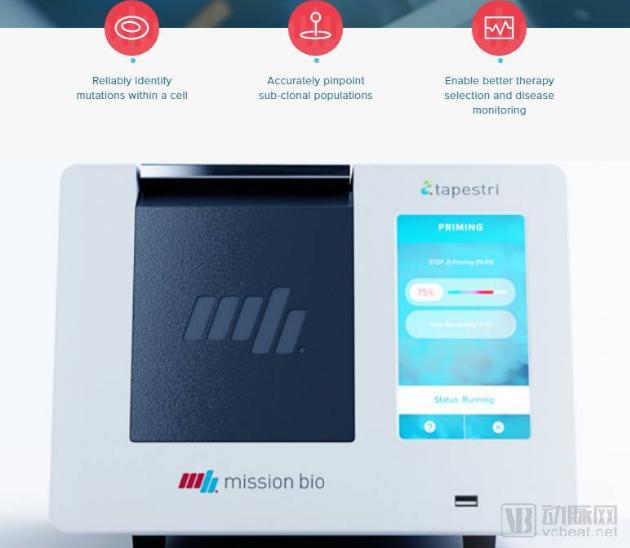
Tapestri device, image sourced from the official Mission Bio website
“Minimal residual disease is the primary cause of cancer recurrence; even overlooking a single cell can be life-threatening. With the Tapestri platform, we can track every cell and every mutation, thereby better guiding cancer treatment and saving patients’ lives,” explained Charlie Silver, CEO of Mission Bio.
“The unique quality control capabilities of the Tapestri platform are strengthening our CRISPR R&D programs,” said Darlene Solomon, Senior Vice President and Chief Technology Officer at Agilent Technologies. “Agilent’s commitment to innovation and precision medicine aligns perfectly with Mission Bio’s Tapestri platform, given its potential to improve treatment outcomes for cancer patients.”
Mission Bio launched the Tapestri platform in October 2017. Today, more than a dozen leading cancer centers in the United States use Tapestri to guide their research, aiming to better understand how clonal heterogeneity influences treatment selection and patient prognosis.
By leveraging its ability to identify mutation co-occurrence across distinct cell populations, the Tapestri platform enables detection of gene editing with single-cell resolution. This capability provides researchers and drug developers with the most accurate quality control method for assessing both on-target and off-target effects of gene editing. As gene and cell therapies become increasingly prevalent, this technology precisely elucidates the true efficiency and accuracy of intended editing systems, thereby informing therapeutic development and enhancing treatment safety and efficacy.
About Agilent Technologies
Agilent Technologies, Inc. is a diversified high-tech multinational corporation that was spun off from Hewlett-Packard’s research and development limited partnership in 1999. The company is primarily engaged in the research and development, manufacturing, sales, and technical services of products in the fields of communications and life sciences.
About Cota Capital
Cota Capital, founded in 2014, is an investment firm headquartered in California. Cota Capital is adopting a new approach to technology investing, continuously identifying attractive technology investment opportunities ranging from seed-stage companies in private markets to publicly traded securities.
About Lam Capital
Lam Capital is a venture capital firm that primarily invests in innovative companies dedicated to addressing the most challenging and impactful issues facing the world today. From the commercialization of life sciences to industrial automation, Lam Capital supports transformative technologies that are disrupting their respective industries.
About Mayfield (Mayfield Fund)
Mayfield, founded in 1969, is one of the world’s premier venture capital firms. The firm primarily provides entrepreneurs with expertise, resources, management teams, and business guidance to help them transform innovative ideas and technologies into successful commercial ventures. Mayfield has invested in more than 300 information technology and healthcare companies, whose combined market value exceeds $100 billion.