

Prospectus of National Health Medical Big Data North Center: Industrial Development and Innovation Driven by the FV=I^D Model
The National Health and Medical Big Data Northern Center Industrial Incubation Base is located in the Xicheng Xijin Times Center, Huaiyin District, Jinan City, Shandong Province. Counting from April 27, 2018, when the Northern Center launched its pilot program, the entire project has taken just over a year.
In late July 2019, a reporter from VCBeat (WeChat ID: vcbeat) visited the site and held an in-depth discussion with Mr. Gao Chuangui, Vice President of Inspur Group Co., Ltd. and Chairman of Shandong Health and Medical Big Data Co., Ltd. Through our conversation, we gained a comprehensive overview of the pilot big data infrastructure development and industrial growth at the Northern Center.

Innovative Value Signaled by a Formula
Data is the source driving innovation. In an EY report on the future of data and life sciences innovation, Inspur identified a formula resembling the mass–energy equivalence equation (E=mc²), namely FV=ID. Within Inspur, they refer to it as the Law of Energy Fission.
Here, FV stands for Future Value, I for Innovation, and D for Data. The value of future wealth must be created through innovation activities indexed by data. Inspur has drawn on this formula while endowing it with new meaning.
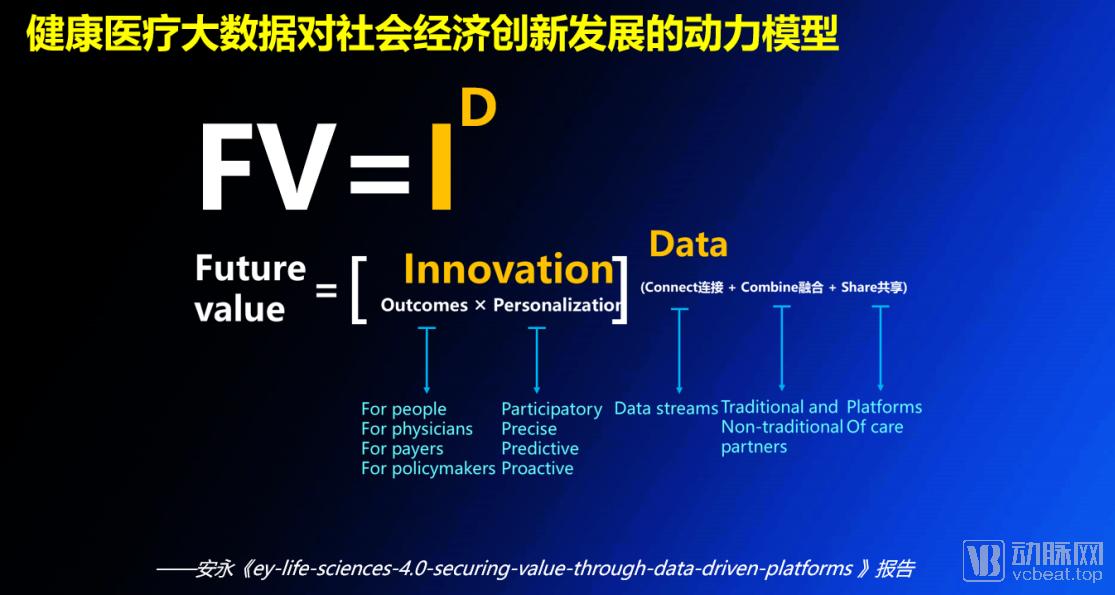
Value Innovation Formula: Future Value = Innovation ^ Data
According to Gao Chuangui, “Data” refers not merely to raw data, but to the linking, integration, and sharing of both traditional and non-traditional data sources. In other words, when hospital internal data, genomic data, and various health and behavioral data collected outside healthcare institutions are interconnected, they generate diverse synergistic effects and exponential impacts. Leveraging government cloud infrastructure and service interfaces, while ensuring data security and personal privacy, enables effective open sharing and fosters a range of value-added services. This approach has given rise to Inspur’s business model for health and medical big data.
Gao Chuangui introduced that “Data” does not refer to the data itself, but rather to data activities. Linking enables data to move, integration brings data to life, and sharing allows data to flow. Underpinning all of this is the healthcare big data platform. Based on this, Inspur positions itself as a data platform service operator.
Who uses the data matters significantly. Inspur is dedicated to developing a “Usage Index,” where “I” represents various data users and practitioners, including clinical medical professionals, pharmaceutical R&D researchers, and health managers, as well as organizations across society that leverage big data to enhance services and drive business value—such as governments, hospitals, pharmaceutical companies, and insurance firms. All these stakeholders aim to utilize data for innovative activities such as clinical research, drug development, and insurance product design.
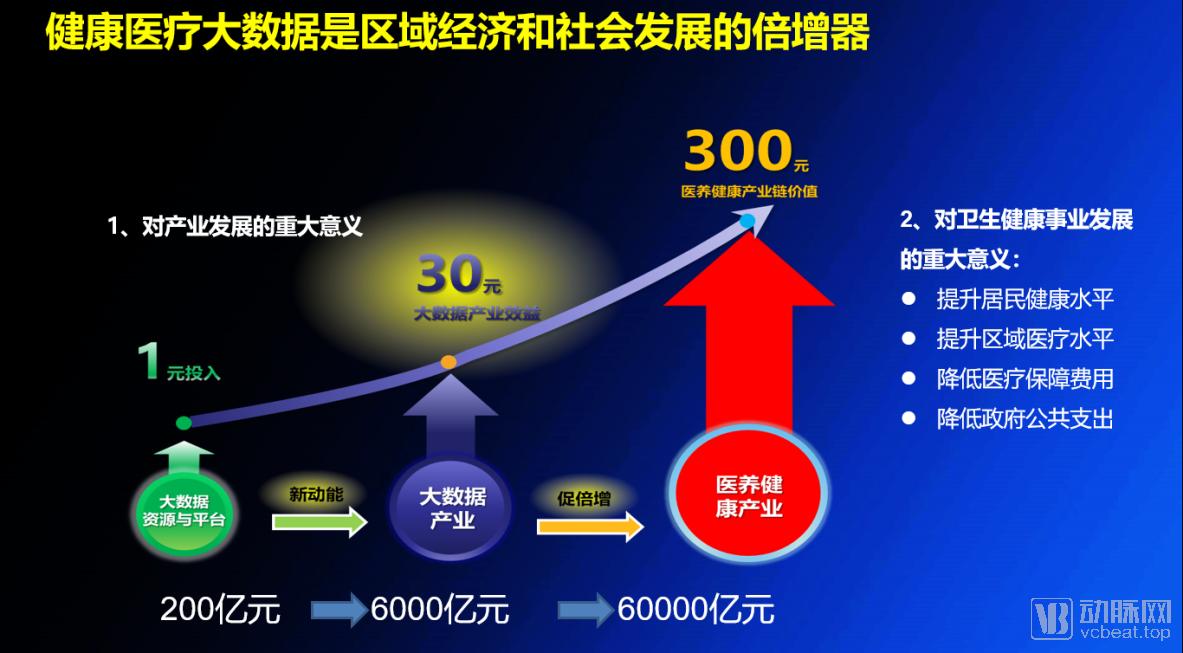
Therefore, Inspur defines this formula as the dynamic model driving socioeconomic innovation and development through healthcare big data. Under this framework, a 1:30:300 data value-added practice has been established. In other words, an investment of RMB 1 billion in the core engine—big data resources and platform construction—has the potential to stimulate a big data industry worth RMB 30 billion. Given that the medical and health sector encompasses 182 related sub-industries, this RMB 30 billion will further drive growth in the medical and health industry, reaching RMB 300 billion.
Pilot Program for Health and Medical Big Data Construction: Catching Up from Behind
On October 21, 2016, a national video-teleconference held by the National Health Commission in Beijing designated Fujian Province, Jiangsu Province, and the cities of Fuzhou, Xiamen, Nanjing, and Changzhou as the first batch of pilot provinces and municipalities. One year later, on December 12, 2017, the second batch of national pilot cities for health and medical big data centers was announced. As planned, Shandong, Anhui, and Guizhou Provinces were selected as the new batch of pilot provinces.
“If one word were to describe the development of the National Health and Medical Big Data Northern Center, it would surely be ‘catching up by starting late.’”
On April 27, 2018, the National Health Commission signed an agreement with Shandong Province and Jinan City, pioneering the establishment of regional centers and data authorization. As a member of the “national team,” Inspur Group officially participated in the pilot program in Jinan, Shandong. This move marked Shandong Province and Jinan City as the first in China to formally enter the substantive construction phase of regional pilots for health and medical big data.
On May 16, Inspur Group spearheaded the establishment of China’s first Strategic Alliance for the Health and Medical Big Data Industry Ecosystem. To date, more than 100 leading entities have joined the alliance, including specialized service providers and innovative companies in health and medical big data, artificial intelligence, and internet technologies, as well as financial investment institutions, research institutes, and organizations supporting health policies and industry development. Notable members include Baidu, Zhiye Health, Donghua Software, Winning Health, Mandala, Miao Health, Chunyu Doctors, Pai Lan Data, and Huibao Yilian.
Big Data in Healthcare is a complex, systemic engineering endeavor characterized by continuous innovation. During the pilot phase of the Northern Center, under the guidance of the National Health Commission, the Shandong Provincial Party Committee and Provincial Government, as well as the Jinan Municipal Party Committee and Municipal Government, attached great importance to this initiative, vigorously promoting it as a major project for converting old growth drivers into new ones. The Shandong Provincial Health Commission provided unified planning, while the Jinan Municipal Health Commission took the lead in piloting and pioneering efforts. Strong support was rendered by various government departments, including the provincial and municipal Big Data Bureaus. Inspur Group signed an agreement with the Jinan Municipal Health Commission to undertake the construction of the big data platform and the pilot application work.
The first phase involves the integration of data resources and the construction of a new-generation national health information platform based on big data, aiming to improve governance and benefit the public. Currently, Jinan City has completed the aggregation and governance of comprehensive data from various medical institutions, physical examination centers, and community health service providers within the city, as well as the integration of relevant government department data, establishing the nation’s first Health and Medical Big Data Center. By leveraging residents’ electronic health codes, the city has implemented a “one-code-for-all” health service system, enabling interoperability of data across diverse institutions. This supports district- and county-level national health platforms built upon the big data infrastructure, facilitating data connectivity, collaboration, and sharing between community public health systems and medical institutions. Targeted care services are provided for four key populations: individuals with hypertension, individuals with diabetes, pregnant and postpartum women, and infants and young children.
The second phase focuses on precision services. By building a “platform + ecosystem” system, we will accelerate the onboarding of various innovative big data, internet, and AI service providers onto the platform, and deliver services tailored to the professional healthcare sector, including clinical big data services, research big data services, personalized health management, and customized solutions for pharmaceutical and insurance companies.
Phase Three is Industrial Integration. By leveraging the open services of health and medical big data platforms, integrated online and offline services are achieved. Various stakeholders—including government, industry, academia, research institutions, finance, service providers, and end-users—collaborate to promote cross-industry integration, empower the health and medical big data and service industry chain, foster new business models, and build a comprehensive, integrated industrial ecosystem.
Currently, the entire project is accelerating its transition from consolidating the foundation of Phase I to advancing into Phases II and III, making it the fastest-developing pilot among all regional health and medical big data construction initiatives.
Three Achievements
Local governments and Inspur have collaborated closely to accelerate the exploration of new models through pilot programs, with a focus on big data-based national health information platforms and value-added services for health and medical big data. Inspur Health positions itself as a platform service operator. Under authorization from governments and institutions, Inspur’s digital economy initiative leverages its health and medical big data platform to collect, aggregate, and govern various types of health and medical data. Through an open big data service platform, it provides diverse services to external stakeholders—including governments, hospitals, enterprises, and individuals—by integrating “cloud, internet of things, big data, mobile, and artificial intelligence” technologies with ecosystem partners’ application services. Built upon comprehensive data interconnectivity, this approach empowers governments, healthcare providers, and individuals, facilitating the transition in health and medical service models from being disease-centered to people’s health-centered, thereby achieving shared benefits and win-win outcomes within the big data ecosystem.
This is also the essence of the Inspur 1113 Model, namely “One Network, One Platform, One Ecosystem, and Three Services.”
Leveraging the “Government Cloud,” Inspur implemented the “1113” model to build a heterogeneous, efficient, secure, and reliable unified network for health and medical big data collection in Jinan, achieving comprehensive data acquisition. It established a health and medical big data platform with functional architectures for data aggregation, governance, services, and security, providing trusted and secure support for data operations.
From the perspective of achievements, the health and medical big data platform has currently realized three core services: the iHealth APP, Internet Plus Health Services, and the Scientific Research Big Data Service Platform.
1. iHealth APP: A New Urban Internet-Based Healthcare Management Service Portal
Leveraging the comprehensive resource advantages of Inspur Group Co., Ltd. and built upon a big data platform, Inspur has independently developed a one-stop, full-lifecycle health service platform—the “iHealth” APP. Relying on the electronic health card uniformly promoted by the National Health Commission, it achieves “One Code for Resident Health,” enabling individuals to view their medical treatment, laboratory tests, examinations, imaging records, as well as medical check-up and health archive information from various healthcare institutions across the city via their mobile devices.
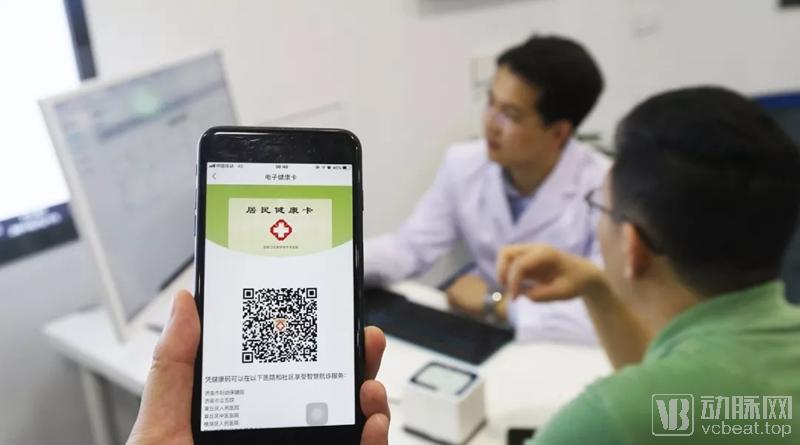
Every resident of Jinan can obtain a Resident Health Code (a dynamic QR code). At healthcare facilities, after users scan the code to grant authorization, physicians can access the user’s historical medical records from various hospitals across Jinan. The data dimensions include diagnoses, laboratory tests, and examinations (including imaging-related information).
Physicians can rapidly access a patient’s medical history, eliminating the need for patients to shuttle back and forth with imaging films and medical records. Unlike traditional approaches that extend electronic health card functionalities within legacy healthcare information systems, Inspur has leveraged big data and the Electronic Health Code to achieve interoperability and integrated application of residents’ clinical diagnosis and treatment data and health records. The Resident Electronic Health Code has thus become the “identity card” for personal health information.
Gao Chuangui refers to the Ai Jiankang app as a “four-unlike.” He believes that this “four-unlike” status represents an optimal state. Ai Jiankang aims to serve as a one-stop entry point and support platform for various health and medical services, as well as a big data–based service innovation hub and a comprehensive functional entity catering to institutions and enterprises. It fully embodies the integration of government, industry, academia, research, and application, thereby effectively enabling the internet-based transformation, transparent service delivery, process management, and service evaluation of diverse health and medical services.
Targeting four key populations—individuals with hypertension, diabetes, pregnant and postpartum women, and infants and young children—the iHealth App also connects with community health centers, clinics, specialized hospitals, and health management institutions, enabling full lifecycle management of institutional onboarding, service publication, and user selection and purchase of services.
The iHealth App has greatly facilitated physician consultations and individual medical care. By leveraging a clinical decision support system, it effectively enhances the efficiency and service capabilities of primary healthcare professionals, integrates diverse health and medical data, enables interoperability and information sharing among hospitals, and significantly reduces patients’ costs and time associated with redundant examinations.
2. Internet + Health and Medical Platform Services
Inspur’s health and medical big data support service platform supports the integration of over 300 wearable devices and vital sign monitoring equipment. It enables real-time sensing and management for key populations, including individuals with hypertension and diabetes, as well as pregnant women and infants. Family doctors can provide timely health interventions to these groups through a combination of online and offline services.
For example, with the family doctor service package, community physicians can collect patients’ vital sign data—including body temperature, blood pressure, blood glucose, blood oxygen saturation, 12-lead electrocardiogram (ECG), uric acid, and blood lipids—and upload them to the Family Doctor Follow-up System and the iHealth APP.
It not only enables backend diagnostics, but also uploads data to the public health platform and big data platform to serve as a data source. Furthermore, it facilitates the intelligent front-loading of expert clinical reasoning from various specialties, thereby decentralizing data resources to primary care settings.
As a health and medical service application, the iHealth APP distinguishes itself by building a city-level support platform for health and medical services. Backed by a big data platform, it connects communities with hospitals, providing unified onboarding services and empowerment to various health and medical institutions across the city. This enables residents to conveniently access diverse health and medical service resources. The app offers a city-level care platform for individuals with hyperglycemia, pregnant women, young children, and the elderly, featuring functions such as personal health data management, family doctor services, appointment registration, service ordering, health assessments, intelligent inquiries, health examinations, and health education for key populations, thereby becoming an urban health internet.
3. Clinical Research Big Data Platform — Inspur RWS (Real-World Study) Platform
Leveraging its big data platform, Inspur has accelerated the governance of disease-specific cohorts and the development of service platforms in accordance with international standards, providing research services to physicians and medical institutions. By implementing data governance based on international standards, large-scale disease-specific cohorts have been established. These standardized sample repositories of scientific research big data enable physicians to efficiently conduct clinical studies and produce high-quality publications, clearly demonstrating the significant role of big data platforms in supporting scientific innovation.
Furthermore, the platform can comprehensively support the scientific research collaboration required for clinical studies, facilitating the efficient conduct of cross-hospital and cross-organizational research activities, such as data processing, analytical reporting, epidemiological surveys, post-marketing drug studies, artificial intelligence, and evidence-based medicine.
The RWS platform enables self-service data query and processing, research project management, analytical note-taking, machine learning, disease risk prediction, clinical data analysis, and clinical research support. It facilitates clinical research projects and disciplinary development, provides resource services for scientific education, and empowers precision medicine.
Data as the Source, Platform as the Foundation
The Northern Health Medical Big Data Center, currently under construction, relies on Inspur for critical computing power, big data capabilities, and data-driven application services. In this regard, Gao Chuangui stated that Inspur pioneered the “Comprehensive, Connected, and Standardized” methodology for data governance applications.
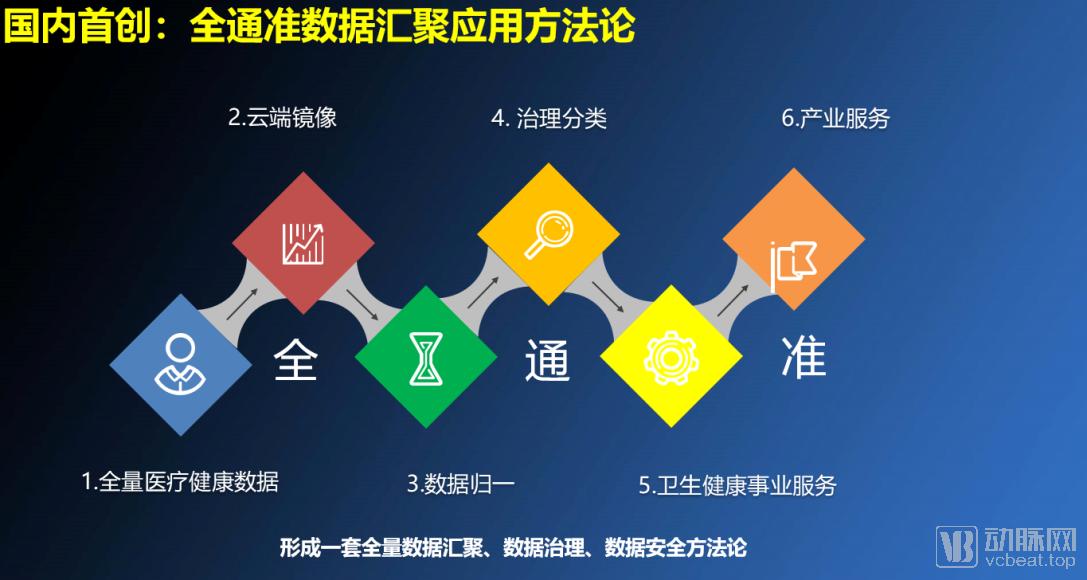
Comprehensive: Collect comprehensive health and medical data to ensure complete capture, enable cloud migration and aggregation of data from business systems across healthcare institutions and health administrative agencies at all levels and of all types, store all data in big data repositories and data lakes, and achieve resource integration of comprehensive health and medical data.
In terms of data acquisition, to handle the full-volume data collection from medical and related institutions at all levels in Jinan City, and to ensure high concurrency and real-time performance of data transmission without affecting the normal operation of hospital business systems, Inspur has adopted its nationally pioneering, independently developed full-volume data acquisition technology (CMSP, Inspur Cloud Message Service Platform, which holds 21 invention patents). This enables efficient data collection, reliable transmission, efficient storage and retrieval, and dynamic synchronization.
Interoperability: Perform conversion and governance based on the "Jinan Health and Medical Big Data Resource Catalog" and standard datasets to unify semantic systems, value domain code tables, and other elements across institutions.
Inspur, drawing on its practical experience, participated in the formulation of the national standard “Information Security Technology—Guidelines for Health and Medical Information Security,” and co-authored with the National Health Commission the “Specifications for Health Information Data Sharing and Exchange on the Jinan City Population Health Information Platform,” thereby establishing pilot standards for health and medical big data sets.

Accuracy: Refers to the formation of standard libraries, disease-specific databases, and thematic datasets following data governance within the health and medical big data platform. This provides big data services tailored for governments, hospitals, research institutions, communities, enterprises, and individuals, supporting real-time queries of massive datasets, natural language processing, machine learning, and various artificial intelligence algorithm requirements. In response to industry demands, the standard libraries and disease-specific databases also offer services such as AI innovation, clinical research, and data cohort support for pharmaceutical companies, insurance firms, and smart hardware manufacturers.
Throughout this process, Inspur also assisted the National Health Commission in analyzing the informatization levels and data quality of medical institutions, identifying their needs for informatization development and existing problems. Gao Chuangui stated that in the past, no big data company had ever helped hospitals with such tasks, but for Inspur, it is a responsibility and commitment.
To address the multitude of business systems in hospitals, Inspur is developing a lightweight hospital information integration platform based on a big data platform. This platform facilitates the continuous flow of incremental data and enables hospitals to provide extensive services such as data sharing and knowledge base search.
For example, a hospital may wish to conduct research using specialized disease data from departments such as cardiology and orthopedics. On the data platform, in addition to its own historical data, the hospital can also access anonymized data of the same type from other hospitals. Akin to the concept of the sharing economy, hospitals will no longer need to purchase Clinical Data Repositories (CDRs) or build integration platforms on their own. This approach enables them to achieve more with less expenditure.
Of course, the prerequisite for achieving this is to ensure the quality of hospital data. First, hospitals must provide data; second, there must be a continuous influx of incremental data; third, Inspur must continuously carry out data governance, starting by promoting healthcare institutions at all levels to establish solid foundations in basic areas such as drug coding, disease coding, surgical procedure coding, billing coding, and real-name patient registration.
As big health and medical data constitute a critical national strategic resource, data security is a non-negotiable red line. Inspur has established a secure data network channel by collecting data from healthcare institutions through the “Government Cloud” system and the dedicated Health and Family Planning Network. The entire process, from raw data to final results, is fully monitorable and auditable, ensuring that “data is usable but not visible, and remains within its designated boundaries.”
Almost everyone asks, “What if the data are inaccurate?” In response, Inspur has adopted the following approach: in addition to automated system-based quality control, it has introduced manual quality control during the data quality assurance phase, assuming the role of a supervisor for improving hospital data quality. Inspur regularly provides the platform with data quality assessment reports, highlighting issues related to drug coding, disease coding, procedure coding, billing codes, and real-name patient registration, among other areas. After more than six months of implementation, data quality at many hospitals in Jinan has shown significant improvement.
Ecosystem as the Foundation, Service as the Soul
Gao Chuangui believes that the healthcare big data platform developed by Inspur serves as a hub, providing various services based on big data support technologies, rather than merely aggregating data for sale. In his view, many current big data applications are castles in the air, far from being truly practical. Therefore, Inspur aims to first serve the public and ensure that the government can see tangible benefits and practical utility, thereby making data dynamic, vibrant, and operational.
“We are building a community of shared interests based on co-governance, sharing, and mutual benefit through the development of our big data platform and ecosystem,” said Gao Chuangui.
To ensure the smooth development of the big data industry in healthcare, in addition to the support and cooperation of the government and hospitals, Inspur also hopes to create a platform-plus-ecosystem model to develop the industry. Facing the ecosystem, Inspur needs to provide rich value-added services based on data and a support guarantee system.
Gao Chuangui believes that Inspur’s ecosystem and platform should establish a sustainable operational service model oriented toward the future. By leveraging this ecosystem model, the company can continuously expand the scope, depth, and breadth of its services, thereby helping ecosystem enterprises achieve better, faster, and more sustainable development.
It is entirely different from the traditional model of selling products and developing software.
Within the Health and Medical Big Data Alliance, enterprises vary in style, domain, and market stature. For Inspur, fostering a mutually beneficial and symbiotic ecosystem among these diverse members is no easy task.
Gao Chuangui believes that the first step is to achieve recognition and alignment of core values. What does the company value in Inspur?
For partners, Inspur offers strong brand endorsement and extensive market system resources. As an enterprise with annual sales reaching the hundred-billion-yuan level, Inspur has established marketing and localized service networks across all provinces and municipalities in China, as well as in the Hong Kong, Macao, and Taiwan regions, and in more than 170 countries worldwide. Any systematic online promotion and training conference organized by Inspur represents a task that is virtually impossible for any startup to accomplish on its own.
As the initiator and administrator of the alliance, Inspur prioritizes the alignment between a potential partner’s business and Inspur’s strategic positioning and business direction when screening cooperative enterprises. Gao Chuangui emphasized, “First, it is essential to establish shared value propositions and market demands. Second, we must determine whether these demands can be addressed through a platform-based model, with strict adherence to regulatory compliance, data security, and privacy protection. If these conditions are met, we then assess whether Inspur can provide the corresponding support services and operational assurances.”
Inspur positions itself as a platform service provider centered on big data, rather than handling all operations in-house. Therefore, Inspur seeks industry-leading enterprises to assess whether their values align, their technical product solutions are feasible, and to determine the desired model of cooperation.
Inspur’s ecosystem alliance is no longer a traditional product-delivery-based alliance system. In conventional cooperation models, product suppliers provide channel partners with an agency price, and offer different distribution prices based on annual sales targets and volumes. This approach essentially sells authorization rights and emphasizes exclusivity. In contrast, the ecosystem built around big data-enabled value-added services represents a sustainable operational model that differs fundamentally from traditional practices. Enterprises do not earn profits merely on a project-by-project basis or depart after implementation; instead, they fully leverage Inspur’s platform-based services, the data-driven value-added capabilities of its ecosystem, and its integrated online-to-offline service capabilities. Customer-facing services and processes are seamlessly integrated, with partners collaborating closely with Inspur and taking the lead in continuous operations, enabling all parties to share value. Therefore, Gao Chuangui believes that ecosystem enterprises, as professional operational service providers in their respective fields, need to integrate their service tools and processes with Inspur’s data and platform tools to better serve users.
During service delivery, data must remain under government supervision to ensure security and personal privacy, as well as business compliance and legality. Inspur is accelerating the refinement and summarization of a comprehensive certification model that integrates laws and regulations, security, technology, products, and services. Cooperation frameworks, content, and regulatory requirements vary among different partners. Both parties involved in the collaboration need to undergo an extended period of adjustment and integration.
Mutual benefit and win-win outcomes require a holistic view of both inputs and outputs. Building an ecosystem demands unified mechanisms for settlement, service delivery, and data operations, which is fundamentally different from the traditional model of selling products or software.
“Many companies seek to partner with us to gain endorsement from Inspur, which would effectively enhance their value as partners. However, our primary consideration is whether their core development philosophy aligns with ours; only then do we evaluate their technical capabilities, service capabilities, and sustainability. We are also very cautious during negotiations,” said Gao Chuangui.
Inspur is essentially helping the government build a platform for innovation capabilities and an empowerment platform for industrial development. Based on its ecosystem, Inspur does not focus on collecting modest service fees; rather, its core objective is to drive the entire industry forward and enhance the efficiency with which the value of data resources is realized. This also reflects Inspur’s social contributions.
Gao Chuangui stated bluntly that the current ecosystem development is far from sufficient. The alliance must continuously expand its membership to generate synergistic effects and provide comprehensive coverage of various innovative applications in the medical and broader health sectors. According to his vision, alliance members should span the four levels of data “collection, connectivity, utilization, and services,” with the scale reaching at least 200 organizations.
This model is replicable.
On June 8, 2018, Jinan innovatively convened the Citywide Smart Health Project Promotion Conference for China’s first pilot city. The core agenda of the conference was to launch the construction and application of the Health and Medical Big Data Center. Principal leaders from healthcare institutions and administrative departments at all levels attended the event, which provided detailed deployments of work tasks and milestone objectives.
What Makes Data Collection Challenging? Gao Chuangui candidly stated that the main obstacles lie in the awareness and mindset of various departments and levels. Health and medical big data is a new phenomenon and a new business model; while it is often easy to talk about, implementation proves extremely difficult. However, in Jinan, the data aggregation process has proceeded smoothly, without encountering significant resistance from hospitals. This success can be attributed to strong support from key local government leaders, effective organization and promotion by the Smart City Office, the Municipal Health Commission, and the Big Data Bureau, as well as the understanding and cooperation of medical institutions at all levels. Undoubtedly, this initiative has been treated as a top-priority project led by the highest-ranking officials in Jinan.
To truly solidify the big data center for healthcare and form an industry, it is impossible without technological and industrial foundation. The technical foundation, industrial foundation, and development philosophy together constitute the foundation of Inspur.
Inspur Cloud’s “Cloud, Data, and Intelligence” strategy is the 3.0 version of its cloud computing strategy proposed in 2017. Through continuous practice over the past two years, this model has become clearer. As a company driven by core technologies for many years, Inspur’s industrial services span from servers, storage, networking, and hardware to industry-specific software, e-government, smart cities, smart enterprises, and big data services. Leveraging the group’s overarching strategy and large-scale platform, Inspur supports the efficient development of healthcare big data operations.
Government-led, government-regulated, enterprise-operated, and industry-driven development. In Gao Chuangui’s view, this development philosophy also represents a profound foundational strength. Whether it is smart cities, government big data, or healthcare big data, all are manifestations of Inspur’s strategic implementation. While many enterprises are resource-driven, we are driven by strategy and innovation.
At this point, Gao Chuangui took out a thick book and told the reporter that the vast majority of policies, measures, systems, and frameworks for Jinan’s health and medical big data planning are documented in this book. Leveraging this template framework and its successful implementation, Inspur has replicated the “Jinan Model” in provinces and municipalities such as Tianjin and Inner Mongolia.
On February 18, 2019, Inspur signed a strategic cooperation agreement with Tianjin Municipality to jointly build the Tianjin Health and Medical Big Data Super Platform, establish the Tianjin “Health Cloud,” and promote the innovative application and industrial development of health and medical big data across the city.
According to official reports from Tianjin, Inspur is collaborating closely with the Tianjin Municipal Health Commission and the Wuqing District Government to jointly build the Tianjin Health and Medical Big Data Super Platform. This initiative aims to aggregate comprehensive health and medical data from medical institutions at all levels and across the public health sector throughout the city, achieve interoperability and sharing of various types of health and medical data, and establish a robust system of standards, security, and support safeguards for Tianjin’s health and medical big data. Leveraging this big data platform, the city will construct and enhance the National Population Health Information Platform, develop the “Healthy Tianjin” mobile application, and create a unified city-wide internet-based appointment and diagnosis service platform. These efforts will promote online contracting services for family doctors and implement the “One-Code Pass for Medical and Health Services,” enabling Tianjin residents to enjoy more convenient and higher-quality medical and health services. Tianjin has authorized Inspur Group Co., Ltd. to operate and develop health and medical big data, jointly fostering the growth of the health and medical big data industry, accelerating the aggregation and open sharing of such data, promoting the integrated development of intelligent new technologies with healthcare, and advancing “Internet + Healthcare,” innovative applications of health and medical big data, and the development of smart healthcare and the health industry, thereby elevating the overall level of health and wellness development.
“In supporting industrial development, Inspur aims to establish long-term, sustainable cooperation with local governments. By building platforms and developing industrial chains, we genuinely help governments achieve ‘leveraging data to attract intelligence and nurture business.’ Only by solidifying big data initiatives and truly realizing platform-based services can we foster the growth of local industrial chains, thereby unlocking the value and development potential of a ‘platform service operator.’ This model has proven to be replicable,” said Gao Chuangui.
Is there also the possibility of integration among centers in the future?
Currently, there are quite a few health and medical big data centers under construction across China. Is there a possibility of integration among these centers in the future?
In response, Gao Chuangui stated, “Interconnectivity and collaboration among big data centers across China require impetus from higher-level government authorities. At the current stage, each region should prioritize its own needs and accelerate the development of local big data services. With the advent of 5G technology and advancements in big data and blockchain technologies, regions will undoubtedly accelerate integration and sharing, with application at the core, in the future.”
Nowadays, government big data has achieved interconnectivity across four hierarchical levels—from counties to prefecture-level cities, then to provinces, and finally to the national level. However, this accomplishment was realized only after more than two decades of government promotion. In contrast, although the development of health and medical big data has been driven by national initiatives, it has been just three years since its inception. The field remains in its primary stage, requiring concerted efforts from all sectors of society and prolonged practical exploration.
The transition from independent development to collaborative sharing requires support in terms of mechanisms, technology, policies, and even interests—a lengthy process. It is reassuring to see that the Inspur Health team is accelerating this progress. As a witness, VCBeat will document the experiences of the early practitioners and explorers in the big data industry for healthcare.