

Goodwill Medical and BMJ Join Forces to Launch a New Generation of Clinical Decision Support System
Recently, VCBeat (WeChat Official Account: vcbeat) learned that at the 5th China-US Summit on Healthcare Informatics Development and the 2018 HIMSS Greater China Annual Conference held in Shanghai, news spread rapidly that Jiahemed, a senior provider of hospital informatics solutions and a leader in medical artificial intelligence, has entered into a comprehensive partnership with BMJ, the world’s leading medical publishing group, to collaborate in the field of clinical decision support.
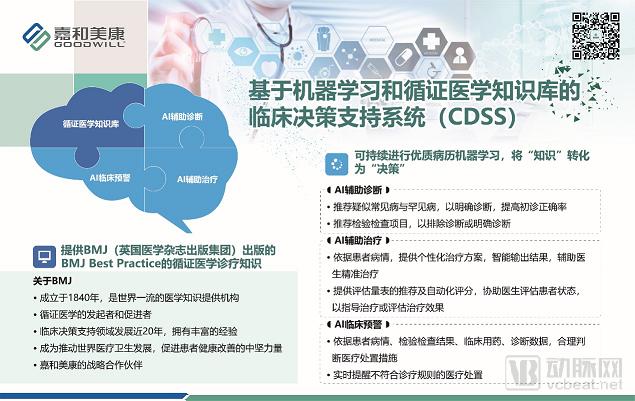
It is reported that through this collaboration, both parties will leverage their respective strengths to introduce a novel model combining an “evidence-based medicine knowledge base + machine learning on high-quality medical records.” This approach aims to overcome the limitations of traditional clinical decision support systems, which rely solely on literature and clinical guidelines and are often based on low-level evidence chains. By delivering more objective, precise, targeted, and clinically actionable recommendations, the system will provide tangible and effective assistance to clinicians in their diagnostic and therapeutic practices.
BMJ Best Practice (BP) – Premier Medical Evidence to Support Diagnostic and Treatment Decisions
BMJ (formerly known as BMJ Publishing Group, abbreviated as BMJ), founded in 1840 and affiliated with the British Medical Association, is a leading international publisher of medical knowledge. Its flagship journal, The BMJ (British Medical Journal), is one of the four most prestigious general medical journals worldwide. BMJ operates across various sectors, including journal publishing, clinical decision support, medical education, and healthcare quality and safety, serving users in more than 160 countries and regions.
BMJ is a proponent and promoter of evidence-based medicine. Over the past two decades, in addition to publishing literature on evidence-based medicine and launching specialized journals in this field, BMJ has established an Evidence-Based Medicine Center and developed several globally renowned clinical knowledge tools for evidence-based practice, such as BMJ Clinical Evidence and BMJ Best Practice. These tools are grounded in evidence-based methodologies and high-level medical evidence (e.g., systematic reviews, meta-analyses, and international guidelines), providing authoritative diagnostic and therapeutic knowledge that can directly support clinical decision-making.
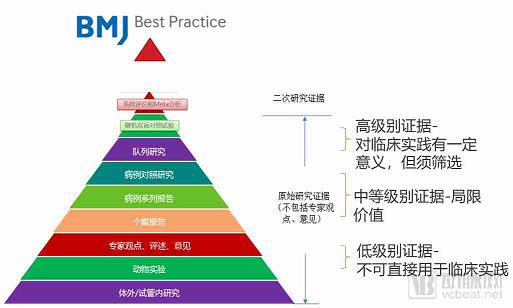
As a distillation and essence of knowledge at the apex of the evidence-based medicine hierarchy, BMJ Best Practice (BMJ BP) features broad coverage, timely updates, convenient retrieval, comprehensive localization, and high-level structuring. It holds significant importance for promoting the scientific rigor of clinical decision-making, enhancing clinicians’ professional competence and knowledge base, and improving the scientific validity, safety, efficacy, applicability, and cost-effectiveness of disease diagnosis and treatment.
Authoritative Content, Timely Updates
BMJ collects the latest clinical evidence by continuously monitoring more than 5,000 trusted data sources worldwide and grading the evidence. The content is then synthesized and authored by over 1,600 independent experts, and published after peer review and professional editing. The same process is applied to maintain content updates, with more than 1,200 update batches released annually to ensure authoritative and reliable information.
Comprehensive Coverage and Rational Classification
BMJ BP covers 32 different specialties, involving more than 80% of known common diseases. It is currently the most comprehensive evidence-based medical diagnosis and treatment knowledge database in China that offers both Chinese and English versions. Meanwhile, its content is presented in the form of disease and symptom topics, with high standardization, structured organization, and complete coverage of the diagnostic and treatment process, enabling very fast response times and high service efficiency in clinical decision-making.

Convenient Retrieval, At a Glance
BMJ BP supports various types of knowledge retrieval, including keyword search, browsing by specialty/disease, and multi-symptom search. Meanwhile, the search results are accompanied by links to corresponding key literature (including more than 7,000 international clinical guidelines and 100,000 high-level publications), with key evidence sources for the current content cited directly within the text, facilitating clinicians in tracing the latest evidence, updating their knowledge, or exploring research directions.
Jiahe Meikang AI – Machine Learning for High-Quality Medical Records
In addition to the evidence-based medicine knowledge base, another indispensable function for CDSS is machine learning on high-quality historical medical records, a process that includes:
First, natural language processing techniques are employed to post-structure free-text information from high-quality historical medical records, generating computer-readable, ultra-fine-grained semantic information;
Secondly, feature processing is performed on the post-structured electronic medical record (EMR) information, including feature cleaning, feature transformation, and feature normalization, to form a dataset for machine learning;
Third, models are trained using algorithms such as Random Forest, Feedforward Neural Networks, and XGBoost, and ensemble strategies including voting and weighted averaging are applied to integrate the algorithmic outputs;
Finally, the model is systematically deployed and feedback is collected to continuously optimize it, ultimately establishing an auxiliary diagnostic and therapeutic decision support model for clinical scenarios.
In this model, the structures and relationships among entities such as different diseases and symptoms are represented with varying weights. When the Clinical Decision Support System (CDSS) obtains a patient’s medical history, its data are matched against feature values from high-quality historical medical records, and different weights are assigned accordingly. This process ultimately generates a list of recommended diagnoses and differential diagnoses, ranked in descending order of probability, thereby helping physicians effectively reduce the time required for clinical confirmation and improve diagnostic efficiency.
Meanwhile, the real-world treatment principles extracted from high-quality historical medical records through machine learning will serve as the core framework for disease management. By integrating these principles with the patient’s current clinical status, the system generates personalized diagnosis and treatment recommendations that are more targeted and clinically relevant. Furthermore, to enhance medical quality and prevent clinical errors, the system intelligently evaluates the appropriateness of current medical interventions based on the patient’s disease progression, laboratory and imaging results, medication usage, and diagnostic findings. It provides real-time alerts for any actions that deviate from established clinical guidelines, thereby offering comprehensive, end-to-end decision support for clinicians throughout the diagnosis and treatment process.
Co-creating Win-Win Outcomes, Initiating Industry Transformation
The evidence-based medicine knowledge base serves as the foundational data support in the clinical decision-making process. It provides a series of standard treatment principles, including diagnosis, medication, examinations/tests, and follow-up, acting as a navigational beacon to guide the fundamental direction of diagnosis and treatment. Meanwhile, the complexity of diseases and individual specificity require us to conduct precise analyses and prioritize judgments for specific cases while grasping the overall direction, rather than simply applying clinical guidelines and indiscriminately providing so-called "standard answers," thereby losing the most critical "decision-making" function of Clinical Decision Support Systems (CDSS).
In response to this, Jiahe Meikang has innovatively combined its machine learning strengths in historical medical records with BMJ’s world-class evidence-based medicine knowledge base. By anchoring clinical logic in the best available medical evidence and leveraging high-quality machine learning models for personalized recommendations, it has successfully achieved authority and precision in clinical decision support, while also delivering personalized and differentiated assistance tailored to individual patients. This approach thoroughly addresses the longstanding drawbacks of previous CDSS systems—such as outdated and unverified knowledge bases, as well as singular, non-weighted treatment recommendations—paving the way for a new generation of CDSS transformation.