

Cotiviti Holdings Enhances Healthcare Payment Accuracy, Saving Clients $2.7 Billion Annually

Cotiviti
Medical Financial Data Service Provider
In June 2018, Cotiviti Holdings (hereinafter referred to as “Cotiviti”), an industry-leading provider of payment accuracy solutions, was acquired by Veritas Capital and its portfolio company Verscend Technologies for $4.9 billion. Following the announcement of this acquisition agreement, Cotiviti’s stock price surged in early June, reflecting a 32% premium. At that time, it had been just over three years since Cotiviti’s establishment.
Although Cotiviti is a relatively young company, it has a distinguished pedigree. In May 2014, Connolly Superholdings (founded in 1979), a leader in post-pay healthcare payment accuracy solutions, announced its merger with iHealth Technologies, a leader in pre-pay healthcare payment accuracy solutions. The newly merged company is dedicated to helping healthcare clients identify and correct inaccurate payments, leveraging integrated solutions to enhance payment accuracy amid an increasingly complex healthcare landscape. The company was officially renamed Cotiviti Holdings in September 2015.
That same year, the company recovered $2.7 billion in losses for its clients. This outstanding performance earned widespread industry recognition for the new name “Cotiviti Holdings,” enabling the company to swiftly establish partnerships with the 25 largest healthcare payers in the United States and most of the top 10 U.S. retailers.
VCBeat (WeChat Official Account: vcbeat) has reviewed the company’s basic profile and core business operations:
IPO, Leadership Change, and M&A: Consolidating Leadership in the Payment Accuracy Sector
After rapidly establishing its industry position, Cotiviti did not rest on its laurels. Its next two major moves further demonstrated the company’s determination to become an industry leader: First, on May 26, 2016, Cotiviti conducted its initial public offering (IPO) and officially listed on the New York Stock Exchange (ticker symbol: COTV), with an issue price of $19 per share, issuing a total of 12.5 million shares and raising $237.5 million. Second, in August of the same year, the company welcomed Dr. Emad Rizk as its first President and Chief Executive Officer following the IPO.
As a seasoned and renowned executive in the healthcare industry, Dr. Emad Rizk has over 25 years of experience working closely with payers, providers, and government entities. Previously, he served as Chief Executive Officer of Accretive Health and joined its Board of Directors. Prior to his tenure at Accretive Health, Dr. Rizk was President of McKesson Health Solutions, a company providing clinical and financial solutions to healthcare payers.
Prior to joining McKesson, Dr. Emad Rizk served as a Senior Partner and Global Director of Pharmaceutical Management at Deloitte Consulting. During his tenure at Deloitte, he led the healthcare cost and quality management practices across all of the firm’s divisions. Previously, he held the positions of Associate Medical Director and Global Medical Director at Monsanto. Dr. Emad Rizk currently serves on the boards of directors of Intarcia/Accuray and the National Association for Hispanic Health. He has also served on the U.S. National Clinical Advisory Board, the National Quality Review Board, and as a director on the board of the DMAA (The Care Continuum Alliance).
One year after joining Cotiviti, in July 2017, Emad Rizk led the company in securing $30 million through equity financing. In the same month, he guided Cotiviti in acquiring RowdMap, a healthcare data analytics firm, for $70 million, with the aim of further enhancing and optimizing Cotiviti’s payment accuracy analytics tools. Industry observers noted that the two companies shared a common strength: their analytics software provides the necessary data support to ensure the viability of high-value, risk-bearing healthcare services.
This acquisition further solidifies Cotiviti’s leadership in payment accuracy and showcases Emad Rizk’s decisive and swift management style to the industry.
In Emad Rizk’s view, as costs in the U.S. healthcare industry continue to rise, stakeholders face increasingly complex clinical and financial risks. Cotiviti’s core mission is to help clients optimize financial performance, enhance payment efficiency, and improve overall healthcare value. Notably, the company serves a broad range of clients, including payers, government entities, healthcare providers, insurance brokers, retailers, life insurers, and law firms.
Emad Rizk stated that the regulatory and structural landscape of healthcare has undergone significant changes recently, such as major modifications to the individual health plan market and the expansion of Medicaid programs, all of which are driving innovation in healthcare plans. However, innovation also faces substantial challenges; for instance, payers must make significant investments to upgrade their outdated IT infrastructure. These legacy systems are unable to respond swiftly to market changes or leverage analytics technologies to strengthen collaboration with providers.
Based on this, the company primarily provides its customers across the United States, Canada, the United Kingdom, and India with three categories of data analytics-driven payment accuracy solutions:
1. A prospective claims accuracy solution that enables healthcare clients to identify and resolve claim discrepancies immediately after adjudication, prior to payment being issued to healthcare providers;
2. Retroactive Claims Accuracy Solutions, enabling health insurers to identify and resolve payment inaccuracies after claims have been paid to healthcare providers;
3. The company also provides analytics and support services, including fraud, waste, and abuse analytics, to identify anomalous patterns in coding and billing practices.
Building Diverse Solutions to Create Differentiated Value for the Healthcare Payment Ecosystem
These three major categories of solutions form the foundation and core of Cotiviti’s payment accuracy solutions. Building on this base, the company further segments them according to different business types and customer profiles, adopting a case-by-case approach to develop four specialized solutions tailored specifically for healthcare industry clients, with the aim of creating differentiated value within the healthcare ecosystem:
Cotiviti’s Payment Accuracy Suite saves medical and administrative costs by providing solutions for every key dimension of the claims payment lifecycle, from early payment strategy management and clinical claim review to post-payment chart review and fraud pattern investigation.
Take the “Fraud, Waste, and Abuse (FWA) Solution” within the Payment Accuracy Solutions as an example.
The economic losses caused by healthcare fraud are estimated to reach tens of billions of dollars annually. Inefficient claims processing, neglected claims, overstaffing or understaffing, disparate record-keeping systems, and incomplete reports and datasets can all contribute to fraud, waste, and abuse (FWA). Furthermore, due to medical identity theft, physical risks, and increasingly close ties with organized crime syndicates, healthcare fraud activities are posing growing harm to patients.
Cotiviti’s FWA solution is jointly designed by clinicians, claims and regulatory experts, managers, and data analysts to address emerging fraud schemes and compliance requirements. This integrated solution applies the data analytics, decision-making, and insights from one module to the rules and algorithms of other modules, thereby creating a more robust anti-fraud solution that detects and prevents fraud, waste, and abuse (FWA) while meeting compliance and financial objectives.
The company’s unique solution has earned it nearly 100 payer clients—ranging from small third-party administrators to 21 of the 25 largest payers in China, many of which have partnered with Cotiviti for over a decade.
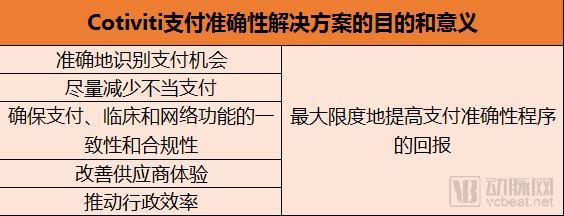
Risk Adjustment Solutions are designed to provide compliant and accurate compensation for members' risk burdens.
Risk adjustment programs are complex, and successful management requires maintaining full compliance while ensuring that the risk burden of individual health plans is appropriately documented in medical records and related submissions. Understanding which risk adjustment tools to use and when to use them is critical to ensuring timely and consistent revenue payments. Furthermore, the regulatory environment changes frequently, and government audits are becoming increasingly common, all of which impact risk adjustment.
To facilitate risk adjustment, Cotiviti deploys clinical and analytics experts specializing in natural language processing (NLP) and machine learning, more than 1,000 certified coding professionals, and over 450 retrieval specialists to provide health plans with comprehensive, end-to-end prospective and retrospective risk adjustment services and support. By integrating technology, artificial intelligence, analytics, and deep domain expertise, Cotiviti ensures that risk-related revenue is optimized while maintaining appropriate compliance.
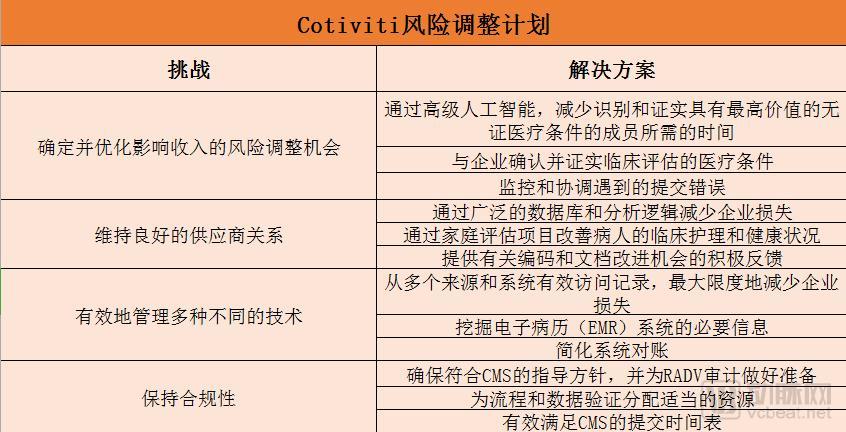
Take the “In-Home Assessments” solution within risk adjustment solutions as an example.
To fully manage and coordinate care for its members, health plans require access to all relevant member medical data. However, the information contained in medical records, claims, or other data sources often fails to provide a comprehensive view of members’ physical and behavioral health. Engaging qualified nurse practitioners or physician assistants to interact with family members and conduct comprehensive personal health assessments can yield essential clinical data that would otherwise be missing.
This process not only advances nursing quality and nursing management but also provides appropriate and comprehensive documentation, ensuring that members’ clinical risk burden is properly captured and validated for risk adjustment.
As value-based reimbursement becomes the standard, Cotiviti’s quality and performance solutions enable health plans to shift from merely reporting quality measures to driving the purchasing, delivery, and utilization of higher-value healthcare programs. The company’s solutions empower health plans to collaborate more effectively with their provider networks, members, and other functional teams within the organization. Health plans can successfully manage members’ clinical and financial risks, maximize the use of limited internal resources, and comply with industry requirements and regulations.
Quality improvement is complex, ever-evolving, and increasingly linked to financial profitability. Cotiviti helps clients transform quality metrics and reporting into a foundation that supports critical missions such as population health, quality improvement, compliance, network management and contracting, and value-based reimbursement. The company combines NCQA-certified measure logic and easy-to-use reporting software with extensive, specialized retrieval and abstraction services to streamline the overall process, striving to achieve the most effective results with minimal effort at every stage.
DxCG Intelligence risk adjustment and predictive models are at the core of Cotiviti’s performance analytics solutions, developed in collaboration with the Centers for Medicare & Medicaid Services (CMS) in the early 1990s.
DxCg Intelligence leverages Cotiviti’s proprietary predictive models to transform healthcare data into individual member risk scores, which correlate with the costs of their potential disease burden. Aggregating individual scores with key attributes generates group-level predictions, facilitating the analysis of critical issues related to healthcare efficiency.
The Hierarchical Condition Category (HCC) model is also built on DxCG Intelligence, and CMS still uses this model today as the basis for risk-adjusted healthcare payments.
Cotiviti’s quality performance solution, DxCG Intelligence, won the 2017 Best in KLAS Award for its payer quality analytics and reporting solution. KLAS Research leverages its robust methodology and comprehensive customer research to evaluate vendor and solution performance across multiple categories. Customers specifically noted that Cotiviti outperforms competitors in software performance and ease of use.
Cotiviti’s Life Sciences and Legal Services enable rapid and effortless retrieval of medical records critical to its clients’ operations.
The life insurance industry relies heavily on the approval and underwriting of robust policies that are both profitable and sustainable over the long term. The ability to rapidly collect accurate Attending Physician Statements (APS) is critical to policy assessment. Cotiviti’s patented medical records retrieval process is sufficiently flexible to allow every user to quickly order, track, retrieve, and view digitized APS documents through a secure online account.
The company serves all stakeholders in the life insurance industry, including Broker General Agents (BGAs) and independent agents. Its solutions enable the capture of previously non-billable expenses and are sufficiently flexible to allow any legal professional to quickly order, track, retrieve, and view digitized medical records.
Cotiviti’s scheduling and retrieval workflow system is the core of its retrieval process, helping agents quickly and accurately request, aggregate, digitize, and index patient clinical data. Once records are extracted, they are readily accessible from its central medical record repository.
The company tracks, stores, and manages detailed information about each provider (e.g., contact information, business hours, retrieval methods, and record location, type, and contact details) to ensure effective retrieval.
Cotiviti’s clients in the life sciences and legal services sectors include Pipeline, which provides sales and distribution software suites for the insurance and financial services markets; TrialWorks, which offers case management software to law firms; and Needles, a company specializing in professional time-and-billing data processing services. All of these companies have over 35 years of operational history.
Regarding the positioning of Cotiviti Holdings, Inc. and its diversified solutions, Jordan Bazinsky, Executive Vice President and Administrative Officer of the company, once stated: “In the healthcare industry, technology and data are becoming increasingly precise, enabling industry participants to operate with a level of granularity unprecedented in the past. In other words, while Cotiviti has performed quite well in observing overall trends and assessing needs, applying the same analytical methods at the individual level remains highly challenging. For instance, we must not only decipher what happened from the data but also analyze why it happened. As we become better equipped to pinpoint the drivers of various risks, we can assign accountability for addressing these issues.”
Thus, solutions in the healthcare payment sector take many forms: value-based smart contracts, new partnerships within healthcare systems, and providing patients with more information about their health to enable better decision-making, among others.
As time passes and technology advances, this fine-tuning of industry knowledge will only become increasingly precise, enabling healthcare payment companies to “treat” the healthcare system and achieve meaningful progress.