

Exploring the Blue Ocean: China's First Emergency Medicine Technology Development Forum Unveils Market Opportunities
In Beijing, the annual emergency department volume of a single hospital ranges from 150,000 to 200,000 visits, with elderly patients (aged 60 and above) accounting for 70% of adult emergency cases.
For entrepreneurs and investors in the healthcare sector, the emergency care track may seem somewhat proximate, as their pharmaceuticals and medical devices cater to patients with various symptoms; yet it also appears somewhat distant, given that they have not singled out emergency care as a distinct category for focused development.
From January 19 to 20, 2019, the First Plenary Session of the First Committee of the Emergency Medicine Branch of the Chinese Geriatrics Society, together with the First China Forum on Scientific and Technological Development in Emergency Care, was held at the Hunan Building in Beijing. Themed “Exploring Patterns of Acute Onset in the Elderly and Standardizing Emergency Treatment Protocols for Geriatric Patients,” the conference aimed to create a platform for open exchange in the field of emergency care.
In light of the specific context of this conference, VCBeat (WeChat: vcbeat) conducted an exclusive interview with Guo Wei, Director of the Emergency Department at Beijing Tiantan Hospital, Capital Medical University, and Chairman of the conference.

Conference Chair: Guo Wei
Emergency Care Requires Refined and Broader Attention
Emergency and critical care services in China have been developing for over 30 years. To date, however, a complete service chain has yet to be established, with emergency departments and pre-hospital care remaining segregated, and medical devices, pharmaceuticals, and other supplies lacking independent classification systems. The sector is currently experiencing a period of rapid growth, requiring momentum from multiple fronts. Beyond advancements within the discipline itself, the development of emergency and critical care services necessitates support from upstream, midstream, and downstream players across the entire industry chain.
“As hospitals have grown larger and patient volumes have increased over the years, it is undeniable that this trend is linked to population aging,” Chairman Guo Wei told VCBeat. “Currently, 70% of adult patients visiting emergency departments are elderly individuals, whose urgent need for emergency care is particularly pronounced.” The establishment of the Emergency Medicine Branch of the Chinese Geriatrics Society also aims to promote more detailed and refined management of the elderly population within the field of emergency and critical care medicine.
“The elderly are different from the young, with distinctions in many indicators; we cannot apply the standards for the young to measure them,” Guo Wei told VCBeat. “Our society also hopes to identify content of particular significance within this special population.”
The society was established on December 30, 2017. Guo Wei stated that, taking advantage of the society’s first anniversary and this conference, he hopes to enhance exchanges with external parties and leverage external resources to promote the better and healthier development of both the society and the entire discipline of emergency medicine and critical care. In this process, the society serves as a platform builder, acting as a lubricant to facilitate mutual communication.
Upstream and Downstream Industry Linkage
Guo Wei stated that this conference is not merely an exchange of technical expertise and knowledge in emergency care; rather, it focuses on the development dynamics of the entire emergency care industry chain, from upstream to downstream. The aim is to collaboratively establish a comprehensive platform for dialogue and exchange, with the hope of advancing the cause of emergency care from a more macroscopic perspective and across broader domains.
Regarding the original intention of this conference, Guo Wei told VCBeat that there were mainly the following four points:
First, experts from the Emergency Medicine Branch of the Chinese Geriatrics and Gerontology Society will exchange insights on the new research advancements and developmental highlights achieved by the society over the past year, to promote mutual improvement;
Second, establish a platform connecting enterprises, investors, and academic societies to facilitate the practical implementation of ideas through industry-academia-research collaboration;
Third, with regard to the government, we aim to secure greater support and guidance through enhanced public awareness campaigns in the field of emergency and critical care.
Fourth, public education: it is necessary to convey the scientific concept of seeking emergency medical care to the general public, enabling them to understand essential skills and how to perform self-rescue in case of emergencies.
This conference will focus closely on emergency care and critical care, aiming to connect the society with upstream stakeholders—enterprises, investors, and government—and downstream stakeholders—the general public, to jointly explore this new blue ocean in emergency and critical care.
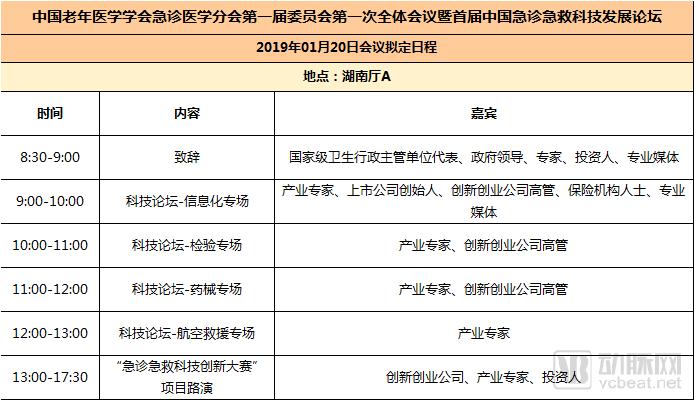
Event Registration
How to Tap into the Blue Ocean Market of Emergency Care? Join Us at the Inaugural China Forum on Technological Advancements in Emergency Care on January 20 for Insights and Discussions.
Meeting Date: January 20, 2019
Venue: Hunan Building, No. 9 Beijingzhan Street, Dongcheng District, Beijing
Registration Link: