Amivantamab Subcutaneous Formulation Receives NMPA Approval for Three NSCLC Indications in China

Johnson & Johnson
Medical Device R&D and Manufacturer


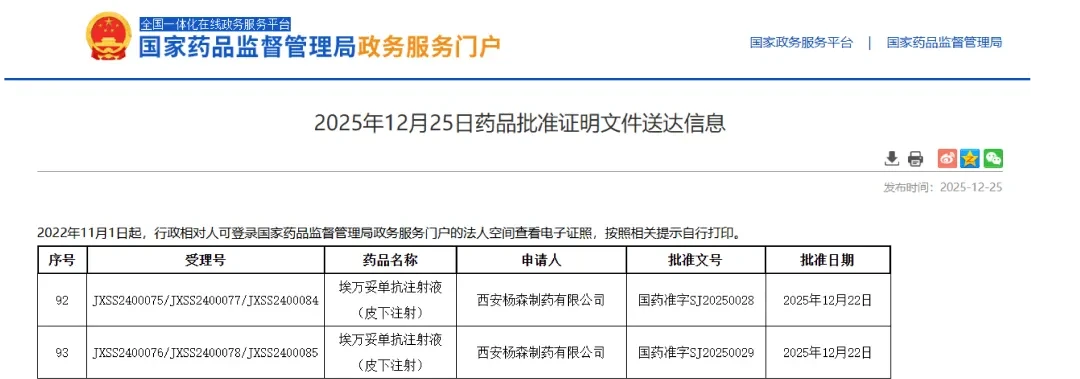
On December 25, the NMPA website showed that Johnson & Johnson'sAmivantamab Subcutaneous Injection (Brand Name: Rybrevant Faspro)Approved for marketing in China, with three approved indications respectively.In combination with Lazertinib for the first-line treatment of locally advanced or metastatic NSCLC with EGFR exon 19 deletion or exon 21 L858R substitution mutation, in combination with chemotherapy for previously treated NSCLC with EGFR exon 19 deletion or exon 21 L858R substitution mutation, and in combination with chemotherapy for the first-line treatment of advanced NSCLC with EGFR exon 20 insertion (EGFR ex20ins) mutation.
Amivantamab is a fully humanized bispecific antibody targeting EGFR and MET. On December 17, 2025, the U.S. Food and Drug Administration (FDA) approved the subcutaneous formulation of amivantamab for all adult patient indications previously approved for the intravenous formulation of amivantamab. The approval of the subcutaneous formulation of amivantamab was primarily based on the positive results from the PALOMA-2 and PALOMA-3 studies.
PALOMA-3 is an international multicenter Phase III clinical study designed to evaluate the pharmacokinetics, efficacy, and safety of subcutaneous (SC) versus intravenous (IV) administration of Amivantamab in combination with Lazertinib for the treatment of patients with EGFR-mutated advanced NSCLC who have developed resistance after first-line therapy. The primary endpoint of non-inferiority for the combination was assessed through pharmacokinetic evaluation by measuring the peak and trough concentrations on Day 1 of Cycle 2 (C2D1) or Day 1 of Cycle 4 (C4D1), as well as the area under the curve (AUC) after Cycle 2 (C2 AUC). The study results showed[1], the study met its primary endpoint. Pharmacokinetic data showed that the geometric mean ratio (GMR) of peak-to-trough blood drug concentration on C2D1 between SC and IV was 1.15 (90% CI: 1.04–1.26), and the GMR of C2 AUC d1-15 was 1.03 (90% CI: 0.98–1.09), meeting the non-inferiority criteria. In terms of safety, the incidence of infusion reactions in the subcutaneous injection group was 1/5 that of the intravenous infusion group (13% vs. 66%), with both groups primarily experiencing mild infusion reactions of grade 1-2 (≥grade 3: 0.5% vs. 4%).
PALOMA-2 Study is an international, multicenter, open-label, Phase II platform study designed to evaluate the efficacy and safety of Amivantamab SC in combination regimens for patients with EGFR-mutated advanced NSCLC. The study includes multiple cohorts comparing different dosing frequencies of SC Q2W, Q3W, and Q4W, covering populations with EGFR sensitizing mutations, Ex20ins, and post-osimertinib resistance. Results show that the SC formulation of Amivantamab demonstrates durable efficacy comparable to the IV formulation across various patient populations, including first-line treatment for EGFR sensitizing mutations, second-line treatment after osimertinib resistance, and first-line treatment for EGFR Ex20ins, while significantly improving convenience of administration and tolerability.[2-5]。
[1] Leighl NB, et al., Subcutaneous amivantamab vs intravenous amivantamab, both in combination with lazertinib, in refractory EGFR-mutated, advanced non-small cell lung cancer(NSCLC): Primary results, including overall survival (OS), from the global, phase 3, randomized controlled PALOMA-3 trial. ASCO 2024. LBA8505.
[2] Lim SM, et al. Subcutaneous amivantamab and lazertinib as first-line treatment in patients with EGFR-mutated, advanced non-small cell lung cancer (NSCLC): Results from the phase 2 PALOMA-2 study. 2024 ASCO abstr LBA8612.
[3] Leighl NB, et al., Subcutaneous amivantamab vs intravenous amivantamab, both in combination with lazertinib, in refractory EGFR-mutated, advanced non-small cell lung cancer(NSCLC): Primary results, including overall survival (OS), from the global, phase 3, randomized controlled PALOMA-3 trial. ASCO 2024. LBA8505.
[4] Scott SC, et al. PALOMA-2: Subcutaneous Amivantamab Administered Every 4 Weeks Plus Lazertinib in First-Line EGFR-Mutated Advanced NSCLC. 2025 WCLC. MA.0805.
[5] Lim SM, et al. First-Line Subcutaneous Amivantamab Plus Chemotherapy in EGFR Exon 20 Insertion-Mutated Advanced NSCLC: Results From PALOMA-2. 2025 WCLC. MA.0803.
Typesetting Editor: Tumor Information-Ming Xiaoli