

Innovent Biologics' Sintilimab Approved in China: Domestic and Global Players Vie for PD-1 Market Share
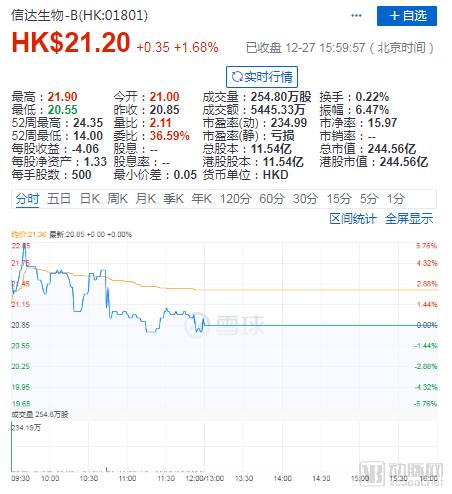
Image from Xueqiu
On December 27, 2018, Innovent Biologics’ PD-1 antibody drug, Sintilimab Injection (brand name: Tyvyt), was officially approved for marketing by the National Medical Products Administration (NMPA) for the treatment of relapsed or refractory classical Hodgkin lymphoma in patients who have undergone at least two lines of systemic chemotherapy. It is understood that Sintilimab Injection was jointly developed by Innovent Biologics and Eli Lilly and Company.International trademark Tyvyt®, Chinese name Daboshu®.This is the second domestically produced PD-1 antibody drug to be launched in China, following Junshi Biosciences’ “Toripalimab Injection,” and it has been widely anticipated.
Innovent Biologics first submitted its marketing application in December 2017, subsequently withdrew the application voluntarily in late February 2018, and re-submitted it on April 16, 2018. Junshi Biosciences initially filed its marketing application in March 2018. Due to the withdrawal of its initial application, Innovent’s review process lagged slightly behind; however, the final approval dates for the two companies differed by no more than 10 days.
In addition to Innovent and Junshi, two overseas blockbuster drugs—BMS’s Opdivo and Merck & Co.’s Keytruda—also entered the Chinese market one after another a few months ago, with prices even lower than those in the United States.
It is understood that Opdivo has been approved for the treatment of adult patients with locally advanced or metastatic non-small cell lung cancer (NSCLC) who are negative for epidermal growth factor receptor (EGFR) gene mutations and anaplastic lymphoma kinase (ALK), and whose disease has progressed after or who are intolerant to prior platinum-based chemotherapy.
Keytruda’s newly approved indication is for locally advanced or metastatic melanoma, and itsChina Retail Price:17918Yuan/100mg, the annual treatment cost is304606yuan, which is only the U.S. market price's54%; For low-income patients, throughPAPPlanned Drug Donation Policy:3+3(Buy3One course of treatment included free of charge3per course of treatment), the minimum annual treatment cost borne by patients is161262yuan; for patients on subsistence allowances, it is available free of charge24months.OpdivoSuggested Official Retail Price100mg/10ml 9260Yuan;40mg/10ml 4591yuan. If calculated according to60kgCalculation (3mg/kg, administered via intravenous injection once every two weeks) requires the use of1Support100mg/10mland2Support40mg/10ml, total18442Yuan per liang, a total of one month36884Yuan;50kgpatients spent approximately13851yuan every two weeks, a total of one month27702yuan.
Junshi and Innovent have not yet disclosed their drug pricing strategies. However, Yu Dechao, Chairman of Innovent Biologics, mentioned in an interview: “Our focus is on producing high-end biologics that are affordable for the general public in China. As the specific drugs have not yet been launched, it is difficult to specify the exact cost at this stage. However, our preliminary plan is to ensure that the annual treatment cost per patient does not exceed RMB 100,000.”
Throughout the history of pharmaceutical development, no drug has garnered global acclaim quite like PD-1/PD-L1 inhibitors. Historically, there has never been such a concerted rush by numerous companies to focus on a single therapeutic target. From Bristol Myers Squibb to AstraZeneca, and further to innovative pharmaceutical enterprises in China, the global industry has invested hundreds of billions in research and development costs for this class of drugs.
However, this has also forced market participants to face unprecedentedly fierce competition. Internationally, Bristol Myers Squibb (BMS), Merck & Co., Roche, and Pfizer dominate the landscape; domestically, four companies—Hengrui Medicine, Innovent Biologics, Junshi Biosciences, and BeiGene—are vying intensely for a leading position.
BMS, with Opdivo in its portfolio, has secured approvals for six major indications: melanoma, non-small cell lung cancer (NSCLC), renal cell carcinoma, classical Hodgkin lymphoma, head and neck cancer, and bladder cancer. Merck & Co., leveraging Keytruda, holds significant market influence in melanoma, NSCLC, head and neck cancer, and urothelial carcinoma. Roche’s Tecentriq, the first PD-L1 antibody approved by the FDA, is currently indicated for NSCLC and bladder cancer. Bavencio, a PD-L1 antibody co-developed by Pfizer and Merck KGaA, remains the only PD-1/PD-L1 inhibitor approved for the treatment of Merkel cell carcinoma (MCC), a rare skin cancer.
Among them, Bristol Myers Squibb’s Opdivo recorded sales of $942 million in 2015 and $4.948 billion in 2017, with peak sales projected to reach $9.59 billion within the next five years; Merck & Co.’s Keytruda posted sales of $566 million in 2015 and $3.809 billion in 2017, with peak sales expected to hit $9.88 billion over the same period.
Among domestic companies, in addition to Junshi and Innovent having announced their marketing approvals, Hengrui Medicine is currently in the application stage, while BeiGene’s PD-1 has been included in the priority review program.
It is understood that the collaboration between Innovent and Eli Lilly encompasses drug R&D, manufacturing, quality control, and sales, with its production lines having reached international standards. According to reports from PharmaCube, the current production capacity of sintilimab injection consists of three 1,000-liter lines, while six 3,000-liter lines are under commissioning. This facility is currently the largest PD-1 production plant in China with completed construction and international standards among domestic PD-1 manufacturers. Meanwhile, Innovent Biologics also emphasized that it will continue to adhere to a specialized academic promotion strategy in the future.
Junshi has already established its own sales team, with most members coming from multinational pharmaceutical companies. They will focus on the three major distributors—Sinopharm Holdings, Shanghai Pharmaceuticals, and China Resources Pharmaceutical—as the primary channels, supplemented by high-quality local distributors, to cover hundreds of hospitals and DTP (Direct-to-Patient) pharmacies.
Both BMS and Merck, as foreign companies, astutely entrusted their general distribution rights to Shanghai Pharma, a local enterprise with commercialization experience, to avoid potential market adaptation challenges in the sales process. According to Shanghai Pharma’s third-quarter financial report, its distribution revenue for Opdivo and Keytruda reached RMB 190 million and RMB 150 million, respectively.
Riding the wave of accelerated approval for imported drugs, Junshi Biosciences and Innovent Biologics became the first domestic innovators to compete head-to-head with pharmaceutical giants. Moreover, Opdivo and Keytruda have both rolled out “friendly” pricing strategies, further intensifying the competitive challenges for local pharmaceutical companies.
However, VCBeat is relatively optimistic about this:
First, the indications currently approved for Opdivo and Keytruda in China are non-small cell lung cancer and advanced melanoma, respectively, so they do not yet directly compete with Innovent, Hengrui, or BeiGene (Junshi’s indication is for unresectable or metastatic melanoma after failure of systemic therapy, which shows some relevance). This provides domestic companies with a buffer period.
Secondly, although Opdivo and Keytruda have offered "friendship prices" to Chinese patients, this pricing strategy may be driven by competitive pressure from domestic companies. While the low-price strategy may narrow the price gap between imported and domestically produced drugs, reports from Junshi Biosciences and Innovent Biologics suggest that a price advantage still exists.
According to forecasts by the research and consulting firm GlobalData, the global market size for cancer immunotherapy will reach approximately USD 14 billion in 2019 and expand to USD 34 billion by 2024. Immune checkpoint inhibitors account for the largest share of this market; however, only five PD-1/PD-L1 monoclonal antibody products have been launched and are currently marketed worldwide.
Although slightly lagging behind, Junshi and Innovent are highly likely to emerge as strong competitors; opportunities will favor those who are dedicated to rigorous drug development.