

AI and Surgical Robots Advance: Gaining Physician Trust Is the Key to Next-Stage Growth
With the development of technologies such as artificial intelligence, robotics, the Internet of Things, and cloud computing, healthcare has begun to enter the “Intelligent Era.” This era promises enhanced medical experiences and offers solutions to the shortage of healthcare resources; however, significant barriers remain to its practical implementation.
Taking AI as an example, obtaining certification and achieving clinical implementation have become the most significant challenges. Meanwhile, cloud computing and big data also face data security issues. In the field of surgical robots, several domestically produced neurosurgical robotic systems were approved in 2018, and China has world-leading robotic systems for orthopedic and spinal surgeries. As multiple products enter the market, what will be the next stage of development for surgical robots?
Amidst the many uncertainties of the era of intelligent healthcare, at the end of 2018 and the dawn of 2019, the “AI + Cloud + Medical Big Data & Medical Devices Summit” was held at Zhongguancun Zhiyou Angel Academy. The summit explored challenges such as the medical applications of disruptive technologies like AI/RT and cloud services, big data security and sharing, bottlenecks in the translation of medical-engineering integration, hotspots in industrial investment, and CFDA certification for new technology products.
The summit invited representatives from the Beijing Municipal Science & Technology Commission and the Haidian District Government; academic experts from universities and research institutes, including Academician Zhang Bo, Academician of the Chinese Academy of Sciences and Dean of the Institute for Artificial Intelligence at Tsinghua University; Mr. Xu Bo, Director of the Institute of Automation, Chinese Academy of Sciences; Mr. Fan Yubo, Director of the China Rehabilitation Aids Center and Director of the Beijing Advanced Innovation Center for Biomedical Engineering; and Professor Wang Tianmiao, Professor at Beihang University and Dean of the Zhiyou Angel Academy; as well as hospital and industry association representatives, including Mr. Zhang Fuchun, Vice President of Peking University Third Hospital, and Mr. Lu Qingjun, Director of the Medical Affairs Department of China-Japan Friendship Hospital.
Notably, in addition to representatives from hospitals and research institutions, the summit also invited delegates from enterprises and investment firms, including Alibaba Health, Medtronic, Tinavi Medical Technologies, Baidu Venture Capital, SoftBank China, Mingshi Capital, and CEIC Health Industry Fund.
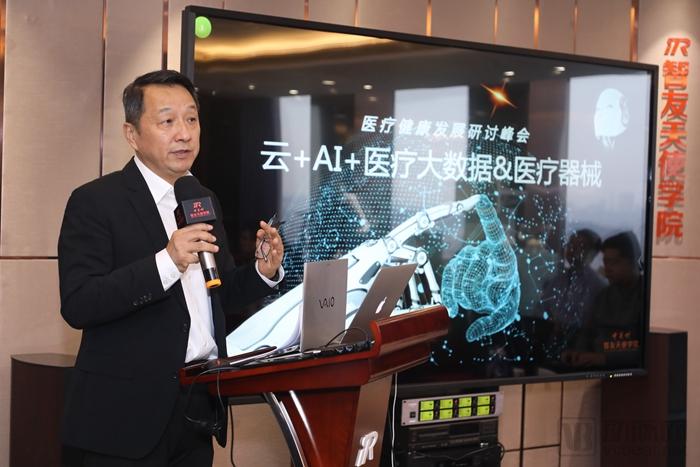
Professor Wang Tianmiao Delivers a Speech at the Forum
2018 can be regarded as the year when AI was fully implemented in hospitals. Data from the VCBeat database shows that AI-based pulmonary nodule screening products have been widely deployed in hospitals, with leading AI companies conducting over 100,000 screenings per day on average.
However, the number of partner hospitals for leading enterprises is mostly at the level of hundreds, primarily consisting of Grade 3A hospitals, and has not yet achieved comprehensive coverage. As of now, no domestic AI company has obtained Class III medical device certification from the CFDA.
Wang Tianmiao, a professor at Beihang University and Dean of the Zhiyou Angel Academy, stated, “AI plus medical devices represents a major trend in medical device innovation. While the accuracy of some AI systems has already exceeded 90%, the issue of false positives persists, constituting a technical bottleneck faced globally. Currently, AI confronts two primary challenges: first, its lack of explainability regarding decision-making processes; and second, the difficulty in determining liability. As both domestic and international stakeholders are still exploring solutions in these areas, AI can currently serve as a screening tool, but its application as a direct diagnostic tool remains challenging.”
Academician Zhang Bo, Dean of the Institute for Artificial Intelligence at Tsinghua University, also pointed out: “Although artificial intelligence has learned from a vast number of samples compared to the human brain, it still cannot match humans in terms of robustness, power consumption, generalizability, and interpretability. Furthermore, medical AI in China suffers from an inherent weakness: the prevalence of large volumes of low-quality data. Therefore, substantial improvements in fundamental technologies are required before AI can gain recognition from healthcare professionals.”
Academician Zhang Bo also pointed out, “Currently, apart from a few surgical robots, there are hardly any mature AI applications that have been successfully implemented. The key issue lies in the unique nature of healthcare, which requires building a robust ecosystem across four aspects to jointly promote the development of healthcare: first, policy and regulatory frameworks; second, scientific research; third, technology translation; and fourth, industrial landscape.”
At the high-level forum, representatives from leading hospitals at the forefront of integrating medicine and engineering, such as Peking University Third Hospital, Beijing Fuwai Hospital, and China-Japan Friendship Hospital, also shared their perspectives on the practical implementation of AI. For healthcare institutions, the primary barrier to trusting AI remains concerns over its accuracy.
What keeps AI out of hospitals is not an inherent bias against machines, but the technical bottlenecks that need to be overcome. Only by making AI smarter can it become a diagnostic assistant for healthcare professionals.
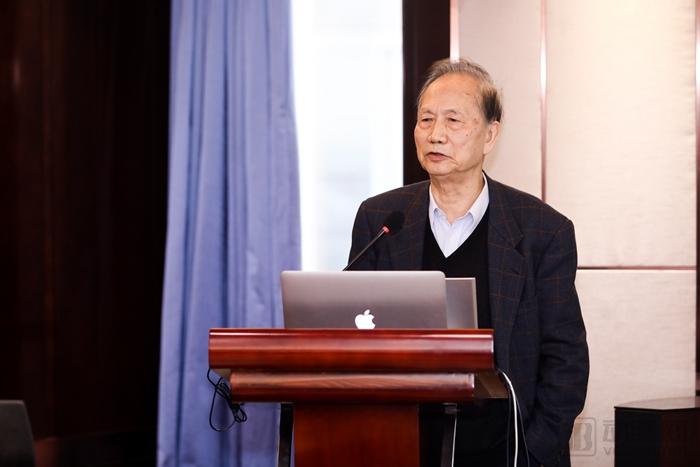
Academician Zhang Bo Delivers Keynote Address at the “AI + Cloud + Medical Big Data & Medical Devices” Summit
In addition to AI being a major direction for medical device innovation, surgical robots also deserve attention. Surgical robots feature higher technical barriers and requirements, representing the pinnacle of medical-engineering integration. From 2005 to 2016, the number of surgical cases performed using medical surgical robots grew from 25,000 to 1 million. While the da Vinci Surgical System once stood alone as the dominant player, multiple domestically produced neurosurgical robots have now received approval. In orthopedic surgery, Tinavi Medical Technologies has launched Tianji®, the world’s first surgical robot for trauma and spine orthopedic procedures.
In the robotics industry, there is a renowned saying: “Li in the South, Miao in the North.” Both are representative entrepreneurial mentors in China. “Li in the South” refers to Professor Li Zexiang of the Hong Kong University of Science and Technology, while “Miao in the North” formally refers to Professor Wang Tianmiao of Beihang University.
Professor Wang Tianmiao believes that there are three clear trends in innovation within the medical device sector: first, the rapid growth of in vitro diagnostics; second, biomaterials for consumables and implants; and third, medical robots. Currently, surgical robots have already achieved commercial implementation in specialties including orthopedics, neurosurgery, abdominal surgery, vascular intervention, and capsule endoscopy.
So, where are medical robots headed in the future? Professor Wang Tianmiao pointed out the essence and trends of medical robots: “The trend of medical robots is actually towards precision prediction, remote operations, and rehabilitation. From the perspective of robot usage, it essentially revolves around addressing patients’ pain points and overcoming obstacles doctors face during surgical procedures, leading to mechanized or mechatronic designs for high-frequency, highly challenging tasks. The strong technological drivers in this area include biotechnology, mechatronics, artificial intelligence, and 3D printing technology.”
At the event, relevant experts also proposed solutions to address payment challenges hindering the clinical adoption of medical robots. For instance, Tinavi’s surgical robots, with a unit cost of RMB 20 million, are unaffordable for most hospitals. The collaborative introduction model adopted by Tinavi and Beijing Haidian Hospital warrants careful consideration. Under this arrangement, the Haidian District Government supports the procurement of the equipment, while the hospital charges a service fee for each procedure performed. This approach holds significant importance for promoting the development of domestically produced innovative medical devices.
Finally, Professor Wang Tianmiao stated, “Throughout the entire development process, we continue to position robots as tools—merely aids to physicians, not replacements. They will fulfill their intended role by performing repetitive tasks with precision. We are in an era where advances in materials, sensing, and artificial intelligence will drive the reintegration and convergence of many medical devices, giving rise to new therapeutic tools.”
At the conference, investors also analyzed hotspots in medical device investment. Liu Ying, Partner at SoftBank China, stated that SoftBank China’s investment strategy favors products with significant technological breakthroughs and medical devices capable of addressing primary healthcare needs. Zhu Jiafeng, Partner at Qianzhan Capital, remarked that as the pharmaceutical industry enters an era of valuation restructuring, the medical device sector will present more investment opportunities.