

Health AI Open Platform Officially Launches: Transcript and Product Overview from the Onsite Speech

Health Hope
Health Management Service Provider
On December 18, at the VCBeat VB100 event, Health Hope officially announced the launch of its Health AI Open Platform.
Health Hope’s Health AI is China’s first open AI technology platform dedicated to the healthcare and medical sector. Health AI offers over 100 research outcomes and specialized capabilities integrating artificial intelligence with healthcare, along with an AI operating system, robotic systems, healthcare management systems, professional content, and smart hardware. Its solutions span various industries and scenarios, including smart homes, smart communities, smart elderly care, smart healthcare, smart mobility, new retail, and government/enterprise sectors.
Below is the transcript of Li Yuxin, founder of Health Hope’s on-site speech.

Li Yuxin: Hello everyone, I am Li Yuxin, founder of Health Hope. I am delighted to announce the official launch of the Health AI Open Platform at today’s event.
First, let’s show everyone an animated video.
This animated feature is one of the most popular applications in Huawei’s newly launched Mate 20 series. It leverages technology from Health Hope, a Huawei supplier, and serves as one of the more than 100 skills available on the Health AI Open Platform.
Today’s press conference is themed “AI: Making Health Within Reach.” We aim to enable more people to see and experience our AI technologies, and to help them understand how the technologies and products developed by today’s AI companies are relevant to consumers, and which ones are truly within reach.
In addition to Huawei, smartphone manufacturers such as OPPO and vivo have also integrated the food recognition capability offered by the Health AI Open Platform. Moving forward, the platform will launch a series of products, ranging from single-function capabilities like food recognition to comprehensive health management solutions, as well as system-level and hardware-based products. This includes the embedding of specialized health management modules in both screen-equipped and screen-less devices, all of which represent key directions in Health AI’s product development strategy.
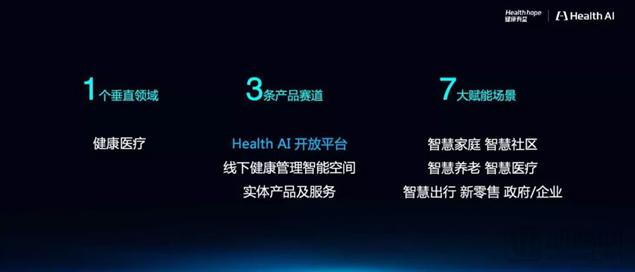
Let me briefly introduce Health Hope. First, Health Hope is positioned in a vertical sector, focusing on AI-driven vertical applications within the healthcare and medical field. On the health management side, we have essentially completed a closed-loop system across the comprehensive domain of health management.
Secondly, Health Hope’s product portfolio spans three key areas. The first is the Health AI Open Platform. Prior to this launch, our AI technology and skills modules had already been in application for several years. In response to the recent surge in market attention and demand for AI technologies, we have decided to make all these capabilities available on an open platform, thereby maximizing their application potential and usage efficiency in the market.
Second, leveraging all current technological applications, modules, and products, we will collaborate with offline partners to establish intelligent offline health management spaces. This constitutes a critical component of Health Hope’s offline implementation strategy, complementing its online open platform.
Third, building on the first two products, we have accessed a large volume of C-end users through B-end partners. These C-end users have extensive needs for health management and pre- and post-medical care services. Based on this, we have developed evaluation-based and service-oriented products, integrating them into all open platforms to provide diverse services to C-end users.
Finally, Health Hope’s products and services span multiple industries and scenarios. The implementation of AI across various sectors has long been a central challenge for the entire AI industry. Whether it involves deploying AI technologies in healthcare—such as in hospitals and medical devices—or in education, stakeholders are actively exploring how technology can empower people’s daily lives through tangible products, covering essentials like food, clothing, housing, and transportation. Every focal point within the broader AI ecosystem offers immense potential for innovation. This reflects the progression from isolated applications to comprehensive coverage as numerous technology platforms extend into vertical domains. Currently, Health Hope’s solutions encompass smart homes, smart communities, smart elderly care, smart healthcare, smart mobility, new retail, and government agencies and enterprises. As such, Health Hope stands out as the company with the most extensive application of AI in the health and medical vertical sector within the industry today.
Today’s Health AI is built upon our years of market observation. It has evolved from an initial focus on single capabilities, such as the Huawei phone’s food recognition feature mentioned earlier, to the diverse product forms we will discuss later. This evolution has undergone rigorous thinking and planning, with the aim of truly integrating various scenarios.
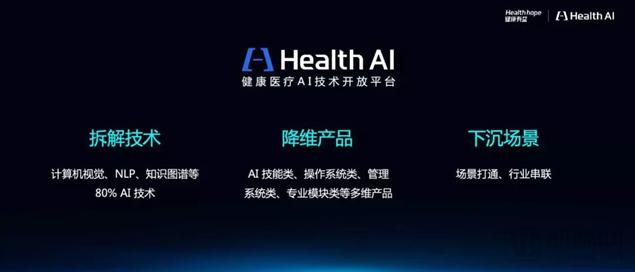
Today, I would like to share some insights on the practical implementation of AI. First, we need to deconstruct technology to utilize it more effectively. Health Hope has already covered 80% of AI technologies under major categories such as computer vision, NLP, and knowledge graphs. Furthermore, we believe that AI must be integrated with specific vertical domains to comprehensively empower these scenarios, thereby ensuring the technology is practically applicable. Otherwise, we would merely be extending technological capabilities while remaining distant from end consumers and actual market demands, which contradicts our original intention of building an open platform for the industry. Our goal in developing such extensive technological capabilities is not simply to provide one or two modules for use, but rather to transform them into diverse products that can be directly delivered to society at large.
Next, we need to downscale the technology into products. Five months ago, Health Hope launched the Ego Smart Healthcare Brain. This AI brain can replicate human vision, speech, and cognitive decision-making, ultimately leaving only physical outputs and action selections as the final logical steps. To meet the diverse needs of front-end products, we integrate different technologies from this “brain” into various applications—a process we refer to as product downscaling. In this way, we bridge seemingly distant advanced technologies with everyday products that are closely relevant to our lives.
We have built a multi-dimensional product portfolio, encompassing AI skill-based and operating system-based offerings. We provide the same underlying system to all developers. For front-end and terminal applications, it is extremely challenging for small and medium-sized businesses (SMBs) to build their own AI technology teams and products, whether they are developing standalone products or applications. However, if a company provides comprehensive AI solutions, this not only improves efficiency but also reduces production costs.
The third aspect involves penetrating grassroots scenarios. Health Hope now covers China’s seven major mainstream scenarios, encompassing the full spectrum of daily life—from home and community to enterprise, travel, shopping, and consumer endpoints. By leveraging the Internet of Everything (IoE), the company delivers its products across all these touchpoints.
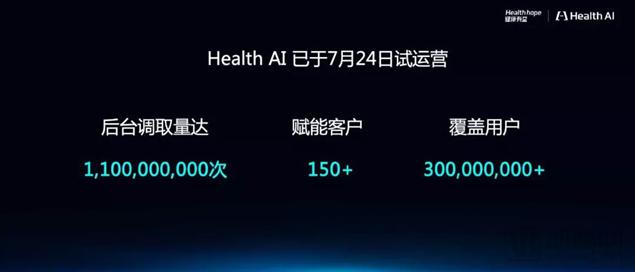
The above data reflects the results of Health AI’s several-month trial operation, which have been highly successful. Backend query volume has reached 1.1 billion instances, and more than 150 clients have been empowered. These 150+ clients have integrated our capabilities into their own products, creating derivative offerings that reach over 300 million users with high-frequency usage.
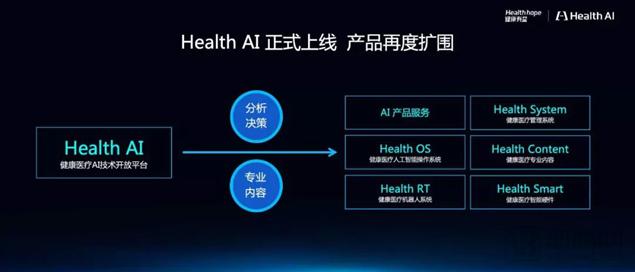
The scenario we are witnessing now has completely surpassed previous understandings. In the era of mobile internet, we needed to download an app to connect with users, relying on vast amounts of data to guide consumer behavior. Today, however, our technology enables us, together with partners across all open platforms, to reach end customers directly. There is no longer a need to download apps or functional software; instead, as skill-based applications become increasingly prevalent, we can seamlessly access both terminal devices and service endpoints across various scenarios at any time.
The Health AI released today delivers output through two components, compared to the product during its trial operation phase.
I. Professional Content. What distinguishes AI companies in vertical domains from AI technologies in the technical field? It is not about a single skill, but rather about integrating professional expertise across various fields to deliver outputs to the front end.
2. Decision-Making Capability. The Ego brain processes massive amounts of corpora, images, and text daily—referred to as multimodal feedback. Determining the analytical techniques to employ for output and identifying which problems to solve require substantial intermediate AI technology integration and professional content generation, before being delivered to front-end products.
Below, I will explain some specific products on the Health AI Open Platform.
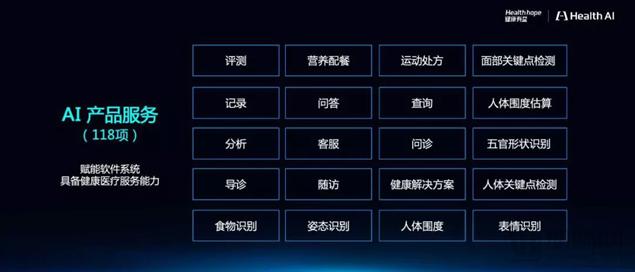
AI Product Services
This is a partial list of skills; a total of 118 skills were released before the Spring Festival, all of which are accessible on the Health AI platform. We also invite developers to jointly test this product at that time.
AI capabilities can extend into everyday human life, leveraging computer vision and natural language processing (NLP) technologies to integrate with both front-end and back-end systems. For this specific AI-powered assessment product alone, more than 160 metrics can be provided across various dimensions, including different demographic attributes, time periods, and special historical contexts.
A single evaluation module can cover nearly all vertical B-end clients across the industry, and the same applies to several other fields. For instance, nutritional meal planning has evolved from initially identifying foods and providing calorie counts to currently offering customized meal plans for patients with chronic diseases such as diabetes. Each category represents a massive volume of demand.
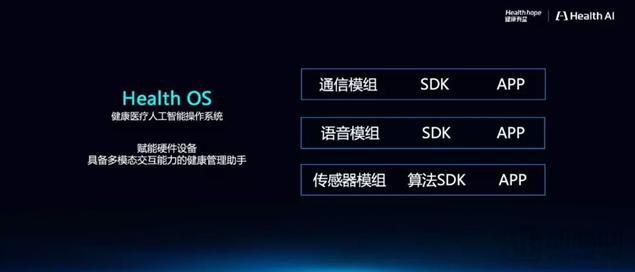
Health OS System
All of our technologies are powered by the Ego Brain, which delivers outputs to software platforms and developers, and subsequently to hardware devices such as smart blood pressure monitors, glucometers, or screen-enabled products. While these devices may appear to users merely as apps displaying daily trends or basic statistical data, they are underpinned by this core intelligence.
However, by embedding communication modules, voice modules, and sensor modules into blood pressure monitors, these devices gain multimodal interaction capabilities. They evolve from simple data-tracking tools into comprehensive health management assistants capable of analyzing data and even generating corresponding health management solutions. We have not made any modifications to the products themselves; we simply integrated these modules into existing devices. Therefore, for the entire industry, we have not incurred any additional costs. Instead, we connect and output our algorithms to all front-end smart products via communication protocols. How can health hardware products be transformed into AI-powered products in the simplest way possible? This is precisely what Health OS is achieving.
Thus, throughout the industrial upgrade process, there is no need for substantial effort or high costs to transform products into AI-enabled ones. Our technology is readily available; it simply requires integrating our modules with existing ones. For application developers, we provide an SDK package via module output. From the user’s perspective, this means upgrading a conventional app into one with AI capabilities. Moreover, apps can even be downloaded with a single click on our platform. We anticipate that the entire industry will upgrade at an extremely rapid pace in a very short time, reflecting how accumulated technology is driving industrial advancement and facilitating sector-wide progress.
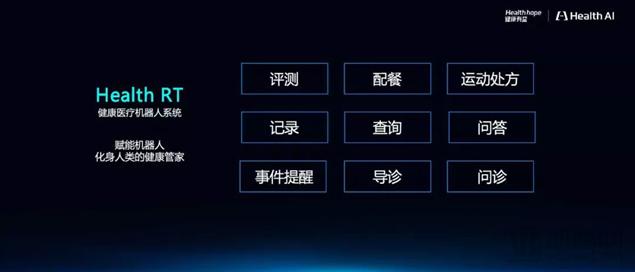
Health RT System
Many domestic peers have developed hardware robots with excellent user experiences, featuring highly coherent movements and awareness. To equip these robots with specialized capabilities in specific fields—such as guidance, consumer services, healthcare, and health management—it is necessary to collaborate with vertical-sector companies to endow the robots with the requisite skills.
Currently, our partners include the leading and large-scale robotics companies in China. They integrate our modules into their camera or voice systems to develop health management robots or medical robots. From the perspectives of industrial upgrading and future trends, this approach will significantly enhance output and execution efficiency in specialized fields.
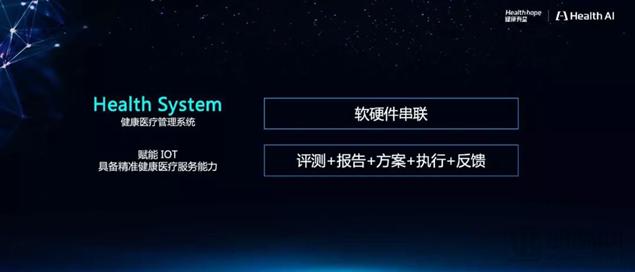
Health System
Health System: In sectors with limited intelligence capabilities, such as traditional healthcare service terminals, certain physical examination centers, elderly care facilities, and community service platforms operated by real estate companies, there is a lack of mature intelligent development capabilities. Previously, the entire system and its offline implementation scenarios lacked intelligent user experiences.
Over the past one to two years, through our commercial implementation and exploration efforts, we have empowered two elderly care community projects in Shanghai, each covering a scale of approximately 20 communities. The applications involved require meticulous product refinement. In addition to integrating systems with all apps and mobile mini-programs, it is also necessary to embed user data—referred to as resident elderly care plans or resident community plans—into the backend, while incorporating numerous smart applications into offline implementation scenarios.
Currently, many smart products on the market, such as blood pressure monitors, assessment software, and therapeutic service devices, either lack memory capabilities or have memory without interactive features. Addressing these limitations is critical for future large-scale deployment in real-world scenarios. How can we connect such a vast population and market with our specific needs? To this end, we have developed the Health System, which offers two key solutions: first, the integration of hardware and software, enabling our comprehensive hardware-software services to be deployed across all offline terminals; and second, feedback through assessment reports, bridging theoretical frameworks with front-end user demands.
For any large community, elderly care center, or chain enterprise with thousands of terminal outlets that we currently collaborate with, user needs are diverse; therefore, end-user products can be developed based on user personas.
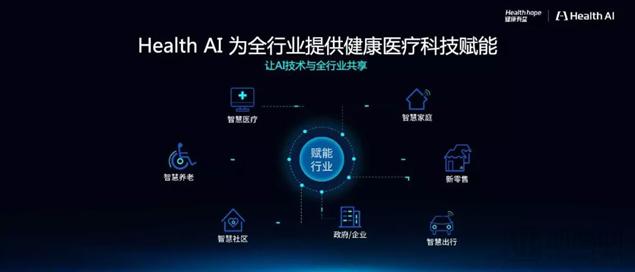
To summarize the major mainstream scenarios empowered by Health Hope, we have established a highly comprehensive suite of AI applications for health management. In terms of practical implementation, our goal is to integrate as seamlessly as possible into people’s daily lives, which underscores the core value of health management. As mentioned at the outset, AI makes health accessible to all.
Across smart homes, new retail, smart mobility, smart communities, smart elderly care, and smart healthcare, we are currently serving over 300 clients. We hope that developers addressing these market needs will leverage our open platform to directly access our technologies, enabling enterprises to bring their products to market—this is the ideal scenario we envision.
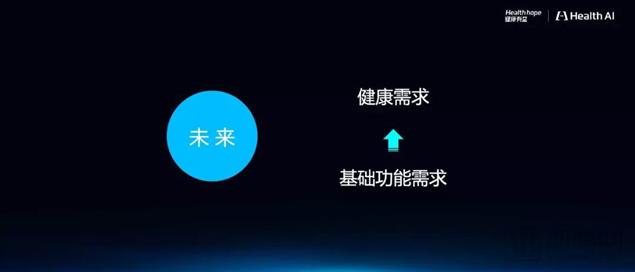
Looking ahead, we hope to fully connect people’s basic demands for the health industry with their true health needs, enabling everyone to experience the warmth of AI. This is what we aspire to achieve. Thank you all. Link to the Health AI Open Platform:
https://healthai.jiankangyouyi.com