

2018 Digital Health Recap: 56 M&A Deals with a Record Single Transaction of $2.1 Billion (Part I)
Recently, the U.S. healthcare media outlet MobiHealth News reviewed a record-breaking 56 mergers and acquisitions in the digital health sector in 2018, of which 13 disclosed their prices, with the total transaction amount reaching $7.6 billion.
MobiHealth News noted that this year, the number and value of mergers and acquisitions in the digital health sector, as well as the high-profile nature of the participating companies, have been noteworthy. For example, in 2018, Amazon acquired PillPack, Best Buy acquired GreatCall, and Roche acquired Flatiron Health. More recently, ResMed acquired Propeller Health, a long-standing key player in the digital health space.
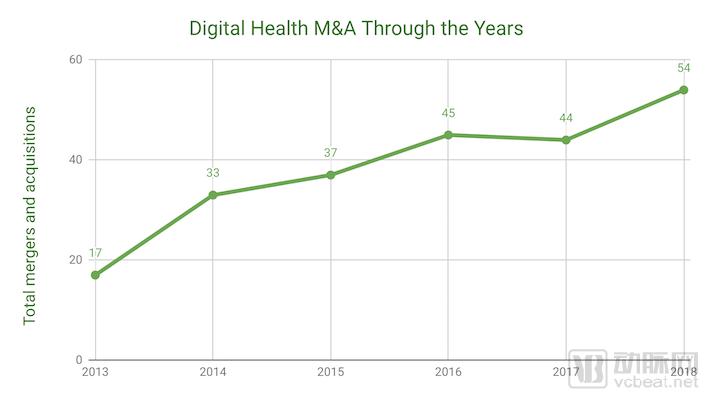
Trend Chart of M&A Deal Volume in the Digital Health Sector, 2013–2018 (Image source: MobiHealth News))
A Review of the Record-Breaking 56 M&A Deals in the Digital Health Sector in 2018: VCBeat (WeChat ID: vcbeat) will publish this content in two parts for its readers. Below is the first part, compiled and translated by VCBeat, covering the first 28 M&A transactions in the digital health sector.
M&A transactions are ranked in descending order by deal size; those with undisclosed deal sizes are sorted by transaction date and listed at the end.“2018 Digital Health Review: 56 M&A Transactions Occurred, with the Largest Single Deal Reaching $2.1 Billion” (Part II), VCBeat will launch next time.
Johnson & Johnson Sells LifeScan to Platinum Equity
This October, Platinum Equity completed its acquisition of Johnson & Johnson’s LifeScan business, which is based in Chesterbrook, Pennsylvania, and Zug, Switzerland. Platinum Equity paid $2.1 billion for the transaction; last year, the company reported net income of $1.5 billion. As Platinum Equity aims to provide customers with as seamless a transition as possible, Valerie Asbury, President of LifeScan, will continue to lead the company’s operations.
Roche Acquires Flatiron Health
Pharmaceutical giant Roche completed its acquisition of Flatiron Health, an oncology EHR software company, in April this year. In 2016, Roche had invested millions of dollars in Flatiron. Through this merger and acquisition, Roche paid $1.9 billion and acquired full equity ownership of Flatiron.
“This is an important step in Roche’s personalized healthcare strategy, because we believe that real-world evidence at the regulatory grade is a key factor in accelerating the development and access to novel cancer treatments,” said Daniel O’Day, CEO of Roche Pharmaceuticals, in a statement. “As a leading technology company in the field of oncology, Flatiron Health is best positioned to provide the technological and data analytics infrastructure that is needed not only by Roche but also by the entire industry’s oncology research and development efforts. However, there is a key principle: maintaining Flatiron’s autonomy and its ability to continue serving all existing and future partners.”
3M Acquires M*Modal’s Technology Division
3M Acquires M*Modal’s Technology Division for $1 Billion3M has acquired the technology division of clinical documentation company M*Modal for $1 billion. This move enhances 3M’s cloud-based artificial intelligence and speech recognition capabilities and expands the company’s portfolio. The transaction, expected to close in early 2019, will add 750 employees to 3M from M*Modal’s technology business.
M*Modal, a spin-off from Carnegie Mellon University headquartered in Pittsburgh, will continue its transcription, dictation, and coding services following the acquisition.
Amazon Acquires PillPack
For months, rumors circulated that PillPack was in acquisition negotiations with Walmart. However, online retail giant Amazon subsequently acquired PillPack for slightly less than $1 billion (the deal terms were not disclosed, but the $1 billion figure has been widely reported).
PillPack is a full-service pharmacy that manages patients’ medications, sorts them by dose, and delivers them directly to patients’ homes.
With this acquisition, Amazon, the consumer goods company renowned worldwide for its “one-click shopping,” is poised to expand its services into areas including prescription drugs. Meanwhile, the joint healthcare venture between Amazon, Berkshire Hathaway, and JPMorgan Chase has also begun operations.
Best Buy Acquires GreatCall
This August, Best Buy acquired GreatCall for $800 million. Based in San Diego, GreatCall is a conservative digital health company that began manufacturing smartphones for the elderly in 2006. Subsequently, GreatCall launched new business lines offering safety-related products and services for seniors.
In June 2017, GreatCall was acquired by the private equity firm GTCR for an undisclosed amount. Subsequently, GTCR sold the company, which had nearly one million paying subscribers, to Best Buy, a retail chain based in Minneapolis. Best Buy stated that the acquisition was part of a major strategic initiative to invest in technology for the growing senior market by 2020.
ResMed Acquires MatrixCare
This November, connected respiratory device manufacturer ResMed announced that it would acquire Minnesota-based EHR company MatrixCare for $750 million. MatrixCare’s EHR is designed to support long-term acute care services, such as skilled nursing facilities, life plan communities, and senior living homes.
The transaction is expected to close before the end of ResMed’s second fiscal quarter of 2019. Upon completion, MatrixCare will operate as an independent business within ResMed’s portfolio. The deal is also anticipated to help ResMed expand its software-as-a-service (SaaS) offerings in the long-term care sector.
Teladoc Acquires Advance Medical
Following last year’s acquisition of Best Doctors, Teladoc acquired Advance Medical for $352 million. This move is expected to help Teladoc expand its global market presence into Latin America and the Asia-Pacific region, enabling the company to deliver care services in 20 languages through its platform.
Teladoc CEO Jason Gorevic stated that these services will be targeted at multinational corporations headquartered in the United States with one-third of their consumers located in other countries, as well as international health insurance companies seeking to enhance their healthcare services.
ResMed Respiratory Care Acquires Propeller Health
ResMed acquired Propeller Health, a digital respiratory health company based in Wisconsin, USA, for $225 million. The company planned to complete the acquisition of Propeller Health by March 2019, after which Propeller was expected to operate as an independent entity within ResMed’s product portfolio.
According to the company's announcement, there will be no immediate changes in Propeller Health's management.
Medidata Acquires Shyft Analytics
In June this year, Medidata acquired Shyft Analytics, a New York-based company that provides cloud storage and data analytics services for clinical trials. The transaction valued Shyft at $195 million, including the 6% stake in the analytics platform previously held by Medidata, and will be paid in cash.
Currently, the two companies have jointly launched a product named the “Life Sciences Intelligence Platform.” Notably, this product integrates clinical and commercial information into a more comprehensive data platform, which can be used to optimize the value of drugs from development through to final commercialization.
Allscripts Acquires HealthGrid
EHR vendor Allscripts acquired HealthGrid for $110 million, including $60 million in cash and a $50 million earn-out contingent on HealthGrid achieving profitability over the next three years.
“Allscripts President Richard J. Poulton stated during the first-quarter earnings conference call announcing the acquisition: ‘The increasing adoption of value-based care, coupled with low patient portal utilization across the industry, makes it essential to adopt a new approach to designing patient engagement solutions. We aim to integrate HealthGrid’s capabilities into our FollowMyHealth platform and add additional features that enable providers to achieve 100% coverage of their patient populations by leveraging existing patient contact information, rather than requiring patients to re-register for the portal.’”
Allscripts Acquires Practice Fusion
EHR vendor Allscripts has acquired smaller EHR vendor Practice Fusion, an early mobile electronic health record provider, for $100 million. Currently, approximately 30,000 outpatient sites utilize Practice Fusion’s EHR, practice management, e-prescribing, laboratory, and patient portal technologies, serving around 5 million patients per month.
Allscripts President Rick Poulton stated in a press release: “In combination with Practice Fusion, we look forward to Allscripts continuing to drive innovation to address more healthcare needs, improve clinical outcomes, and advance real-world evidence research. Furthermore, Practice Fusion’s affordable EHR technology resolves the longstanding challenge of enabling independent physician practices, while its cloud-based infrastructure aligns with Allscripts’ forward-looking vision for solution delivery.”
Logisticare Acquires Circulation
Logisticare, the largest non-emergency medical transportation (NEMT) broker in the United States, has reached an agreement to acquire Circulation, a healthcare transportation company that supports app-based services, for $44 million, with an additional $1 million to be paid to each of the co-founders over three years.
The transaction is somewhat complex: with a total deal value of $57.5 million, the buyer will receive $11.5 million because Providence, Logisticare’s parent company, holds a minority stake in Circulation. Logisticare intends to retain Circulation’s entire management team and integrate its technology into its nationwide operations.
Dexcom Acquires TypeZero Technologies
In late August this year, Dexcom announced the acquisition of TypeZero Technologies but did not disclose the transaction price. In its Form 10-Q filing with the U.S. Securities and Exchange Commission (SEC), Dexcom mentioned a “net cash outflow of $11.3 million related to the acquisition,” which may represent the purchase price for TypeZero Technologies.
TypeZero Technologies is renowned for its expertise in insulin delivery advisory algorithms and has previously collaborated with competitor Senseonics. Dexcom plans to launch an automated insulin delivery system based on TypeZero’s technology in 2019.
Persistent Systems Acquires Herald Health
Persistent Systems, headquartered in Pune, India, has acquired Herald Health, a two-person health tech startup that successfully conducted pilots at Brigham and Women’s Hospital and Boston Children’s Hospital in Boston.
According to multiple Indian media outlets, the two companies did not disclose the terms of the transaction, but the total deal value was $5.2 million. Founded in 2015, Herald Health has neither raised capital nor hired full-time employees, apart from its two co-founders. The company has developed a software platform that automatically notifies various hospital stakeholders when data changes occur in electronic health records (EHR) and other data systems.
InTouch Health Acquires TruClinic
InTouch Health, a marketing company for an enterprise telemedicine platform, announced in January this year the acquisition of TruClinic, which specializes in consumer-facing online virtual healthcare.
InTouch Health’s leadership stated that the purpose of this acquisition is to expand the company’s existing product portfolio, provide healthcare providers with more comprehensive virtual care programs, and better ensure continuity of care between physicians and patients.
Following the acquisition, InTouch Health integrated TruClinic’s software into its product offerings, enabling patients to consult with healthcare system physicians from home and further expanding InTouch Health’s telehealth platform.
AccessOne Acquires HealthFirst Financial
In January this year, patient financing company AccessOne announced the acquisition of HealthFirst Financial, a software service provider offering patient financing programs to healthcare institutions, for an undisclosed amount.
Following the completion of this acquisition, AccessOne will be able to provide healthcare-system-customized health products, including mobile tools, for their care settings. However, the company’s ultimate goal is to reduce bad debt and improve patient satisfaction.
StayWell Acquires Provata
Merck subsidiary StayWell acquired Provata Health in February of this year for an undisclosed amount. StayWell provides preventive care platforms for employers, health plans, and healthcare systems, while Provata Health offers a digital health platform for employee wellness. This platform includes a chronic disease management system with connected scales and blood pressure monitors, a lifestyle management platform with activity trackers, and a mental health platform featuring VR headsets.
Nicole Latimer, CEO of StayWell, stated, “This acquisition will significantly enhance our capabilities. We recognize that we must be more advanced in delivering provider-facing solutions via mobile devices. The acquisition of MedHelp was an important step in this direction, and by offering the functionalities inherent to the Provata platform, we have now become an industry leader. We no longer need to build our own solutions and can immediately enter the market with this powerful mobile-enabled suite. Many health plans we have previously engaged with required mobile capabilities, making this feature critically important at present.”
Fitbit Acquires Twine Health
Earlier this year, Fitbit acquired the medical training platform Twine Health for an undisclosed amount.
According to the acquisition announcement, this acquisition will help Fitbit continue its expansion into the healthcare sector and extend its products to health plans, medical systems, and self-insured employers, creating opportunities to increase subscription revenue. Ultimately, Fitbit plans to expand Twine’s products to 25 million device users and extend Twine into new disease areas.
MindBody Acquires FitMetrix
MindBody, a health platform headquartered in San Luis Obispo, California, has acquired FitMetrix, a performance-tracking service platform, for an undisclosed sum. Headquartered in Atlanta, FitMetrix primarily helps fitness businesses, such as gyms, engage with users and track their workout progress to improve retention rates. The company’s platform allows customers to book classes, monitor their exercise routines, and connect with gyms.
Reports indicate that FitMetrix and Mindbody partnered in 2015 to enable fitness studios and gyms to integrate digital performance tracking across multiple categories. Following the collaboration, Mindbody gained the ability to use customized workout metrics to track, rank, and reward clients in real time.
HIMSS Acquires HealthBox
At the global annual conference in March, HIMSS, the parent company of MobiHealthNews, announced the acquisition of HealthBox to bolster its innovation consulting and fund management operations. Founded in 2010 as a digital health accelerator, HealthBox has since been transitioning toward the fields of innovation consulting and fund management.
Following the acquisition, Healthbox will support HIMSS in the field of innovation consulting by helping healthcare organizations understand what constitutes innovation and providing them with innovation guidance.
In terms of fund management, Neil Patel, President of Healthbox, stated that the company collaborates with healthcare organizations to formulate strategies and establish criteria for screening and evaluating companies. It engages executives in the investment process by acting as a facilitator rather than making decisions on their behalf.
SCI Solutions Acquires DatStat
In April this year, SCI Solutions, a patient engagement and care coordination company, announced the acquisition of DatStat, a company specializing in digital health tools and patient engagement services. The financial terms of the deal were not disclosed.
The SCI Solutions platform provides patient scheduling, referral management, and revenue cycle software infrastructure, and is currently used by 1,000 hospitals and imaging centers as well as 13,000 physician practices. The company plans to integrate its offerings with DatStat’s digital self-service tools, which include resources for patient visit preparation, secure messaging systems, visit summaries, and care plans.
SleepScore Labs Acquires Sleep.ai
SleepScore Labs, a manufacturer of contactless sleep trackers, has acquired the Dutch company Sleep.ai for an undisclosed amount. Founded in 2014, Sleep.ai specializes in wearable devices and applications that help users determine whether they are snoring. One of its products is a wearable band worn on the user’s arm, which vibrates when the user turns over and begins to snore. The device can also connect to the user’s smartphone.
Colin Lawlor, CEO of SleepScore Labs, stated in a press release: “For many customers, they are not even aware that they suffer from snoring or bruxism. The team at Sleep.ai has made remarkable progress in improving patients’ sleep health.”
Livongo Acquires Retrofit
In April this year, digital chronic disease management company Livongo announced the acquisition of Retrofit, a company specializing in weight management and disease prevention. The financial terms of the deal were not disclosed.
Following the completion of this acquisition, Livongo’s customers will gain access to Retrofit’s diabetes prevention program. This move will also help the Mountain View–based company integrate more healthcare professionals into its existing management system, thereby expanding its service offerings to include weight management and nutritional services.
American Well Acquires Avizia
In late February this year, Boston-based American Well acquired the telehealth company Avizia for an undisclosed sum. The acquisition is expected to help American Well expand its acute care capabilities, which are Avizia’s specialty.
Meanwhile, following the completion of this acquisition, American Well will be able to leverage Avizia’s extensive portfolio of medical-grade carts and customize software workflows for more than 40 clinical specialties, such as telestroke and telebehavioral health services.
Dr. Ido Schoenberg, CEO of American Well, stated, “Over the past few years, we have closely monitored Avizia. We believe that our DNA, culture, and mission are aligned, and we are confident that this acquisition will enable us to deliver an integrated platform to a robust, combined customer base.”
InTouch Health Acquires Reach Health
On the same day it announced the acquisition of Avizia, InTouch Health, a developer of telehealth technologies for hospitals and health systems, announced its acquisition of another telehealth company, Reach Health.
InTouch Health’s leadership stated that the addition of Reach Health would help expand the company’s market scale while further strengthening its telehealth capabilities, ensuring that existing Reach Health customers receive more reliable, secure, and compliant care.
Withings Reacquires Nokia Digital Health
Eric Carreel, co-founder of the French health technology company Withings, has repurchased the Digital Health division two years after it was sold to the Finnish tech giant Nokia.
Withings, founded in 2008, has gained widespread popularity for its smartphone-connected scales, blood pressure cuffs, activity trackers, and thermometers. According to the buyback announcement, the Withings team plans to continue selling Nokia Health products, as well as new Withings innovations, through the end of the year.
In its acquisition announcement, Carreel stated, “From this point forward, we must focus on developing tools capable of advanced measurements and related services that help prevent chronic health conditions.”
Marlin Equity Partners Acquires and Merges Virgin Pulse and RedBrick Health
Virgin Pulse and RedBrick Health, two employee health and wellness engagement platforms, announced in May that they would merge under the Virgin Pulse name. A week earlier, Marlin Equity Partners acquired RedBrick Health and then Virgin Pulse on the same day; the acquisition amounts for both companies were not disclosed.
The acquisition aims to make the capabilities of both platforms available to their combined customer base. According to the two companies, the newly merged entity will continue to support the Virgin Pulse and RedBrick platforms while driving innovation in their products.
Among them, Virgin Pulse’s flagship product, the SaaS platform Virgin Pulse Engage, delivers a personalized, mobile-first experience to help employees improve their health. Meanwhile, RedBrick Health’s platform provides real-time data and guidance, health assessments, and biometric screening services.
WebMD Acquires Jobson Healthcare
WebMD, a subsidiary of Internet Brands, acquired another healthcare content group, Jobson Healthcare Information, earlier this year for an undisclosed amount.
The primary objective of this acquisition is to comprehensively enhance Medscape’s content, particularly for pharmacists and eye care professionals (including optometrists and ophthalmologists). Jobson will continue to operate from its existing offices and provide many of its current publications.
Sophia Genetics Acquires Biosoftware
Genomic AI company Sophia Genetics acquired Interactive Biosoftware this year. The latter is the manufacturer of Alamut, a clinical decision support software for the interpretation of clinical genomic data. The specific terms of the transaction have not been disclosed.
Jurgi Camblong, CEO and Co-Founder of Sophia Genetics, stated in a press release: “Both Sophia AI and Alamut feature trusted, patient-centric innovative technologies in the healthcare sector. The addition of Alamut marks a significant step forward in our mission to help clinicians better diagnose patients. With our technology now used by more than 900 teaching hospitals, we hold a unique advantage in connecting clinicians and facilitating knowledge sharing.”