

Miao Health Releases 'The Unhealthy Dictionary' Based on 58.4 Million Users: Transforming Low-Frequency Behaviors into User Engagement
“Sedentary Individuals,” “Heart Health Advocates,” “Out-of-Network Populations,” “Misdiagnosed Obesity Cases,” “Health Novices”...
At the 2018 Top 100 Future Healthcare Health Management Forum, Kong Fei, CEO of Miao Jiankang, released the “2018 Dictionary of Unhealthy Behaviors,” delivering a “health communication” campaign in a format best suited for the internet by categorizing health behaviors across different regions, populations, and types.
Since its establishment in 2014, More Health has been continuously exploring the technological transformation of health management, while also validating its business model through both online and offline channels. After a series of trials, what can More Health achieve with its data? VCBeat attempts to analyze More Health’s data-driven journey by combining Kong Fei’s on-site presentation with interview insights.

Kong Fei, CEO of Miao Health
Shift User Awareness: Conduct Market Education via Internet-Based Approaches
“Giving a series of unhealthy behaviors an interesting name, or one that is more likely to resonate with the individuals involved, may provide the necessary stimulus for users. The ultimate goal is to motivate users to take action and change their unhealthy habits. On the other hand, now that we have accumulated sufficient data, it serves as a form of market education, raising health awareness,” said Kong Fei.
For health management, the core support lies in the awakening of public health awareness. He emphasized that the launch of The Dictionary of Unhealthy Habits represents a “milestone” achieved after four years of entrepreneurship by Miao Health. Behind these unhealthy behaviors is the support of health behavior and health data from 58.4 million users.
Kong Fei believes that the health and medical industries differ in their ability to attract traffic. Health services align more closely with the internet business model, whereas healthcare represents a low-frequency scenario that inherently lacks internet attributes and does not serve as an entry-level internet application scenario. A low-frequency scenario cannot become an entry point.
In healthcare behaviors, identifying high-frequency activities, creating high-frequency engagement, aggregating low-frequency interactions into high-frequency ones, and leveraging low-frequency scenarios to generate commercial value have become the keys to successful business models.
Since people cannot visit doctors frequently, high-frequency demand is difficult to generate. Therefore, adopting a health management approach, with physicians or health managers as the driving force, may be an effective way to stimulate high-frequency demand.
The number of B-side clients is increasing.
Miao Health’s coverage of 58.4 million users stems from three sources: first, users from the insurance industry; second, members of large enterprises; and third, consumer-end mobile phone users.
According to Kong Fei, in its first year, Miao Health’s user base was predominantly composed of individual consumers (C-end), as business-facing (B-end) products had not yet been developed. During that inaugural year, Miao Health leveraged offline stores for customer acquisition, employing a new retail model to rapidly attract 20 million users. By offering experiential sales of smart hardware devices such as blood pressure monitors and thermometers designed for use with mobile phones, the company enhanced store value while simultaneously acquiring customers online.
B-end users are derived from services provided to corporate employees, insurance group clients, government platforms, and telecom & mobile device manufacturers. Miao Health’s B-end services include employee health management solutions and health management system services.
Miao Health’s group physical examination and health management services primarily target small and medium-sized enterprises (SMEs). By offering comprehensive solutions ranging from employee check-up planning and institutional selection recommendations to value-added professional medical services, Miao Health facilitates the upgrading of corporate health services.
Many companies include health checkups as part of their employee benefits packages. However, a health checkup is not equivalent to comprehensive health management services. Most individuals fail to engage in timely, targeted health management after receiving their checkup reports, leading to a prevalent phenomenon of “checkup without follow-up care.” Miao Jiankang offers corporate clients free value-added health services beyond standard checkup packages, including interpretation of checkup reports, telemedicine consultations, self-assessment and medication guidance, and assistance with hospital appointment registration. These offerings significantly expand the scope of its health management services.
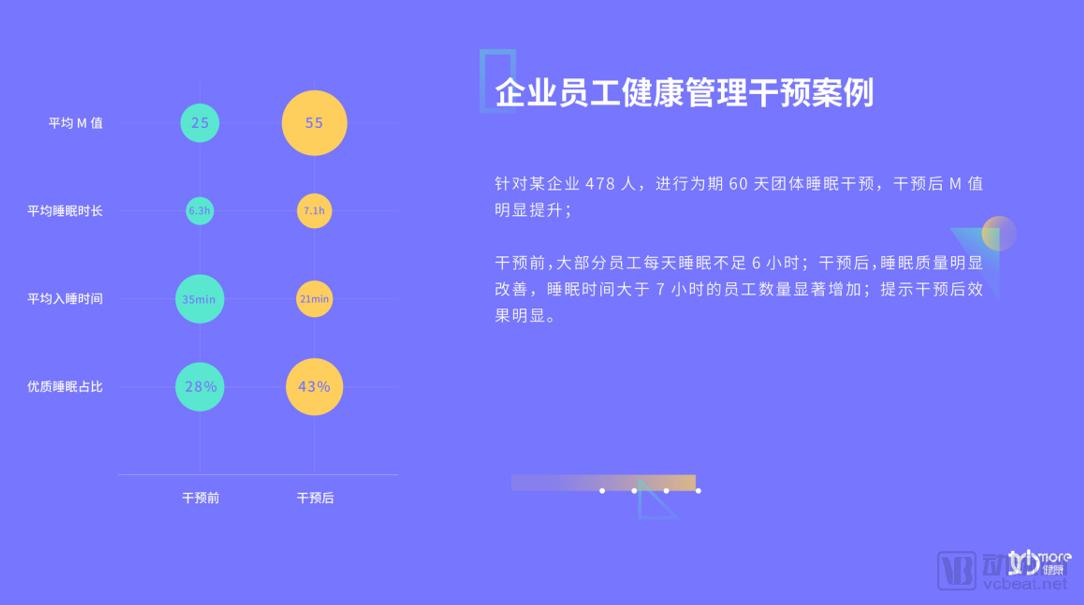
In a typical case, Kong Fei cited an example of a company with 478 employees that underwent a 60-day group sleep intervention. After the intervention, the M value increased from an initial 25 to 55. Prior to the intervention, most employees slept less than 6 hours per day; afterward, there was a significant increase in the number of employees sleeping more than 7 hours.
The health management system services include partners such as Huawei Health, Samsung Health, and Lenovo’s U Health, empowering clients with a broad customer base but lacking in-house health service capabilities.
The business model has evolved from a consumer-centric (C-end) approach to a B2B2C model, benefiting from the maturity of Miao Health’s products serving enterprise clients. Citing the high cost of online customer acquisition and the challenges in ensuring user adherence, Kong Fei stated: “The number of B2B customers is increasing., when we first started our consumer-facing business, we found that retaining users was not easy, even with gamification techniques. Business-to-business (B2B) users are different: through partnerships with insurance companies, the M-value’s health assessment influences insurers’ pricing, which helps retain users. The longer users stay, the greater the value derived from them. In this regard, the M-value becomes even more valuable.”
Managing Health with M-Value: Tracking the Effectiveness of Health Management through Big Data
The core of health management lies in “management” and “organization.” In the past, simply following doctors’ advice with vague recommendations like “watch your diet and exercise more” could not be considered true health management. Kong Fei stated, “Transforming health education into health management requires data-tracking capabilities to effectively manage it. Without knowing whether users have followed the system-recommended plans or whether those plans were effective, it is impossible to properly manage users.”
The Health Behavior Index is a proprietary health behavior algorithm developed by Miao Jiankang, abbreviated as the “M Value” (More Health Behavior Score). By comprehensively analyzing data such as users’ health behaviors, physical metrics, and medical examination reports, it quantifies users’ health behaviors into a numerical score, helping them intuitively understand their health behavior status.
Tailor health behavior promotion plans to each user’s habits, guiding improvements in exercise, nutrition, sleep, and mental well-being to help users truly embrace the philosophy of “100 M-Points Daily for a Healthy Life Every Day.”
Since its inception in 2014, Miao Health has focused on promoting the interoperability of various health data and services. In early 2016, it launched “Miao+,” an open platform for health data and services. Leveraging the connectivity capabilities of Miao+, the platform has integrated data from over 300 smart devices across major mainstream brands, as well as diverse health-related data such as physical examination results, genetic information, and insurance records, thereby providing users with comprehensive health data monitoring and management.
According to Kong Fei, approximately 1.16 million people use Miao Health’s products daily, generating 67.28 million M-Values.
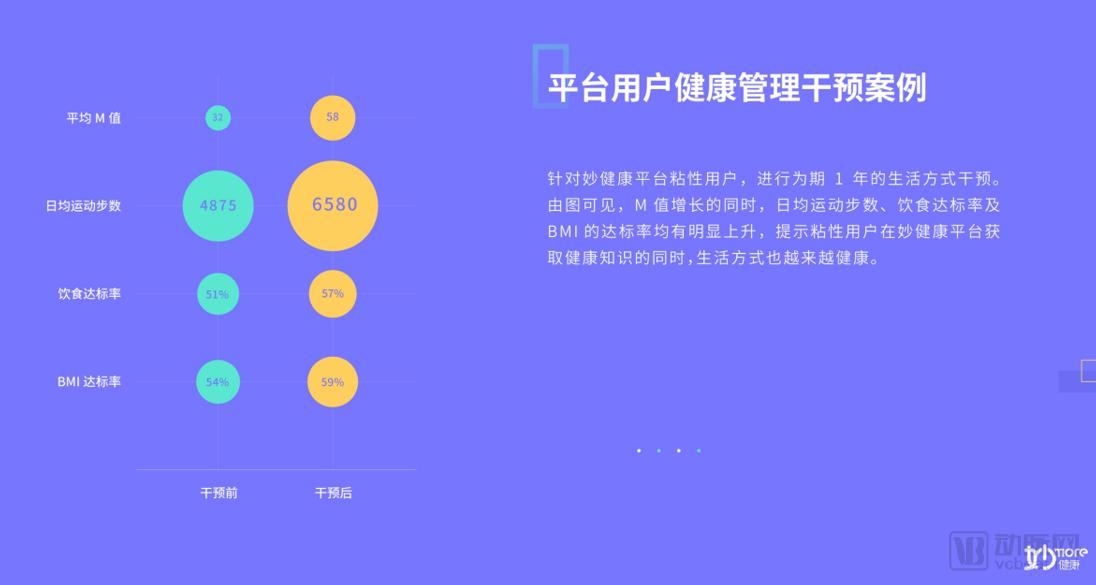
In health management intervention cases for users of the Miaojiankang platform, the team conducted a one-year lifestyle intervention for engaged users. During the intervention, health was quantified using Miaojiankang’s proprietary M-Score. As the M-Score increased, there were significant improvements in average daily step count, dietary compliance rate, and MBI compliance rate, indicating that engaged users not only acquired health knowledge through the Miaojiankang platform but also adopted healthier lifestyles.
Precisely because the Miao Health platform accesses and generates vast amounts of data on a daily basis, Kong Fei and his team have been dedicated to advancing standards for the interoperability of wearable devices. In 2017, Miao Health, in collaboration with the Ministry of Industry and Information Technology (MIIT) and the Chinese Center for Disease Control and Prevention (China CDC), launched the “Big Data Platform for Health Management Information Exchange” project, aiming to establish a standard for the interoperability of health-related wearable devices in China. The “Health Management Information Exchange Platform” was subsequently released in April 2018.
At the 2018 Future Healthcare Top 100 Forum, Kong Fei informed us that at the recently concluded 19th Plenary Session of the Mobile Internet Applications and Terminal Technology Working Committee (TC11) under the China Communications Standards Association, two standards drafted with the participation of More Health—namely, “General Technical Requirements for Health Information Interaction Business Systems Based on Mobile Internet” (2018-0151T-YD) and “Service Indicator Requirements and Evaluation Methods for Smart Hardware Open Platforms Based on Mobile Internet” (2018-0195T-YD)—were approved by the plenary session and officially adopted as industry standards.
This also means that interactions between data from wearable devices will be traceable, and more wearable devices will be able to connect to the Miao+ platform.
New Interactive Insurance Initiatives: Expanding Offline Health Management Centers
Given the uneven distribution of medical resources, it is impractical to assign a personal health physician to every individual for health management. To improve efficiency, artificial intelligence support is essential. Miao Health’s AI leverages existing data accumulation to continuously optimize algorithms and deliver intelligent recommendations.
Tailored healthy lifestyle solutions are recommended for different users, covering exercise, dietary management, sleep, stress management, and chronic risk factors. On the platform, each user may receive different health tasks daily. After the platform assigns these health tasks, wearable devices connected via Miao+ track whether the user has completed them. By monitoring compliance with completion criteria, the system quantifies the user’s health status and generates an “M-Score.” This constitutes Miaojiankang’s comprehensive health management solution.
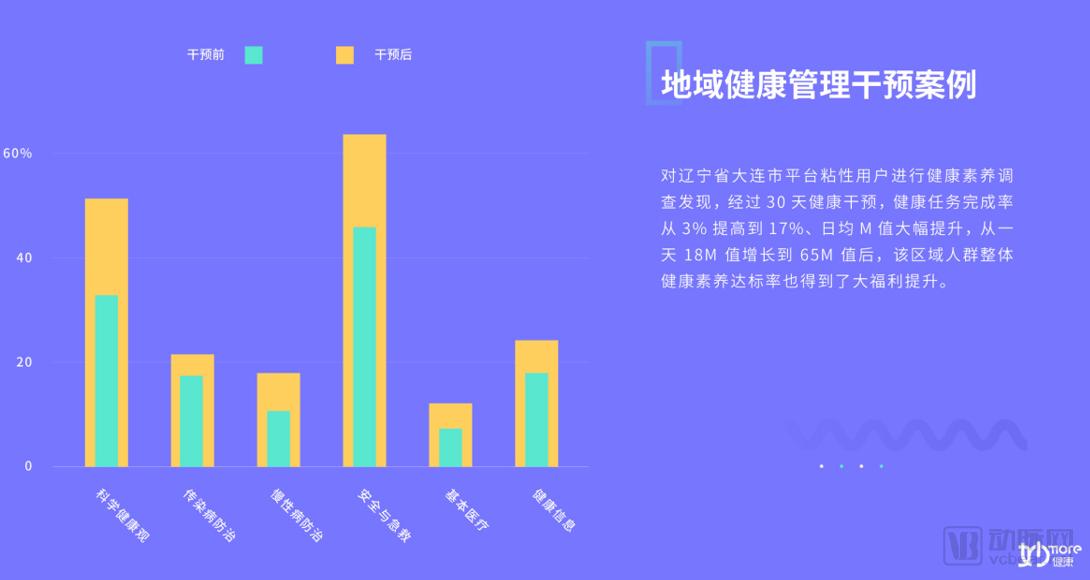
In a regional health management intervention case, a health literacy survey conducted among highly engaged users of the platform in Dalian, Liaoning Province, revealed that after 30 days of health intervention, the completion rate of health tasks increased from 3% to 17%. The average daily M-value rose significantly, increasing from 18 to 65 per day. Consequently, the overall rate of compliance with health literacy standards in this population also saw a substantial improvement.
This November, U.S. insurance giant John Hancock Life Insurance announced it would cease sales of traditional life insurance policies, signaling ahead of schedule the advent of an era in which health management has become a standard component of health insurance. All John Hancock policies will now include the “Vitality Program,” providing customers with fitness trackers from Fitbit, Garmin, and Polar. By leveraging health behavior data and health management services, the program incentivizes customers to adopt healthier lifestyles, thereby achieving cost containment.
Frost & Sullivan predicts that in 2019, personalized health insurance driven by lifestyle and health data will reshape the health insurance industry. This is because the growth rate of the health insurance industry in 2018 will be less than 1.5%. To ensure future growth in global insurance revenues, many insurers have begun providing data- and digital-driven healthcare services to their policyholders while reducing potential claims costs. By the end of 2019, 5–10% of health insurance plans will be linked to interactive policies in some form.
In China, Miao Health has already begun collaborating with insurance companies such as Sunshine Insurance and Aeon Life to explore data-driven interactive insurance. Kong Fei stated, “We hope to work with insurance partners and other ecosystem collaborators to create China’s first interactive insurance policy... In the future, we may integrate the M-Value with a bank’s payment system. This would allow consumers to use their M-Value for purchases at Starbucks, supermarkets, and other retailers.”
Furthermore, after attracting sufficient online traffic, and leveraging a trust-based healthcare model, Miao Health’s first jointly operated store with the Canadian Wellness Institute (CWI) is scheduled to open after the Spring Festival, enabling users to access offline health management services. Established in 1997, CWI relies on advanced medical fitness facilities and a professional medical team to develop personalized treatment plans based on clinical evidence-based medicine. It has served over 6 million individuals, prevented nearly 10,000 cardiac incidents, achieved a total weight loss of 120,000 pounds among participants, and saved the Manitoba provincial government approximately CAD 400 million in healthcare expenditures solely through chronic kidney disease management.
Kong Fei stated that after the full integration of Miao Health’s system with that of the Canadian Health Management Center, Miao Health aimed to open 12 stores in 2019 and expand to 30 stores in 2020.
Benchmarking against the U.S. health management system, scientific management, payment mechanisms, and user adherence constitute the three core pillars of health management. From AI- and big data-driven health management platforms to explorations in interactive insurance, and further to the introduction of the service framework from Canadian health management centers, Miao Health’s closed-loop ecosystem is becoming increasingly comprehensive.
Amid the gravity of medical care and rising public health awareness, offline models are being tested as the concept of health management becomes increasingly specialized and narrowly defined. Various business models must undergo continuous market validation; while investor optimism exists, real user data remains the ultimate benchmark for evaluating effectiveness. We will continue to track the development of the offline model currently being piloted by More Health, aiming to provide insights for entrepreneurs persistently exploring the path of health management.