

HealthAI Open Platform Empowers Over 300 Million Users with 118 AI-Powered Health Services, Files for IPO
Data shows that China’s health industry has consistently maintained an annual growth rate of over 10%, with its market size exceeding RMB 3.2 trillion by the end of 2016. The market for health management has surpassed RMB 110 billion and is projected to expand to RMB 203.9 billion by 2020. With the continuous development and maturation of high-tech innovations such as smart healthcare, the health management sector has evolved from simple self-management to specialized, real-time management, further enhancing service experience and public awareness.
With the rational deployment of capital, the incremental value offered by new technologies and innovative business models have emerged as the two most critical drivers attracting industry attention. How does Jiankang Youyi, possessing both these elements, empower diverse scenarios through AI-driven health products and services, and what business model has enabled it to gain investor favor?
At the end of 2018, Health AI, the open healthcare AI technology platform under Healthy Benefits, successfully completed a three-month trial run and was officially launched. It is set to be rolled out comprehensively in 2019, achieving deeper integration between technology and application scenarios.

Li Yuxin, Founder of Health Benefits
Health Management Services Face Gaps, AI Empowers Smart Management
As excessive medical treatment has led to an imbalance in healthcare resources, the health demand for shifting from treating diseases to preventing them has been elevated to the level of top-level design. According to publicly available data, a set of macroeconomic indicators reveals that China’s healthcare market still holds immense potential: statistics from the National Bureau of Statistics show that in 2017, the population aged 60 and above in China reached 240 million, indicating a severe degree of aging, while the number of individuals with chronic diseases approached 300 million. Amidst this substantial demand, however, the supply of resources remains disproportionately inadequate.
As AI has been elevated to a national strategy, the healthcare sector has become a key arena for its practical application. The most prominent form of health management services is premium wellness care, where medical institutions provide one-on-one healthcare services to exclusive members. In the context of a shortage of general practitioners and health management resources, artificial intelligence has emerged as a means to enhance efficiency. One-on-one health management services are evolving into a one-to-many service model under the smart healthcare paradigm, leveraging physicians’ expertise to deliver more efficient and scalable solutions.
According to estimates by the renowned consulting firm Frost & Sullivan, the value of artificial intelligence in the healthcare IT application market will exceed $1.7 billion by the end of 2019. By deploying AI platforms in selected healthcare workflows, productivity is expected to increase by 10–15% within the next two to three years.
Once the accuracy of artificial intelligence (AI) in image recognition and speech recognition reached a certain level, AI began to be gradually applied in the healthcare industry. The accuracy of AI-based image recognition has already surpassed that of humans, while speech recognition and natural language processing technologies have been widely adopted in daily life.
The artificial intelligence (AI) industry chain is generally divided into three tiers: the foundational layer at the base, the technological layer in the middle, and the application layer at the top. Li Yuxin, founder of Health Benefit, stated that Health Benefit provides vertical AI applications for the healthcare and medical sector. Positioned between the technological and application layers, the company has established a closed-loop service ecosystem covering the comprehensive field of health management on the consumer-facing end.
Three Major Product Lines Create a Closed-Loop Service, Delivering AI and Professional Expertise to Drive Intelligent Enterprise Upgrades
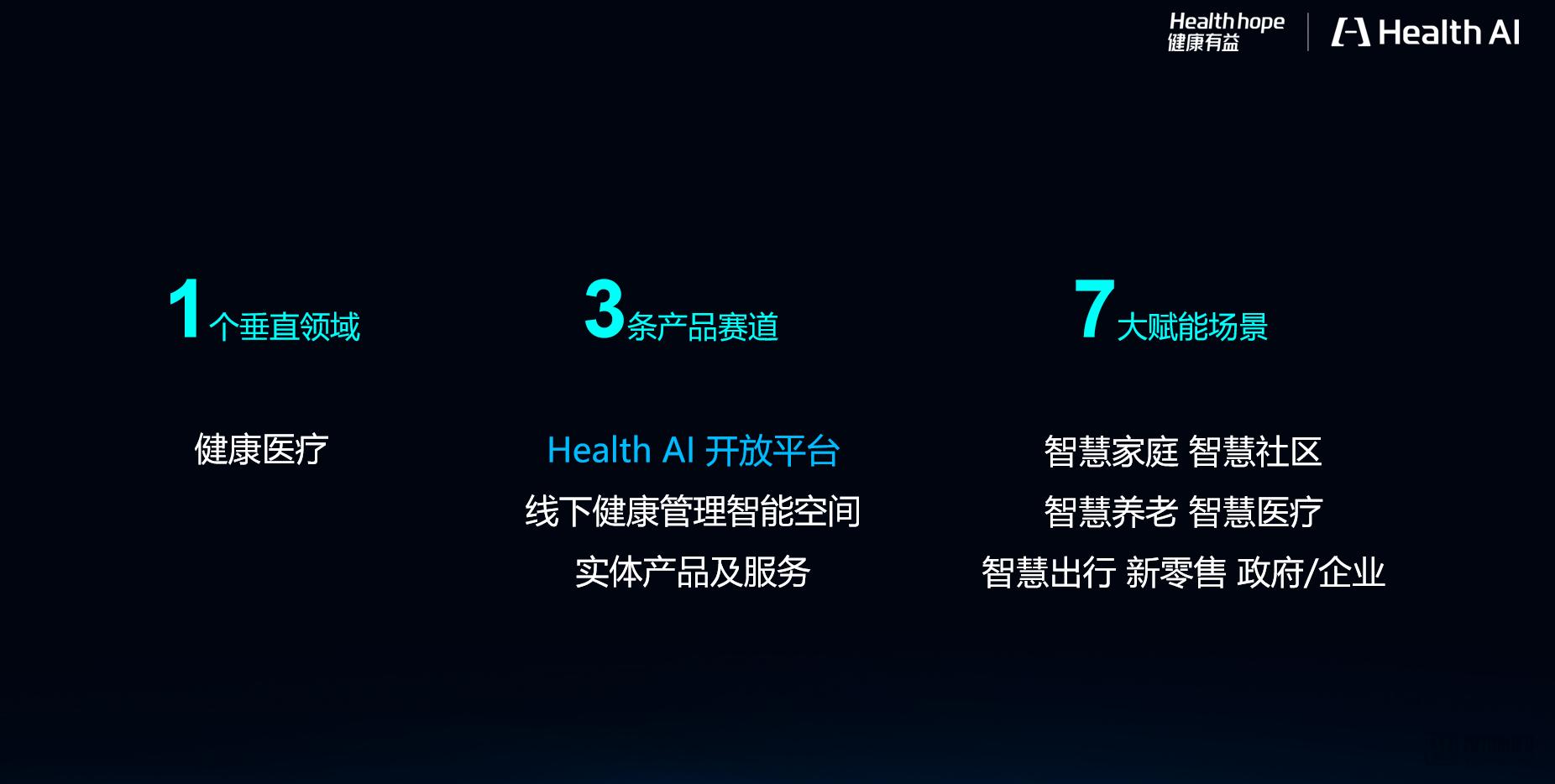
According to Li Yuxin, Health Benefits mainly includes three product tracks:
First is the open healthcare AI technology platform, Health AI. Health AI began its trial operation on July 24, 2018. It currently serves more than 150 enterprises, reaching over 300 million users through their applications. Backend data queries have exceeded 1.1 billion and are growing rapidly. Li Yuxin stated that all AI capabilities were consolidated into an open platform due to the high market demand for AI, and the Health AI open platform provides the broadest application space for this market.
Second, an offline intelligent health management space. Leveraging all current technologies, professional expertise, products, and services, we are establishing an offline intelligent health management space and integrating various resources from our partners into the solution. Li Yuxin stated that this represents a crucial offline implementation component, complementing our existing online open platform.
Third, physical products and services. While the first two products pertain to online and offline channels respectively, the health-oriented B2B2C model covers a large base of consumer-end (C-end) users. In serving these C-end users, diverse needs for health management and disease management have emerged. “We have developed a portfolio of physical products and services, integrating them into all open platforms to provide C-end users with a variety of health services, including lifestyle management, medical consultations, patient navigation, dietary guidance, and exercise programs,” said Li Yuxin.
Partnering with Giants Like Huawei to Serve a Broader Market
To address the vast B2B market and the diverse intelligent upgrade needs of various health services, the Health AI Open Platform will provide AI-powered products and services tailored to healthcare demands, including the artificial intelligence operating system Health OS, the robotic system Health RT, the management system Health System, professional content Health Content, and smart hardware.
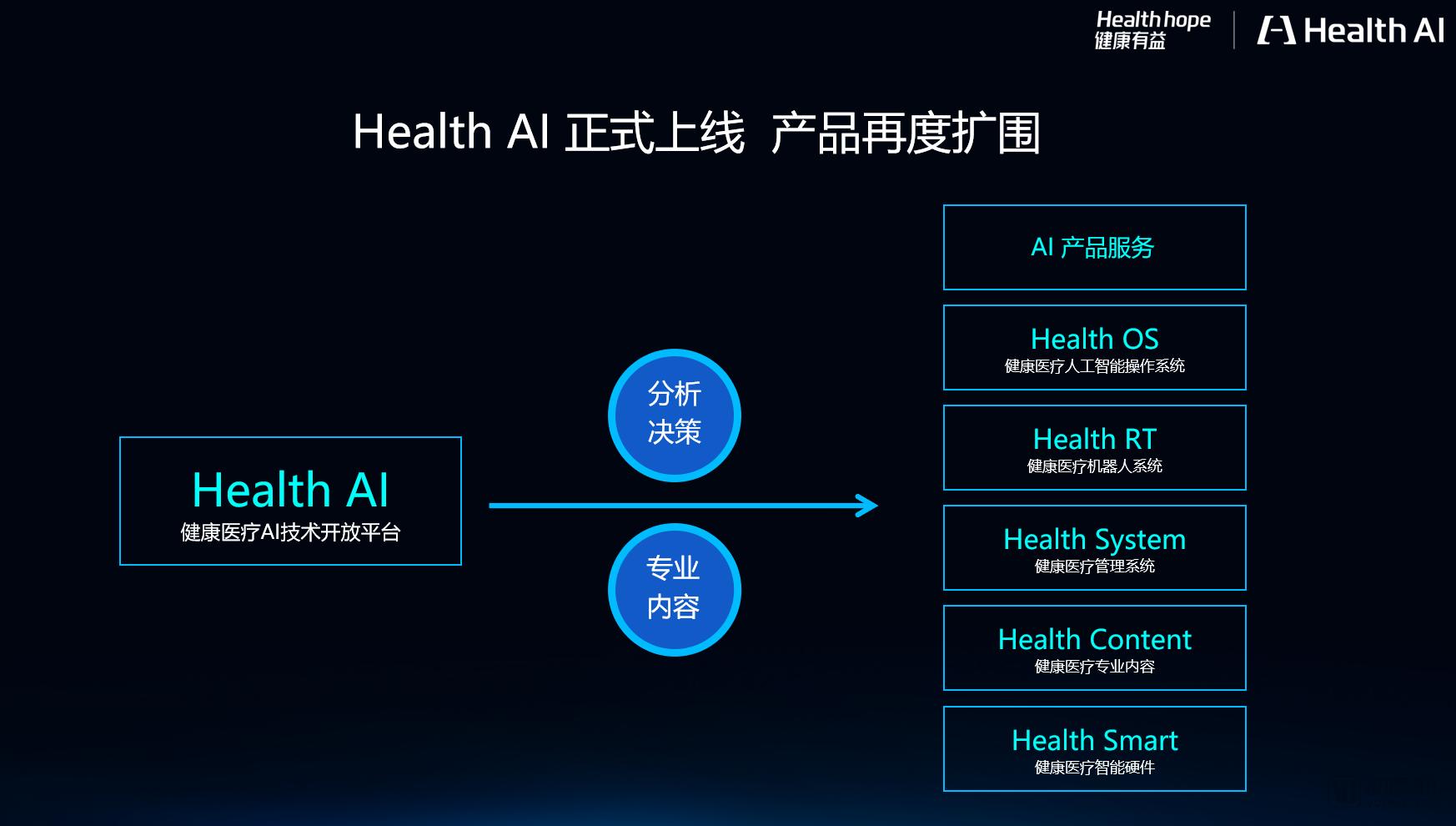
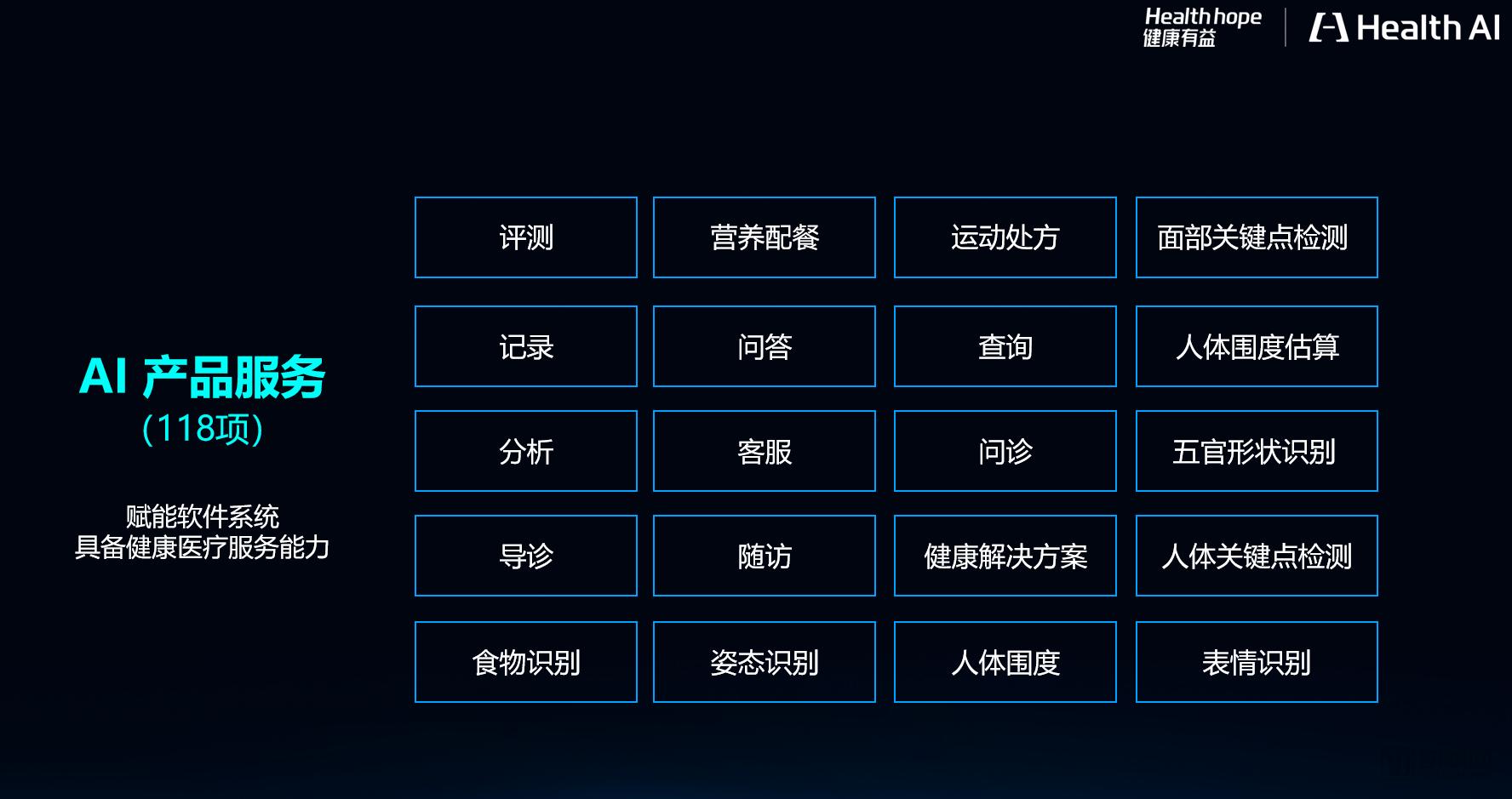
Among these, Health AI’s AI product services offer over 100 capabilities, including intelligent Q&A, food recognition, facial expression recognition, 3D human body reconstruction, posture correction, dietary logging, medical consultation, and intelligent triage. Partners across the industry can directly access these services via SDKs, APIs, H5, and other methods. Currently, it has already delivered AI capabilities to leading enterprises such as Huawei, Xiaomi, JD.com, and OPPO.
Health OS can facilitate intelligent upgrades for health management in hardware products such as home medical devices and wearables, including blood pressure monitors, glucometers, and various smart home and smart appliance products.
The Health RT system empowers service robots with healthcare and medical service capabilities through multimodal human-computer interaction. Although domestically produced robots typically possess coherent motion and cognitive abilities, AI enablement is required to realize advanced service functions such as consumer guidance and medical health management. Currently, Health Youyi has established collaborations with leading Chinese robotics companies, including Canbot and Zhongde, as well as the Robot Funder Club (an alliance of founders from Zhongguancun’s dual-innovation service robotics sector). Robots equipped with the Health RT system can be transformed into devices capable of delivering health management or medical services.
The Health System is designed to cover all scenarios, enabling the integration of health information and the delivery of health solutions. It effectively connects user terminals, management platforms, and cloud services to provide comprehensive, scenario-wide solutions. For sectors with lower levels of intelligence—such as traditional service endpoints like physical examination centers, elderly care facilities, and real estate communities—the system facilitates intelligent upgrades for hardware and software in health management. Additionally, it integrates all smart devices within these settings, aligning theoretical frameworks with frontline needs into a cohesive whole. Currently, the Health System has been implemented in two elderly care community projects in Shanghai, each covering approximately 20 communities.
In terms of its business model, Health Benefit primarily focuses on empowering B-side clients by delivering AI capabilities and scenario-based solutions to address a wide range of health needs. “For front-end and terminal applications, it is extremely challenging for enterprise users to build their own teams, whether they are developing products or applications. If a company provides comprehensive AI solutions, it not only enhances efficiency but also reduces production costs,” Li Yuxin told reporters.
In terms of platform integration, Health AI has completed integrations with open platforms such as Baidu, iFlytek, JD.com, and Xiaomi, filling their skill gaps in the healthcare and medical sectors. The highly anticipated “flagship” Huawei Mate 20 series smartphones incorporate the food recognition capability from the Health AI open platform; since the phones’ launch, this feature has become one of the most frequently used skills. Moreover, this capability has been deployed on dozens of the latest mainstream models from Huawei, OPPO, and vivo, making Health AI’s food recognition function an essential AI feature for contemporary smartphones.
Offering 118 AI-powered products and services, with direct access to end-users across seven major scenarios
The key technologies of AI fall into three categories: computer vision, natural language processing (NLP), and knowledge graphs. Currently, the Health AI platform encompasses 80% of AI technologies, providing multidimensional empowerment through AI skill-based, operating system-based, and management system-based solutions. To date, its AI product services alone cover 118 skills, including health assessments, nutritional meal planning, posture recognition, food recognition, 3D human body reconstruction, and health solutions.
Li Yuxin believes that technology alone is far from sufficient; AI can truly gain traction only when it is integrated with application needs within vertical domains, comprehensively empowering specific scenarios. Otherwise, no matter how extensively the technology is extended, it will remain vastly disconnected from end-user demands. “This is the underlying logic guiding Health Benefit’s journey from R&D to product commercialization. The original intention behind building an open platform was not merely to package technology into one or two modules for simple industry use, but rather to empower a wide variety of products and services, ultimately serving the health of the entire population,” said Li Yuxin.
Health-beneficial intelligent health management services are embedded in every aspect of daily healthy living, encompassing pre-diagnostic scenarios such as disease screening and prevention, as well as the rehabilitation phase, including chronic disease management.
HealthYou has officially launched its Health AI Open Platform, aiming to comprehensively build an open ecosystem for AI technology. Targeting seven major scenarios—smart homes, smart communities, smart elderly care, smart mobility, smart healthcare, new retail, and government/enterprise sectors—the platform helps business clients unlock pathways for the intelligent upgrade of healthcare services.
In the health management industry, platform-based enterprises typically attract core users directly through mobile apps, integrate data from wearable devices and other sources into their platforms to accumulate vast amounts of health data, process this data to develop more sophisticated algorithms, and ultimately deliver them as products. However, in viable and sustainable business models, merely building a platform or an app is not their ultimate objective.
Li Yuxin believes that in the mobile internet era, the typical model involves engaging users through apps, guiding them to make purchases by inputting large volumes of data. In contrast, HealthYou directly opens up its technological and professional capabilities, reaching end customers jointly by connecting with partners. “Users do not need to download an app or any specific functional software; instead, technology empowerment is deeply integrated into various scenarios. As more capabilities are made accessible, these technologies can reach both the terminal and service ends anytime, anywhere.”
As a technology company with comprehensive, full-scenario empowerment capabilities, Health Benefit is sharing AI technology across industries, deconstructing and simplifying complex health management products and services for various vertical sectors, and enabling diverse hardware and software devices to deliver health services. Furthermore, by effectively interconnecting these intelligent devices, it establishes a complete AI ecosystem for health management, thereby meeting the market’s health needs.