

China Establishes First Internet Hospital Committee with Industry-Academia Collaboration to Drive Sector Growth
At the end of 2018, Chengdu welcomed its first snowfall, adding a festive atmosphere to the damp chill. For the internet hospital industry, this turn of the year also heralded the arrival of its own “spring” of development.
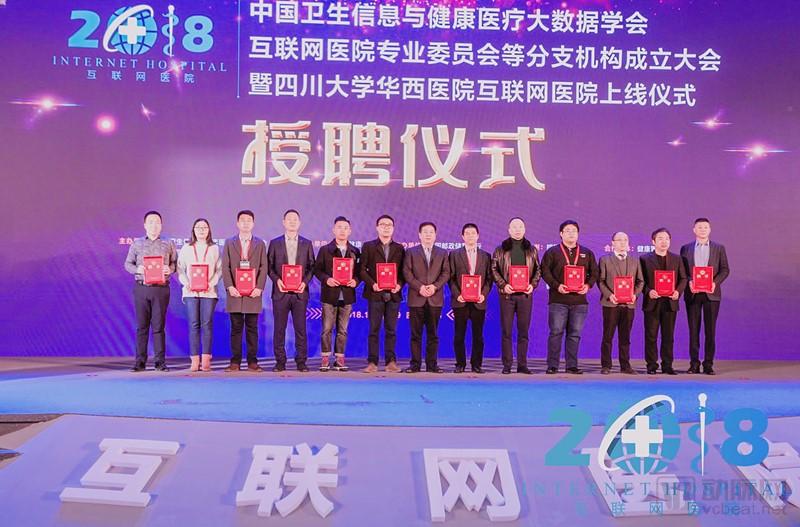
On this occasion, the Chinese Health Information and Healthcare Big Data Society held the inaugural meetings for its newly established branches, including the Internet Hospital Professional Committee, the Internet Hospital Standardization Management Committee, and the Internet Hospital Development Working Committee. Meanwhile, West China Hospital’s Internet Hospital was officially launched.
What are the respective functions of these conferences? What is the background behind their establishment? How do they promote the development of internet hospitals, and what is their significance? Which other institutions will be participating?
The CPC Central Committee and the State Council have always attached great importance to the application of health and medical big data and the use of “Internet Plus” technologies, especially after the 19th National Congress of the Communist Party of China explicitly proposed the “Healthy China” strategy in its report. Given China’s vast territory, unbalanced regional development, and various practical realities, implementing this strategy remains a long and arduous task.
At the conference, Jin Xiaotao, President of the Chinese Society for Health Information and Big Data in Healthcare, stated that the establishment of three special committees in Chengdu, located in western China, holds significant exemplary value for promoting the radiating impact of “Internet Plus Services” in the western region and enhancing the public’s sense of gain.
Meanwhile, Sichuan Province has also vigorously promoted the deep integration of new Internet Plus information technologies with the medical and health sector. This effort closely aligns with the working principle of “prioritizing primary care, driving development through reform and innovation, emphasizing prevention, placing equal importance on traditional Chinese medicine and Western medicine, integrating health into all policies, and fostering joint participation and shared benefits among the people,” as outlined in documents such as the Outline of the Healthy China 2030 Plan and the Guiding Opinions of the State Council on Actively Promoting the Internet Plus Action.
Li Weimin, President of West China Hospital, Sichuan University (hereinafter referred to as “West China Hospital”), stated that the hospital has actively responded to the national policies on “Internet + Healthcare” and explored innovative models under the “Internet +” framework. “We focus on addressing the pain points in patient care and the challenges in hospital management. By leveraging internet-based technologies and tools, we innovate patient experiences, services, and management practices, thereby providing more convenient and efficient healthcare services for patients and society. This contributes to effectively promoting tiered diagnosis and treatment services, building an integrated national health system, and fully advancing the ‘Healthy China’ strategy.”
The establishment of the Internet Hospital Professional Committee under the China Health Information and Healthcare Big Data Association will undoubtedly provide a strong impetus to the innovative development of internet hospitals in China.
So, what will the three special committees do?
Jin Xiaotao pointed out at the meeting that, based on the principles of problem-oriented, demand-oriented, and goal-oriented approaches, he proposed a three-character suggestion: “Specialization,” “Standardization,” and “Integration.”
First is “specialization.” Jin Xiaotao believes that the special committee should achieve dedicated personnel, dedicated teams, focused oversight, specialized research, exclusive supply, and specialized outcomes, thereby systematically reviewing the committee’s operations.
Second is the “benchmark.” It is necessary to establish mechanism standards, including those for revenue and distribution, with efforts focused on ensuring systematicity, standardization, scientific rigor, and forward-looking perspective.
Finally, “linkage.” We must unite more people to get things done, bring together more organizations and resources, and leverage the greater power of collective action.
As the representative of the chairing entity of the Development Working Committee for Internet Hospitals, Wang Ke, Chairman of Sichuan Huaxi Health Technology Co., Ltd., stated in an interview with reporters that the establishment of the Development Working Committee serves as a “shot in the arm” for the “Internet + Medical Health” industry, facilitating innovative and leapfrog development in high-quality medical services.
Wang Ke believes that, as an industrial collaboration community and a joint innovation consortium, the Internet Hospital Industry Research Institute serves primarily as a platform integrating the internet economy with the real economy. This involves fostering the coordinated development of offline medical institution clusters and the internet economy. It facilitates connectivity across the upstream and downstream segments of the industry chain. Rather than focusing solely on medical institutions and the pharmaceutical sector, it establishes a closed-loop service system spanning from frontline medical care to consultation, diagnosis, pharmaceutical distribution, and health management implementation, thereby achieving resource sharing. Furthermore, it strengthens inter-institutional linkages among healthcare providers, promoting the implementation of tiered diagnosis and treatment models and facilitating the decentralization of high-quality medical resources. This not only enhances accessibility to medical care but also helps reduce healthcare costs for the general public. Finally, it actively encourages Chinese internet enterprises to engage across the entire industry chain, driving the upgrading of the medical and broader health sector.
In the future, the Internet Hospital Industry Research Institute will join forces with leading industry representatives—including West China Women’s and Children’s Health, Tencent, Sogou, CEC Data, and Work+ Medical Incubator—to advance the establishment of an integrated industrial platform encompassing “industry, academia, research, and application.”
Wang Xiaochuan, CEO of Sogou Inc., stated that Sogou Search currently handles up to 90 billion searches annually, with 70 million of those pertaining to medical content, underscoring the substantial demand.
As China’s second-largest search engine, Sogou aims to explore the “Internet + Healthcare” space by addressing public health education needs, providing appointment registration and consultation services, and supporting AI-assisted diagnosis, thereby improving the efficiency of medical services, increasing healthcare supply, and facilitating convenient access to care and the realization of universal health coverage.
“By joining the Development Work Committee and the Industrial Research Institute, I hope to leverage the connection between Sogou’s traffic platform and public hospitals to integrate internet hospital service systems, thereby helping more users access high-quality medical services,” Wang Xiaochuan told reporters.