

China's Biotech Sector Hits Record High with Over 142 Deals and $92.2 Billion in Transaction Value in 2025

Evaluate
Pharmaceutical Business Intelligence and Forecasting Analysis Service Provider
Fosun Pharmaceutical
Healthcare Industry Group

Harbour BioMed
Antibody Drug Developer

Yarrow
ASO Therapy Developer

AstraZeneca
Pharmaceutical Technology Research and Development Provider

Simcere Zaiming
Developer of Innovative Anti-Tumor Drugs
Ipsen
Biopharmaceutical Manufacturer

January 2, 2026
eMedClub News
Evaluate's Head of Corporate Assets and Investment Portfolio Strategy, Mark Lansdell, told Fierce Biotech that even as geopolitical pressures mount and the potential risks of policy adjustments loom large in 2025,The pace of acquisitions and licensing deals in China's biotechnology sector has not slowed down, with the cumulative value of related agreements reaching a new high.。
"In terms of the number of transactions, the final scale in 2025 will be almost the same as in 2024," Mark Lansdell said in an interview with the media in early December. Meanwhile, according to Mark Lansdell, Evaluate has already compiled the statistics.Various Transactions in China in 2025(Including Authorization, Acquisition, and Financing)Approximately 142 transactions, a slight increase from 134 in 2024, and roughly on par with the total number of transactions in 2023.。
Frequent Transactions
Recently, there have been several related cases. In December,Fosun Pharmaceutical Announces Strategic Cooperation Between Its Controlling Subsidiary and U.S.-Based Clavis Bio, using an innovative model of joint development and option rights to co-develop cutting-edge target drugs. The value of this collaboration is not only reflected in the potential milestone payments of up to US$362.5 million for a single project but also extends Fosun Pharmaceutical's overseas layout for its innovative products. Clavis Bio, a wholly-owned subsidiary specifically established by the well-known venture capital firm Aditum Bio for this collaboration, enables both parties to share long-term value and accelerate drug innovation.

In addition,Harbour BioMed and BMSReach a long-term global strategic cooperation and licensing agreement exceeding 1 billion US dollars;Saizen Medical and Yarrow BioscienceSigned an exclusive licensing agreement for the GenSci098 injection project exceeding 1.3 billion US dollars;JACOBIO PHARMACEUTICALS AND ASTRAZENECAReached a licensing agreement exceeding 2 billion US dollars;ZAIMING and Ipsen...reaching an agreement worth over $1 billion for SIM0613, an ADC pipeline with best-in-class potential.
These blockbuster deals, which often exceed $1 billion, are by no means isolated commercial cooperation activities. Instead, they are vivid evidence of the continuous enhancement of China's biotechnology industry innovation capabilities and global industry recognition. At the same time, the innovative breakthroughs in various cooperation models have transcended the single framework of traditional licensing transactions, making them more aligned with the current development trends in the biopharmaceutical field, reflecting...Chinese biopharmaceutical companies have reached the global collaboration threshold in R&D accumulation for frontier targets, ADC, and other key areas.`, also highlights the high level of trust that multinational pharmaceutical companies have in China's innovative achievements.`
Value Climbing
In in-depth conversations, Mark Lansdell further focused on licensing and acquisition deals with local Chinese companies. He pointed out that the trend in the number of such deals has generally aligned with the overall deal landscape in recent years and will continue until 2026. Meanwhile,He emphasized that the key point lies in the transaction value.。
Combining historical data shows that the total value of 131 deals in 2022 was approximately USD 32.2 billion, slightly increased to about USD 35.2 billion in 2023, and achieved a significant leap in 2024 with the total value jumping to approximately USD 51.9 billion; as of early December when he was interviewed,The total transaction volume in 2025 has reached approximately USD 92.2 billion. However, he also particularly reminded that these figures reflect the potential total value of recorded transactions, not the final actual amount cashed out.
At present, there have been some single ultra-large transactions that were difficult to foresee three or four years ago.The average transaction value also increased simultaneously., this trend is not solely driven by a few high-investment cases. For instance, in May this year, Pfizer$1.25 billionAn upfront payment was reached for the licensing agreement of the PD-1/VEGF bispecific antibody SSGJ-707, and 3SBio is eligible to receivePotential payments totaling up to 4.8 billion US dollars. The completion of this drug deal has increased Pfizer's competitive advantage over companies like Summit and BioNTech.
Coincidentally, Takeda Pharmaceutical also reached an agreement with Innovent Biologics in October.$1.2 billion upfront paymentThe collaboration. If Takeda exercises its option, Innovent Biologics is also entitled to receive R&D and sales milestone payments for IBI363, IBI343, and IBI3001. Collaboration transactionThe total amount can reach up to 11.4 billion US dollars.。
In terms of value share, the proportion of domestic licensing and acquisition agreements in the global industry's total transaction value is gradually increasing.From approximately 9% in 2022 to around 21% by the end of November 2025, with significant changes.
Mark Lansdell believes that the value of these deals is mostly concentrated in potential milestone payments and royalties, with upfront payments accounting for a relatively smaller proportion. This structure is attractive to both parties involved in the transactions while also implying a cautious approach to collaboration. In his view, China's biotech R&D output has now become rich enough to be impossible to ignore.Especially in cutting-edge technology fields such as ADC, bispecific antibodies, and cell therapy,If a company wants to avoid cooperating with Chinese biotechnology companies, it almost needs to deliberately detach itself from the Chinese market.
"China has demonstrated extremely high strategic vision in the selection of technical directions, disease areas, and treatment tracks," Mark Lansdell concluded.
Opportunities and Challenges Coexist
In fact, Mark Lansdell is not the only one who has noticed China's growing influence in the innovative biopharmaceuticals field. In July this year, analysts from Jefferies pointed out,In the first quarter of 2025, approximately 32% of the global biotechnology outbound licensing transaction value will come from China., while this proportion remained at 21% in both 2024 and 2023.
"We believe that Chinese biotechnology companies are reshaping the U.S. biopharmaceutical landscape — bringing in licensed assets from China, which is expected to help multinational corporations alleviate development pressures at an affordable cost and within a manageable timeframe," analysts stated in a report sent to clients earlier this summer.
However, while the industry is developing rapidly, it may bring higher risks related to intellectual property security, regulatory compliance, and strategic alignment. The newly emerging "multi-layered regulatory and geopolitical challenges" require companies to possess "comprehensive due diligence capabilities and strategic foresight" when reaching deals.
"Against the backdrop of an increasingly complex regulatory environment,Industry Focus Remains on Customized Reinforcement Transactions"Strategically strengthening the innovation pipeline through such collaborations," said Roel van den Akker, head of PwC's U.S. pharmaceuticals and life sciences deals practice, in a statement at the time.
Notably, the Biosecurity Act adds a layer of potential variability to international cooperation. Recently, the U.S. Senate passed the 2026 National Defense Authorization Act, which includes the Biosecurity Act. The act prohibits U.S. administrative agencies from engaging in direct or indirect cooperation with biotech companies of concern.
However, compared with the initial version of the bill, the final enacted "Biosecurity Act" is relatively moderate. It no longer names specific companies or sets up a mechanism for listed companies to appeal and removal, but it will still impact the development of the biopharmaceutical industries in China and the United States. Despite the complex and volatile international situation, the biopharmaceutical industry as a whole continues to develop positively, with deeper cooperation links between China and the international community, and a promising future ahead.
Editor-in-Chief | Liming
Proofread by Fugue
References:
1.https://www.fiercebiotech.com/biotech/despite-geopolitical-pressures-china-biotech-deals-remain-pace-collective-value-soars

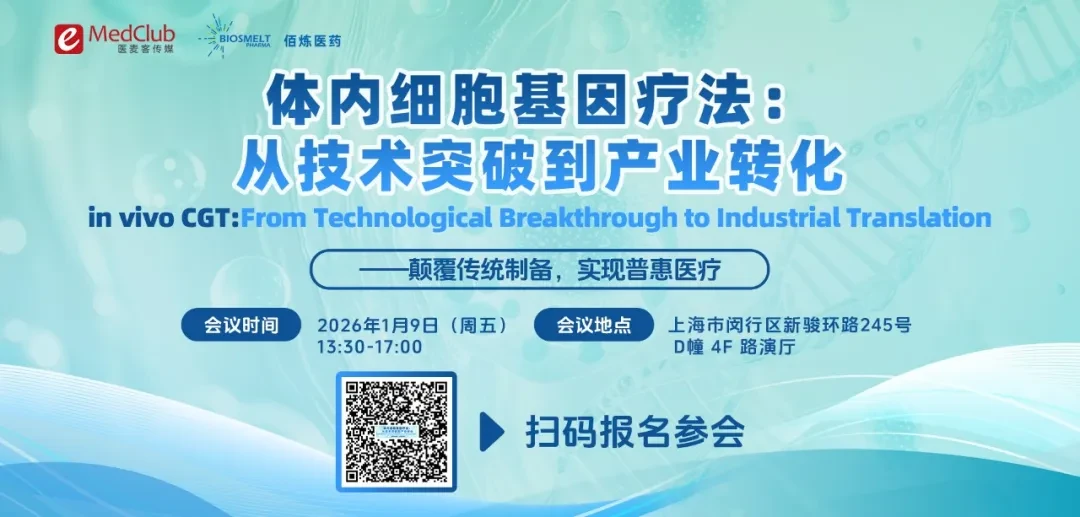
Exciting Event Preview
Press and hold to scan the QR code to participate immediately ↓
Recommendation 1
January 9th, 13:30-17:00
Offline Conference | In Vivo Cell and Gene Therapy: From Technological Breakthrough to Industrial Transformation

DianDian "Share”、“Like" and "In view”
Give me a little charge~