

Wearable ECG Monitoring Devices: Navigating the Market Post FDA Certification with a Near 50% Approval Rate
2012 marked the inaugural year for consumer-grade wearable devices, while 2018 was the dawn of medical-grade wearables. Internationally, however, this milestone arguably occurred in 2017; VCBeat’s statistics reveal that many dynamic ECG monitoring products received FDA approval in that year. A landmark event in 2018 was Apple’s launch of the iWatch with FDA-cleared ECG detection capabilities, which reignited enthusiasm across the entire dynamic ECG monitoring market. In China, Huami’s AMAZFIT became the first medical-grade wearable dynamic ECG recorder to receive CFDA certification.
What stage of development have wearable dynamic ECG monitoring technologies reached both domestically and internationally? Following regulatory approval, what are the next emerging trends? VCBeat has surveyed the key players in the domestic and international wearable dynamic ECG monitoring market and, through interviews with industry insiders, identified two major trends:
1. After clearing the hurdle of CFDA/FDA certification, the next step will be to connect physicians with diagnostics.
2. Two tigers can coexist on one mountain: smartwatches and ECG patches will further integrate.
In the inaugural year of medical wearable devices, wearable products began to play a role in initial screening and auxiliary diagnosis. Breakthroughs have been achieved in products monitoring the four vital signs: body temperature, heart rate, blood pressure, and respiratory rate. Additionally, biomarkers such as blood glucose, electrocardiogram (ECG), electroencephalogram (EEG), and blood oxygen saturation have become highly competitive areas.
Especially in heart rate monitoring, wearable devices can detect atrial fibrillation and other arrhythmias that are difficult to identify. Currently, ambulatory ECG wearables can more conveniently address the medical needs of patients with arrhythmias. Likewise, individuals experiencing symptoms suggestive of arrhythmias—such as palpitations, dizziness, shortness of breath, or unexplained syncope—may also opt to use ambulatory ECG monitoring devices.
Meanwhile, some individuals are striving to extend arrhythmia monitoring to asymptomatic populations, although there is currently controversy over how to define high-risk and general populations for atrial fibrillation. It is crucial to use data to demonstrate the benefits of ambulatory ECG monitoring for the general public.
To meet the needs of these two groups, medical-grade ECG monitoring products must ensure accuracy to serve as auxiliary diagnostic tools, while also being intelligent, lightweight, and user-friendly like consumer-grade devices.
Atrial fibrillation can lead to stroke. Data from the U.S. Centers for Disease Control and Prevention indicate that approximately 15–20% of ischemic strokes are caused by atrial fibrillation. For patients with atrial fibrillation at high risk of stroke, physicians typically prescribe anticoagulant medications as a preventive measure. In contrast, patients at low risk can reduce their stroke risk through lifestyle modifications.
However, the prerequisite is that they must be aware of their risk status. Researchers stated that most patients, whether at high or low risk, did not undergo preventive measures or early screening.
Currently, the U.S. ambulatory heart rate monitoring market is valued at $1.4 billion annually and continues to grow, with the launch of Apple Watch’s ECG feature expected to drive further user engagement.
The prevalence of atrial fibrillation is also closely associated with conditions such as coronary heart disease, hypertension, and heart failure. In China, more than 500,000 people suffer sudden cardiac death each year due to heart disease. According to the China Health and Family Planning Statistical Yearbook released by the National Health and Family Planning Commission, cardiovascular disease has become the leading cause of death among Chinese residents, surpassing cancer and other diseases.
Current dynamic electrocardiogram (ECG) monitoring primarily relies on two signal acquisition methods: ECG and photoplethysmography (PPG). ECG detects bioelectrical activity by capturing bioelectric signals, which are then digitized and processed to output accurate and detailed information on cardiac health.
PPG refers to PhotoPlethysmoGraphy, abbreviated as PPG, which is used to monitor heart rate. The principle is simple: blood is red, reflecting red light and absorbing green light. PPG obtains heart rate information by detecting the volume of blood flowing through the wrist at specific times.
Another classification method is based on lead differentiation. A standard electrocardiogram (ECG) requires 12 leads. The 12-lead fully automatic ECG analysis system is capable of recording 12-lead, 6-lead, 3+1-lead, 3-lead, and long-term rhythm lead data. During routine ECG recording, if an abnormal heart rhythm is detected, the system can automatically complete a 1-minute waveform recording and extended recording of the rhythm lead.
Most dynamic ECG monitoring products use simulated leads. Taking the Apple Watch’s ECG feature as an example, it has only one lead. Furthermore, this single lead is not a standard lead acquired using standard methods; instead, signals are collected through alternative means and then computationally simulated by software algorithms to generate waveforms familiar to physicians, thereby constituting a simulated lead.
Recently, AliveCor announced its next strategic direction: the launch of a six-lead electrocardiogram (ECG) compatible with smartphones. Perhaps one day, wearable devices will also become medical-grade monitoring products.
During the 2012 consumer wearable device bubble, health wearables became trapped in a dilemma characterized by product homogenization and superficial data collection. However, the market for wearable dynamic ECG monitoring devices has now established new barriers to entry and new rules of engagement. Traditional medical device companies, tech giants, and startups are all standing at a new starting line. Following Apple’s release of the Series 4 Apple Watch with ECG monitoring capabilities, Apple has arguably become a major player in this field.
Apple’s Series 4 Apple Watch ECG monitoring feature has received FDA clearance. After detecting an irregular heart rate, the Apple Watch issues an alert. Users can then place their finger on the Digital Crown to capture electrical heart signals; after 30 seconds, a simulated single-lead electrocardiogram (ECG) can be viewed in conjunction with the ECG app.
However, there is no need to view Apple as the primary adversary of wearable dynamic ECG monitoring, as Apple can promote atrial fibrillation (AFib) monitoring to a broader consumer base, including individuals who may not be at high risk for AFib. In the short term, Apple’s large user base can provide substantial data to demonstrate the benefits of dynamic ECG monitoring.
Apple officially conducted a study, the Apple Heart Study, which enrolled more than 400,000 participants. It is the largest screening study on atrial fibrillation to date and one of the largest cardiovascular trials ever conducted. A portion of the data from the Apple Heart Study was submitted to the FDA to support the approval of products for monitoring heart rate abnormalities.
In this substudy, among participants who simultaneously wore an ECG patch and used the Apple Watch’s ECG feature, 80% had atrial fibrillation detected by the ECG patch, and 98% had atrial fibrillation or other clinically relevant arrhythmias detected by the ECG patch.
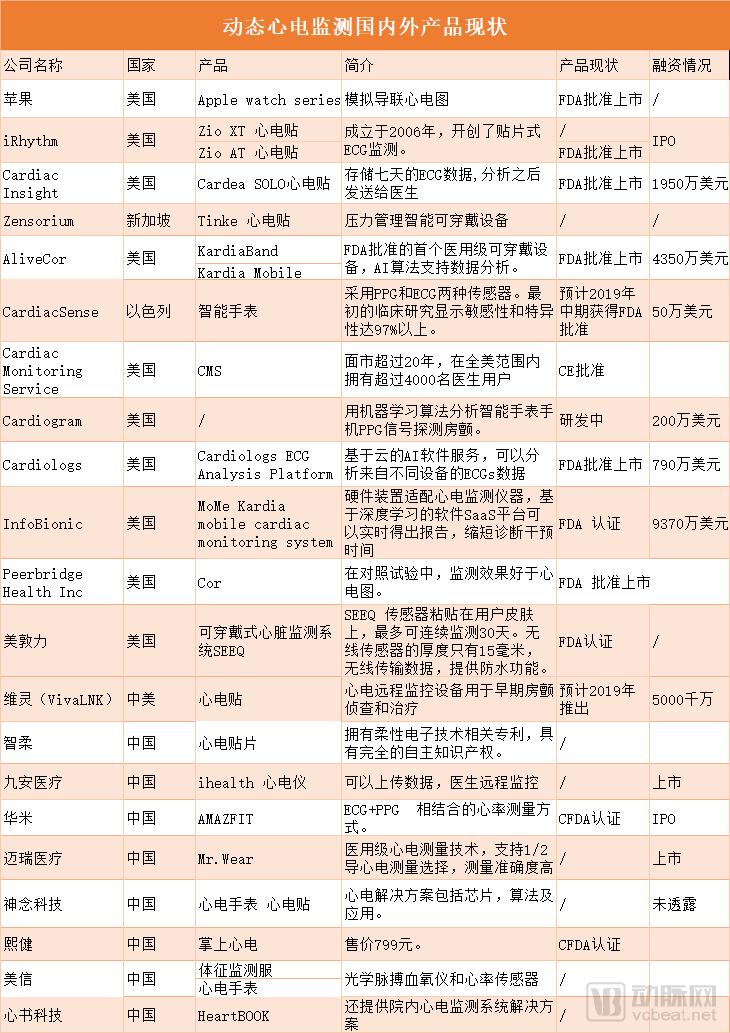
As shown in the table above, many products have obtained FDA clearance, and Huami’s AMAZFIT has been approved as a Class II medical device in China. After passing the review and certification hurdles,Next, acquiring doctors is just as important as acquiring users.
This physician could be a brick-and-mortar, offline family doctor, while an AI system may assume the role of diagnostician.
Take AliveCor as an example. While this name may be unfamiliar to some, it previously provided ECG monitoring support for the Apple Watch Series 3 abroad and serves as a key partner for Omron’s ECG products. AliveCor’s KardiaMobile device can be attached to a smartphone like a case, with users placing their fingers on it during use.
The second-generation product, KardiaBand, consists of a silicone strap and a sensor module, and is compatible with the Apple Watch Series 3.
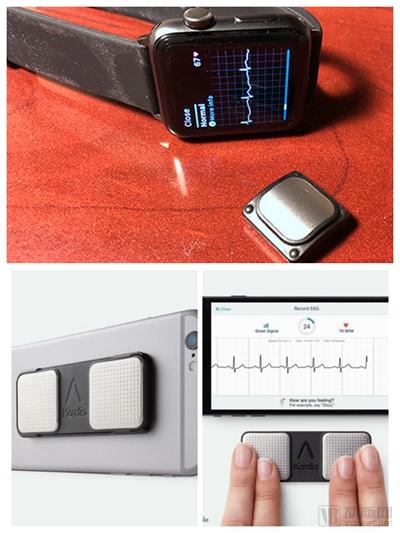
Top: KardiaBand Bottom: Kardia Mobile
Previously, AliveCor’s products did not provide any recommendations; however, the company now offers a service that mails data reports to primary care physicians. AliveCor is also beginning to promote its products to physicians and clinics as remote monitoring devices. Furthermore, it has launched KardiaPro, an AI-supported telecardiology platform that enables remote monitoring of cardiovascular patients by providing physicians with ECG data.
In other words, AliveCor began to connect patients and physicians from the physician side.
In China, the trend is shifting toward integrating vast amounts of health data with diagnosis and rehabilitation. In addition to the notable achievement of receiving CFDA approval, the AMAZFIT device released by Huami is also noteworthy for its accompanying Mi Dong Medical App.
VCBeat interviewed Lu Jigang, founder of Ruihua Xinkang, a cardiac rehabilitation center that provides medical support for Huami’s AMAZFIT, to gain in-depth insights into how a consumer-grade medical wristband can be transformed into an “auxiliary diagnostic tool.”
“In fact, many people cannot interpret electrocardiogram (ECG) readings. As a professional cardiac rehabilitation institution, we provide expert data interpretation and recommendations behind the scenes. We have jointly launched a cardiac rehabilitation app with Huami,” said Lu Jigang.
Why Is Cardiovascular Disease the Leading Cause of Mortality? Because Two Critical Stages—Early Screening and Rehabilitation—are Largely Neglected. The importance of early screening has been mentioned above; in China, 1,000 people suffer sudden cardiac death every day, some of whom have no prior history of heart disease, meaning they are considered healthy by general standards. Regarding rehabilitation, postoperative cardiac rehabilitation can reduce mortality rates by 26% among heart disease patients.
In addition to online data integration and value mining, Ruihua Xinkang has also entered into a strategic partnership with Huami to create a closed-loop system for early screening, treatment, and rehabilitation of cardiac conditions.
“Data can identify issues but cannot resolve them. As a cardiovascular specialty, we can provide lightweight consultations and Q&A services in the background. For customers with concerns, we will recommend that they undergo professional electrocardiographic monitoring at local medical institutions. We also offer report interpretation.” Lu Jigang stated, “Post-treatment, we can also provide rehabilitation education, enabling patients to access professional cardiac rehabilitation guidance from home.”
If Huami’s smart bands demonstrate strength in hardware, then Ruihua Xinkang has helped complete the layout of soft power.
Through market mapping, we can also observe that the two dominant product forms, both domestically and internationally, are ECG patches and smartwatches. Consequently, the largest number of companies have adopted these product configurations. iRhythm pioneered patch-based ECG monitoring products and is currently among the top three digital health companies in the United States by market capitalization. Following Apple’s launch of a smartwatch with ECG functionality, iRhythm’s stock price experienced a significant decline. However, current trends indicate a convergence between wristbands and ECG patches.
iRhythm’s products are available by prescription only. Upon completion of the monitoring period, patients simply mail the device back. The stored data is uploaded to iRhythm’s cloud-based servers, where proprietary AI algorithms identify and analyze cardiac rhythm patterns. A final report is generated within 24 hours and provided to the patient’s physician.
However, many smartwatch devices are not intended to provide diagnoses but merely inform users whether their electrocardiogram (ECG) “shows signs of atrial fibrillation (Afib).” Therefore, they do not replace the need for more definitive, physician-guided diagnostic monitoring, such as that provided by iRhythm devices. In fact, due to the broader reach of the Apple Watch, demand for iRhythm’s Zio 14-day continuous ECG monitoring may increase.
Moreover, unlike Zio and other existing ECG monitoring devices, Apple’s new watch and algorithm are not designed to detect arrhythmias in general, but rather specifically to detect atrial fibrillation (AF)—at least for now—which limits the device’s overall utility as an arrhythmia monitor. Perhaps most importantly, Apple is a newcomer to the healthcare sector. While its iPhones, watches, and apps undoubtedly appeal to young, affluent consumers, it remains to be seen how effective Apple will be in helping people recognize and manage serious health conditions such as AF.
Coincidentally, in China, Huami’s AMAZFIT also launched its smart band and ECG patch simultaneously. The AMAZFIT Wearable Dynamic ECG Recorder supports two measurement methods: wrist-based monitoring via the smart band and chest-based monitoring via the ECG patch. The usage of the smart band is similar to that of the Apple Watch. In wrist-based measurement mode, users simply need to wear the ECG recorder on their wrist, keep their arm raised horizontally, and press their index finger from the other hand on the metal button below the screen, holding it down from top to bottom to initiate the measurement. Results are available in approximately 30 seconds.
Another noteworthy aspect is that more traditional device manufacturers have chosen to compete in this field with ICM (implantable cardiac monitors). However, ICMs are costly, and implantable cardiac monitoring is an invasive procedure, which to some extent affects patient acceptance.
In the field of implantable cardiac monitors (ICMs), Medtronic is the dominant player, with its flagship product being the Reveal LINQ. However, competitors now include not only Abbott and Boston Scientific but also Apple. Abbott has launched the Confirm Rx device, while Boston Scientific was expected to introduce its ICM product in 2019. Abbott’s device is currently the only ICM compatible with smartphones, eliminating the need for an additional transmitter.