

Deepwise Medical's 2018: Empowering Departments with AI and Transforming Healthcare with Technology

DeepWise
Developer of Artificial Intelligence Medical Imaging Diagnosis System
“The relationship between AI and doctors is not about one replacing the other, but rather about mutual enhancement and empowering healthcare.” This is the stance of Qiao Xin, CEO of DeepWise, and also the goal for DeepWise’s future development.
For DeepWise, 2018 was an extraordinary year. In its mere first year of establishment, DeepWise completed its Series C financing round, raising a total of RMB 300 million and setting an industry record for the fastest fundraising pace. Bolstered by both technological advancements and capital infusion, DeepWise successfully ascended to the forefront of the artificial intelligence sector, becoming an indispensable force in the research and development of medical AI.
As one of the youngest companies in the medical AI sector, DeepWise has rapidly emerged as a powerhouse in imaging AI, with its R&D capabilities ranking among the top in the industry. Is it talent that imbues DeepWise with its soul, or data that forges its strength? The path DeepWise has taken is worth examining closely.
Healthcare differs from other industries, as its vast body of knowledge requires practitioners to accumulate extensive experience over a prolonged period. With more than 20 years of experience in Siemens Healthineers’ Medical Imaging division, Qiao Xin, CEO of DeepWise, has gained a profound understanding of the real needs at each stage of corporate development. Qiao Xin stated, “At this stage, the capabilities of artificial intelligence stem from human expertise. It is humans who, through annotation, programming, and other methods, gradually embed human intelligence into software—the core remains human. Therefore, DeepWise’s most fundamental advantage lies in its talent.”
“Since its inception, DeepWise has placed talent at the core of its strategy. After one year of development, our research institute has grown to a team of 80 members. Its leading figure, Professor Yizhou Yu, was recently named an ACM Distinguished Scientist in 2018 and elected as an IEEE Fellow for the class of 2019. Under his leadership, the DeepWise Research Institute continues to strengthen, providing sustained momentum for the company’s growth.”
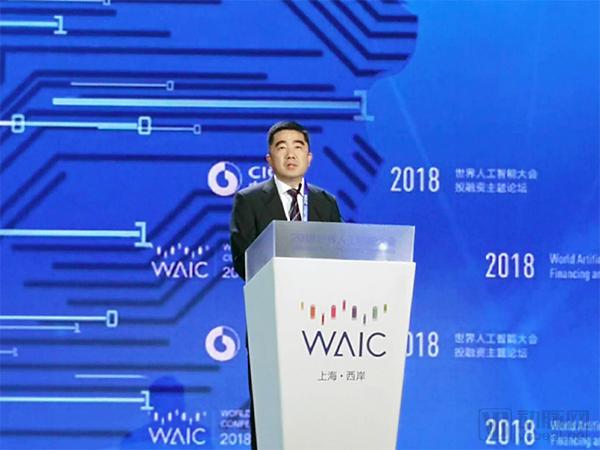
DeepWise CEO Qiao Xin Delivers Keynote Speech at the 2018 World Artificial Intelligence Conference
The remaining members of the institute are also leaders in the industry. Its intelligent professional model algorithm team is composed of Ph.D. holders and senior researchers from Peking University, the Chinese Academy of Sciences, and Stanford University. Seventy percent of the team members have published papers at top-tier conferences such as ICCV, AAAI, and CVPR. In addition, the team includes numerous imaging experts and management specialists with many years of experience working at multinational medical corporations.
To the outside world, DeepWise appears to maintain a low profile, resembling a recluse who diligently cultivates internal capabilities for long-term strength. The company has devoted greater efforts to technological research and development, where iterative advancements are often subtle and not easily detected by external observers. Thanks to this development strategy, DeepWise, despite being only one and a half years old, has already launched seven AI-related product lines covering oncology, stroke, breast health, imaging cloud services, and more. DeepWise has strategically positioned its artificial intelligence solutions to address the diseases with the highest incidence rates in China.
Consistent acclaim from frontline physicians helped DeepWise deliver a stellar performance in 2018. In the December 2018 special edition of China Daily commemorating the 40th anniversary of reform and opening-up, DeepWise Medical, alongside Alibaba and Geely Automobile, was featured as a representative of private enterprises. It showcased the boldness of Chinese private companies in seizing opportunities amid the global trend toward intelligent transformation and engaging in fierce competition with international rivals through independently developed technologies.
Yet even DeepWise, with its seven product lines, has only made a small inroad into AI-driven healthcare, with the areas it has explored representing just the tip of the iceberg. This implies that vast opportunities remain for DeepWise to uncover, and the hidden market potential within the AI sector makes it difficult to assess just how much potential DeepWise truly holds.
Therefore, in the coming year, DeepWise’s core strengths will be directed toward both upgrading existing products and achieving breakthroughs in new disease areas. Although its current products have already gained widespread recognition from experts, there remains significant room for advancement in AI technology. DeepWise boasts a core algorithm team that is second to none in the industry, serving as the foundation of its scientific research capabilities.
Meanwhile, DeepWise regards innovation as the core of its operations. Qiao Xin believes that innovation is the inexhaustible driving force for a company’s long-term survival and the lifeline determining its fate. Only by continuously launching products can a company secure a first-mover advantage in the market, break through intense competition as AI technology matures, and occupy strategic high ground.
To date, DeepWise is also preparing for a new round of financing. Qiao Xin stated, “In future financing and development efforts, we will not readily accept investment offers; instead, we will carefully consider the strategic layout of investment institutions and assess the strategic value that investors can bring to DeepWise.”
As of December, DeepWise had deployed its AI-powered products in nearly 300 hospitals. DeepWise’s solutions are not only utilized in tertiary Grade-A hospitals but also extensively implemented in primary care facilities, reflecting the company’s commitment to leveraging AI technology to broaden healthcare accessibility for the general population. Additionally, health checkup institutions represent a key strategic partnership focus for DeepWise, with significant progress recently achieved in these collaborations.
Regarding the application scenario of health checkups, Qiao Xin stated: “Health checkups and clinical diagnosis are two distinct scenarios: diagnosis places greater emphasis on ‘analysis,’ whereas health checkups focus solely on ‘detection.’ However, this does not imply that AI algorithmic requirements are lowered for health checkups. In fact, the population undergoing health screenings is vast, and screening protocols vary across different diseases. To ensure the success rate of health checkups, we must conduct more research to guarantee the validity of screening results, which in fact raises our technical requirements.”
“Of course, the core still lies in technological development. This is not a problem for DeepWise, which boasts a team determined to overcome all challenges and resolve any technical difficulties—this is DeepWise’s core competitiveness.”
Valuing medical AI companies has long been a challenge. In the absence of clear commercialization pathways, many enterprises can only estimate potential future profitability based on total addressable market size and plausible market share, often failing to reach consensus on standard future cash flow projections. Consequently, valuations derived from different methodologies frequently exhibit significant discrepancies, even when based on identical data, as the data itself lacks standardized processing protocols. Therefore, achieving a precise valuation figure at this stage remains difficult.
A common approach to assessing the reasonableness of a company’s valuation is to benchmark it against valuations of peers in the same sector. Although this method entails considerable margin of error, it still offers certain reference value. Taking autonomous driving companies that rely on computer vision as their core technology as an example, industry-wide valuations generally exceed USD 1 billion, with most companies valued between USD 1.1 billion and USD 2 billion. In contrast, AI companies focused on the healthcare sector tend to have relatively lower valuations. As a hallmark indicator of corporate development, valuation reflects a company’s stage of growth; however, as a reference metric, it often fails to capture many aspects of a firm’s core value, such as its robust R&D capabilities and significant growth potential. DeepWise, in particular, demonstrates substantial potential and considerable room for valuation upside in this regard.
Moreover, the application of AI technology in the healthcare sector is still undergoing rapid development, continuously expanding into new frontiers. In the future, AI may be applied to pathology, surgery, and rehabilitation. The gradual realization of all these future scenarios will bring greater value to existing AI enterprises, as they have gained a head start. As a leader in the AI healthcare industry, DeepWise possesses both the talent advantage to support sustainable development and the backing of external resources such as policy and capital. These assets will continue to guide DeepWise forward, Deeper and Wiser.