

Eli Lilly to Acquire Loxo Oncology for $8 Billion, Gaining Blockbuster Pan-Cancer Drug Vitrakvi and Precision Oncology Pipeline
VCBeat (WeChat ID: vcbeat) has learned that on January 7, Eli Lilly announced it would acquire all outstanding shares of Loxo Oncology for $235 per share in cash (approximately $8 billion). The transaction is not subject to any financing conditions and is expected to be completed by the end of the first quarter of 2019.
Loxo Oncology’s pipeline features a series of blockbuster drug candidates—LOXO-292, LOXO-305, and LOXO-195—as well as Vitrakvi (LOXO-101), the “broad-spectrum anticancer drug” that previously sparked extensive industry-wide discussion.
Lilly’s move is seen as a strengthening of its oncology portfolio. Beyond Lilly, the future direction of the “broad-spectrum anticancer drug” Vitrakvi has also become a focal point of industry attention.
This article is divided into four parts:
1. With a portfolio of multiple blockbuster drugs, Loxo has repeatedly garnered favor from industry giants;
2. Bayer has paid $400 million, and the acquisition does not affect the collaboration;
3. Organic and Inorganic Growth: Eli Lilly Strengthens Pipeline to Boost Performance.
4. Mergers and acquisitions are an evergreen theme in the industry, with no shortage of acquisition targets.
Loxo was founded in May 2013. Like many small biopharmaceutical companies, Loxo remained modest in size; as of the end of 2017, it had only 59 full-time employees.
Loxo was founded by Dr. Joshua H. Bilenker, who graduated from the University of Pennsylvania with training in internal medicine and medical oncology, and earned his M.D. from the Johns Hopkins University School of Medicine. He subsequently worked at the U.S. Food and Drug Administration (FDA) for two years, primarily focusing on the clinical evaluation and marketing approval of biologic oncology products.
In 2006, Joshua H. Bilenker joined Aisling Capital, a U.S.-based healthcare investment firm, where he remains a partner. Aisling was also an early investor in Loxo Oncology. Other investors in Loxo include OrbiMed, Array BioPharma Inc., and New Enterprise Associates (NEA). The founders hold a relatively small equity stake of only 4.5%.
Loxo’s early business primarily involved joint development with Array BioPharma Inc. This collaboration, which commenced in July 2013, was expanded in November 2013 and April 2014, focusing mainly on the TRK inhibitor (i.e., LOXO-101). Under the agreement, Array provided Loxo with compound design, research, and preclinical testing services.
In August 2014, just over a year after its founding, Loxo went public on the NASDAQ, raising $69 million.
In its prospectus, Loxo stated that as genetic testing in cancer becomes more routine, it has become clear that cancers arising in different parts of the body may share the same types of genetic alterations. Tumors can increasingly be identified and treated based on their distinct genetic alterations, whereas in the past, the organ of origin was the most important factor.
Both research and clinical data indicate that although some tumors harbor numerous identifiable genetic alterations, their proliferation and survival are primarily dependent on a single activated kinase. This dependency, commonly referred to as oncogene addiction, renders such tumors highly sensitive to small-molecule inhibitors targeting the respective alterations.
Researchers and clinical oncologists now frequently incorporate genetic assessment into clinical trials and routine care, with the aim of guiding patients toward effective cancer therapies. Loxo believes that the growing focus on oncogene addiction will lead to more effective drug development and stronger clinical responses in genetically defined patient populations. Accordingly, Loxo primarily focuses on drug development efforts targeting genetically defined patient populations.
Loxo’s prospectus further states that its Chief Scientific Officer previously led the medicinal chemistry team responsible for the discovery of erlotinib (Tarceva) and tofacitinib (Xeljanz), two oncology drugs approved in the United States, while its Acting Chief Medical Officer helped lead the development of carfilzomib (Kyprolis) and ibrutinib (Imbruvica), two oncology drugs granted accelerated approval in the United States. Consequently, Loxo possesses certain technological advantages.
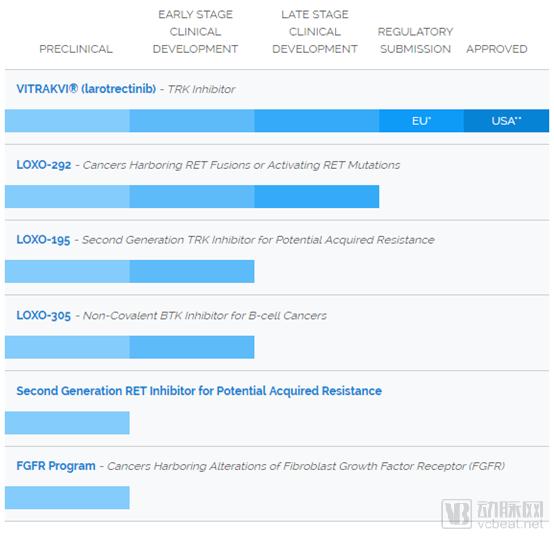
After several years of development, Loxo’s R&D pipeline has continued to expand. Its current key pipelines include:
——LOXO-101, an oral TRK inhibitor developed and commercialized in collaboration with Bayer, has recently received FDA approval. Upon its initial FDA approval, Vitrakvi became the first gene abnormality-targeting therapy demonstrated to be effective across multiple cancer types.
——LOXO-195: Loxo Oncology and Bayer are also investigating LOXO-195, a next-generation TRK inhibitor, for resistance to TRK inhibition. The product is expected to be launched in 2022.
——LOXO-292: Loxo-292 is an oral RET inhibitor that has been granted FDA Breakthrough Therapy designation for three indications and was expected to be launched in 2020. Loxo-292 targets cancers driven by rearranged during transfection (RET) kinase alterations. RET fusions and mutations occur in various tumor types, including certain lung and thyroid cancers, as well as other malignancies.
——LOXO-305 is an oral BTK inhibitor currently in Phase I/II clinical trials. LOXO-305 modulates Bruton's tyrosine kinase to alter cancer progression, aiming to overcome acquired resistance to currently available BTK inhibitors. BTK is a potent molecular target identified in numerous B-cell leukemias and lymphomas.
Loxo’s Investigational Pipeline
In terms of R&D expenses, Loxo’s total R&D expenditures for 2015, 2016, 2017, and the first three quarters of 2018 were $25.57 million, $58.28 million, $140 million, and $56.9 million, respectively. The decline in R&D expenses in 2018 was primarily because LOXO-101 (Vitrakvi), which accounted for the majority of R&D spending, had been approved for market launch, with costs to be shared equally (50/50) with Bayer.
On November 14, 2017, Loxo and Bayer entered into an agreement under which Loxo and Bayer would collaborate on the development and commercialization of larotrectinib and LOXO-195, representing the company’s franchise of highly selective TRK inhibitors for patients with TRK fusion cancers.
Under the agreement, Loxo has granted Bayer a co-development and commercialization license for larotrectinib and LOXO-195. Effective from the effective date, the Company is eligible to receive a non-refundable cash payment of $400 million from Bayer. In accordance with the terms of the Bayer agreement, Loxo received $250 million in November 2017 and the remaining $150 million in March 2018.
In addition to the $400 million upfront cash payment, Loxo is eligible for $450 million in milestone payments tied to regulatory approvals and initial commercial sales of laotrectinib in certain major markets. Upon regulatory approval and commencement of initial commercial sales of LOXO-195 in certain major markets, Loxo will also receive $200 million in milestone payments.
Loxo will lead the development and regulatory filing of the above products in the United States, while Bayer will be responsible for markets outside the United States. Globally, Loxo will bear 50% of the development costs. In the United States, Loxo and Bayer will jointly promote the products; Loxo will cover 50% of the commercialization costs and receive 50% of the profits. Upon reaching a specified threshold of U.S. net sales, Bayer will pay Loxo a $25 million milestone payment. Loxo will have the option to opt out of the joint promotional activities in the United States, in which case it will receive 30% of U.S. net sales.
In territories outside the United States, where Bayer is responsible for commercialization, Bayer will make tiered payments to Loxo, including double-digit net sales royalties and sales milestone payments, totaling $475 million.
This agreement also includes a standstill provision that prevents Bayer from acquiring five percent or more of Loxo’s voting rights.
Regarding mutual termination of the agreement, the provisions are as follows: The agreement shall terminate with respect to a specific product or country/region upon expiration of the royalty term for such product in that country/region. Either party may terminate the agreement due to material breach or bankruptcy. In addition, Bayer may terminate the agreement four years after written notice becomes effective to Loxo, or if Loxo receives a “Complete Response Letter” from the U.S. FDA regarding larotrectinib, or if Loxo fails to obtain marketing approval for larotrectinib by December 31, 2018.
Therefore, after reviewing the entire agreement, it is clear that the collaboration between Loxo and Bayer will continue under the existing terms. However, a new agreement may be negotiated between Loxo and Bayer following a change in Loxo’s ownership, with Eli Lilly now holding the decision-making authority. Premature modification of the contract would trigger substantial financial penalties.
Eli Lilly and Company was founded in 1876. Throughout its more than 140-year history, the company has remained committed to providing innovative medicines and support services to meet the needs of patients and the market. Notable milestones include launching the world’s first commercially available insulin product in 1923 and pioneering methods for the large-scale production of penicillin G in the 1940s.
Eli Lilly and Company has deep-rooted ties with China. As early as the first half of the 20th century, Eli Lilly established its first overseas office in Shanghai, and re-entered the Chinese market in 1993. Guided by the commitment to “Rooted in China, Benefiting Patients,” the Chinese market has become one of Eli Lilly’s most important and fastest-growing markets.
Eli Lilly and Company boasts a robust drug portfolio spanning oncology, immunology, diabetes, neurodegenerative diseases, pain management, and other therapeutic areas. Its flagship products—including insulin lispro, tadalafil, pemetrexed, and teriparatide—each generate annual sales of $2 billion or more, earning them the status of bona fide “blockbusters.” The company continues to develop novel therapies to address unmet medical needs.
Driven by the strong performance of newly launched products, Eli Lilly and Company has seen robust revenue and profit growth, maintaining an upward trajectory for nearly a decade. In fiscal year 2017, Eli Lilly reported revenues of $22.871 billion, representing an 8% increase. For the first three quarters of 2018, the company achieved revenues of $18.118 billion.
On December 19, 2018, David A. Ricks, CEO of Eli Lilly and Company, stated at the company’s recently held 2019 guidance and investor meeting: “Over the past five years, Eli Lilly has successfully launched 10 new medicines, strengthened our pipeline, and reshaped the company to improve operational efficiency by introducing new drug candidates from both our internal laboratories and external partners. This transformation has also enabled us to attract world-class scientific talent to our research teams. Our actions in recent years have delivered significant value to our key stakeholders. Most importantly, they have benefited patients, many of whom are enjoying improved quality of life thanks to new Eli Lilly medicines.”
Dr. Daniel Skovronsky, Chief Scientific Officer and President of Eli Lilly, highlighted the company’s recent progress in research and development, including:
• The company is reshaping its drug discovery engine with a dual objective: to reduce the time required for the drug discovery process—from target identification to clinical testing—by approximately three years, while also increasing the use of externally sourced derivative innovations to acquire new tools for target, modality, and method discovery.
• Eli Lilly and Company has significantly accelerated its development activities, reducing the average time from first-in-human dosing of potential new drugs to commercial launch by more than two years.
• Eli Lilly’s Phase III molecular success rate has steadily increased, as its clinical pipeline has benefited from a greater emphasis on target validation, patient population selection, and molecule optimization, resulting in more robust Phase II data and improved Phase III trial designs.
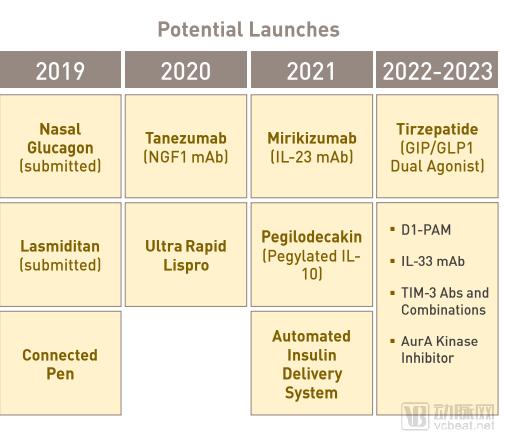
In the future, Eli Lilly will also strengthen its R&D pipeline in oncology, pain, neurodegenerative diseases, immunology, and diabetes, with the goal of launching 20 new drugs over the next decade.
Eli Lilly’s Promising New Drugs Expected to Launch in the Next Decade
Eli Lilly’s earnings forecast indicates that revenue for 2019 is expected to range between $25.3 billion and $25.8 billion, with adjusted earnings per share (EPS) of $5.90 to $6.00, surpassing both the $25 billion sales threshold and analysts’ EPS expectation of $5.80. However, this outlook does not include Loxo Oncology, nor does it account for the stake in Elanco Animal Health, which was spun off last year. Eli Lilly stated that it will update its financial guidance when it releases its 2018 earnings on February 13.
Returning to the current acquisition, Anne White, President of Lilly Oncology, stated: “Lilly is committed to developing innovative, breakthrough medicines that will bring meaningful change to cancer patients, helping them live longer and healthier lives. The acquisition of Loxo Oncology allows us to expand our portfolio into the fields of precision medicines and cancers driven by specific genetic abnormalities. The ability to target tumor dependencies in these patient populations will be a key component of Lilly Oncology’s strategy.”
Proactive Planning: Organic and Inorganic Growth Strengthen Eli Lilly’s Pipeline and Lay the Foundation for Sustained Performance Growth
Recently, the pharmaceutical industry has witnessed a surge in mergers and acquisitions: Bristol-Myers Squibb (BMS) announced its acquisition of Celgene for a total consideration of $74 billion in cash and stock. The merger of these two global leaders in oncology drug manufacturing kicked off the wave of biopharmaceutical M&A activity in 2019, becoming one of the largest pharmaceutical mergers in history.
Eli Lilly is also a frequent participant in mergers and acquisitions. Prior to this transaction, the company acquired ARMO BioScience, a California-based firm, for $1.6 billion in May 2018. ARMO’s immunotherapy drug, pegilodecakin, is primarily used in late-stage clinical treatment of pancreatic cancer and is also undergoing early-phase clinical trials for lung cancer, renal cell carcinoma, melanoma, and other solid tumors.
In the pharmaceutical and biotechnology sector, ARMO BioSciences was also an early-stage company. Founded in 2013, it went public only in January 2018, with Eli Lilly’s acquisition price representing a two-fold premium over its IPO price. Just four days after this deal, Eli Lilly announced another oncology drug acquisition plan, intending to purchase the compound AK-01 from Montreal-based AurKa Pharma Inc. for up to $575 million. Notably, this same compound had been sold by Eli Lilly in 2016.
M&A integration remains an enduring theme in the pharmaceutical and biotechnology sector, driven primarily by the following factors: companies facing patent cliffs for their flagship products acquire others to bolster their pipelines; or, when organic growth stalls, acquisitions enable rapid expansion of operational scale to meet investor expectations for growth.
The latter reason may be more significant, as the pharmaceutical and biotechnology sector is inherently a slow-growth industry. Compounded by various factors such as policy, regulation, and reimbursement, sustaining continuous growth is highly challenging, let alone achieving the exponential growth seen in the internet sector. After going public, companies are easily swept up by investor sentiment, engaging in mergers and acquisitions to bolster performance. In other words, Wall Street has transformed the business model of the pharmaceutical and biotechnology industry.
Certainly, the rapid development of biomedicine has also brought more targets for industry mergers and acquisitions, especially some small companies. Relying on the capabilities of key figures to develop flagship products, these companies then sell them to large corporations for commercialization. After spending a few years within these larger entities, individuals often leave to embark on new projects, seemingly forming a positive cycle of "industrial division of labor."
A fundamental principle in drug development, particularly for innovative medicines, is to center on patient needs and address unmet clinical demands. By adhering to this logic, companies can not only benefit patients but also reap substantial financial rewards.