

BOE Unveils Its First Digital Hospital in Hefei with a $450 Million Investment
With an investment of RMB 3.2 billion, Hefei BOE Digital Hospital, the first digital hospital independently planned and constructed by BOE, unveiled itself to the public during its first media open day on December 21. VCBeat learned from the site that the hospital is expected to officially commence operations in March this year.
Hefei BOE Hospital is the first large-scale tertiary general hospital built by BOE Technology Group. Construction began in September 2016. The hospital has a planned capacity of 1,000 beds and employs over 800 staff members. It focuses on establishing eight centers of medical excellence with internationally advanced standards in cardiology, orthopedics, neurology, oncology, health management, women’s and children’s health, reproductive medicine, and traditional Chinese medicine.
Unlike traditional hospitals, Hefei BOE Hospital leverages technologies such as the Internet of Things (IoT) and artificial intelligence to enable digital healthcare, digital operations, and digital services.
China’s First Digital Hospital Launches in Hefei
On Media Open Day, VCBeat conducted an on-site visit to Hefei BOE Digital Hospital, exploring and summarizing the key features of this hospital of the future.
Feature 1: One-Stop Outpatient Clinic
Each department in the hospital is equipped with a one-stop outpatient clinic, where consultation, diagnosis and treatment, payment, medication dispensing, and medication guidance can all be completed within the same area. This eliminates the need for patients to run back and forth between floors and reduces the risk of cross-infection during transit.
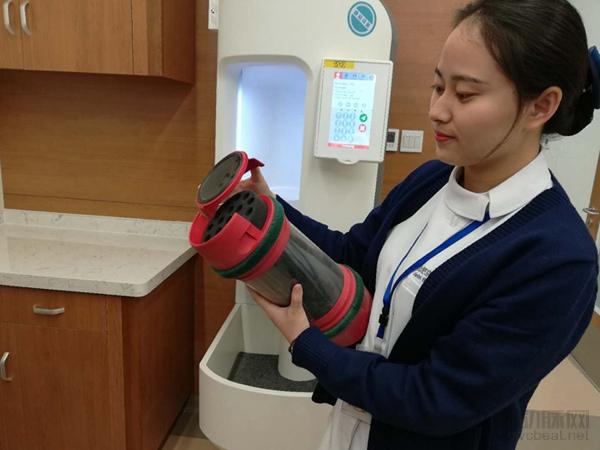
Staff Demonstrate Pneumatic Drug Delivery System
A tiered waiting system has been adopted, featuring a primary waiting area and a secondary waiting area. The primary waiting hall boasts an innovative layout with color schemes and textures reminiscent of a café, significantly enhancing the patient’s healthcare experience. The secondary waiting area is equipped with basic vital signs monitors, where nurses conduct preliminary assessments—including temperature, blood pressure, pulse, and blood glucose—prior to the consultation. This process allows for the entry of essential clinical data into the system and its transmission to the physician’s computer, thereby eliminating redundant and ineffective communication between doctors and patients and improving consultation efficiency.
VCBeat has learned that another highlight of the outpatient area is its innovative pharmacy units. Hefei BOE Hospital has equipped each consultation zone with approximately two pharmacy units, eliminating the traditional step of patients having to go to the central pharmacy to collect their medications. Patients can obtain their prescribed drugs within the consultation zone via a pneumatic drug transmission system, with the entire process taking only about 1–2 minutes.
Feature 2: Simulation Medicine Center
Hefei BOE Hospital is a medical institution integrating clinical care, education, and research, with its Simulation Medicine Center serving as a paradigmatic facility for medical education. The center features an integrated training laboratory comprising consulting rooms, patient wards, operating theaters, and an intensive care unit (ICU). Equipped with high-fidelity patient simulators, it replicates diverse clinical scenarios, enabling healthcare professionals to engage in repetitive practice and thereby mitigate potential medical risks.
Feature 3: Hybrid Operating Room
In conventional hospitals, interventional therapy and surgical procedures are typically performed separately, necessitating multiple transfers of the patient during the course of treatment. The hybrid operating rooms established at this hospital enable simultaneous medical imaging examinations and angiography, thereby eliminating the need for repeated patient transfers between the interventional radiology department and the operating room. This integrated approach offers a new therapeutic strategy for patients with conditions such as congenital heart disease, those requiring craniotomy, complex aneurysms, and multiple vascular lesions, particularly for high-risk patients who cannot tolerate traditional surgery.
Moreover, digitalization is also one of its key features.
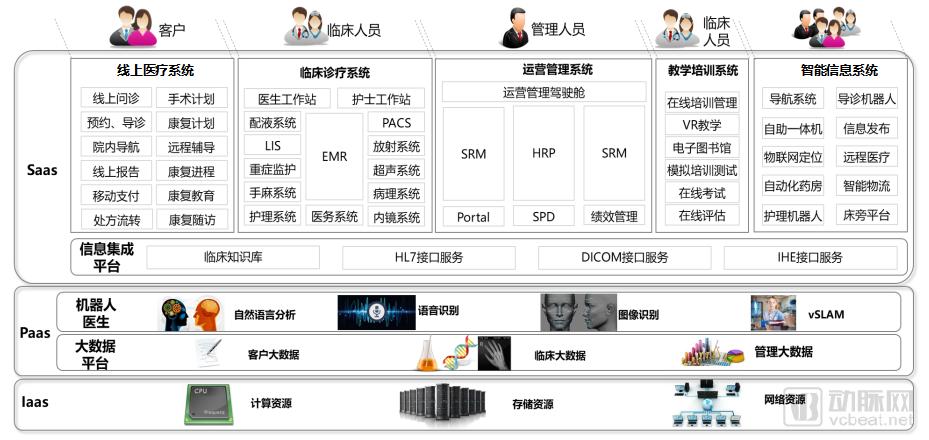
Image provided by the interviewee
Multi-Dimensional Layout for the Smart Health Industry
BOE, which started in the LCD screen industry, entered the smart healthcare sector in 2013. In addition to the already completed Hefei BOE Digital Hospital, BOE has ongoing similar digital hospital projects under construction in Chengdu, Suzhou, Wuhan, and other cities. Previously, the company acquired Beijing Mingde Hospital in 2015 for RMB 250 million.
In July 2018, BOE announced an organizational restructuring, subdividing its three original business segments—Port Devices, Smart IoT, and Smart Health Engineering—into seven business groups. Among these, the former Smart Health Engineering segment was split into two smaller sub-sectors: Mobile Health and Health Services. In the Mobile Health sector, BOE launched a mobile health management platform based on artificial intelligence and big data. In the Health Services sector, BOE focused on smart health services as its core, driven by digital hospitals, and integrated with regenerative medicine, digital human technologies, and health parks to create a comprehensive, full-lifecycle smart health ecosystem service chain for the mid-to-late stages of life.