

ResMed Bets Billions on Digital Health: Strategic Shift and Product Portfolio Expansion
Recently, medical device giant ResMed acquired digital health company Propeller Health for $225 million, aiming to enhance the functionality of its existing products by leveraging Propeller Health’s strengths in digital technology. (For details, please refer to the report by VCBeat.)“ResMed Acquires Propeller Health for $225 Million to Expand COPD and Asthma-Related Product Portfolio”)
After two generations of management, ResMed has pursued a dual strategy: on one hand, it continuously expands its product portfolio around its core CPAP devices through innovative technologies and independent R&D of hardware; on the other hand, it acquires companies to enhance its software capabilities and build a comprehensive product matrix.
An analysis of ResMed’s recent acquisitions and new product launches reveals that while the company, under founder Peter Farrell, deeply cultivated the hardware sector for many years, its new CEO, Mick Farrell, is attempting to shift strategic direction by leading ResMed into the digitalization of medical devices.
According to incomplete statistics by VCBeat (WeChat ID: vcbeat) reporters, ResMed has spent heavily to acquire 12 companies from 2015 to the present, nine of which are related to digital service software.
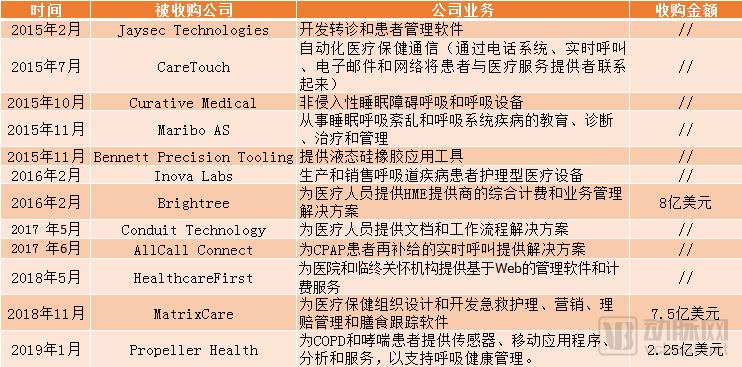
Chart: Overview of ResMed’s Acquisitions from 2015 to Present
Through “cloud connectivity + digitalization” technologies, ResMed has gradually built an ecosystem spanning “hardware + software + services.” Its growth and evolution appear to mirror the development trajectory of the entire chronic respiratory disease sector.
ResMed is a medical device company headquartered in San Diego, California. It was founded by Peter Farrell in Sydney, Australia, in 1989. The company primarily specializes in cloud-connected medical devices for the diagnosis and management of sleep-disordered breathing. These devices have transformed the care of patients with obstructive sleep apnea (OSA), chronic obstructive pulmonary disease (COPD), and other chronic respiratory conditions. Its flagship product lines include the AirFit™ 20 series, the Astral™ series, and the Stellar™ series.
ResMed’s founder, Peter Farrell, holds a Ph.D. in Chemical Engineering and Bioengineering from the University of Washington in Seattle, as well as a Doctor of Science degree from the University of New South Wales. Prior to founding ResMed, he served as Vice President of Research and Development at Baxter Healthcare in Japan and established the Baxter Medical Research Center in Sydney.
In 1981, Professor Colin Sullivan and his colleagues at the University of Sydney developed nasal continuous positive airway pressure (CPAP) therapy, marking the first non-invasive treatment for obstructive sleep apnea (OSA).
The CPAP therapy developed by Colin Sullivan and his team was not only successfully published in the prestigious medical journal The Lancet, but also secured patent rights for the technology. In 1987, Peter Farrell, on behalf of Baxter Healthcare Corporation, acquired Colin Sullivan’s patented technology through a Management Buy-Out (MBO), with the aim of commercializing it. That same year, Baxter Healthcare conducted clinical trials on a group of patients with severe sleep apnea. In 1988, leveraging Colin Sullivan’s technology, Baxter Healthcare launched its first commercial CPAP device and mask.
Although early-generation CPAP devices were bulky, noisy, and uncomfortable to wear, they helped normalize blood pressure and heart rate in patients with sleep-disordered breathing (SDB).
Peter Farrell’s son, Mick Farrell, later recounted his father’s original motivation for founding ResMed in an interview with local media: “He witnessed firsthand how a patient’s life was saved by using an early-generation CPAP device, which even allowed him to keep his job and marriage. This reinforced my father’s conviction that there are many more patients worldwide with similar needs.”
At that time, sleep apnea was still relatively unknown, and few researchers were studying the condition. Peter Farrell recognized it as a significant unmet medical need. In 1989, when Baxter Healthcare decided to withdraw from the sleep apnea market, Peter Farrell decisively acquired the licensing rights to Colin Sullivan’s technology, along with Baxter’s existing CPAP devices and related business operations, founding ResCare (the predecessor of ResMed).
Since its inception, ResCare has adopted as its corporate mission “to improve patients’ quality of life, alleviate the burden on healthcare systems, and alter the progression of underlying chronic diseases.”
In 1990, ResCare relocated from Sydney to San Diego, United States. During its first two years of operation, ResCare operated at a loss, but it turned profitable starting in its third year. In 1995, ResCare was renamed ResMed (an abbreviation for Respiratory Medicine) and began to focus on the market for products used in the treatment and management of respiratory diseases. In 1999, ResMed went public on both the New York Stock Exchange and the Australian Securities Exchange, under the ticker symbol RMD on both exchanges.
Since the launch of its first product—a basic CPAP device—in the year the company was founded, ResMed, under the leadership of founder Peter Farrell, has centered on its core products, upgraded existing functionalities through clinical trials, and continuously expanded its product portfolio.
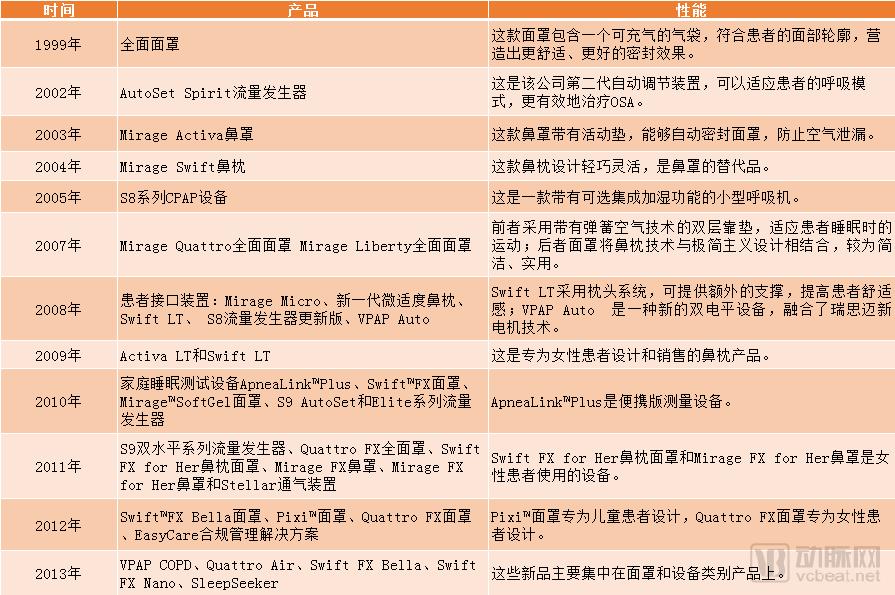
Figure: Selected new products launched by ResMed during the tenure of its founder, Peter Farrell
VCBeat (WeChat ID: vcbeat) reporters noted that due to certain flaws in the initial CPAP devices, ResMed focused on improving patient comfort when upgrading this product series. In subsequent models, ResMed integrated humidifiers and introduced features such as automatic adjustment, delayed pressure ramp-up, and preheating, while also making the devices increasingly compact and lightweight. Additionally, ResMed incorporated both invasive and non-invasive applications into its CPAP devices to meet diverse patient needs.
In addition to CPAP devices, ResMed has successively launched VPAP (bi-level positive airway pressure) devices, AutoSet (auto-adjusting) devices, nasal masks, and portable diagnostic equipment. Among these, the VPAP devices feature a more refined design and advanced automatic adjustment mechanisms. The upgraded VPAP devices adopt a dual-layer design, are equipped with a display screen for viewing efficacy data, and include an alarm function.
ResMed’s nasal masks have undergone continuous updates and upgrades since their market launch in 2003. For instance, ResMed has enhanced stability through an auto-adjusting forehead support system, adopted a lightweight design to mitigate air leakage, developed specialized nasal masks for women and children aged two years and older, and continually optimized the design to improve patient comfort.
According to ResMed’s 2013 financial report, the company’s product portfolio included flow generators, diagnostic products, mask systems, and accessories. By that time, ResMed had evolved from a single-product medical device startup into a large enterprise with a diverse product portfolio.
After steering the company for 24 years, ResMed founder Peter Farrell stepped down as CEO on March 1, 2013. That year, in an interview with the media, Mr. Farrell stated that ResMed places strong emphasis on developing innovative technologies to enhance patient comfort and convenience while improving health outcomes.
Data supports Peter Farrell’s claim. Statistics show that by 2013, ResMed held approximately 3,500 patents, including those already granted and those pending application. These patents covered products such as masks, algorithms, ventilators, devices, and accessories.
After stepping down, Peter Farrell transitioned to a non-executive role (Chairman of the Board) at the end of 2013, overseeing the company’s strategic development, while his 40-year-old son, Mick Farrell, succeeded him as Chief Executive Officer.
Mick Farrell holds a Master of Business Administration degree from the MIT Sloan School of Management at the Massachusetts Institute of Technology in Cambridge, Massachusetts. Prior to joining ResMed, he worked in management consulting, biotechnology, chemicals, and metals manufacturing at companies such as Genzyme Corporation (now a subsidiary of Sanofi following its acquisition), Dow Chemical, and BHP Billiton.
In 2000, Mick Farrell joined ResMed and entered the management team in 2007, assuming key leadership roles. From 2007 to 2011, he served as Senior Vice President of ResMed’s Global Sleep Apnea Business Unit, leading the global team in the design, development, and market launch of the S9 series of flow generators. In 2011, he was appointed President of ResMed Americas, overseeing sales and commercial operations in the American markets.
During his tenure at ResMed, Mick Farrell led the team to achieve a sales increase of more than 30% within seven quarters. In 2013, after undergoing multiple assessments, he succeeded his father, Peter Farrell, as Chief Executive Officer.
Foreign media have commented that Mick Farrell’s appointment as the new CEO of ResMed was due to his outstanding achievements in business strategy, marketing, and business development. His tenure has also ushered ResMed into a new era of digitalization in medical devices.
Even through leadership transitions, “innovation” remains the central theme of ResMed’s development. Under the guidance of its first-generation leader, ResMed had already established a relatively comprehensive product portfolio. Consequently, Mick Farrell did not need to devote as much effort as his predecessor to expanding the product line; instead, he focused more on enhancing the functionality of existing products, developing digital medical devices, and building a complete industrial chain.
However, achieving the aforementioned goals clearly cannot rely on ResMed’s efforts alone. Acquiring technologies or operating rights from other companies is a significant strategy many enterprises employ to achieve expansion, and ResMed is no exception. Indeed, under the leadership of its founder, Peter Farrell, ResMed had already completed at least 15 acquisitions of varying sizes. Nevertheless, most of these earlier acquisitions were aimed at expanding its hardware product portfolio. In contrast, the acquisitions undertaken under Mick Farrell’s leadership have been more focused on enhancing the company’s software capabilities.
According to incomplete statistics compiled by VCBeat (WeChat ID: vcbeat), ResMed has acquired a total of 12 companies since February 2015. Among these, nine were involved in digital service software related to patient management, automated medical communications, billing services, workflow solutions, physiological data monitoring, and respiratory health management, while the remaining three were aimed at expanding its product portfolio or market presence.
Below are some of the most significant transactions in ResMed’s acquisition history:
In July 2015, ResMed acquired CareTouch, a leader in replenishment solutions for the Home Medical Equipment (HME) industry. The CareTouch 360™ portal provides personalized and targeted communication links between HME providers and patients, enabling HME providers to maintain patient engagement and manage patient populations through customized, focused therapeutic programs.
Through this acquisition, CareTouch’s 360™ portal has been integrated into ResMed’s Air Solutions connected care platform, enabling ResMed to further help HME providers streamline communication with patients regarding ongoing treatment needs; meanwhile, ResMed also benefits from the operational efficiencies gained through cloud-based process automation.
In August 2015, ResMed acquired Curative Medical, a Chinese manufacturer of non-invasive devices for sleep-disordered breathing and ventilation. The acquisition aimed not only to supplement ResMed’s product portfolio in respiratory care and sleep apnea but also to expand the company’s overall influence in China’s respiratory medical device market.
In February 2016, ResMed acquired Inova Labs, a private medical device company, to expand its oxygen therapy services for patients with chronic lung disease. Inova Labs is a manufacturer of respiratory support devices for individuals with sleep apnea, with its core business focused on the development and commercialization of innovative oxygen therapy products.
Oxygen therapy represents the largest segment of non-pharmacological medical device delivery for COPD treatment. Through the acquisition of Inova Labs, ResMed has expanded its respiratory care portfolio to include innovative portable oxygen concentrators as well as essential stationary oxygen concentrators for home use.
In April 2016, after years of deep collaboration with Brightree, ResMed officially acquired the company for $800 million. Brightree is a leading cloud-based software provider in the industry, dedicated to improving clinical and business performance in the post-acute care sector.
Through the acquisition of this company, ResMed expanded its business of providing practice management software and services to medical device and home health providers.
In November 2018, ResMed acquired MatrixCare, an EHR software provider specializing in long-term care, for $775 million. MatrixCare is the largest LTPAC technology provider in the United States and offers fully integrated, full-spectrum EHR solutions.
Following the acquisition, ResMed has expanded its SaaS portfolio beyond home medical equipment, home health, and hospice care to include verticals such as skilled nursing and senior living.
Since then, ResMed has built an integrated solutions ecosystem in the aforementioned areas to maintain records for individual patients across multiple care domains, generate analytics and insights applicable to both individuals and entire populations, and streamline the entire care process.
Moreover, the recent $225 million acquisition of digital health company Propeller Health is another significant move by ResMed to enhance the digital capabilities of its products.
As stated by Mick Farrell, CEO of ResMed, “Propeller Health’s digital solutions and partnerships strengthen the promotion of ResMed’s existing product portfolio, providing support at every stage for millions of patients with COPD and other chronic diseases.”
Accordingly, in the various new products launched in recent years, ResMed has focused not only on enhancing hardware performance but also on improving software services. For instance, the S+ series’ contactless sleep tracker can record and provide feedback on users’ sleep patterns, helping them better understand their sleep issues. The AirFit 20, launched in 2017 as the world’s smallest CPAP device, weighs less than 0.5 kilograms and features waterless humidification along with smartphone app-based operation.
Furthermore, ResMed has launched specialized data communication and control products, such as AirView Diagnostics, to enhance the work efficiency of professionals involved in diagnosing or managing patient therapy. Meanwhile, cloud-based patient management and engagement platforms, including AirView, U-Sleep, and myAir, enable the provision of remote healthcare services to patients, encompassing remote monitoring, medication and care guidance, and data exchange.
Since the launch of the world’s first CPAP device, ResMed has built a complete industrial chain based on the “hardware devices + software applications + digital services” model under the leadership of two generations of the Farrell family. Currently, ResMed’s product portfolio includes CPAP devices, VPAP devices, diagnostic products, respiratory masks/nasal masks, dental devices, and cloud-based software informatics solutions.
According to ResMed’s annual financial reports over the years, the company’s annual R&D expenditure accounts for approximately 8% of its net income. Between 2014 and 2018 alone, ResMed invested $650 million in research and development. Moreover, employees engaged in R&D activities constitute 15% of the company’s total workforce. ResMed has also established laboratories in 11 countries, including the United States, Germany, France, Japan, and China, to conduct clinical trials in sleep and respiratory care.
These data appear to underscore a fact: even as Mick Farrell has devoted greater attention to building digital products, ResMed has not relaxed its efforts in the research and development of new technologies. As the company stated in its financial report, “The speed at which we develop new products, complete clinical testing and regulatory approval processes, and bring new products to market is a critical factor in maintaining our competitiveness.”
As of June 2018, ResMed had approximately 6,000 employees, sold its products in around 120 countries and regions worldwide through its subsidiaries and independent distributors, and operated manufacturing facilities in Australia, France, Singapore, and the United States. ResMed has become one of the world’s leading manufacturers of CPAP devices and masks, holding over 40% of the global market share for respiratory care products.
An examination of ResMed’s development trajectory in recent years reveals that the company has remained steadfastly focused on the field of chronic respiratory diseases. Even its recent expansion into new areas, such as diabetes, is aimed at investigating the interplay between these conditions to identify more effective treatment strategies.
In ResMed’s 2018 annual report, VCBeat gleaned some of the company’s “strategic intentions”: “We believe that sleep and related respiratory care represent a globally underpenetrated market. We are confident that our products can improve patient outcomes, create efficiency for our customers, help physicians and healthcare providers better manage patients with chronic diseases, and reduce overall healthcare system costs.”
As ResMed has stated, the respiratory care market indeed holds significant untapped potential. Driven by factors such as an aging population, excessive tobacco consumption, worsening air pollution due to urbanization, the prevalence of sedentary and other unhealthy lifestyles, and rising rates of preterm birth, the incidence and prevalence of various chronic respiratory diseases are continuing to climb worldwide.
According to data from the National Sleep Foundation, approximately 380 million people worldwide suffer from COPD, with over 18 million cases of COPD and asthma in the United States alone. Meanwhile, the World Health Organization (WHO) reports that more than 3 million people die from COPD each year, accounting for 6% of global deaths. Respiratory diseases, including COPD, are becoming a major global health concern and are projected to become the third leading cause of death by 2020.
As awareness of chronic respiratory diseases increases and demand for health solutions grows, more companies are turning their attention to the ventilator market. Currently, key players in the global respiratory care equipment market include not only ResMed but also many other strong competitors, such as 3M (Minnesota Mining and Manufacturing), Philips, Medtronic, Novartis, AstraZeneca, Becton Dickinson & Co, Masimo, Fisher & Paykel Healthcare, and China’s Mindray Medical.
According to the market research report “Global COPD and Asthma Devices Market Research and Forecast 2018–2023” published by WiseGuyReports, the compound annual growth rate (CAGR) from 2018 to 2023 is 7.2%. The global ventilator market is projected to reach a market size of USD 26.662 billion by 2023.
Due to high per capita healthcare expenditure and well-developed healthcare infrastructure in North America and Europe, these regions are expected to hold a substantial market share. Furthermore, the growing demand for home care treatment devices in the Asia-Pacific and Latin American regions, coupled with high growth in developing countries, presents significant growth opportunities for the ventilator market. The Asia-Pacific region is projected to be the fastest-growing market, with China, India, and Japan emerging as the most lucrative markets within the region.
Meanwhile, as big data and artificial intelligence become increasingly integrated with the healthcare industry, the market for digitally driven medical devices will gradually emerge.
Currently, the key players in this market include Propeller Health, Adherium, Cohero Health, MIR, NuvoAir, AsthmaMD, Kaia Health Software, Tactio Health, AstraZeneca, and Novartis, among others. These companies are strengthening their positions in the digital respiratory solutions market to capture its significant future potential.
Certainly, the astute ResMed has already acquired leading digital health companies such as Propeller Health. Within the next five years, ResMed is poised to capture a significant share of the global digital respiratory solutions market, valued at $557 million (data sourced from R2G’s “Global Digital Respiratory Solutions Market Report 2009–2023”).
(Compiled by Cheng Xiaoqin)