

Neofect Submits IPO Prospectus Following Breakthrough with NeoMano Robotic Glove for Hand Paralysis Rehabilitation
Recently, VCBeat (WeChat ID: vcbeat) learned that at the 2019 CES held in Las Vegas, USA, the American startup medical technology company Neofect was shortlisted for the “Best Startup” award at CES 2019 with its robotic glove NeoManos. Meanwhile, the company’s robotic glove NeoManos was also shortlisted for the “Best Accessibility Technology Award” at CES 2019.
Neofect was founded in June 2010 by Hoyoung Ban and Scott Kim, two students from the University of Virginia’s Darden Graduate School of Business, and Dr. Young Choi, who specialized in Stroke Rehabilitation Algorithms and Robotics at the University of Southern California.
According to a survey by the Christopher & Dana Reeve Foundation, one in every 50 Americans suffers from some form of paralysis. Neofect, a medical technology startup headquartered in San Francisco, California, is dedicated to helping patients with hand paralysis. The company has introduced a novel solution and developed a series of innovative home-based exercise devices and software designed to facilitate rapid recovery and rehabilitation for individuals with hand paralysis.
Unveiled at the 2019 CES, NeoMano is a comfortable, soft, and wear-resistant glove powered by titanium wires that can close the wearer’s fingers, thereby helping patients with stroke, spinal cord injury (SCI), multiple sclerosis, cerebral palsy, and amyotrophic lateral sclerosis (ALS) to grasp objects.
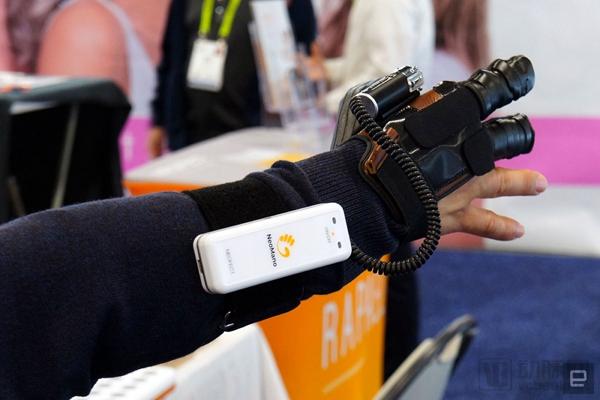
Image source: Engadget
The NeoMano glove is easy to don and use. Once placed on the index finger, middle finger, and thumb, the user simply presses the button on the wireless Bluetooth controller to activate the pulley housing and motor, which drives the built-in titanium wires to actively close the wearer’s hand. Pressing the button again releases the tension, allowing the fingers to return to a neutral position. The NeoMano glove is portable, enabling users to wear it whenever grasping assistance is needed.
With the NeoMano glove, patients with spinal cord injury (SCI) and others with limited hand mobility can hold a coffee cup, grasp and turn door handles, use a toothbrush or digital devices, button up shirts, and perform other basic activities of daily living. This helps them participate more fully in social activities.
“After providing rehabilitation therapy to stroke patients, we recognized the need to improve mobility for individuals with spinal cord injuries and other forms of partial hand paralysis,” said Scott Kim, Co-founder and CEO of Neofect. “By helping patients mimic normal hand movements, the NeoMano glove can deliver significant physical and psychological benefits and boost patient confidence.”
It is reported that the NeoManos glove was showcased at CES 2018, when the product was not yet ready for mass production. Since then, Neofect has redesigned the glove using key technologies, fulfilling its promise to make the NeoMano glove look “cooler.”
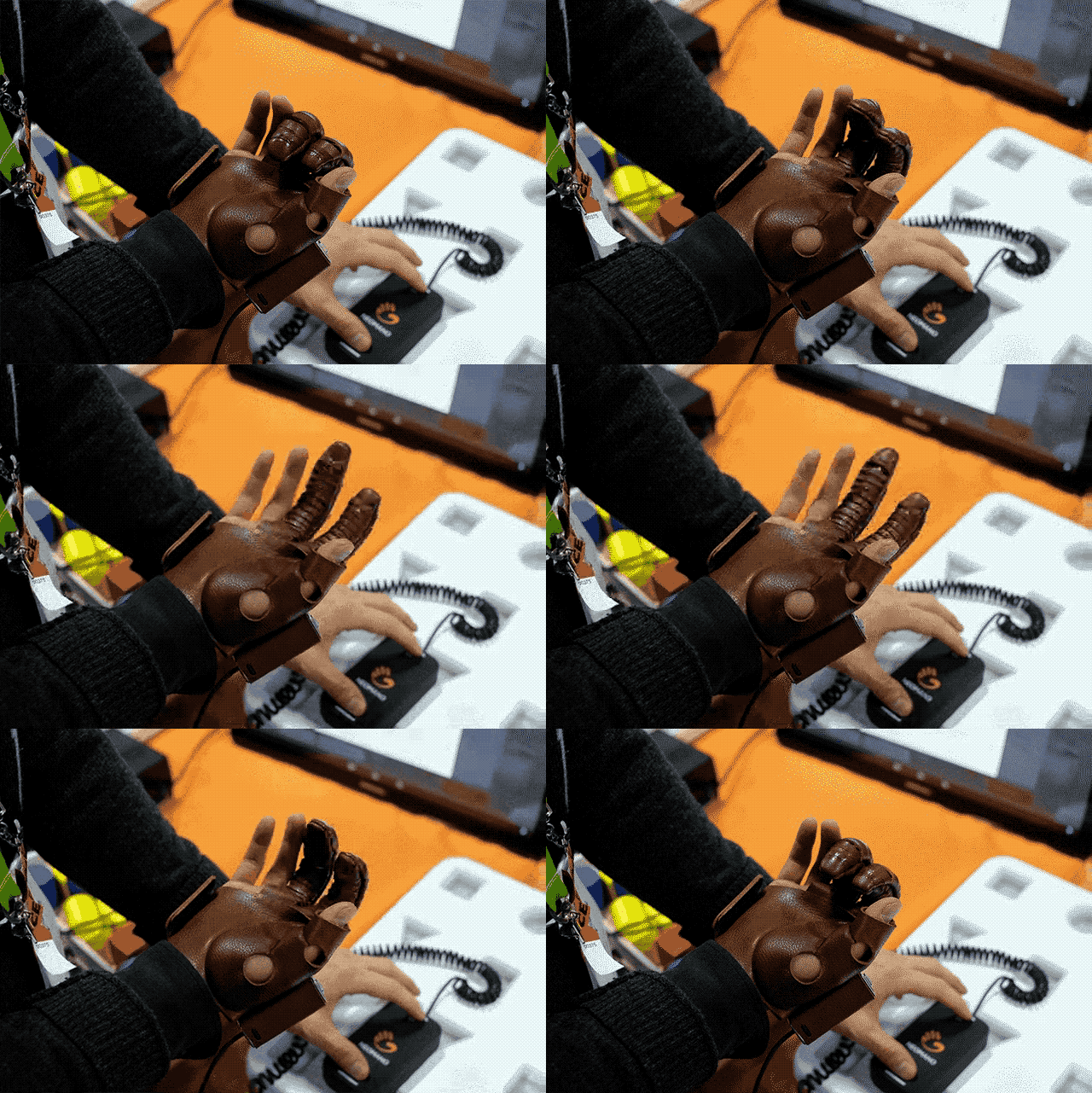
Image source: Engadget
The new NeoMano glove offers improved comfort, with the titanium wires previously used to assist paralyzed fingers in performing "lift" and "lower" motions now fully enclosed. More importantly, hardwired connections between components have been eliminated in the new NeoMano glove, with most components connected wirelessly. The glove connects to a power and control unit worn on the wearer’s forearm, which in turn links to a remote control that can be worn around the user’s neck. This configuration allows users to quickly access and activate the controller.
Neofect stated that a single charge of the NeoMano provides approximately eight hours of use. This wire-based device can assist wearers in lifting objects weighing up to 1 kilogram. While this weight may not seem significant for healthy individuals, it can be sufficient to restore a sense of normalcy for patients suffering from conditions such as amyotrophic lateral sclerosis (ALS), multiple sclerosis, and nerve damage. The NeoMano glove was officially launched on the market in June 2019.
In addition to the NeaMano glove, Neofect offers other flagship products, such as the RAPAEL Smart Glove. This product provides more engaging and measurable rehabilitation training services for patients recovering from stroke and other musculoskeletal and neurological injuries. Launched in 2014, the RAPAEL Smart Glove has been sold to numerous home-care patients in the United States and hospitals worldwide, including NewYork-Presbyterian, the Department of Veterans Affairs (VA), Shirley Ryan AbilityLab (formerly the Rehabilitation Institute of Chicago), Brooks Rehabilitation, and Swedish Medical Center.
Furthermore, Neofect has developed innovative smart rehabilitation solutions to help patients with neurological and musculoskeletal injuries perform daily tasks that they would otherwise be unable to complete independently.