

2019 J.P. Morgan Healthcare Conference: Navigating the Biopharma Downturn — Strategies from Industry, Academia, and Investors
Ichigo Ichie. In January 2019, the J.P. Morgan Healthcare Conference was held in San Francisco as scheduled. At this event, dubbed the “Super Bowl of Biopharma,” massive biopharmaceutical technology deals are often struck amidst clinking glasses and a few handshakes and conversations.
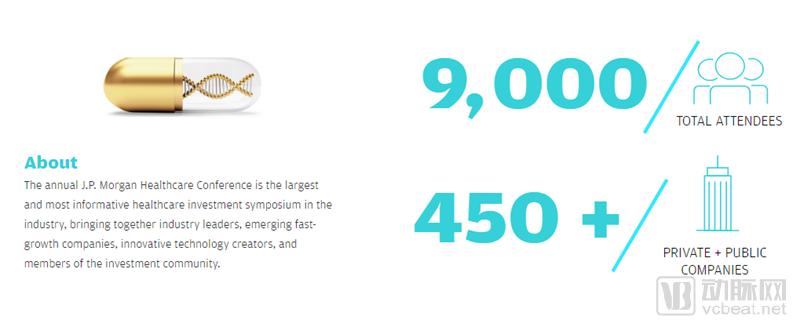
On the final day of the conference, participating companies jointly discussed the anticipated growth in the U.S. generic drug industry; academic researchers called for increased technology transfer; and large-scale deals significantly boosted confidence among biotechnology investors.
Here are the key highlights curated for you by VCBeat (WeChat Official Account: vcbeat):
Executives from generic drug companies attending the JPM Healthcare Conference stated that pricing pressures on pharmaceuticals in the United States are currently easing, and they view this development with cautious optimism.
U.S. generic drug prices have been under pressure for years due to consolidation among acquirers and the increasing number of FDA-approved generics.
Teva Pharmaceutical CEO Kare Schultz described this trend as a “death spiral,” while Mylan NV CEO Heather Bresch likened the situation to an “earthquake.”
However, both executives indicated that pricing pressures on pharmaceuticals appear to be easing. Schultz told investors, “This is a dramatic shift; we are no longer experiencing the ‘death spiral’ of declining prices, and the current situation is far more stable.”
Shortly after Schultz assumed the role of CEO in 2017, he decided that Teva Pharmaceutical would either raise prices on unprofitable products (accounting for approximately 10% of the company’s portfolio) or discontinue their sales. However, the executive emphasized that this improvement did not mean the market would return to the levels seen in the years prior to the sustained price declines. He added, “It simply means that the market’s continuous decline has stopped.”
Bresch responded to this view, albeit with greater caution. “I think the word ‘stable’ is relative,” she stated, noting that the generic drug industry is still grappling with the aftermath and striving to restore stability.
While pharmaceutical giants are celebrating the record number of new drug approvals in 2018, it remains uncertain whether this success can be sustained. Laurie Glimcher, President and CEO of the Dana-Farber Cancer Institute, expressed concern at the 2019 Wuxi Global Forum that pharmaceutical companies have too narrow a focus and are overly cautious in engaging with external research resources.
“We have made significant progress in immunotherapy, but it is only applicable to 20% of patients, and merely eight to nine types of tumors are sensitive to this therapy.” She stated that while major pharmaceutical companies are focusing on the same area, continuing to develop more PD-1-targeted therapies is undoubtedly a waste of time.
Glimcher believes that the industry needs to explore other areas, and academia and small biotechnology companies are more likely to achieve this goal than large pharmaceutical companies. However, this goal will be achieved faster only if large pharmaceutical companies provide appropriate resources and support. For example, in November 2018, Deerfield Management announced an $80 million investment in Dana-Farber to establish a protein degradation center.
“Most new target discoveries will occur in academia, but we can only take them so far,” she noted.
Glimcher added that the problem lies in the fact that academic centers are not fairly compensated for their contributions to the industry. “When we collaborate with venture capital firms or pharmaceutical companies, we receive only a 2% royalty because we are early-stage partners. If we want to multiply the number of new drug targets, pharmaceutical companies will need to engage in more collaborations with academic institutions and provide appropriate rewards for their outstanding work, regardless of the stage of development.”
Glimcher believes that the relationship between Dana-Farber and Deerfield is one that pharmaceutical companies should pay attention to. She said, “Deerfield has a unique approach to funding academic institutions, providing up to $80 million to support a series of basic and translational science projects in the field of protein degradation. More importantly, Deerfield recognizes that they must share benefits with the academic community, so we hold a 50% equity stake in the research outcomes.”
Regenxbio’s adeno-associated virus (AAV) platform for gene therapy has been licensed to more than a dozen partners for the treatment of a range of diseases. 2019 will be a milestone year for the company’s portfolio of five clinical-stage and one preclinical gene therapy candidates.
Regenxbio has reported positive Phase I/IIa results for its lead candidate, RGX-314, in wet age-related macular degeneration (AMD), and plans to advance this gene therapy into Phase IIb later this year. This program is highly significant for the company on multiple fronts, including its transition into late-stage development and its potential to expand market share in the wet AMD sector.
Ken Mills, the company’s founder and CEO, pointed out that “mainstream” indications such as wet age-related macular degeneration (AMD) are not the norm for gene therapy, which tends to focus on rare diseases. A case in point is AVXS-101, acquired by partner Novartis AG last April for $8.7 billion through its purchase of AveXis. This gene therapy for spinal muscular atrophy (SMA) is currently under review by the U.S. FDA and is expected to gain approval this year.
Ken Mills stated that when he founded Regenxbio, gene therapy was considered unsafe and uninnovative due to safety concerns that arose during its previous era of development. Ten years later, “it is truly rewarding to see a product gain approval,” he said.
Regenxbio has three other programs in or entering Phase I/II clinical trials: RGX-501 for homozygous familial hypercholesterolemia, with interim data expected to be released in the second half of 2019; RGX-111 for mucopolysaccharidosis type I (MPS I), with patient enrollment anticipated to begin in mid-2019; and RGX-121 for MPS II, which is also scheduled to report interim data in the second half of 2019. Additionally, Regenxbio plans to submit an Investigational New Drug (IND) application for its preclinical candidate, RGX-181, intended for the treatment of late-infantile neuronal ceroid lipofuscinosis type 2 (CLN2), in the second half of 2019.
Regenxbio is now placing less emphasis on partnerships and more on its own product pipeline, but Mills stated that the company will continue to license its NAV Technology Platform to partners through suitable candidate products and technical expertise, as it aims to help more patients in need.
Dr. Reddy’s Laboratories persevered through its challenges in China. As the world’s second-largest pharmaceutical market, China’s evolving regulatory landscape has opened doors of opportunity for the company. The firm believes that its long-term presence in the country may now begin to pay off.
At the JPMorgan Healthcare Conference, Erez Israel, Chief Operating Officer of RadNet, stated, “Over the past two decades, we have sold approximately $100 million worth of products in China. Even during challenging times, we never withdrew from the Chinese market, and we hope to reap the benefits now.”
Building on the overview released last October when the company announced its second-quarter results, Israel provided further details on the company’s development plans in China. China has recently introduced a series of regulatory reforms, establishing guidelines for accepting foreign clinical trial data to support new drug approvals, with the aim of encouraging innovation and accelerating the drug approval process. The company believes that 70 products in its U.S. portfolio can meet China’s new regulatory requirements, and registration for some of these products has already begun.
“A number of these products could even hit the market soon; we are well versed in this, as our past registration timelines in China have been longer,” said the former Teva Pharmaceuticals executive, who did not provide further product details.
Israel also mentioned plans to expand local manufacturing and partnerships in specific regions of China during the JPM conference. The company’s existing subsidiary in China, Kunshan Rotam Reddy Pharmaceutical Co., Ltd. (KRRP), was established as a joint venture with Canada’s Rotam Group. In 2017, another subsidiary of Reddy, Reddy (Wuxi) Pharmaceutical Co., Ltd., was also established in China.
“Establishing strong relationships with Chinese regulatory authorities and possessing in-depth knowledge of commercialization processes across all provinces in China are additional advantages that benefit the company during its market expansion,” said Israel. “We currently have 70 products, and the company aims to make a significant entry into the Chinese market by introducing more products, even as the landscape of the Chinese market undergoes changes.”
The new offensive in the Indian market is another key component of Reddy’s strategy, as management recognizes that the company may not have focused on the Indian market as much as it should have. “Reddy was once a major player in the Indian market, and now we are returning with new products,” added Israel. He further noted that approximately 70% of the company’s management has changed over the past 18 months.
New York-based biotech company UroGen has not yet determined the pricing for UGN-101 (0.4% mitomycin gel), a product indicated for the treatment of stage III upper tract urothelial carcinoma. Liz Barrett, the company’s newly appointed CEO, stated at the JPM Conference that, given the drug’s value, its price is likely to be substantial.
UGN-101 is a sustained-release formulation of mitomycin C, a DNA-crosslinking chemotherapeutic agent that is liquid when refrigerated but solidifies in vivo, developed using UroGen’s RTGel technology platform.
Barrett has recently joined UroGen, the biotechnology company that announced on January 3 that Liz Barrett, former head of Novartis Oncology, would join the company to oversee the approval and launch of UGN-101.
On January 8, the company released additional data from its Phase III Olympus study, showing that 57% of the 61 evaluable patients treated with UGN-101 for low-grade upper tract urothelial carcinoma achieved a complete response at the primary disease assessment timepoint.
Barrett stated that UroGen plans to launch UGN-101 in 2020.
The company has made extensive preparations, but the pricing has not yet been determined. Barrett stated that current treatments involve multiple comorbidities and surgical procedures, making its value proposition strong from a pharmacoeconomic perspective. “We are very confident that we will be able to set a fairly substantial price,” she said.
The company also has a tumor-specific formulation named UGN-102 (0.18% mitomycin) in Phase II trials, but its executives have stated that they are eager to expand their R&D scope beyond this disease.
UroGen has established a partnership with Allergan to leverage its RTGel technology platform for the development of a botulinum toxin product for the treatment of overactive bladder.
“Currently, the treatment with botulinum toxin requires patients to receive approximately 40 to 60 injections into the bladder. In contrast, RTGel achieves therapeutic efficacy with just a single injection of botulinum toxin. So you can imagine what a significant advancement this represents for patients,” Barrett stated at the JPM Conference.
Brad Loncar, CEO of Loncar Investments, stated that investor enthusiasm for flying to the J.P. Morgan Healthcare Conference this year was muted following the biotech sector’s difficult second half of 2018 and the broader market downturn in December.
Loncar said, “Expectations for biotechnology could not have been lower in 2019; no one wanted any association with biotech companies.” However, two major M&A deals occurring just before and after the conference changed this situation.
On January 3, Bristol-Myers Squibb announced its plan to acquire Celgene for $74 billion. Shortly thereafter, on January 7, Eli Lilly moved forward by agreeing to acquire Loxo Oncology for $8 billion.
Given that both companies encountered significant setbacks in their later-stage R&D, the partnership between Bristol-Myers Squibb and Celgene was meaningful. “Both companies struggled into 2019,” said Loncar. He added that Bristol-Myers Squibb and Celgene needed to take steps to appease frustrated investors, and that they might be stronger together than as independent entities. He pointed out that the two companies expected to realize $2.5 billion in synergies following the merger.
However, Loncar predicts that this will not be the only major M&A deal this year, as pricing pressures have strengthened the negotiating position of payers. Biotechnology and pharmaceutical companies anticipate a decline in their operating margins, driven by revenue compression resulting from lower net drug prices. He noted that pharmaceutical manufacturers will face pressure to consolidate, achieve scale, and enhance bargaining power, while simultaneously seeking ways to improve operational efficiency and reduce costs.
Eli Lilly’s acquisition of Loxo Oncology has also drawn significant attention from investors. In response, Loncar stated, “Things are always changing rapidly, and this is exactly what is happening.”