

Life Biosciences Secures $50 Million Series B Funding to Advance Anti-Aging Research Across Eight Biological Pathways Through Six Subsidiaries
VCBeat (WeChat Official Account: vcbeat) learned from the official website of Life Biosciences that the company completed a $50 million Series B financing round on January 15, 2019. The proceeds from this round will be used for research related to aging. Tristan Edwards, co-founder of the company, stated that the initial target for this financing round was $25 million, but the amount was increased to meet investor demand. Investors in this round included individuals, family trusts, and other professional investors; the specific list has not yet been disclosed.
Life Biosciences is a biotechnology company researching human aging, dedicated to combating aging through biotechnology to extend human lifespan. The company was co-founded by Tristan Edwards and scientist David A. Sinclair in 2017 and is headquartered in Boston, United States.
Tristan Edwards is the Co-founder and CEO of Life Biosciences. He holds CFA, CMT, and CPA certifications and serves as an executive at four biotechnology companies, including Continuum Biosciences and nimal Biosciences. Additionally, he is a seasoned investor with 16 years of investment experience.
Another founder of Life Biosciences, Dr. David A. Sinclair, is a Tenured Professor of Genetics at Harvard Medical School and Co-Director of the Paul F. Glenn Center for Biology of Aging Research. Widely recognized as one of the world’s most senior scientists in the field of aging, Dr. Sinclair has made significant contributions to research on mitigating the aging process. In recognition of his pioneering medical research, he has received more than 35 related awards and was named by Time magazine in 2018 as one of the “50 Most Influential People in Health Care.”
From the perspective of Life Biosciences, human aging is not an isolated physical symptom but is closely linked to changes in eight biological signals. These eight hallmarks of aging are: Mitochondrial Dysfunction, Altered Communication & Inflammation, Chromosomal Instability, Cellular Senescence, Loss of Proteostasis, Epigenetic Alterations, Stem Cell Exhaustion, and Metabolism.
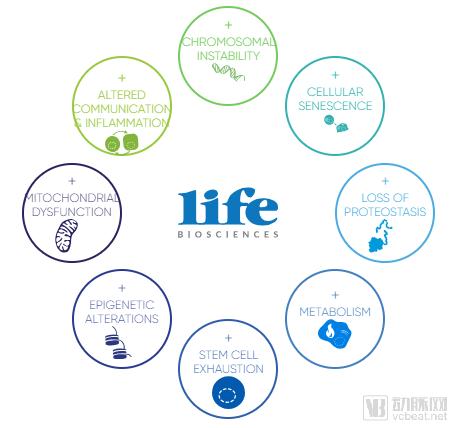
Image sourced from the official website
From cellular senescence (Cellular Senescence) In studying the aging process, Life Biosciences discovered that when cells become damaged or cease to function, they are replaced by new, healthy cells. As individuals age, the body becomes unable to clear all “senescent cells.” These senescent cells persist in the body like zombies, secreting factors that induce cancer and severely impairing the normal functioning of tissues and organs. Removing senescent cells can treat age-related diseases and may potentially achieve “aging reversal.”
As we age, mitochondria may malfunction (Mitochondrial Dysfunction), chromosomes may lose the ability to segregate accurately (Chromosomal Instability), proteins fail to fold correctly into their three-dimensional structures (Loss of Proteostasis), stem cell exhaustion fails to replenish fresh cells in a timely manner (Stem Cell Exhaustion), and various abnormal states are microscopic changes brought about by aging of the organism. In addition, the human body's metabolism slows down (Metabolism) leads to fat accumulation, the emergence of conditions such as diabetes and fatty liver disease, and also marks bodily aging.
Life Biosciences has six subsidiaries, each of which focuses on at least one of the eight hallmarks of aging. For example, its subsidiary Unity Biotechnology specializes in eliminating senescent cells, while Continuum Biosciences is dedicated to ensuring proper mitochondrial function. Ultimately, all six subsidiaries share their respective research data through the Lua and LifeAI communication platforms.
It is worth noting that Lua, a HIPAA-compliant medical technology platform, was acquired by Life Biosciences only last October. Additionally, Life Biosciences has invested in Prana, an Australian publicly listed biotechnology company developing drugs to combat neurodegenerative diseases.
“We have always operated in stealth mode,” said Dr. Sinclair. “Life Biosciences has brought together many of the world’s leading longevity scientists and secured the relevant intellectual property.” In less than two years since its founding, Life Biosciences has rapidly captured a significant share of the longevity market. According to sources familiar with this round of financing, the company’s valuation has reached $500 million.