

Three Key Strategies for Healthcare AI Companies to Accelerate System Deployment by 50%
Over the past two years, medical artificial intelligence systems have achieved breakthrough developments and gained widespread recognition from hospitals and physicians. The development of AI in medical imaging has been particularly rapid, with its application extensively expanding to the diagnosis of various diseases affecting multiple organs, including the lungs, heart, brain, eyes, and skin.
Looking ahead, artificial intelligence systems will transform diagnostic and treatment models, enhance the capacity of healthcare service delivery, improve clinical standards, and drive the transformation of operational models across the entire healthcare industry. However, accelerating the development and application of existing AI systems remains a significant challenge.
In response, NVIDIA, the world’s largest GPU manufacturer, has assembled a team of experts to compile the white paper titled “NVIDIA Healthcare AI,” offering the following three recommendations to healthcare artificial intelligence companies:
1. Begin with the development and application of AI systems for medical imaging, and on this basis, further integrate additional data types such as electronic medical records, laboratory and diagnostic test results, and patients’ daily health monitoring data, thereby constructing richer and more comprehensive healthcare big data to lay a solid foundation for developing more advanced artificial intelligence systems.
2. With the continuous in-depth development of artificial intelligence technologies, specialized medical AI platforms are gradually emerging. It is recommended to adopt a specialized, integrated platform to streamline platform construction and debugging efforts, thereby allowing greater focus on model training and system application, while ensuring that the developed AI systems deliver high reliability and efficiency.
3. On the basis of establishing a specialized medical artificial intelligence platform in hospitals, work closely with clinical departments to select suitable disease types for the development of diagnostic and treatment systems, thereby improving the effectiveness of diagnosis and treatment.
In fact, NVIDIA’s three recommendations are based on three key operational priorities for the development and deployment of existing medical artificial intelligence systems: establishing a medical big data system, developing AI algorithms and models, and building specialized AI platforms. Specifically, these include:
1. Establish a big data system capable of processing and integrating multi-source, multi-format data: In AI systems for medical imaging, the system can process image data output from various medical devices such as CT, MRI, X-ray, and ultrasound, perform professional data annotation, and conduct large-scale computations.
2. Establish specialized deep learning models, either by leveraging professional open-source models or by developing custom models in-house. These models require continuous upgrades and improvements during deep learning training and AI system operation to ensure their accuracy and reliability.
3. Establish a professional AI computing platform, encompassing the construction of hardware infrastructure and the deployment of computing systems. The overall platform may also adopt a specialized, integrated model—a turnkey solution that bundles chips, servers, computing systems, algorithmic model software, AI application systems, and cloud services. In summary, the fundamental principles for building the computing platform are to deliver robust computational power and ensure reliable stability, while enabling seamless integration with deep learning software, thereby enhancing the overall computational performance of AI system development and operation.
In addition to the three recommendations mentioned above, this white paper provides an in-depth look at the current status of AI adoption in hospitals, the ecosystem landscape of medical AI, and the two primary models for building medical AI platforms. The following content is excerpted from this highly informative industry white paper.
To get a glimpse of the full authorized white paper from NVIDIA, quickly scan the QR code below:

Current Status of AI Implementation in Hospitals
Medical artificial intelligence is developing rapidly in many countries around the world. As of the first half of 2018, the U.S. Food and Drug Administration (FDA) had approved nine AI-related products, including automated monitoring and early-warning systems as well as computer-aided diagnostic tools, many of which have already been adopted by hospitals. Japanese hospitals have begun experimenting with and piloting AI systems, particularly in the field of imaging-assisted diagnosis, thereby enhancing Japan’s healthcare service delivery capacity.
Nearly 1,000 hospitals in China have deployed artificial intelligence (AI) systems, with more than half of them implementing AI solutions for medical imaging. Currently, there are over 100 healthcare AI companies in China, approximately 40 of which specialize in medical imaging AI. Some AI systems are deployed on-premises within hospitals to provide direct auxiliary support to clinical departments; for instance, Infervision’s medical imaging AI system has been implemented at Shanghai Changzheng Hospital and Wuhan Tongji Hospital, among others. Other AI systems are cloud-based, delivering remote diagnostic assistance to hospitals in primary care settings or in western regions of China.
For instance, Wanli Cloud’s “DoctorYou” AI medical imaging platform provides remote consultation services to hundreds of primary-care hospitals; some systems are also designed for patient use, such as certain AI-powered dermatology systems that offer auxiliary diagnostic services via mobile apps.
After initial development and deployment, medical artificial intelligence (AI) systems have gained widespread recognition among physicians. According to an IDC survey on the use of AI-assisted diagnostic tools for medical imaging in hospitals, 100% of hospitals that had already deployed medical imaging AI systems reported overall satisfaction with their performance. Among the 24 surveyed hospitals that had not yet implemented AI systems, more than 35.3% indicated plans to deploy AI within the next year.
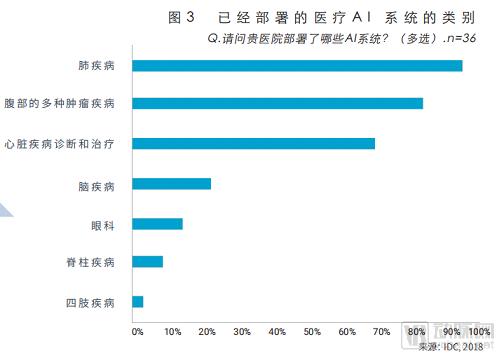
Currently, medical imaging artificial intelligence systems in China are used to support disease diagnosis across multiple fields, with lung nodule and lung cancer diagnosis being the most common applications. Auxiliary diagnosis for abdominal tumors, cardiovascular diseases, neurological disorders, ophthalmic conditions, and dermatological diseases is also rapidly advancing. The China Food and Drug Administration (CFDA) is currently developing certification standards and regulations for medical AI systems as specialized medical devices; to date, only a few products have received CFDA certification.
Even after obtaining certification, AI systems must collaborate with other medical devices in clinical applications to jointly provide diagnostic support, rather than making independent diagnoses. It is expected that by the end of 2018, China’s drug regulatory authorities will issue relevant standards and guidelines to clarify the evaluation and certification processes for AI systems. Once an AI system receives CFDA certification, it will enter a new phase of rapid development.
Construction of Medical Artificial Intelligence Platform
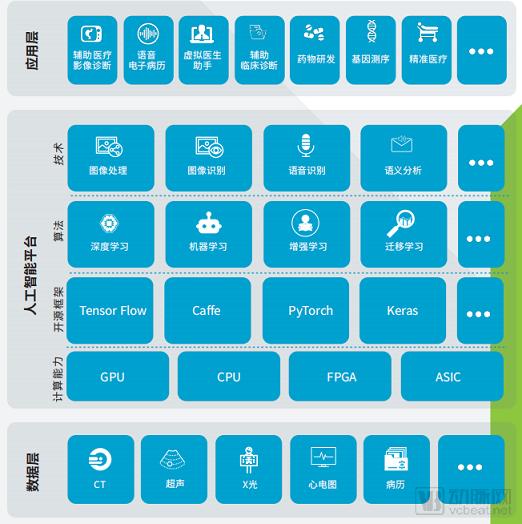
The medical artificial intelligence platform comprises the data resource layer, the AI platform, and the medical application layer. The data resource layer provides foundational data by collecting medical imaging data, electronic health records, and other clinical data from various departments, thereby breaking down data silos between business systems and establishing a solid data foundation for the AI platform.
An artificial intelligence platform comprises computing power, open-source frameworks, algorithms, and technologies. Computing power ensures the operational speed of the AI platform. Taking medical imaging data for pulmonary nodules as an example, each patient typically has 20–30 images. Commonly used computer vision models for automated pulmonary nodule detection, such as Residual Neural Networks (ResNet), enable the training of neural networks with dozens or even hundreds of layers, which places high demands on computing power. The massive volume of data leads to prolonged computation times. Therefore, building a supercomputing platform not only shortens computation time but also enhances medical efficiency and reduces patient waiting times, which is crucial in clinical applications.
In addition to computational power, the selection of open-source frameworks and algorithms also plays a crucial role. For instance, choosing open-source frameworks with strong engineering capabilities such as TensorFlow, or those with excellent performance in image processing such as Caffe, and adopting algorithm models commonly used in image recognition, such as Convolutional Neural Networks (CNN) and Recurrent Neural Networks (RNN), significantly influences the effectiveness of medical artificial intelligence applications.
The selection of technology is closely tied to its application. In applications supporting medical imaging diagnosis, it is essential to choose image processing and image recognition techniques that are appropriate for the existing data quality; for instance, when image quality is poor, image enhancement techniques can be employed to improve it. In voice-based electronic medical record (EMR) applications, technologies such as speech recognition and semantic understanding are selected to assist physicians in completing medical documentation through voice input.
The development of medical artificial intelligence platforms assists healthcare institutions in enhancing service quality, balancing medical resources, and alleviating the pressure on medical services, particularly in regions with scarce medical resources. Healthcare institutions select appropriate development models based on their respective levels of informatization to help improve their medical service capabilities.
Platform Model 1: Building an Independent Medical Artificial Intelligence Platform
Hospitals are leveraging vast amounts of medical data to build artificial intelligence (AI) healthcare platforms that operate independently of their core business systems. These platforms integrate multi-source, heterogeneous data scattered across various operational systems, employ natural language processing (NLP) techniques to convert clinical narrative descriptions into structured data, and generate medical knowledge graphs. This approach preserves valuable medical expertise and treatment experience, enabling its rapid replication to regions with scarce medical resources. However, the development of such independent healthcare platforms involves a prolonged implementation cycle and requires integration with numerous business systems, presenting significant challenges during the construction process.
To achieve high-performance algorithmic models, medical data typically requires annotation. Even when employing unsupervised or semi-supervised learning, annotated medical data are still necessary for model training in the early stages. Data annotation is a time-consuming and highly specialized task that imposes stringent requirements on annotators. Currently, data annotation is primarily performed manually by experienced specialist physicians. Meanwhile, collaboration among healthcare IT vendors needs further enhancement. As the “lifeblood” of medical development, data must flow freely across various systems; breaking down barriers between hospital business systems is key to the advancement of medical artificial intelligence systems.
Platform Model 2: Building an Embedded Medical Artificial Intelligence Platform
The hospital’s existing information systems, which serve as the operational backbone for daily functions, feature complex architectures and entail substantial costs for modification. Consequently, emerging AI-based medical diagnostic solutions on the market are unlikely to replace these legacy business systems. In most cases, AI systems provide service interfaces that integrate with the existing infrastructure, thereby combining artificial intelligence technologies seamlessly with established workflows. Taking medical imaging as an example, alerts for suspected lesions are displayed directly within the original Picture Archiving and Communication System (PACS), eliminating the need for physicians to switch to a separate system.
This embedded AI module can reduce system development costs. More importantly, this approach does not alter physicians’ existing diagnostic workflows or operational habits, thereby lowering the learning curve for healthcare professionals. AI systems that preserve established clinical protocols are more readily accepted by hospitals, resulting in higher utilization rates.
Adopting an embedded AI platform eliminates the need to rely on data from legacy systems. In an era where data has become increasingly critical, this approach ensures the security of data within existing medical systems by avoiding the need to open their databases, while also enhancing collaboration among vendors, thereby facilitating the adoption of AI technology in the healthcare industry.