

Global Pharma Meets Blockchain: Four Key Applications and Strategic Moves by Pfizer, Novartis, and Other Giants
The healthcare sector currently faces two major challenges: first, the complexity of the medical system, which involves pharmaceutical manufacturers, healthcare providers, and patients, necessitating connectivity among all parties to ensure accurate information exchange; second, the lack of traceability in the medical supply chain. These issues manifest specifically as follows: medical data is overly fragmented, adversely affecting research and services, with approximately half of clinical trials remaining unpublished; drug development costs continue to rise, and the production and distribution of substandard and counterfeit drugs remain severe problems.
Blockchain technology features traceability, eliminates the need for multi-party coordination, and offers high accuracy and credibility. Consequently, it holds the potential to address the aforementioned challenges and create entirely new business models. As the technology has evolved, VCBeat (WeChat Official Account: vcbeat) has conducted a comprehensive review of its practical benefits to the industry, focusing on “Pharmaceuticals + Blockchain.” The main contents of this article include:
1. Applications of Blockchain in the Pharmaceutical Industry: Drug R&D, Pharmaceutical Supply Chain Management, Prescription Management, and Billing and Claims Management;
2. How are pharmaceutical giants Pfizer, Novartis, Roche, Merck & Co., and Sanofi positioning their strategies?
Drug supply is a critical component in the delivery of clinical care and medical services. Consequently, the pharmaceutical industry has introduced various innovative applications across the entire supply chain—from drug discovery and clinical trials to product commercialization—as well as corresponding solutions, such as counterfeit drug identification and improving patient medication adherence.
1. Drug Development
Any pharmaceutical company will invest heavily in drug research and development. However, as healthcare costs continue to rise and market demand for innovative drug therapies increases, collaboration among multiple pharmaceutical companies to enhance competitiveness becomes particularly important. Blockchain can provide a technical platform that facilitates information exchange among multiple parties while ensuring data accuracy. For example, immutable records and timestamps, as digital tools, can effectively protect intellectual property rights.
Blockchain technology can also improve the sharing of clinical and trial data. Even in non-collaborative drug development, blockchain can effectively track and manage various aspects of clinical trials, such as data management, access control, and adverse drug reaction monitoring.
Furthermore, it is not uncommon for pharmaceutical companies to outsource their clinical research projects. To address issues of inaccurate information dissemination, blockchain can provide a viable mechanism to ensure data integrity and accuracy, such as in reporting the side effects of new drugs. In research systems based on blockchain technology, research results are transparent and verified, making it difficult to obtain erroneous outcomes.
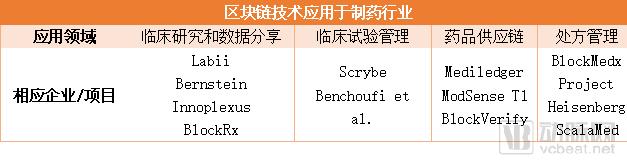
Intellectual Property Management.For non-patented products, blockchain technology is commonly used to manage intellectual property rights and facilitate the development of innovative drugs. For instance, Labii has launched a blockchain-based electronic laboratory notebook; Bernstein has leveraged blockchain technology to introduce timestamped digital trail management, ensuring priority of intellectual property rights—a feature that benefits collaborative drug research and development. iPlexus utilizes blockchain technology to make both unpublished and published data in drug research and development more accessible.
Clinical Trials.In the drug development process, blockchain technology can also be applied to the management of clinical trials. For instance, the IEEE Standards Association recently hosted a forum on blockchain and clinical trials, aiming to leverage blockchain to facilitate patient recruitment, ensure data integrity, and accelerate progress in drug development. At the forum, researchers introduced Scrybe, a blockchain project designed to provide an efficient and trustworthy mechanism to expedite clinical trials and research processes. Furthermore, it offers a simple and transparent framework to assist relevant stakeholders in conducting legal and ethical oversight of the trial process.
M. B. Ravaud once conducted a study aimed at exploring how blockchain technology can facilitate clinical research. In this project, Ravaud found that blockchain, as a reliable and open solution, can effectively manage permissions, data, and output results in clinical trials. This innovation in clinical trials is crucial for drug research, as many clinical studies consume significant time and budget, and the competitive sharing of trial data can accelerate drug development.
Furthermore, the field of pharmaceutical research is quite extensive, encompassing drug discovery, device manufacturers, and clinical trial results. BlockRX leverages Advanced Digital Ledger Technology (ADLT) to provide a solution that connects disparate stakeholders within the healthcare system.
2. Supply Chain and Counterfeit Drug Detection
Supply chains are critical to the healthcare industry; therefore, appropriate monitoring and tracking are required throughout the entire process—from raw material sourcing to drug manufacturing, storage, and distribution—to ensure smooth supply chain operations. In recent years, counterfeit drugs have become an increasingly prominent concern. To address this issue, regulatory authorities must establish a mechanism that enables patients and all stakeholders in the supply chain to verify the composition of pharmaceutical products.
Due to the lack of appropriate tracking mechanisms, there are numerous vulnerabilities in the supply chain, leading to the emergence of counterfeit and substandard drugs. To address this issue, regulatory authorities have enacted new regulations requiring all stakeholders in the pharmaceutical supply chain to track the distribution process of medicines. Blockchain technology offers a highly suitable solution, enabling parties to maintain information within an open, secure, and tamper-proof system while ensuring that data is accessible to multiple stakeholders.
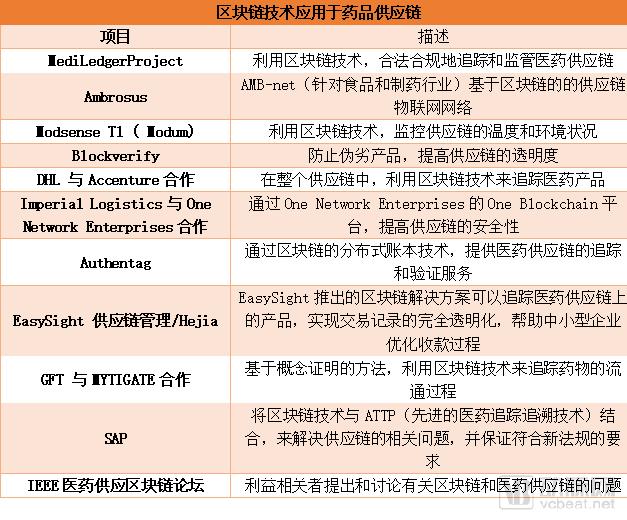
Consequently, numerous solutions leveraging blockchain technology to track the pharmaceutical supply chain have been proposed. For instance, the MediLedger project, initiated by pharmaceutical giants such as Pfizer and Genentech, is utilizing blockchain technology to establish an open network for the pharmaceutical supply chain. As relevant regulatory requirements mandate the use of interoperable systems to trace the entire supply chain of prescription drugs, this project is compliant with such regulations.
Furthermore, Ambrosus has launched its flagship product, AMB-Net, targeting the food and pharmaceutical industries. AMB-Net is a blockchain-based Internet of Things (IoT) supply chain network that enables companies to customize their supply chain solutions. Modum has introduced the MODsense T1 temperature sensor, which can be used to monitor the pharmaceutical supply chain and complies with Good Distribution Practice (GDP) for medicinal products. Blockchain technology ensures the accuracy and security of sensor data and other digital records. BlockVerify has launched a blockchain-based anti-counterfeiting system. In its provided solutions, users can utilize BlockVerify tags to record the circulation process of products.
3. Prescription Management
Proper prescription management is crucial for ensuring optimal healthcare services. In recent years, the severe misuse of prescription medications has led to issues such as the opioid crisis. Consequently, numerous blockchain-based solutions have been proposed by relevant stakeholders to address challenges in prescription management.
BlockMedx leverages an Ethereum-based platform to manage the prescription process, with all data securely stored on the blockchain. After a physician issues a prescription to a patient, designated pharmacists can verify it via the blockchain before dispensing the medication. This system enhances the efficiency of managing controlled substances, such as opioids.
Project Heisenberg also tracks the prescription process through smart contracts. It provides separate portals for patients, physicians, and pharmacies to enable their participation in the prescription workflow. Meanwhile, ScriptDrop is dedicated to simplifying the process of delivering medications to patients. By delivering drugs directly to patients’ hands, ScriptDrop alleviates the burden on patients of picking up prescriptions from pharmacies. ScriptDrop also leverages virtual assistants to monitor medication usage (adherence).
ScalaMed also offers a blockchain-based solution that enhances medication adherence by establishing a patient-centric model to track all prescriptions. ScalaMed describes this solution as an e-prescription inbox capable of addressing the issue of poor medication management.
In current systems, it is difficult to consolidate diverse data into a single patient-accessible location, whereas ScalaMed’s solution centralizes all prescription information to prevent adverse drug interactions.
Although there are many blockchain-based prescription management solutions available today, some traditional centralized systems can also address the issue, particularly in scenarios involving a limited number of stakeholders. Clinicians and pharmacies can collaborate through tools such as single sign-on (SSO) to public databases, thereby facilitating the management of patient medication.
4. Billing and Claims Management
Financial management is also a critical component of healthcare, yet its development has been inefficient, primarily due to issues of trust and transparency—challenges that can be addressed through blockchain technology. When multiple parties or intermediaries are involved in claims processing, numerous redundant tasks and verification checks often arise.
Blockchain technology facilitates direct communication between patients (claimants) and payers (those who settle claims). Smart contracts can be used to negotiate premiums and transaction prices, and can also integrate data on patients’ current health status, medication usage, and lifestyle with dynamically adjusted insurance costs.
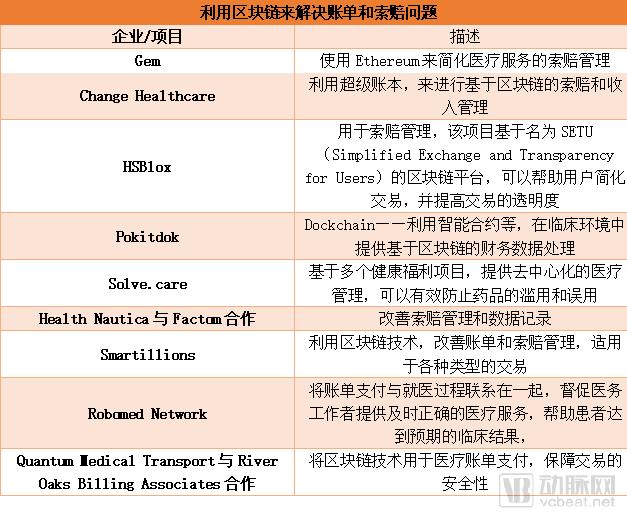
Therefore, the application of blockchain to claims management and financial administration has been proposed. For instance, Gem is leveraging Ethereum to streamline healthcare claims management by integrating patients, providers, and insurers into a unified system with real-time monitoring of patients’ health status. Change Healthcare is utilizing the Hyperledger framework to conduct blockchain-based claims and revenue management.
HSBlox has launched two products—RevBlox(TM) and CuraBlox(TM)—for claims management. Built on a blockchain platform named SETU (Simplified Exchange and Transparency for Users), these products help users streamline transactions and enhance transactional transparency. In addition to leveraging the accuracy and openness of blockchain technology, HSBlox employs machine learning to automate claims decision-making, such as detecting duplicate claims or identifying reasons for claim denials.
Pokidot’s Dockchain leverages smart contracts to deliver blockchain-based financial data processing in clinical settings. Several healthcare companies, including insurers such as Humana and UnitedHealthcare, have been exploring a pilot project that uses blockchain to maintain and share administrative information from healthcare providers. The initiative aims to address redundancies and inefficiencies in insurance claims management.
It is worth noting that while blockchain provides a technological medium to enhance trust in multi-party transactions, we still need to establish mechanisms to facilitate such transactions. For instance, standardized data formats must be developed to enable more efficient sharing of information on health status, treatment records, and corresponding claims. If a common language is adopted within the blockchain ecosystem, all involved parties (such as hospitals and insurance companies) will need to translate their proprietary data into this common language to ensure effective communication with other stakeholders.
Pfizer
In May 2017, Pfizer and several other pharmaceutical companies announced the launch of the MediLedger project, which aims to create blockchain-based tools for managing the pharmaceutical supply chain. This initiative enables manufacturers, wholesalers, hospitals, and other relevant institutions to record all drug-related information on the blockchain, thereby maximizing traceability.
In addition, Pfizer has also engaged in early-stage collaboration with the blockchain startup Chronicled to establish a new project supporting supply chain operations. This project utilizes a permissioned blockchain system (accessible only to vetted participants) to track which party took custody of which medications at what time.
By ensuring that only manufacturers can commission serial numbers and attach unique identifiers to products (as recorded in the ledger), the system makes it more difficult for counterfeit goods to enter the supply chain at arbitrary points. The blockchain system employs zero-knowledge proofs, allowing companies to ensure compliance without actually sharing data.
Novartis
Since 2016, Novartis has been exploring blockchain technology and conducting various proofs of concept (PoCs). The company is developing blockchain-based pilot projects to identify counterfeit medicines and monitor drug temperatures in real time.
Furthermore, Novartis has participated in the IMI’s blockchain healthcare project and is collaborating with European medicines regulatory agencies and the European Union. This healthcare initiative aims to unite pharmaceutical companies, small and medium-sized enterprises (SMEs), universities, clinical laboratories, hospitals, patient representatives, and other stakeholders to leverage blockchain technology for improving healthcare services. It seeks to explore the broad application of blockchain in areas such as counterfeit drug detection, supply chain management, patient data, and clinical trials.
Roche
Genentech, a subsidiary of the Roche Group, has also participated in the MediLedger blockchain project. The core of this project is to establish a distributed pharmaceutical supply chain network and explore a new operational model to ensure patient safety and drug availability.
The MediLedger project has received support from the international supply chain consulting organization LinkLab and has begun leveraging JPMorgan Chase’s enterprise-grade blockchain platform, Quorum, to develop its blockchain-based healthcare applications. If the project achieves its intended objectives, stakeholders across the pharmaceutical supply chain—including manufacturers, wholesalers, and hospitals—will be able to record drug shipment data on the blockchain.
Merck & Co.
In June 2018, Merck & Co. announced that it was filing a patent application for a blockchain-based system capable of storing the geographic coordinates of objects and tracking product circulation throughout the supply chain. Blockchain technology ensures data security, accuracy, and integrity. Merck plans to leverage this system to improve the pharmaceutical supply chain and address the issue of counterfeit and substandard medicines.
As early as December 2016, Merck & Co. filed the patent application, which involves using blockchain technology to store information about a physical object (such as a product), enabling users to receive timely updates and thereby rapidly verify the product’s authenticity.
Sanofi
In late 2017, Sanofi made an equity investment in the blockchain startup Curisium. Curisium aims to build a technology platform for healthcare providers using blockchain and secure computing technologies, enabling patient-centered value-based care.
In addition to investing in Curisium, Sanofi is also applying blockchain technology to other areas to drive technological innovation and drug development. For instance, Sanofi plans to launch a series of pilot projects involving late-stage clinical trials in oncology. Furthermore, blockchain technology can be leveraged to create a system that tracks the entire distribution process of pharmaceutical products. If health authorities, pharmacies, and patients all have access to this information, the circulation of counterfeit drugs can be effectively prevented.
As an innovative technology, blockchain is being implemented across various industries. Its characteristics of decentralization, traceability, and tamper resistance are bringing fresh perspectives to vertical industry applications and fostering new business models. In 2019, we predicted that it would be a year for the in-depth implementation of blockchain technology in the pharmaceutical industry.