

Seven-Day Dialogue on Health Management (Theoretical Framework Edition): Building a Clear, Achievable, and Practical Health Management Solution
Two institutions successively rebranded, with their new names both pointing toward health management. This detail left a deep impression on me and, to some extent, reflected the state of health management development at the time: health management was a catch-all category, into which anything could be placed.
Nevertheless, I am more inclined to agree with the term “health management”:
In my view, personal health is like sailing against the current; if you do not advance, you will fall behind. If you do not take proactive measures to stay in the upstream “health zone,” you will naturally drift downstream toward medical institutions. Once the initiative for health is handed over to hospitals, it is no longer about management but rather about locking the barn door after the horse has bolted—by then, regret comes too late.
The concept is sound, but its practical implementation involves numerous considerations. In recent years, industry research on health management has largely remained at the theoretical and conceptual stages, failing to provide robust practical solutions. Many companies and products in the health management sector have faded into obscurity after a brief period of prominence. There are many reasons for this decline; in my view, human factors play a more significant role—people simply were not prepared to embrace health management.
Entrepreneurs Rushed In Unprepared: It Has Proven That Fast-Paced Models Like Internet Thinking and E-Commerce Tactics Are Not Suited for Health Management. Everyone Understands the Value of Patience and Steady Progress, Yet They Fear Both the Impatience of Capital and the Speed of Competitors.
Users Are Unprepared and Fickle: Most users have an inconsistent understanding of health management. On one hand, they may spend tens of thousands of yuan annually on smoking, yet consider spending a few hundred yuan on health management “too expensive.” On the other hand, they often expect instant results from health management plans found online. However, health management is not merely a set of methods; it is a comprehensive, meticulous, and personalized process. After all, consistent companionship is the most enduring commitment. In this process, users play crucial roles as data collectors, discoverers, and adherents.
# The Evolving Landscape of Health Management
As time passed, the health management industry, which had been in a period of “consolidation” for many years, suddenly saw numerous favorable developments in 2018: deregulation and support on the supply side, robust demand on the demand side, active participation from payers, and innovations in new technologies all presented opportunities for extraordinary growth in the health management sector.
The “China Health Management and Health Industry Development Report 2018” also presents a similar perspective: the report posits that the period from 2007 to 2017 was a phase for academic theoretical research, discipline construction, and practical exploration in health management in China, while 2017–2018 constituted a significant historical window of opportunity for the development of China’s health management and health industry.
"There was no path in the world at first; as more people walked, a path came into being."
The allure of a blue ocean has drawn capital and players in droves, turning the quiet country lane of health management into a competitive racetrack.
In addition to the focused professional athletes on the track, there are also interested observers and users like me on the sidelines. Driven by interest and personal needs, I have gradually adopted various health management products. After consistent use over a period of time, some of these products have indeed had a positive impact on my personal health. Meanwhile, I have also observed emerging trends in health management around me, which are improving the lives and mindsets of those nearby.
This is the origin of this article series. I will analyze health management cases and products that I have used or observed from a product and industry perspective, offering my own assessments.

Theoretical Framework for Health Management
The theoretical framework serves as the foundation for both writing and critical thinking. In this series, the interpretation and analysis of products and case studies are grounded in my personal understanding of health management; collectively, these insights constitute the theoretical framework of this series. I present my perspectives herein, and welcome any critiques or corrections for areas that may fall short.
Health management is a broad concept; let us take the simple act of eating as an entry point. The adage “Eat well for breakfast, eat enough for lunch, and eat less for dinner” is a widely recognized principle of health preservation, embodying fundamental concepts of health management. However, what constitutes a healthy distribution of caloric intake across the three daily meals? How do dietary recommendations differ between office workers and patients with diabetes? Even within the same demographic group, dietary plans must be tailored to individual factors such as gender, height, weight, basal metabolic rate, and digestive capacity. Ultimately, individuals’ varying levels of health literacy regarding dietary habits determine the sophistication of their health management practices:
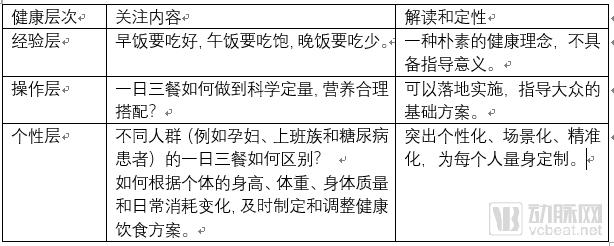
Three Levels of Public Understanding of Health
As shown in the table above: Users at the experiential level possess rudimentary health concepts; in contrast, users at the operational level have developed basic proactive health awareness but lack personalized methods, passively adhering to a “one-size-fits-all” approach; meanwhile, users at the personalized level have attained a certain degree of health literacy and strive to “tailor their approach,” formulating dietary plans best suited to their individual needs.
The personality layer mentioned in the table above can be further “drilled down”: Not long ago, I visited a friend’s startup, where they use image recognition technology to analyze the nutritional content of meals and provide diners with professional dietary and exercise recommendations based on factors such as their individual constitution. The mobile application integrating this technology has already been deployed in several hospitals in Singapore, yielding promising results.
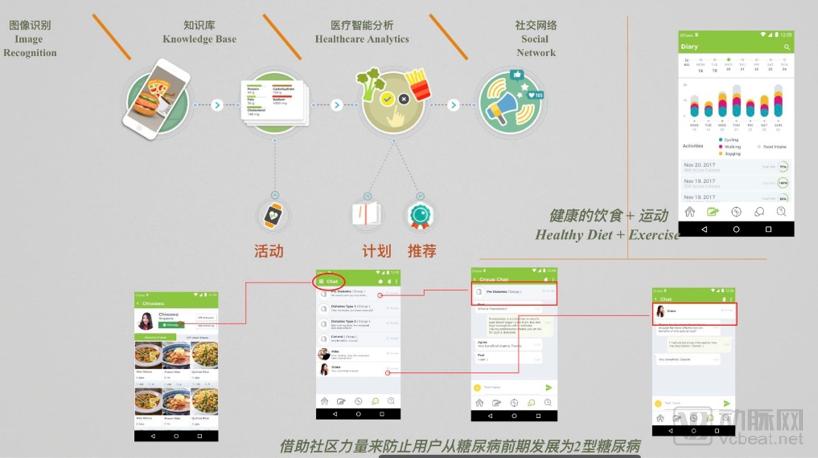 Screenshot of a Dietary Health Management Solution Based on Image Recognition Technology
Health management requires interaction: the “three levels” primarily elucidate the public’s level of awareness regarding health management, while the “four quadrants” focus more on practitioners, as everyone is engaged in health management-related activities, delivering content, solutions, products, and more. How can we position and evaluate these efforts using a simple approach? Based on my own understanding, I have developed a four-quadrant diagram:
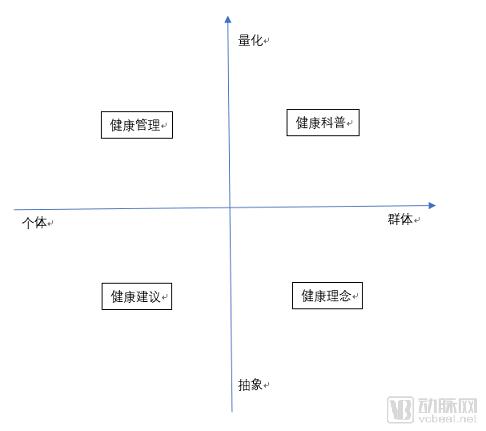
The purpose of management is improvement. As the great 19th-century mathematical physicist Lord Kelvin stated, “If you cannot measure it, you cannot improve it.” To achieve objective and scientific measurement and assessment of individual health, it is essential to collect various subjective and objective data.
Regardless of the method—whether via GPS, motion sensors, biometric devices, or even manual status updates—personalized services can only become a reality, and health management can only be effectively implemented, when comprehensive, sufficient, and continuous individual data are imported, analyzed using predefined formulas and algorithms, and combined with human intervention.
Therefore, the more we focus on quantifying, tracking, and improving individual health metrics, the finer the granularity of health management becomes, and the clearer the overall picture emerges. The ultimate goal of health management is to provide forward-looking and precise recommendations and services by targeting the smallest individual units.
As mentioned above, objective and scientific measurement and assessment of individual health are inseparable from the collection of various subjective and objective data.
Early health management solutions commonly suffered from a reliance on manual data entry and a lack of automated data collection and import. In some cases, the entire burden of data collection was shifted to users: they were required to manually input everything from basic demographic information (such as gender, age, and height) to medical history, medication usage, dietary details (including what and how much was consumed for each meal), exercise types and durations, and blood glucose test results. This approach not only failed to adequately address existing health management challenges but also imposed additional burdens on users, making it clearly undesirable.
Moreover, the data entered lacks timeliness and accuracy, and the indicator dimensions are insufficiently rich, making it fundamentally inadequate for guiding problem-solving. Even with data available, limitations in manpower and computational power make it difficult to effectively implement health management solutions.
Through the application of technologies such as the Internet of Things (IoT) for wearable medical and health devices, the real-time collection of vast amounts of user health data and behavioral patterns has become a critical entry point for information acquisition in future smart healthcare and health management.
This is just the first step.
Only by integrating these health data, vital sign indicators, and medical records can we advance the integration of prevention, treatment, rehabilitation, and health management across the entire life cycle.
In the digital age, regardless of the entry point or how health management solutions are designed, they must ultimately answer three questions for users: Who am I? Where am I? What should I do?
Who Am I? You are a unique individual with your own unique health data;
Where Am I? Based on data and computational results, we can tell you exactly where you stand in terms of your health coordinates and current position.
What should I do? Here is a clear, achievable, and practical health management solution.
References:
1. Jiang Xiaodong: Internet Healthcare Has Entered the Second Half—AI + Healthcare
2. Wu Liuxin: Blue Book of Health Management: Report on the Development of China’s Health Management and Health Industry (2018)