

Verily's FDA-Cleared ECG Smartwatch and Strategic Alliances Position Google to Challenge Apple in Digital Health
For Verily, the life sciences company under Alphabet, Google’s parent company, recent times have been filled with good news. On January 3, Verily secured $1 billion in funding; on January 18, it acquired Fossil’s smartwatch business for $40 million; and just yesterday (January 20), Verily’s ECG monitoring feature for its smartwatch received FDA clearance. This means that Apple is no longer the sole dominant player in the medical-grade wearable device market, as Google has entered the fray, establishing a landscape with two industry giants standing tall.
In 2015, Google restructured into Alphabet, with Verily serving as the subsidiary responsible for the majority of its healthcare initiatives. This subsidiary focuses on leveraging data to improve healthcare through analytical tools, interventions, and research. For ease of reading, this article will use “Google” instead of “Alphabet.”
From Google’s series of moves, we can see that tech giants are no longer merely testing the waters in the healthcare sector but have already launched large-scale, coordinated operations. Meanwhile, tech behemoths such as Apple, Google, Microsoft, and Amazon are actively forming strategic alliances with traditional industry players to jointly compete against their rivals.
Although Verily’s Study Watch is currently primarily used in clinical trials, its FDA-cleared ECG monitoring capability means researchers can directly utilize the relevant data. The device is currently classified as a Class II medical device. However, Google is likely to integrate Verily’s technology into the Pixel Watch, positioning it for direct competition with the Apple Watch.
Just last week, Google acquired Fossil’s smartwatch technology for $40 million, a move that may be aimed at catching up with Apple.
Previously, there was little interaction among the major tech giants in the healthcare sector. Google has focused on AI in healthcare, while Apple’s strategy has been more fragmented. Amazon made a strong entry into the healthcare market last year by acquiring PillPack for $1 billion. Amazon’s move caused a sharp decline in the stock prices of traditional pharmacy retailers such as CVS and Walmart.
In the past, investments in the healthcare sector could still be viewed as experimental; however, with the commercialization of products, direct competition has become unavoidable. For instance, Apple and Google are currently among the few tech giants to have obtained FDA clearance for ECG monitoring features. Both companies boast large user bases and extensive data repositories, and both have genuinely crossed the threshold into medical-grade products, making it difficult to distinguish between the two.
In VCBeat’s article yesterday analyzing Apple’s strategy, it is evident that Apple is primarily committed to building its healthcare services—HealthKit, CareKit, and ResearchKit. Among these, ResearchKit was specifically developed for clinical trial data collection.
This is also a key area of focus for Google. The Study Watch, which recently received FDA clearance, was specifically designed for clinical trials. It helps researchers better monitor participants’ vital signs and provides more comprehensive data. Verily’s backend algorithms and machine learning tools can further process these data in the cloud.
Based on current achievements, pharmaceutical giant Gilead invested $90 million in 2018 to collaborate with Verily. Previously, handling such vast amounts of data was unfeasible and unimaginable; however, with the support of Verily’s computational technologies, the landscape has changed.
John McHutchison, Gilead’s Chief Scientist, also stated candidly that Gilead had been monitoring Verily’s technology for some time prior to the collaboration. It can be said that Verily’s platform has gained a certain degree of recognition.
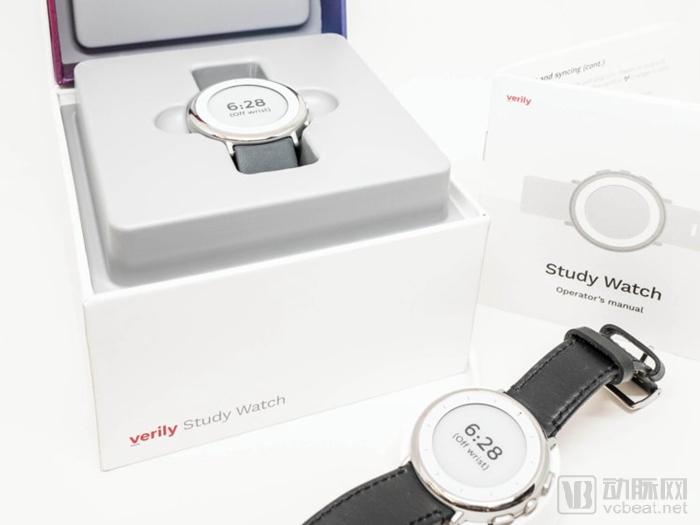
Google's Study Watch
Last year, when Amazon announced its $1 billion acquisition of the online pharmacy PillPack, the market capitalization of the three traditional U.S. pharmacy retail giants—Walgreens, CVS, and Rite Aid—plummeted by approximately $14.5 billion. The fact that a single acquisition dealt such a severe blow to these established pharmacy leaders underscores the formidable power of tech giants like Amazon.
Amazon’s user base of over 300 million has generated economies of scale that have already eroded many traditional industries, with pharmacy retail likely being the next.
Traditional pharmacies require more allies to mitigate risks, as they cannot rely solely on their own strength; after all, Walgreens’ market capitalization is less than 10% of Amazon’s. Consequently, Walgreens has formed alliances by partnering with tech giants such as Verily and Microsoft.
According to a report by Business Insider, Verily has partnered with Walgreens to provide multiple services to the pharmacy chain.
The primary collaboration focuses on diabetes management. First, Verily will provide Walgreens with a “virtual diabetes program” built upon Onduo, its virtual diabetes clinic. In this regard, Google’s Verily possesses considerable confidence and resources.
As early as 2016, Verily partnered with pharmaceutical giant Sanofi to co-invest $500 million in establishing Onduo, an online type 2 diabetes management platform. Upon registering with Onduo, users receive a complimentary home-delivered monitoring kit; they are then assigned a dedicated diabetes management coach via the app. Finally, Onduo leverages technological devices to continuously monitor users’ health data, while a professional medical team provides expert health management recommendations.
In addition, Verily’s products can also be sold at Walgreens following their development.
Walgreens’ partnership with Microsoft is more B2B-oriented. The two companies have formed an alliance to jointly tap into the U.S. pharmaceutical market, valued at $814.7 billion. They will collaborate on cloud computing to integrate big data with pharmaceuticals. As is well known, Microsoft and Amazon are global leaders in cloud computing; Amazon currently holds the largest share of the global cloud computing market, while Microsoft ranks second.
It is worth mentioning that Amazon has also released Comprehend Medical on AWS, enough to smell the gunpowder.
In the future, we may see Google engage in more collaborations with traditional pharmacy retail giants. For instance, in the insurance sector, Alphabet, Google’s parent company, invested $375 million in Oscar Health. Meanwhile, CVS, a major rival of Walgreens, acquired the health insurer Aetna for a staggering $70 billion.
Oscar Health has received multiple rounds of investment from Alphabet, Google’s parent company, as well as its subsidiaries GV, Verily Life Sciences, and CapitalG. It is no exaggeration to call it Google’s “favorite daughter.” Future collaborations with many of Google’s partners are highly likely, especially since there are already precedents for such cooperation.
For example, the CGM monitoring used in Onduo utilizes the Dexcom CGM.Dexcom was previously a partner of Verily, Google’s life sciences division. The two companies collaborated on the development of a compact continuous glucose monitor (CGM), aiming to create a smaller, single-use sensor that could be worn like a bandage for 14 days and would not require fingerstick blood tests for calibration—unlike the current G6 model, which requires daily calibration via fingerstick blood testing.
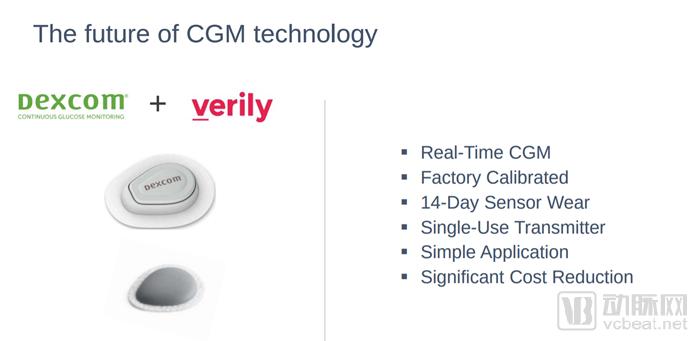
Verily and Dexcom Partner to Pioneer Non-Invasive CGM
Similarly, Google has invested in Oscar Health multiple times, recognizing its value as a third-party platform with direct access to patients. Other third parties can build seamlessly on this platform. From an insurer’s perspective, Oscar has the potential to enable this by allowing third parties to access its claims management systems and aggregated patient data, thereby facilitating the distribution of Verily’s products and services, such as Verily’s Onduo.
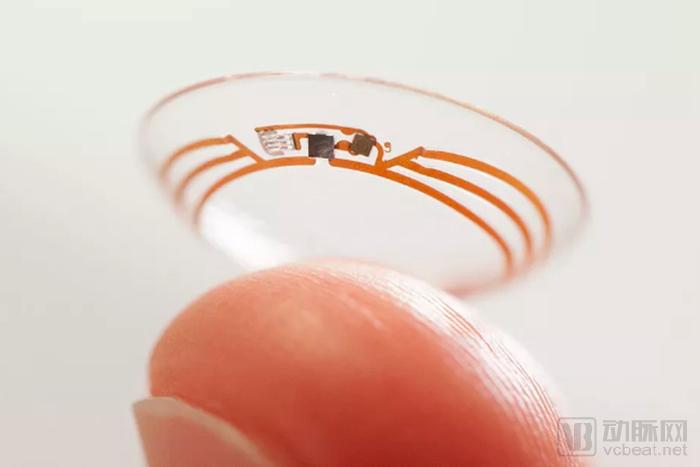
Now, Verily has chosen to partner with Walgreens, a traditional retail pharmacy chain, to enter this market. Verily is developing numerous cutting-edge “black-tech” products, and these efforts are currently paving the way for future commercialization. One example is the non-invasive continuous glucose monitoring (CGM) device co-developed with Dexcom.
Therefore, rather than Verily choosing to side with Walgreens against Amazon, it is more accurate to say that Google, through Verily, has once again integrated traditional retail pharmacies into its healthcare ecosystem.
This ecosystem is no longer just a concept; it is gradually taking shape. A report from CB Insights shows that Google is the tech giant that has invested in the highest number of healthcare companies.
In 2015, Google restructured into Alphabet, with Verily being the company under Alphabet that carries most of its healthcare business. After the restructuring, three companies could focus on healthcare: Verily, DeepMind, and Calico. However, Google's reach into healthcare extends beyond these entities, with its venture capital arm GV (Google Ventures) being the most active.)。
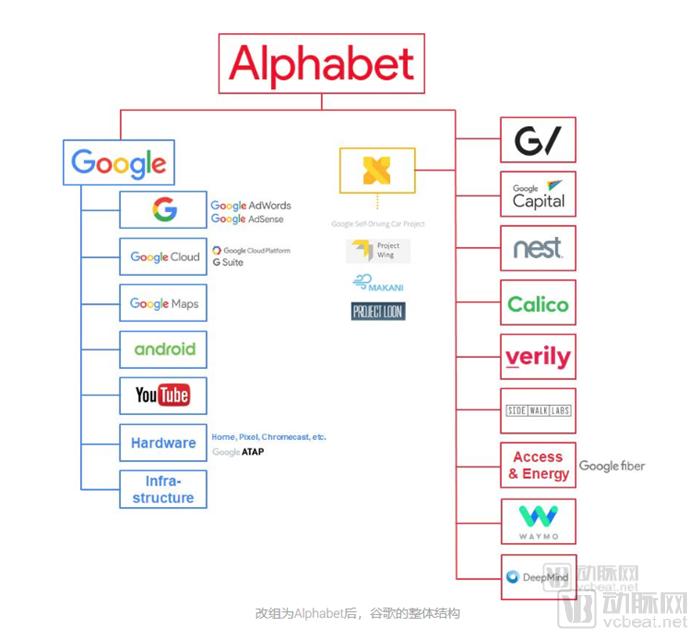
Within Google’s ecosystem, in addition to the pharmaceutical giants such as Sanofi and Novartis, which have engaged in deep collaborations with Verily; medical device company Dexcom; and traditional retail pharmacy giant Walgreens, a significant portion of its presence has been established through Google Ventures. Notable examples include Oscar Health, a health insurance unicorn that has raised over $1 billion in funding; clinical trial company Science37; and genetic testing company 23andMe.
Among the 15 largest healthcare financing deals involving tech-medical giants in 2018, Google participated in 14 through various investment vehicles.
Since 2012, GV (Google Ventures) has made a total of 92 investments in the healthcare sector. GV’s investment style remains bold, with continuous activity in the biotechnology field, which is also Verily’s primary focus. Since 2012, Google has participated in 30 out of 36 deals.
Because the FDA’s new drug approval rate is only 10%, and the development timeline for new drugs exceeds 10 years, biopharmaceutical investment is often referred to as the “Valley of Death,” characterized by high risk and long cycles. Nevertheless, Google participated in Alector’s $133 million Series E financing round to fund the company’s research into a novel therapy for Alzheimer’s disease—a condition for which no new drugs have been approved since 2003.
andAmazonIn this arena, its moves have been few but highly publicized. Last year, its $1 billion acquisition of PillPack sent shockwaves through the industry. Prior to that, Amazon had made only two investments in healthcare: one in GRAIL, a cancer diagnostics company, and the other in Owlet Baby Care, an infant health monitoring company.
Regarding investment,AppleIts efforts appeared somewhat weaker. From 2012 to 2018, Apple primarily focused on developing its internal healthcare services: HealthKit, CareKit, and ResearchKit. Apple only acquired the sleep monitoring company Beddit in May 2017, and earlier, in 2016, it had acquired Gliimpse, a personal health data platform.
The only company that can rival Google in terms of investment volume is GE.. GE is the tech giant with the highest number of acquisitions and the second-largest investor after Google. Its two most recent investments are in Evidation Health, which focuses on real-world data and has partnered with Sanofi, and Verana Health, which specializes in ophthalmology data.
Other companies, such as Microsoft and Facebook, have also made investments in the healthcare sector. In 2018, Microsoft followed GV in investing in DNAnexus. Meanwhile, Facebook acquired the Finnish fitness tracking company formerly known as Protogeo in 2014.
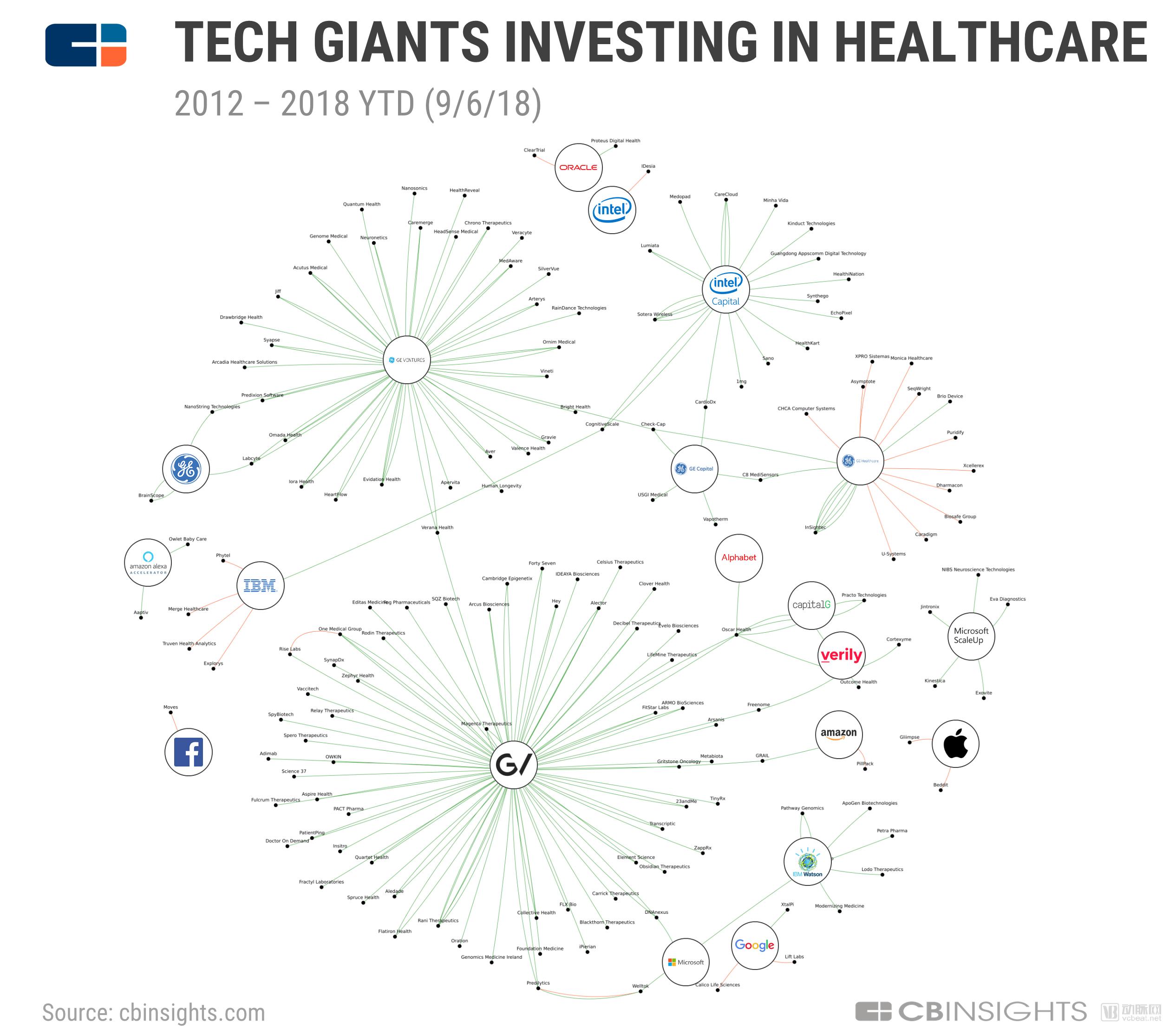
As evident from the above comparison, Google has made the most substantial investments and achieved the deepest market penetration in the healthcare sector. By forging extensive partnerships, Google has built a robust overall strength, whether competing against other tech giants or traditional healthcare service providers. From another perspective, Google’s healthcare ecosystem already spans multiple stages of patient care, including new drug R&D, medical devices, pharmaceutical distribution, patient management, and telemedicine. This industrial chain is further empowered by Google’s cutting-edge technologies in AI and machine learning. Currently, Google holds a slight lead over other tech giants in the race for healthcare dominance.