

Ping An Invests Billions in R&D, Launches Smart Healthcare with Million-Scale Medical Knowledge Graph
According to Ping An Group’s 2018 annual report, its total revenue reached RMB 1.082146 trillion, with net profit attributable to shareholders of the parent company amounting to RMB 107.404 billion. According to Gao Mengxuan, Co-General Manager and Chief Strategy Officer of Ping An Smart City, tens of billions of yuan will be allocated to research and development expenditures, seeking breakthroughs amid steady growth.
Where did these funds flow? Ping An Smart City is a major tributary; the “Smart City” race requires continuous investment to secure an early advantage in the age of artificial intelligence.
The rapid surge in revenue growth served as a much-needed stabilizer for the sluggish AI market in 2019. Financial reports indicate that revenue from the fintech and healthtech segments amounted to RMB 54.88 million in 2017, rising to RMB 77.48 million in 2018—a year-on-year increase of 44.2%, significantly outpacing the 11.0% growth in R&D expenditures.
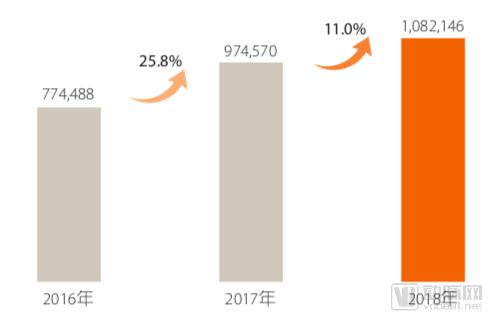
Ping An Group’s Revenue Profile: Rising Alongside Growing Income
The drivers behind this growth warrant careful examination. Over the past two years, Ping An’s strategic footprint in smart healthcare has spanned from macro-level urban governance to micro-level management of individual disease conditions, with artificial intelligence and informatization serving as key pillars supporting this initiative.
“The hospitals of the future will be an integration of digitalization and intelligence.”Gao Mengxuan concluded in the interview, “Ping An Smart Healthcare is moving toward this goal.”
Overall, Ping An’s achievements in the big health sector are closely tied to its strategic layout.
On one hand, Ping An Smart Healthcare focuses on hospital management, striving to build smart medical consortia outside hospitals and assisting hospitals with intelligent management within.
On the other hand, with regard to hospitals’ core business of patient treatment and management, Ping An Smart Healthcare is also focusing on leveraging AI-assisted diagnosis and treatment to promote the intelligent transformation of medical services.
Obviously,Ping An Smart Healthcare’s ultimate goal is to address two key issues: the fragmentation of medical information into isolated silos, and the scarcity and misallocation of healthcare resources.
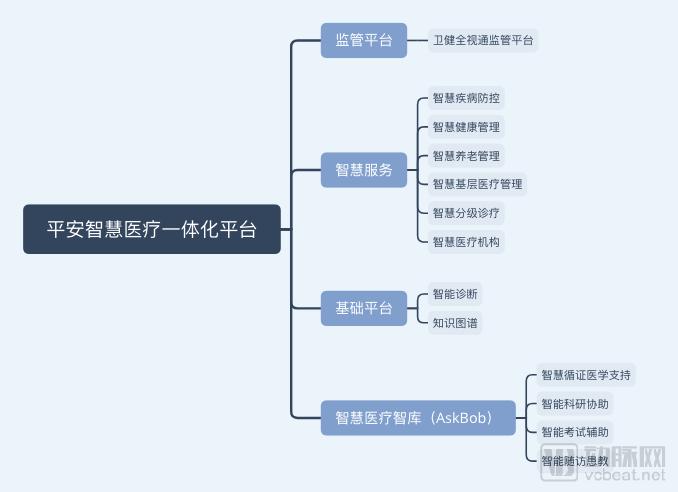
Ping An Smart Healthcare Layout
Based on the data in the figure above,Ping An Smart Healthcare serves clients including health regulatory bodies such as the National Health Commission, hospital administrators (hospital management), department heads (e.g., for assisted diagnosis), and patients (e.g., for follow-up care).. Integrating into hospital information systems is a critical step for Ping An Smart Healthcare.
The continuous infusion of capital into technological R&D means Ping An Smart Healthcare does not need to worry about investment. However, for frontier technologies such as artificial intelligence, funding is not a universal panacea, as patient data is non-tradable. Therefore, the interoperability and connectivity among hospitals facilitated by Ping An are particularly crucial.
A successful example is the collaboration in mid-April 2019 between Ping An Smart City’s Smart Healthcare division and the National Clinical Research Center for Metabolic Diseases at the Second Xiangya Hospital of Central South University. At the event, the two parties unveiled a jointly developed Smart Medical Consortium Remote Ward System. Leveraging Ping An’s technology, this initiative aims to establish a smart medical consortium that facilitates regular connectivity between tertiary hospitals and primary care institutions. Its core objective is to break down data barriers across different hospital tiers, thereby enabling more valuable telemedicine services.
Through the application of systems such as “remote ward rounds” and “remote departmental consultations,” tertiary hospitals can extend their teaching reach to primary care institutions, drive discipline development at these facilities, enhance overall clinical medical standards, and provide patients with greater access to healthcare services.
Chronic disease management is also included in this framework. Patients with diabetes can first undergo routine examinations and data entry at primary care hospitals. The Smart Medical Consortium will then rapidly and accurately route them into specialized medical service pathways across hospitals at all levels nationwide, based on their individual conditions. This approach establishes a comprehensive, full-course management service platform for diabetes patients through standardized treatment, thereby gradually developing standardized clinical guidelines for metabolic diseases tailored to China’s national context, and ultimately improving the quality control of diagnosis and treatment at the primary care level.
Currently, the diabetes management platform serves over 500 patients, with a monthly active rate exceeding 70%. Patient reliance on the platform is on the rise, and their understanding of diabetes has significantly improved.
Smart medical consortiums serve inter-hospital relationships, while intra-hospital management is equally commendable. Ping An Smart Healthcare began its layout of medical informatics products in 2018, deploying its AI-powered Clinical Decision Support System (CDSS) to more than 50 primary healthcare institutions. In the application scenarios previously described, Director Zhou Guangzhi in Changsha can conveniently access the medical records of patients in Henan. This indicates that systems deployed at the grassroots level are gradually coming to the fore, becoming a key component in Ping An Smart Healthcare’s construction of smart medical consortiums.
When designing the system, R&D personnel at Ping An Smart Healthcare placed particular emphasis on aligning with physicians’ actual operational habits to ensure that the system optimizes their existing workflows. For instance, during the patient consultation phase, physicians typically listen to the patient’s chief complaint, reflect on the information, and then provide recommendations. With an AI-assisted Clinical Decision Support System (CDSS), feasibility analyses can be conducted based on the patient’s chief complaint, and the likelihood of various outcomes is presented to physicians in a visual format.
Regarding medication, this system provides recommendations on available drugs, dosages, dosage forms, and frequency based on the physician’s diagnosis. This transforms the physician’s task into a “multiple-choice” decision, reducing unnecessary cognitive load and simultaneously improving the accuracy of patient condition assessment.
AI-assisted scientific research is also a hot trend, with leading medical AI companies targeting medical experts who have research needs, attempting to use AI to assist physicians in clinical validation and resource retrieval.
Gao Mengxuan told VCBeat, “Clinicians at top-tier hospitals have an increasingly surging demand for research tools. Big data processing and data structuring within the industry have become significant barriers preventing many clinicians from engaging in research, as these tasks require both specialized knowledge and substantial time and effort. Meanwhile, researchers also need to understand which fields are currently seeing a concentration of literature publications and assess the likelihood of their work being accepted—for instance, whether DNA-related studies are on the rise, and what advancements have been made regarding specific genetic loci.”
“Ping An Smart Healthcare’s knowledge graph does not merely store textual information; rather, it structures the data and injects it into corresponding knowledge nodes, establishing existing connections between nodes and uncovering potential associations. For example, if a clinician wishes to determine whether a specific drug may act on a particular gene, using Ping An’s knowledge graph enables the AI system to search for relevant connections based on keywords. If any literature mentions such a connection, the system will retrieve the corresponding papers; otherwise, it indicates that there is no established link between the drug and the gene.”
According to VCBeat, Ping An has established five major knowledge bases—covering drugs, diseases, prescriptions, risk factors, and medical resources. Encompassing 500,000 concepts and 5 million relationships, this integrated and comprehensive knowledge system constitutes the world’s largest Chinese medical knowledge graph. Building on this foundation, Ping An has developed AskBob, its first medical think tank with precise semantic understanding capabilities, providing users with one-stop access to accurate semantic medical knowledge queries and intelligent clinical decision support.
Mapping out Ping An’s entire smart healthcare ecosystem would be overly complex due to its numerous components. Therefore, we categorize it into three phases—pre-diagnosis, during diagnosis, and post-diagnosis—to examine how Ping An’s AI technologies provide value support in smart healthcare.
In the pre-consultation phase, Ping An Smart Healthcare primarily offers two products: intelligent triage and guidance, and intelligent disease risk prediction.
Intelligent triage and patient guidance represent a typical AI application scenario. Taking “Smart Xiaogeng,” deployed at Beijing Tsinghua Changgung Hospital, as an example, this patient guidance robot—jointly developed by the hospital and an enterprise—provides services including triage, patient navigation, health education Q&A, and follow-up care, covering both pre-consultation and post-consultation medical scenarios.
Among these features, “Smart Xiaogeng” offers intelligent triage that recommends appropriate medical departments based on symptoms described by patients. Its intelligent guidance system automatically answers frequently asked questions across five major categories: consultation procedures, department locations, hospital or physician working hours, health insurance policies, and general hospital information. The intelligent patient education Q&A module provides automated responses to basic scientific questions about hypertension and diabetes, and also retrieves medication information, covering indications, dosage and administration, contraindications, side effects, and use in special populations. Additionally, the intelligent follow-up system smartly recommends follow-up plans based on patient medical history, automatically initiates follow-ups, responds to patient inquiries, performs disease prediction, maintains post-diagnosis health records, and manages post-consultation care for patients with chronic diseases.
The Intelligent Disease Risk Prediction System is built upon big data and AI-driven machine learning technologies. This system mines disease risk factors from a vast array of features, currently covering predictive models for 30 types of chronic diseases and their complications, including cardiovascular and cerebrovascular diseases, diabetes, and respiratory disorders. It automatically identifies disease risk factors from over 3.5 million health examination records and electronic medical records, employing machine learning methods to establish intelligent disease prediction models.
Taking the prediction of cardiovascular and cerebrovascular diseases as an example, AI can generate predictive results for multiple conditions—including coronary heart disease, stroke, atrial fibrillation, heart failure, and myocardial infarction—in less than a week.
During the consultation phase, Ping An Smart Healthcare’s AI products are deployed across disease screening, diagnosis, treatment, and quality control. In medical imaging for screening and diagnosis, the product currently features thousands of diagnostic models across multiple modalities and more than 40 treatment models, covering nine major human body systems.
Ophthalmology has become a leading frontier for AI adoption due to its high demand and broad scope. In this field, Ping An Smart Healthcare’s intelligent eye screening platform has achieved a sensitivity of over 95% for common ophthalmic conditions such as diabetic retinopathy by learning from and analyzing hundreds of thousands of fundus images. Its age-related macular degeneration model can automatically locate drusen and perform related quantitative analysis.
Targeting cutting-edge OCT imaging, Ping An Smart Healthcare and Optovue have jointly developed an intelligent diagnostic system for OCT-based fundus diseases. The entire process, from initiating the OCT examination to the patient scanning a code to receive an intelligent screening report, can be completed within three minutes. Preclinical multicenter trials, led by the Eye, Ear, Nose, and Throat Hospital of Fudan University and involving Shanghai General Hospital and Shanghai Tenth People’s Hospital, demonstrated that the system excels in OCT image quality control and accurately identifies the vast majority of common fundus lesions.
By leveraging NLP technology, the Ping An Smart Healthcare Knowledge Graph can be applied to both the intra-consultation and post-consultation phases. During consultations, it supports intelligent diagnosis within Clinical Decision Support Systems (CDSS), while in the post-consultation phase, it extends into the follow-up care market.
Post-consultation applications primarily focus on two areas: patient education and intelligent follow-up. Regarding patient education, Gao Mengxuan stated, “Our knowledge graph includes a database of over 70 million Q&A entries, all reviewed by experts. Patients can use the family doctor app to consult on questions such as ‘Can diabetic patients eat watermelon?’ or ‘Can these two medications be taken together?’ These are issues that are often difficult to discuss with doctors in routine visits, and some primary care physicians may not even have the answers. Meanwhile, online search results vary widely in quality and reliability. Ping An’s smart healthcare platform provides authoritative answers to such queries.”
"Smart follow-ups can also be conducted through this system. 'The 5G era will better promote the development of this electronic family doctor, and the Internet of Things will help us make better use of data from wearable devices. Through smart bands, AI can monitor patients' respiratory status; through facial recognition, AI can assess patients' physical balance. All these data will be recorded to generate risk assessment reports for the patients' physicians,' explained Gao Mengxuan."
Through this assessment report, physicians can gauge the degree of patient adherence. For instance, if patients with obesity frequently refuse to take their medications and sensors indicate insufficient physical activity, the AI system will flag them as having “poor adherence.” This enables nurses to provide targeted care, thereby improving adherence and enhancing the effectiveness of chronic disease management.
China is home to numerous outstanding physicians; by providing them with effective tools tailored to their needs, the value they deliver can be enhanced qualitatively.
To date, although various innovative medical products have permeated every scenario within hospitals, the product-centric design philosophy still struggles to break the constraints between medicine and technology in this complex discipline. In particular, technologies such as AI and 3D printing still require substantial research support to alleviate the current predicament.
Therefore, Ping An Smart Healthcare has entered into cooperation agreements with local health commissions, the China Academy of Information and Communications Technology (CAICT), the Chinese Research Hospital Association, Tsinghua University, and the Institute of Medical Information of the Chinese Academy of Medical Sciences, among other institutions and research institutes. The aim is to improve the health industry from a macro-social perspective.
In December 2018, Ping An Smart Healthcare, in collaboration with the Center for Public Health Research at Tsinghua University, released the Urban Health Index. Leveraging regional health and medical big data platforms, this index mines relevant information from existing data to comprehensively assess urban health status.
The index covers three major dimensions and 80 indicators. While comprehensively reflecting a city’s lifestyle, natural environment, and allocation of medical resources, it also focuses on monitoring the incidence of nearly 40 major diseases. Furthermore, the index achieves real-time integration and dynamic updates with local big data platforms for all indicators, providing the most timely decision-making support for urban health management.
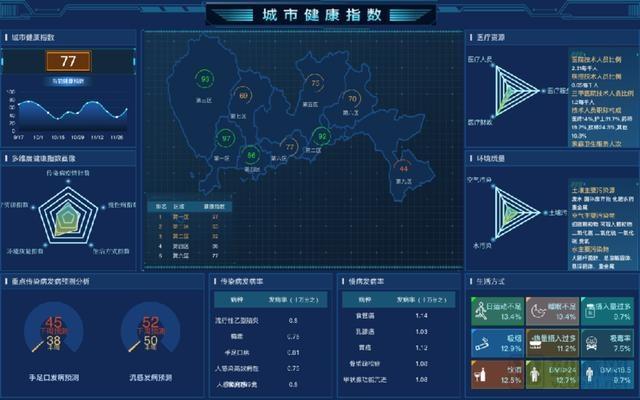
Infectious disease prediction is one of the practical applications of this metric. Centers for Disease Control and Prevention (CDCs) require more rapid and accurate models, along with faster information processing capabilities, to optimize infectious disease indices such as those for influenza. This enables the prediction of outbreak cycles for diseases like influenza, facilitating the timely allocation of resources—including hospital beds, vaccines, and medical personnel—thereby providing decision support for CDCs and safeguarding “population health.”
Currently, Ping An Smart Healthcare is collaborating with the Shenzhen Center for Disease Control and Prevention (CDC) and the Chongqing CDC. Data from previous collaborations with the Chongqing CDC indicate that AI-based prediction models for influenza and hand, foot, and mouth disease (HFMD) can forecast outbreaks one week in advance. The accuracy of these AI models for both influenza and HFMD exceeds 86%, rising to over 90% during peak seasons. Furthermore, the application of an intelligent screening model for chronic obstructive pulmonary disease (COPD) has significantly reduced screening costs and improved efficiency, achieving an accuracy rate of 92%.
For regulatory authorities, medical quality control faces numerous challenges. The traditional quality control model involves cumbersome processes and the collection and processing of quality control data, while lacking intelligent information management tools. This makes it difficult to objectively, accurately, and efficiently reflect daily operational realities.
Guided by the concept of “Cloud Quality Control,” the Shanghai Clinical Pathology Quality Control Center and the Shanghai Radiological Diagnosis Quality Control Center, in collaboration with Ping An Smart Healthcare, will gradually transition to a new digital, networked, and intelligent model characterized by “online, automated, real-time, and dynamic” operations.
This means that Ping An Smart Healthcare is pioneering a novel business model for AI in its own way, offering decision-making recommendations for disease prediction from a macro perspective—a viable path indeed.
Unlike other companies, Ping An Smart Healthcare is part of the Ping An ecosystem, which enables it to innovate its business model and is expected to drive transformative changes in the insurance industry.
As the modern healthcare system continues to improve, life expectancy has increased significantly, leading to a marked rise in pharmaceutical expenditure. Consequently, actuarial systems based on outdated claims provisions have become increasingly unstable, creating an urgent need for insurance companies to adopt more precise models to guide pricing strategies. Furthermore, as insurance service models mature, acquiring new customers and developing innovative insurance products also require robust support from data and technology.
This is a win-win internal collaboration. The Ping An ecosystem provides Ping An Smart City with funding, data, and channel support, serving as a stable payer based on its R&D expenditure. In return, the models developed by Ping An Smart City provide advisory services to Ping An Insurance and assist Ping An in building its healthcare ecosystem.
Therefore, the value of Ping An Smart Healthcare’s technological development lies not only in empowering governments and medical institutions but also in providing data and model support for Ping An’s core insurance business. Under this model, its AI products do not need to rush to secure payments from hospitals or patients; instead, they can focus solely on R&D and market deployment.
By leveraging these advantages, Ping An Smart City has made significant strides in the healthcare sector. However, Ping An is not the only player combining informatization and artificial intelligence; internet giants such as BAT are also joining the fray, making smart cities an irresistible trend.
Ultimately, will Ping An Smart City break away from the purely “assistive” role and establish itself as an independent force in smart city development? Only time will tell.