

Amazon's Comprehensive Healthcare Strategy: AI, Cloud, Big Data, E-commerce, Insurance, and Diagnostics
The optimal allocation of corporate profits is through investment, particularly in businesses with strong future prospects.
Amazon’s path to growth has been a path of investment. From an online bookstore to a full-category e-commerce platform, and from cloud computing to artificial intelligence, Amazon has consistently taken the lead in strategically positioning itself in businesses that few others viewed favorably. Yet, remarkably, the course of events has invariably validated Amazon’s forward-looking investments.
Since 2017, Amazon has intensified its expansion in the healthcare sector, including investing in the cancer detection company Grail, acquiring Whole Foods Market to gain pharmaceutical retail outlets, establishing the health technology team “1492,” forming a joint non-profit healthcare venture with Warren Buffett, and acquiring the online pharmacy PillPack...
"In the corporate world, people often ask 'Why?'—a good question. But equally important is the question 'Why not?' — Jeff Bezos, founder of Amazon"
For a company with expansion written into its very DNA, the question is not why Amazon is entering the healthcare industry, but rather why it wouldn’t.
In this article, you will see:
1. A Brief History of Amazon: Steadfastly Guarding Its Core Business and Pursuing Orderly Diversification;
2. An Overview of Amazon’s Healthcare Business Layout: A Step-by-Step Plan;
3. Analysis of the Strengths and Weaknesses of Amazon's Healthcare Strategy: Brand, Membership, Capital, and Technology;
4. A Bold Conjecture on Amazon’s Healthcare Ambitions: Enhancing Quality and Controlling Costs Through Supply Chain Management;
“Amazon has been a technology company from day one; it just happened to be in retail.” — Werner Vogels, CTO of Amazon
Amazon was founded by Jeff Bezos in July 1994. It was initially named Cadabra before being renamed Amazon. The company is incorporated in Delaware, USA, due to the region’s more favorable tax regime compared to other jurisdictions.
In July 1995, Amazon.com went online. The company’s initial business was selling books over the internet, and the first book sold was Douglas Hofstadter’s Fluid Concepts and Creative Analogies: Computer Models of the Fundamental Mechanisms of Thought. In October, Amazon began offering its services to the general public. Within the first two months, its products were shipped to all 50 U.S. states and 45 other countries, with weekly sales reaching $20,000.
In 1997, Amazon went public on the NASDAQ stock market with a highly unconventional initial business plan: it did not urgently expect to achieve significant profitability within four to five years. This “slow” growth prompted complaints from many shareholders, who believed that the company’s performance was not expanding rapidly enough to deliver reasonable returns on their investment, or even to ensure its survival in a competitive landscape.
However, when the dot-com bubble burst in the early 21st century, Amazon did not collapse like numerous other e-commerce companies; instead, it survived and ultimately emerged as a giant in the internet retail industry. In the fourth quarter of 2001, Amazon achieved profitability for the first time: financial reports showed that quarterly revenue exceeded $1 billion, with a net profit of approximately $5 million. This may demonstrate the success of Bezos’s unconventional business model.
Amazon's current main products and services include:
Online Retail Business—All-category e-commerce, as well as fresh food e-commerce in areas such as Seattle, Bellevue, and Kirkland;
Offline Retail Business——Amazon acquired Whole Foods, a U.S. health food supermarket chain with over 400 stores, for $14 billion;
Consumer Electronics—Kindle, tablets;
Media Publishing Business—Amazon Music, Video, and IMDb websites;
Software Technical Services—AWS cloud services, AI, voice technology, etc.
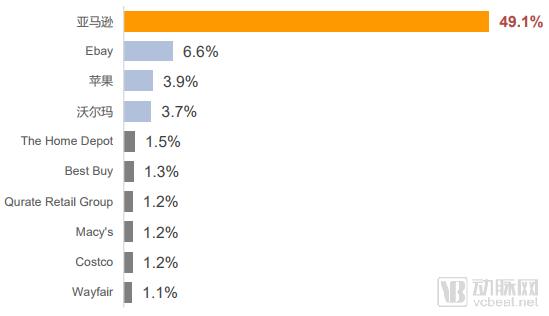
In 2017, Amazon’s sales accounted for 34% of U.S. online retail spending; this share is projected to reach 53% by 2027. This also implies that Amazon’s proportion of total U.S. retail sales was 4% in 2017 and is expected to rise to 12% by 2027. Amazon’s revenue in 2017 totaled $177.9 billion, ranking it 26th among U.S. companies on the Fortune 500 list.
Market Share of U.S. E-commerce Companies in 2017
Source: Founder Securities
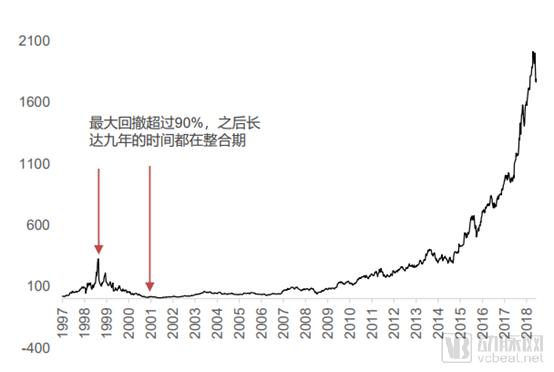
Amazon Stock Price Trend
Source: Founder Securities
According to data from the Department of Outbound Investment and Economic Cooperation under the Ministry of Commerce, U.S. online retail sales were projected to reach $445 billion in 2018, with forecasts indicating that U.S. online retail sales will surpass $1 trillion by 2027. Data from the U.S. E-Commerce Association shows that online shopping accounted for 12% of total U.S. retail sales in 2017, and the share of online sales in the nation’s total retail sales (both online and offline) is expected to continue growing.
Amazon’s attraction to the healthcare industry has existed since its early days. As early as 1999–2000, Amazon invested in Drugstore.com, planning to expand its e-commerce business into the pharmacy sector. However, due to factors such as intermediaries and regulatory agencies, its ambitions were abruptly halted.
By around 2017, Amazon had revived its ambitions in the healthcare sector.
Amazon's Healthcare Expansion Timeline
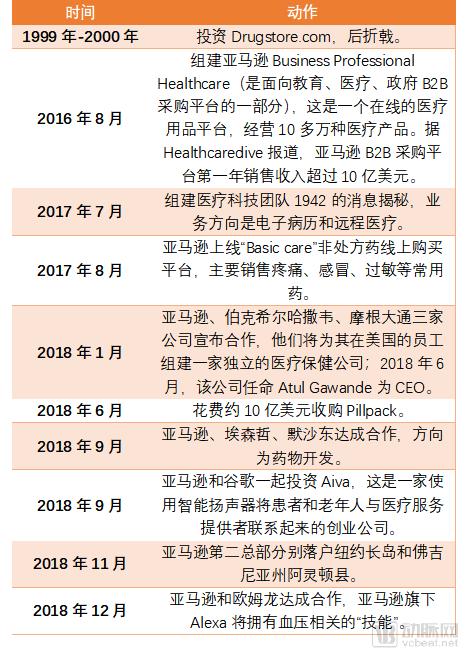
In summary, Amazon’s current footprint in the healthcare sector is primarily concentrated in three areas: online pharmacy, wholesale of medical supplies, and healthcare technology services.
Online Pharmacy
Amazon has made significant strides in the pharmaceutical distribution sector following its $1 billion acquisition of the online pharmacy PillPack. Through this acquisition, Amazon can provide medication supplies to residents across all 50 U.S. states. PillPack’s model of packaging and distributing medications based on individual patients’ specific regimens aligns closely with Amazon’s corporate philosophy. Furthermore, PillPack’s prescription management platform, pharmacyOS, bears strong similarities to Amazon’s order management and fulfillment services.
In accordance with the U.S. Drug Supply Chain Security Act (DSCSA), by 2023, every entity in the pharmaceutical supply chain must be part of an interoperable tracing system, and each individual unit (such as a medicine bottle) must be traceable from end to end.
Amazon has applied for a wholesale pharmacy license. Combined with the licenses acquired through its purchase of PillPack, it only needs a manufacturing license to complete end-to-end drug distribution. This would enable Amazon to handle products directly from manufacturers and, when necessary, relabel or repackage them into different units. UPS already holds its own manufacturing license and appears capable of managing the entire supply chain.
Pillpack Product Page

Image source: theverge.com
Wholesale Business of Medical Supplies
Compared with other sectors, B2B business is often overlooked, as decision-making involves only a small group of people and lacks public appeal. This is particularly true in medical procurement, which has long been conducted through contractual supply arrangements and government-designated channels. Nevertheless, it is undisputed that Amazon is entering the B2B market for medical supplies.
Amazon’s B2B procurement services primarily cater to three customer segments: government, education, and healthcare. Currently, its healthcare B2B business is led by Chris Holt, who holds the title of Leader, Global Healthcare. A seasoned veteran, Holt earned his Bachelor of Business Administration from the USC Marshall School of Business (1985–1989). After graduation, he joined Emery Worldwide, where he managed logistics for global air routes. In 1998, he returned to academia to study logistics management at the Massachusetts Institute of Technology (MIT). Prior to joining Amazon, Holt worked at UPS, Tiger Medical Group, and Cardinal Health.
Amazon B2B medical procurement offers tens of thousands of products, ranging from surgical supplies to daily medical consumables. The process requires registering a business account, which is distinct from a personal account, to verify identity and purchasing needs. Currently, Amazon provides medical supply procurement services across all 50 U.S. states. However, Amazon does not yet offer cold chain logistics for medical products, as the infrastructure for this service is still under development.
Amazon Healthcare B2B Product Page
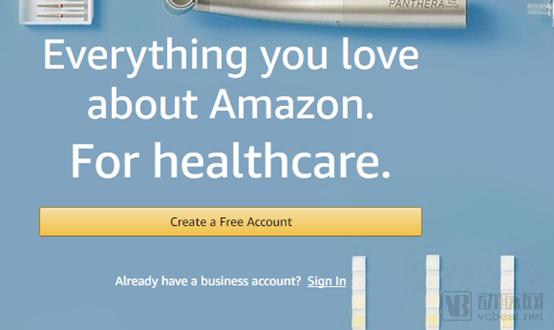
Image source: Amazon official website
Medical Technology Services
Amazon’s Echo is a voice-controlled speaker with video capabilities, making it well-suited for monitoring purposes, particularly in home settings. The Alexa platform hosts lightweight medical applications from institutions such as the Mayo Clinic and Libertana, which can answer health-related questions, send alerts in emergencies, and facilitate communication between users and caregivers.
Amazon can handle the backend processes for HIPAA compliance and voice technology, while providing enterprises with a platform and distribution channels through Alexa and Echo. Alexa is being piloted in hospitals across China, including Northwell, Mass General, and Boston Children’s Hospital.
However, since Alexa is not yet HIPAA-compliant, the tasks performed by this software are generally limited to non-identifiable uses, such as surgical checklists, patient disease and medication information, and hospital information. If Alexa were HIPAA-compliant, its scope of use could be further expanded.
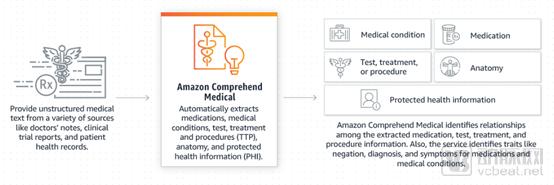
On November 27, 2018, Amazon announced Amazon Comprehend Medical, a product that leverages machine learning models to accurately and rapidly identify medical information, such as medical conditions and medications, and determine the relationships between them, including dosage and strength. Users can access the product through simple API calls, without requiring expertise in machine learning, the need to write complex rules, or the necessity of training models. Primarily targeting hospital clients, it aims to reduce the cost of processing medical documents and enable rapid, accurate extraction of information from medical records.
Amazon Comprehend Medical Workflow
Source: AWS Official Website
Amazon has offered several AWS solutions to existing healthcare companies, particularly in the areas of security and compliance. AWS places a strong emphasis on genomics, which is becoming increasingly important to stakeholders such as payers, providers, and researchers. Due to the declining cost of sequencing and the growing use of genomic screening and applications in clinical settings (e.g., oncology profiling), the demand for computational power and storage capacity to analyze these datasets has correspondingly increased.
We will analyze the strengths and weaknesses of Amazon's healthcare strategy from four dimensions.
Brand: ★★★★★
Amazon enjoys a strong global reputation for its excellent customer experience, and entering the healthcare sector would further enhance its brand value.
Member: ★★★★
Prime members are the core of the company, which continuously enhances member stickiness by expanding membership benefits. In 2018, Amazon disclosed for the first time that its Prime membership had surpassed 100 million subscribers. Although the company raised the annual membership fee from $99 to $119 in June, Prime Day subscriptions in July still achieved the fastest growth on record. Whole Foods Market, acquired in 2017, has also been integrated into the Prime membership program, demonstrating synergistic effects.
Funding: ★★★☆
Analysis suggests that 2018 marked a year of significant revenue and profit realization for Amazon, with year-over-year revenue growth accelerating in recent years, profit margins reaching historic highs, and this positive trend continuing to unfold.
Amazon Revenue Data (2004–2017)
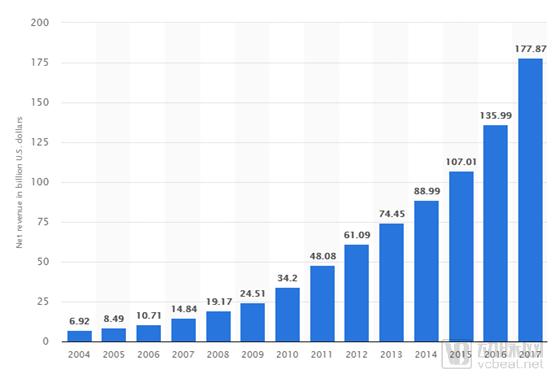
Source: Statista, Unit: Billion USD
The advertising business is growing rapidly and making a significant contribution to profitability. According to third-party data, Amazon currently ranks third in the U.S. online advertising market share, trailing only Google and Facebook, and is projected to be the fastest-growing company in the industry in 2018. Compared with the two traditional digital advertising giants, Amazon has its own advantages. Given Amazon’s current transaction volume, customer base, number of clicks, user attention, new video content, and the overall scale of its ecosystem, the company’s advertising potential is enormous. Monetization is still in its early stages, and the market expects Amazon’s advertising revenue to reach $20 billion by 2022.
As a globally leading publicly traded company, Amazon would not face funding constraints if it were determined to invest in a new business venture. However, times have changed; investors are becoming less tolerant of mature companies. Consequently, persuading investors to commit substantial capital to an entirely new field will be no easy feat for Amazon.
Technology: ★★★
Amazon began laying the groundwork for its cloud business in 2005, and in recent years, AWS has held an absolute advantage in market share. According to data from Synergy Research Group, Amazon Web Services accounts for 33% of the cloud infrastructure market, compared with 13% for Microsoft and 6% for Google. Amazon’s market share exceeds the combined total of Microsoft, IBM, and Google. However, it is worth noting that competitors’ cloud businesses are growing rapidly and catching up quickly.
Strategic product Alexa is also continuously adding new skills, collaborating with more brands to integrate additional product lines. Currently, the Alexa platform has developed over 45,000 skills, partnered with more than 2,500 brands, and seen consumer adoption of 13,000 smart home devices. Amazon’s smart devices, such as Echo, have integrated AI into daily home life and established connectivity with Prime, creating a closed-loop ecosystem for smart homes.
Of course, none of these technologies belong to the healthcare sector. For Amazon, healthcare is an entirely unfamiliar domain. Whether it involves pharmaceutical companies, medical device manufacturers, health insurance providers, or pharmaceutical retail, all differ significantly from online retail operations. Amazon needs to start from scratch and recruit seasoned professionals to lead these efforts.
The keywords behind Amazon’s ability to “disrupt” or, more accurately, reshape the retail industry are quality improvement and cost control. In the pre-e-commerce era, retail prices were highly opaque, and the lengthy transaction processes led to multiplied price markups. The direct, peer-to-peer model of e-commerce has delivered tangible benefits to consumers, not only effectively lowering prices but also fostering a stronger service orientation in traditional retail through technological transformation.
Amazon has also pioneered a new model for online retail by building its own logistics network, delivering an online shopping experience that is nearly equivalent to the in-person consumer experience. In terms of integrating online and offline channels, Amazon has secured more stable offline touchpoints and maintained service consistency through its self-operated Amazon Go stores and its acquisition of Whole Foods Market.
Amazon’s strength lies in its supply chain management capabilities. Whether for books or 3C products, Amazon can precisely allocate demand and supply, serving both sellers and buyers.
Compared with the retail industry, the healthcare industrial chain is more complex, and at times it does not constitute a simple binary relationship between demand and supply.
Medical Industry Chain

Source: Founder Securities
For Amazon, the immediate opportunity lies in restructuring the supply chains for pharmaceuticals, medical devices, and related products. Logically, the next step should be to enhance PillPack’s online pharmacy capabilities to enable same-day prescription dispensing. Amazon could achieve this by establishing retail pharmacies and/or point-of-sale locations within Whole Foods stores, or by partnering with independent pharmacies in regions where its market presence is less dominant.
Once Amazon establishes a medication delivery system targeting end patients, it can replace traditional Pharmacy Benefit Managers (PBMs) and provide pharmacy benefit management services to payers. The benefits include building a pharmacy network for patients, negotiating drug prices on behalf of small health plans and self-insured employers, and monitoring abnormalities in patients' medication usage (such as poor medication adherence). Amazon Prime members may naturally become members of Amazon's PBM business.
As in the pharmaceutical industry, the supply chain is currently intricate and rife with various intermediaries. Manufacturers transact with distributors, who in turn engage with Group Purchasing Organizations (GPOs) that negotiate on behalf of hospitals to reduce the costs of medicines and technologies (although hospitals sometimes negotiate directly).
Other possible directions also include:
Leveraging Smart Home Technology to Advance Home Care
Amazon’s smart speakers could serve as an entry point for healthcare services (with several such cases already in existence), such as providing in-home care and safety alerts for the elderly and children, and integrating with other medical hardware products to monitor users’ health status in real time.
Establishing Offline Physical Clinics
Amazon can test and refine its clinic concept within Whole Foods stores, then establish additional clinics in areas with a higher concentration of Medicare and Medicaid beneficiaries. For Amazon, setting up clinics in Whole Foods is a fast-track approach.
Retail clinics have recently become the preferred business venture for U.S. retail pharmacy operators. Both CVS Health and Walgreens Boots Alliance (WBA) offer such clinics in nearly a thousand of their stores, providing convenience to patients while effectively reducing healthcare costs. This model is virtually a win-win situation: pharmacies benefit from increased foot traffic and address the need for professional services, while insurance providers gain cost efficiencies.
Entering the Health Insurance Sector
U.S. employers are required to purchase health insurance for their employees, and for many businesses, rising healthcare costs have become a significant burden. At its core, insurance is a financial service that transforms dispersed uncertainties into manageable probabilities. Given that Amazon has already partnered with Berkshire Hathaway, the world’s most adept investor, insurance operations are also in the planning stages.
Strengthen Investment in Medical Technology
Emerging technologies such as cloud computing, big data, the Internet of Things (IoT), mobile internet, artificial intelligence (AI), and blockchain are gaining prominence in the healthcare industry. Given Amazon’s existing business foundation, it is well-positioned to further expand its strategic presence in this sector.
Amazon may ultimately build an integrated service model encompassing medical services, the medical supply chain, health insurance, medical technology, patient management, and health management. This would not only reduce its own healthcare costs but also benefit more businesses and individuals.
If the Amazon example is difficult to grasp, the development of Alibaba Health in China serves as an excellent case study: it entered the market through pharmaceutical e-commerce and launched its “New Retail Pharmacy” initiative; it then gradually penetrated core healthcare scenarios—hospitals—by integrating appointment scheduling, consultations, diagnosis and treatment, and medication management, while providing AI-powered clinical decision support and patient triage software along with technical services. The timing, strategic logic, and pace of healthcare expansion by these two e-commerce and internet giants are highly consistent.
Amazon holds a significant advantage in transforming the healthcare sector, as intermediaries in this field are primarily driven by profit motives. Despite various obstacles—including market leaders, established processes, and buyers’ general apprehension toward new entrants—Amazon’s entry into healthcare will either reshape the entire existing system or compel incumbent players to become more competitive. This represents both a model innovation and a triumph of capital.