

JD Health Expands Internet Hospital Footprint Nationwide Following Success in Suqian
One month ago, JD.com announced a new round of organizational restructuring, realigning its previous three major business groups according to “business models and business scenarios.” Following the adjustment, the mid-office departments now encompass three major business groups: the 3C Electronics and Consumer Retail Business Group, the Fashion and Home Platform Business Group, and the Lifestyle Services Business Group.
On January 16, 2019, JD Internet Hospital’s Suqian Branch announced its launch. Concurrently, the Suqian medical insurance system achieved systemic integration with JD.com, thereby revealing the internet healthcare landscape under JD’s Lifestyle Services Business Group.
From signing a strategic cooperation agreement with the Yinchuan Municipal Government in August 2017 to jointly build “Healthy Yinchuan,” to achieving a closed loop of “medical care, pharmaceuticals, and medical insurance” in Suqian in January 2019, JD.com, as a rising star in the internet healthcare sector, has leveraged its inherent platform advantages and industry-leading pharmaceutical supply chain capabilities. By collaborating with local governments, hospitals, and other stakeholders, JD.com has broken new ground in the fields of internet hospitals and internet-based medical insurance within just over a year, setting a demonstrative benchmark for the overall development of “Internet + Healthcare” in China. Centered on the core principle of “empowering integrated online and offline services to ultimately facilitate medical access for the public,” JD.com will use Suqian as a model to chart a “Smiling Medical Care Curve” for more Chinese citizens, making seeing a doctor no longer a daunting task.
On August 30, 2017, JD.com signed a strategic cooperation agreement with the Yinchuan Municipal People’s Government to engage in in-depth collaboration in areas such as health big data, pharmaceutical e-commerce, and smart medical insurance, jointly building “Healthy Yinchuan.” Four months later, JD Internet Hospital was officially launched and began operations, integrating its “Internet Hospital” services into the JD.com app to meet users’ needs ranging from shopping to healthcare.
Jin Enlin, General Manager of JD.com’s Medicine City under the Lifestyle Services Business Group, stated, “Prior to this, we made extensive preparations. In summary, these include the following three points:”
First, investigate user needs.The initial rationale for establishing an internet hospital was straightforward: patients have online consultation and diagnosis needs, but information asymmetry often leads to significant waste of time and money. For instance, the general public often lacks sufficient knowledge about diseases and medications; prior to seeking medical care, patients may be unclear about their conditions, including which specialty department to register with or which type of physician to consult. The functions of an internet hospital are well-positioned to address these uncertainties.
In his view, furthermore, internet hospitals enable one-on-one communication between patients and doctors, akin to the service model of family physicians.
Second, build the team.When the internet hospital was first being established, most of the team consisted of former colleagues from JD.com, as they were more familiar with the company’s systems; additionally, some physicians were recruited. Currently, two-thirds of the team comprises physicians and professionals with experience in the internet healthcare sector.
Third, integration with JD.com.Leveraging the advantages of the JD.com platform, including traffic influx and resource integration, JD Internet Hospital has achieved rapid product development, earning widespread recognition from many physicians and specialists.
Over the past year, JD Internet Hospital has connected with more than 80,000 specialists, over 200,000 physicians, and more than 1,000 hospitals at Level II and above, establishing a suite of online medical services including appointment registration, health check-ups, and vaccinations. It has become one of the fastest-growing platforms in the industry. In addition to standard text-and-image consultations and telephone consultations, it has pioneered chronic disease management centers and innovative service scenarios for offline-integrated internet hospitals.
What Does the Launch of the Suqian Branch Signify?
On January 16 this year, the Suqian Branch of JD Internet Hospital was officially launched, marking the first online-offline integrated collaboration between a public hospital and a platform-based internet hospital in China. Figuratively speaking, this collaboration is equivalent to directly “moving” Suqian First People’s Hospital onto the JD Internet Hospital platform.
Going forward, residents of Suqian will not only be able to quickly find suitable physicians for online consultations through the JD Internet Hospital Suqian Branch portal, but also conduct follow-up visits and chronic disease management online after their initial in-person hospital consultation. This means that individuals can access professional medical advice via the internet hospital, with follow-up care available from the comfort of their homes. Compared to traditional healthcare-seeking, which often involves significant time spent on transportation and waiting in lines, this digital approach—completable within minutes via a smartphone—offers substantially greater convenience.
According to Zhu Wei, President and Deputy Party Secretary of Suqian First People's Hospital, the integrated connectivity of online and offline medical resources and services has enhanced the security of resource allocation and hospital operations. In 2018, the hospital recorded 670,300 outpatient and emergency visits, 38,800 discharges, and 15,200 surgical procedures. As a public tertiary general hospital, it sees a large volume of patients daily, most of whom seek consultations for common illnesses, routine follow-ups, or chronic disease management, thereby consuming significant medical resources. After partnering with JD Internet Hospital, patients can complete preliminary consultations, follow-up visits, and chronic disease management online from home, allowing offline outpatient resources to be prioritized for patients with acute and critical conditions.
In other words, this effectively implements a tiered diagnosis and treatment system for Suqian First People’s Hospital. By triaging consultations for chronic diseases and follow-up visits, it identifies patients who truly require in-person hospital care, thereby significantly improving the efficiency of medical resource utilization and optimizing resource allocation. While alleviating the pressure on physicians, it also enhances response speed and consultation quality, providing patients with a more secure and reliable healthcare experience.
Meanwhile, by taking the lead in collaborating with internet hospitals, healthcare institutions can effectively advance their overall digital transformation. Leveraging the superior resources and capabilities of internet enterprises such as JD.com, hospitals can significantly reduce the costs and time required to build and upgrade their health information systems. Furthermore, with the implementation of electronic medical records (EMR) and AI-powered triage systems, they can deliver more precise and efficient diagnostic and treatment services to patients.
“Next, we will achieve system interoperability, designating JD Internet Hospital as the sole platform for online medical consultations. Offline services, including appointment scheduling, payment, and information inquiries, will all be completed through JD Internet Hospital,” stated Jin Enlin. He added that in the future, doctors’ schedules and prescriptions from the hospital will be uploaded to the Suqian Branch of JD Internet Hospital. Patients will be able to book both online consultations and offline visits through a single entry point, and return to the internet hospital platform for follow-up visits with their original physicians.
Xin Lijun, Vice President of JD.com and President of the JD Life Services Business Group, stated that other internet hospital startups in the industry have, to varying degrees, encountered bottlenecks related to pharmaceuticals. From this perspective, the emergence of JD Internet Hospital can be described as being “born with a silver spoon.” On one hand, the JD platform has established a significant presence in the minds of consumers; on the other hand, JD Pharmacy is already one of the largest online-to-offline (O2O) pharmaceutical retail platforms in China—a capability that no other internet hospital in the country possesses.
Furthermore, the true purpose of internet hospitals is to enhance medical care efficiency by addressing the integration of online and offline services, thereby enabling patients to consult on a unified platform, rather than replacing physical hospitals.
What sets JD Internet Hospital apart from other platforms is its unwavering commitment to integrating online and offline medical resources. Aligning with the national core policies of tiered diagnosis and treatment and the separation of prescribing from dispensing, JD has established substantive collaborations with offline hospitals, covering all clinical scenarios to effectively address the challenges of difficult and costly access to healthcare for the general public.
Therefore, JD Internet Hospital has received support from offline hospitals, such as the First People's Hospital of Suqian. These institutions believe that more medical services will be delivered in offline settings in the future, and they hope to secure offline support while vigorously promoting online treatment, as only with such integration can patient care be considered comprehensive and responsible.
Coinciding with the launch of its Suqian branch, JD.com announced on the same day that it had achieved systematic integration with the Suqian medical insurance system. Ms. Zhang, a resident of Suqian, completed China’s first online medical insurance payment on a pharmaceutical e-commerce platform. This represents a significant milestone, marking the entry of China’s pharmaceutical e-commerce sector into the era of online medical insurance payments and the pioneering realization of a closed loop encompassing “medical care, pharmaceuticals, and medical insurance.”
In fact, within the entire "Internet + Healthcare" sector, pharmaceuticals have consistently exhibited a relatively high degree of digitalization, whereas medical insurance faces somewhat greater barriers. This is because health insurance payment constitutes a critical component of the healthcare system, and administrators of health insurance accounts have traditionally maintained a cautious stance toward new payment channels.
Why have other regions not lifted restrictions on online medical insurance payments, while Suqian has?
Jin Enlin candidly stated that JD.com engaged in extensive communication with the local government of Suqian regarding the Suqian project. “The other party was highly concerned about security issues such as fraudulent transactions, but the outcome largely depended on the government departments’ original intention and determination to serve the public. In fact, any technical issue can be resolved through appropriate solutions.” Ultimately, JD.com’s proposal gained recognition from the Suqian Human Resources and Social Security Bureau and its technical departments.
Overall, there are two factors that contribute to obtaining government support:
First, reliable technical solutions.
Second, the government's willingness.
This collaboration began in 2017, when the Suqian Municipal People's Government and JD.com launched the “Healthy Suqian” initiative, which was incorporated into the city’s overall smart-city development plan.
In addition, Xin Lijun also revealed a special reason why the closed-loop integration of medical care, health insurance, and pharmaceuticals was able to be pioneered in Suqian.
“It turns out that hospitals in Suqian were privatized. The government realized that privatization could not solve all problems; since healthcare is fundamental to people’s livelihoods, full marketization would lead to issues. Suqian aims to proactively address and quickly rectify the problems arising from the earlier privatization.”
In 2003, Suqian in Jiangsu Province “sold off” all its public hospitals, becoming a footnote in the history of China’s healthcare system reform. Subsequently, this fully market-oriented reform made Suqian the only prefecture-level city in China without any public hospitals for a time. It was not until September 2015 that Suqian established its first public hospital—Suqian First People’s Hospital, which has now joined JD Internet Hospital.
The integration of the medical insurance system and the launch of JD Internet Hospital’s Suqian Branch have completed the final piece of the puzzle for JD to establish an internet-based closed loop of “medical care, pharmaceuticals, and medical insurance” in Suqian, fully realizing the “tri-medical linkage.” Meanwhile, a “Smile Healthcare Curve,” which spans the pre-diagnosis, during-diagnosis, and post-diagnosis stages and connects “medical care, pharmaceuticals, and insurance,” has also taken its complete shape. This is the true objective of the “tri-medical linkage.”
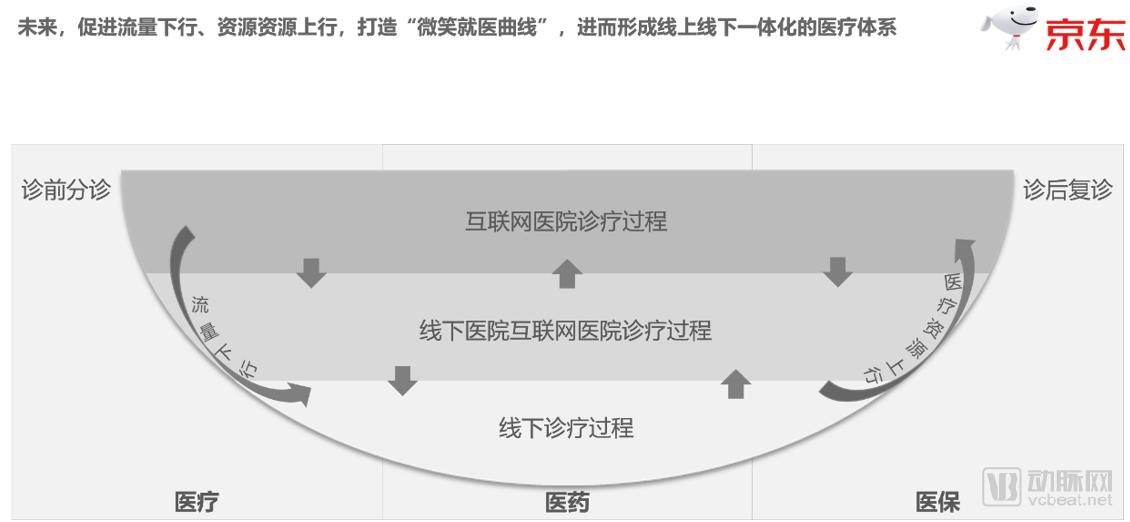
Regarding this curve, Jin Enlin explained it as follows: Leveraging JD.com’s integrated online-offline healthcare service system, patients can access medical care through two channels: the Suqian Branch of JD Internet Hospital and the Suqian Smart Outpatient Clinic. Through the former, patients can complete the entire consultation process online, including remote consultations, prescription issuance, and medication purchase. For issues that cannot be resolved online, patients can use the latter channel to schedule appointments with specialists at Suqian No. 1 People’s Hospital for offline treatment. Throughout this process, the online and offline diagnosis and treatment workflows are seamlessly interconnected.
Following offline consultations, follow-up visits can be completed either on the JD Internet Hospital platform or within the Suqian Smart Outpatient System, as these two systems are interconnected. In the future, users from JD’s main platform can be directed to physical hospitals after undergoing online triage—for instance, receiving recommendations on which specialist is best suited for their specific condition. Patients can directly register and schedule appointments with physicians at these hospitals through our platform, a process referred to as “downstream traffic flow.” Additionally, patients can easily locate their previous offline consulting physicians on the JD Internet Hospital platform, such as those in orthopedics, gynecology, and obstetrics. This enables an extension of the care continuum with their attending physicians, thereby enhancing the overall patient experience.
Meanwhile, throughout the entire patient journey—pre-consultation, during consultation, and post-consultation—a closed-loop service integrating medical care, pharmaceuticals, and health insurance is implemented. JD.com handles the pharmaceutical segment, while health insurance payments can be made online.
Behind this curve, JD.com’s “Internet + Healthcare” ecosystem has established a complete architecture, with each of its business units already leading in their respective niche sectors.
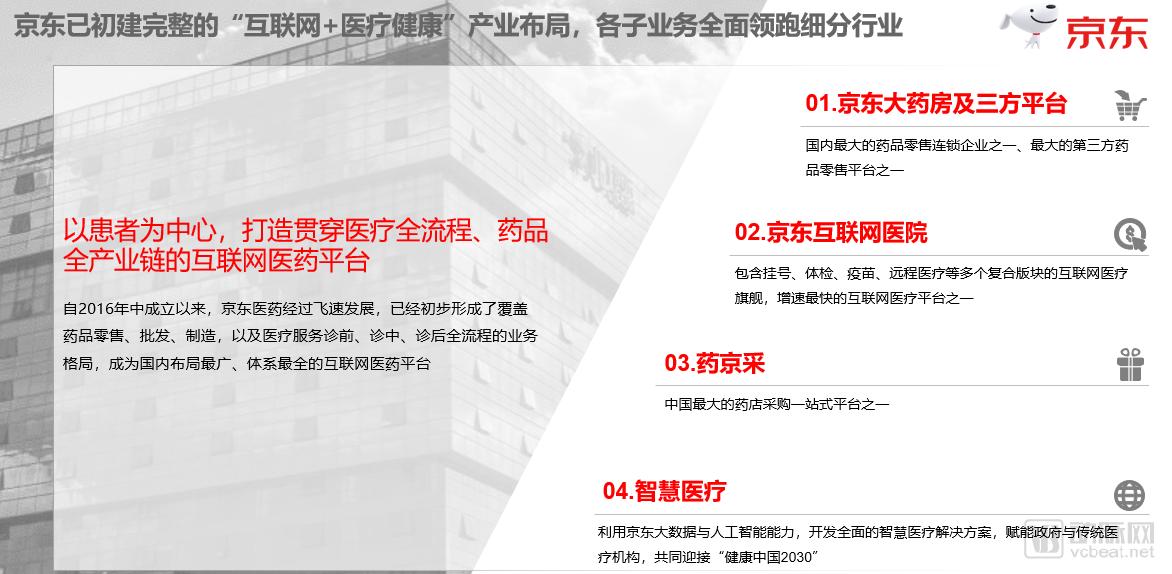
Specifically, JD Health is divided into four business segments: JD Pharmacy and Third-Party Platform, JD Internet Hospital, Yaojingcai, and Smart Healthcare. Its product growth lines are as follows:
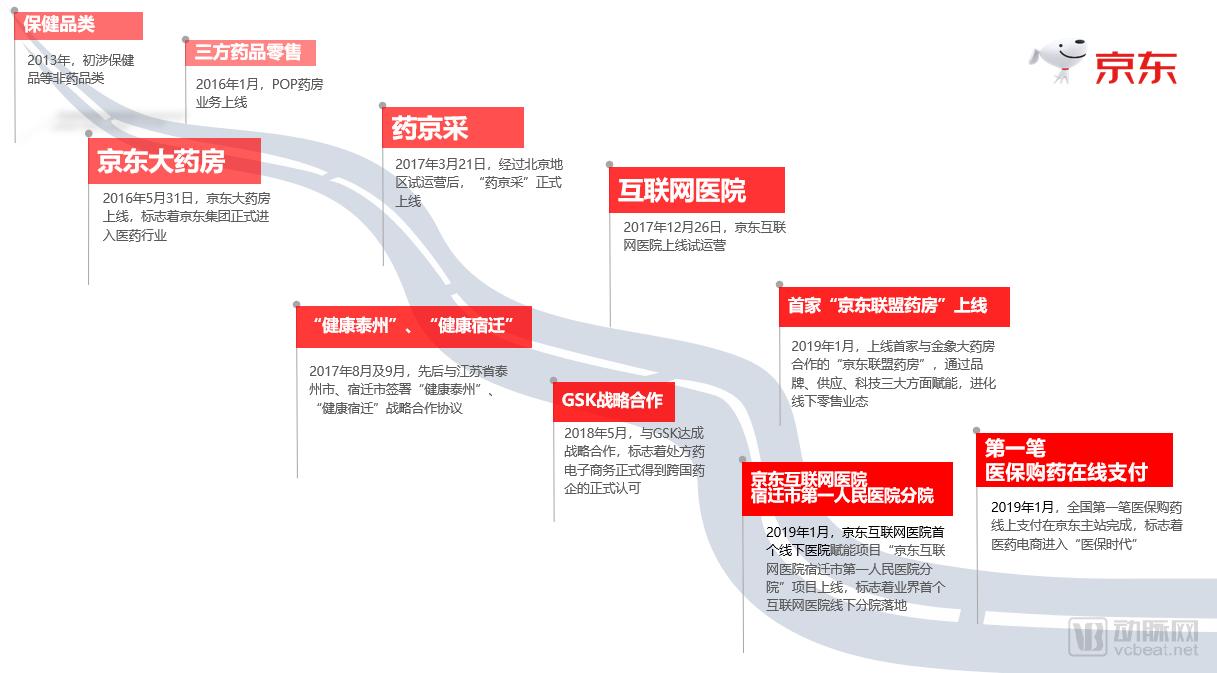
Health supplements are the earliest category JD.com has operated in the healthcare sector, dating back to 2013.
“The four sub-business segments follow an overarching logic centered on patients, aiming to build a fully internet-based pharmaceutical platform that integrates the entire healthcare journey with internet healthcare and pharmaceuticals,” said Xin Lijun.
“Our overarching philosophy is to serve the government, promote good governance, revitalize industries, and benefit the people as our fundamental objectives. Through three key sectors—medical care, medical insurance, and pharmaceuticals—we offer approximately eight solutions to support local governments and healthcare institutions, thereby helping to realize the national initiatives advocated under the ‘Internet Plus Healthcare’ framework,” added Jin Enlin.
Currently, the launch of JD Health’s Suqian Branch and the integration of the Suqian medical insurance system with JD.com have basically established a tripartite linkage among healthcare providers, medical insurance, and pharmaceuticals. This is merely the first step in our collaboration. Jin Enlin stated that we will further deepen our cooperation in three key areas:
First, we will continue to deepen our collaboration with Suqian First People's Hospital, achieving comprehensive integration between full-scenario online services and all offline medical resources, thereby creating a benchmark model for the "Smile Healthcare Curve."Under the “Healthy City” strategic cooperation agreements signed with cities such as Taizhou and Fuzhou, JD.com will replicate this model in these locations.
Second, expand the network of partner hospitals.In addition to Suqian First People's Hospital, we will expand cooperation and integration with more secondary hospitals to truly establish an integrated online-offline medical network featuring a unified online platform and multiple offline nodes.
Third, extensively empower industry partners.JD Internet Hospital serves as a connector for all medical and pharmaceutical resources. We will empower hospitals, physicians, pharmaceutical manufacturers, and pharmacy partners with its internal resources, thereby expanding the network and service boundaries of JD Internet Hospital.
“In fact, we aim to build a rigorous, efficient, and professional diagnosis and treatment platform. On the current basis, we will further introduce more experts and expand into additional medical scenarios. Our next step is to empower pharmaceutical manufacturers, pharmacies, hospitals, and other stakeholders. Beyond meeting the needs of doctors and patients, we intend to integrate these resources into the JD Internet Hospital system, positioning JD Internet Hospital as the foundation and connector of the entire healthcare ecosystem,” said Jin Enlin.
JD Health aims to achieve the following in the future: JD Internet Hospital will serve as the entry point for diagnostic and treatment services. Upon accessing this platform, patients suitable for online consultations will receive care remotely, while those unsuitable for virtual visits will be assisted through JD Internet Hospital’s registration and appointment scheduling features to locate appropriate specialists for offline initial consultations and follow-up visits.
Regarding offline expansion, Xin Lijun also mentioned that investing in hospitals to achieve deep collaboration is not off the table. “The core of JD Health’s internet healthcare strategy is integrated online-offline empowerment, ultimately making it more convenient for patients to seek medical care. From this perspective, we certainly do not rule out deep partnerships with certain hospitals, whether through investment or self-built facilities. These are plans for the future.”
He believes that the priority should be to address the public’s pain points—namely, the difficulty and high cost of accessing medical care—as well as the government’s pain points, such as the unchecked growth of health insurance expenditures and the resulting regulatory challenges. While revenue can be generated in the process of resolving these issues, it requires long-term investment.
“When we entered this industry, our horizon was not two years, but ten—whether we could address this issue within five years,” said Xin Lijun.