

WeDoctor Launches Hangzhou's First Internet-Based Traditional Chinese Medicine Clinic in Xiaoshan Information Port Town
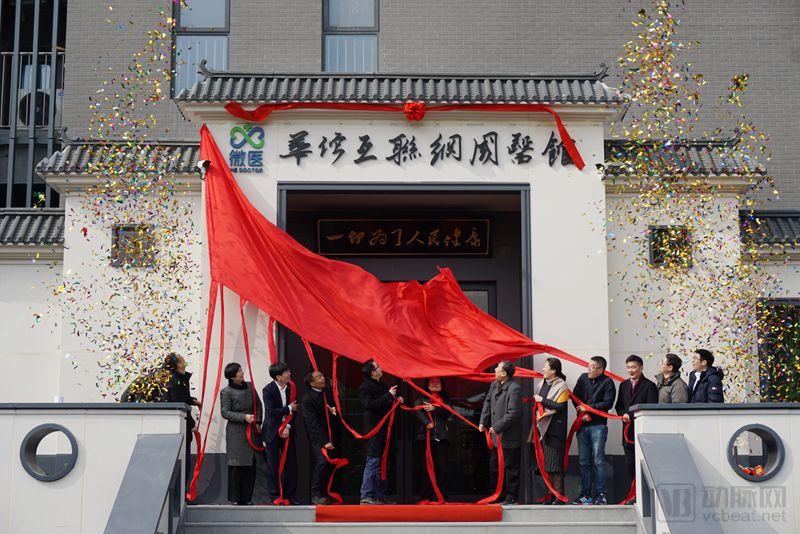
“Consult” National TCM Masters Right in the Business Park: Receive Rehabilitation and Herbal Steam Therapy for Neck and Lower Back Pain Just Downstairs from Your Office... On January 26, Hangzhou’s First Internet-Based TCM Clinic—Huatuo Internet TCM Clinic—Was Officially Unveiled in Xiaoshan Information Port Town. In the Future, More Than 20,000 Employees in the Town and Nearby Residents of Xiaoshan Will Be Able to Access Convenient, Personalized Traditional Chinese Medicine Services Without Leaving the Town.
On the day of its opening, the Zhejiang-style Traditional Chinese Medicine (TCM) Internet Platform was officially launched, with Xiao Luwei, President of the Zhejiang Association of Traditional Chinese Medicine and a renowned national TCM master, serving as the platform’s guiding expert. Additionally, Sang Jie, a nationally recognized TCM master with profound expertise in Mongolian and Tibetan medicine, has established his Internet-based Inheritance Studio at the Huatuo Internet National TCM Clinic. Furthermore, the Huatuo Internet National TCM Clinic has been designated as the site for the following entities: the “Internet Medical Consortium for Calculus Diseases,” the Hangzhou Normal University “Institute of Internet-Based Preventive Treatment and Health Management,” and the Hangzhou Workstation of the Zhejiang Qiushi Institute of Medicinal Diet Science.
In 2017, the total number of visits to traditional Chinese medicine (TCM) medical and health institutions across China reached 1.02 billion, an increase of 60 million from the previous year. The “2016 National TCM Health Index Research Report” showed that the TCM health and wellness index for Chinese residents was 60.9, with nearly half of the population in a non-healthy state. Notably, the proportion of residents aged 20–44 in a diseased state was 23.0%, higher than the 12.1% observed among elderly individuals aged 60–80. Demand for TCM services is growing increasingly robust.
Young adults aged 20–44 are in a critical phase of career and academic advancement. High stress levels, late nights, prolonged sedentary behavior, and overeating have left them plagued by chronic health issues such as cervical spondylosis, carpal tunnel syndrome (often referred to as “mouse hand”), lumbar muscle strain, spleen and stomach deficiency, and constipation. Although Traditional Chinese Medicine (TCM) can alleviate and treat these conditions, it requires consistent, regular therapy. Consequently, residents are demanding greater convenience and accessibility in TCM services.
Huatuo Internet Traditional Chinese Medicine Clinic was established against this backdrop. Han Menglong, Director of the Economic Development Bureau of Hangzhou Xiaoshan Economic and Technological Development Zone and Secretary of the Party Committee of Hangzhou Bay Information Port, stated that Xiaoshan Information Port Town has made “Internet+” and “Artificial Intelligence+” its distinguishing features, vigorously developing the digital economy industry and attracting more than 20,000 entrepreneurs and innovators. As a young town, it boasts an average entrepreneur age of 26.4 years—a demographic characterized by youth and ambition. However, the high pressure and intensity of work in the digital economy sector have generated substantial demand for routine medical consultations and health maintenance services.
It is understood that the Huatuo Internet TCM Clinic has a total floor area of 4,800 square meters. Its practicing physicians are all experienced experts in Traditional Chinese Medicine (TCM). By integrating advanced TCM artificial intelligence systems, telemedicine platforms, constitution identification devices, and concentrated herbal granules, the clinic employs traditional TCM therapies—including herbal medicine, acupuncture and tuina massage, herbal fumigation, moxibustion, gua sha, cupping, cervical and lumbar traction, as well as specialized medicinal diets—to provide high-quality, personalized TCM services to employees within the industrial park and nearby residents. For complex cases, remote consultations with renowned senior TCM practitioners, including National TCM Masters, are also available.
On its opening day, many people gathered on the third floor of the Hua Tuo Internet Traditional Chinese Medicine Clinic to witness the “black-tech” innovations in TCM.
It is reported that after founding and successfully operating the Wuzhen Internet Hospital and the Wuzhen Internet Traditional Chinese Medicine (TCM) Clinic, WeDoctor Group—the world’s largest healthcare technology unicorn—established Hangzhou’s first internet-based TCM clinic, the Huatuo Internet TCM Clinic. The clinic has also implemented previously developed “cutting-edge” TCM technologies, such as the Xuanhutai AI-Assisted TCM Diagnosis and Treatment System.
As early as 2016, the Xuantai Traditional Chinese Medicine (TCM) Intelligent Clinical Decision Support System was deployed nationwide. To date, it has been integrated into 1,200 healthcare institutions across China, assisting in the issuance of over 2.8 million prescriptions. Dr. Du Peng, a TCM practitioner at the Houzhai Street Community Health Service Center in Yiwu City, is a recipient of the “Xuantai System Application Star” award and has used the system to assist in prescribing more than 50,000 formulas. “With a background in rehabilitation medicine, I am an atypical TCM practitioner. I studied TCM to better support patients’ rehabilitation,” said Dr. Du. He noted that since adopting the Xuantai System, many prescription challenges have been effectively addressed. The system provides prompts regarding formula composition and medication selection, allowing him to make minor adjustments based on its recommendations when he feels uncertain.
“In the future, we will focus our research on the inheritance of specialized TCM conditions via the internet and the integration of Zhejiang-style Traditional Chinese Medicine (TCM) with digital technologies,” said Ni Rong, CEO of WeDoctor’s Huatuo Cloud and lead developer of the Xuanhutai Intelligent TCM Clinical Decision Support System. He noted that the Huatuo Internet National Medical Center is committed to providing high-quality TCM services to residents in Xiaoshan and Hangzhou, while also strengthening research into the integrated development of internet technologies and TCM. This initiative aims to preserve and transmit the expertise of national TCM masters and renowned senior practitioners, enabling primary-care TCM physicians to learn from their wisdom and become “master TCM practitioners at patients’ doorsteps.”