

JD Health: JD.com's Third Unicorn Accelerates Its Push into Digital Healthcare
Last night, JD.com Group released its financial report for the first quarter of 2019 and simultaneously disclosed three major developments:
First,JD.com Group Announces the Formal Establishment of JD Health as a Subsidiary Group. It Is the Third Giant Unicorn Created by JD.com Group, Following JD Digits and JD Logistics;
Second, as the only subsidiary group under JD.com that operates healthcare-related businesses, JD Health will leverage the capabilities and resource advantages of JD.com inPharmaceutical Retail, Pharmaceutical Wholesale, Internet Healthcare, and Healthy CitiesOn the basis of four business segments, graduallyRefine the industrial layout of “Internet + Healthcare”;
Third, on the day before JD.com Group released its financial report,JD Health Secures Over $1 Billion in Series A Funding, with multiple investment firms from China and abroad leading the round. Upon completion of the financing,JD.com will remain the controlling shareholder of JD Health.
The newly established JD Health will build upon its existing core strengths in healthcare and pharmaceuticals, continuously consolidating and expanding its leading position in areas such as pharmaceutical e-commerce and internet-based healthcare.and further expand and deepen JD Health’s footprint in the “Internet + Healthcare” industry through data- and technology-driven smart healthcare solutions.
The healthcare sector has long been a key focus for major corporations, with internet giants (BAT) being the most active participants. Most of them began their engagement in 2014, continuously penetrating the core of the medical system—hospitals—and transforming and influencing patients’ healthcare-seeking behaviors and habits, thereby making medical services more accessible.
Specifically, Tencent entered the healthcare sector through investments in 2014 and began exploring its own healthcare business operations in 2015;
Also in 2014, Alibaba Group partnered with Yunfeng Capital to invest $170 million in the Hong Kong-listed CITIC 21st Century, acquiring a 54.3% stake. In October of the same year, CITIC 21st Century was renamed “Alibaba Health,” marking Alibaba’s formal entry into the healthcare sector.
On January 8, 2015, Baidu established its Healthcare Division. Although this division was disbanded on February 9, 2017, Baidu launched the AI Innovation Business Unit (Baidu Lingyi) in April 2018 to intensify its efforts in medical AI.
JD.com entered the market relatively late. Although health supplements were the earliest product category managed by JD Mall in the healthcare sector, dating back to 2013, it was not until 2016 that JD.com formally ventured into the medical industry.
2016 was another turbulent year for the development of internet healthcare, with JD.com’s involvement in the medical sector primarily taking the form of investments. It was not until 2017, when policies governing internet healthcare became somewhat clearer, and particularly after the implementation of new regulations on internet healthcare in 2018 that hospitals actively participated in building internet hospitals, that the internet healthcare industry truly gained new vitality and hope.
At the Second Digital China Summit, which concluded on May 8, 2019, the National Health Commission released the Report on Promoting the Development of “Internet + Healthcare.” The report indicated that there were currently 158 internet hospitals across China, the policy framework for “Internet + Healthcare” had been basically established, and the industry was demonstrating sound development momentum.
According to data from the "Several Opinions of the State Council on Promoting the Development of the Health Service Industry," the total scale of China's big health industry is expected to reach 8 trillion yuan in 2020. Emerging technologies, represented by 5G, the Internet of Things (IoT), artificial intelligence (AI), and big data, are bringing about significant transformations across various scenarios, processes, and services within the big health sector.
The Chinese government has successively issued a series of guiding opinions and specific policies to promote the development of “Internet + Healthcare,” which have bolstered corporate confidence,Presenting a historic opportunity for “Internet + Healthcare,” JD Health Subgroup was officially established at this pivotal moment.
Next, VCBeat (WeChat ID: vcbeat) will provide a brief overview of JD.com’s healthcare layout to examine what changes may arise following the establishment of the JD Health subsidiary group.
As a major initiative announced in JD.com’s Q1 2019 financial report, JD.com Group has signed definitive investment agreements with investors including CPE China Fund, CICC Capital, and Baring Private Equity Asia for the Series A preferred share financing of JD Health, its healthcare subsidiary. China Renaissance served as the exclusive financial advisor for this transaction.
JD Health’s total financing is expected to exceed US$1 billion, accounting for more than 14.5% of JD Health’s fully diluted shares.This round of financing will facilitate JD Health’s further expansion of its core business, attract industry talent, and actively explore new ventures in the broader healthcare sector.
Tang Yu, Managing Director of China Renaissance Group, stated, “JD Health is an active pioneer and a distinguished leader in the ‘Internet + Healthcare’ sector. Leveraging its existing businesses, including JD Pharmacy, third-party retail platforms, Yaojingcai, and JD Internet Hospital, it continues to expand the boundaries of the internet within the healthcare industry. The completion of JD Health’s Series A financing has enabled China Renaissance to support JD Health in seizing industry opportunities, achieving rapid growth, and strategically positioning itself in the broader healthcare and wellness sector.”
The internet penetration rate in the healthcare and medical industry remains relatively low, indicating substantial growth potential. Influenced by policy shifts and technological trends, the industry is encountering a historic opportunity. Upon the completion of this round of financing, JD Health will continue to consolidate and expand its leading advantages in pharmaceutical e-commerce and internet-based healthcare, building upon its core business system centered around medical services and pharmaceuticals. Furthermore, driven by data and technology-enabled smart healthcare solutions, JD Health will further broaden and deepen its layout in the “Internet + Healthcare” sector, aiming to establish itself as a trusted flagship enterprise in the health industry.
JD.com’s Medical Products Keep Pace with the Times
As can be seen from the public information disclosed by JD.com in 2018,Its healthcare-related products fall into four categories: JD Pharmacy and third-party platforms, JD Internet Hospital, Yaojingcai, and Smart Healthcare.
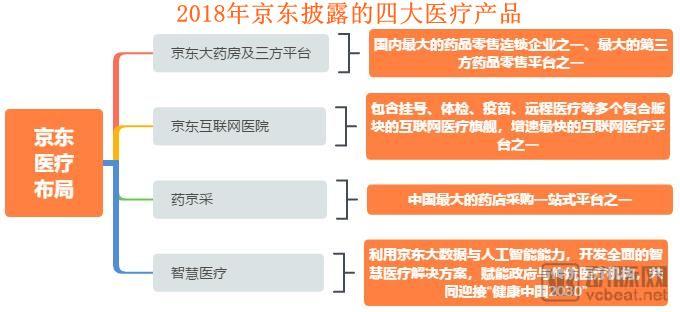
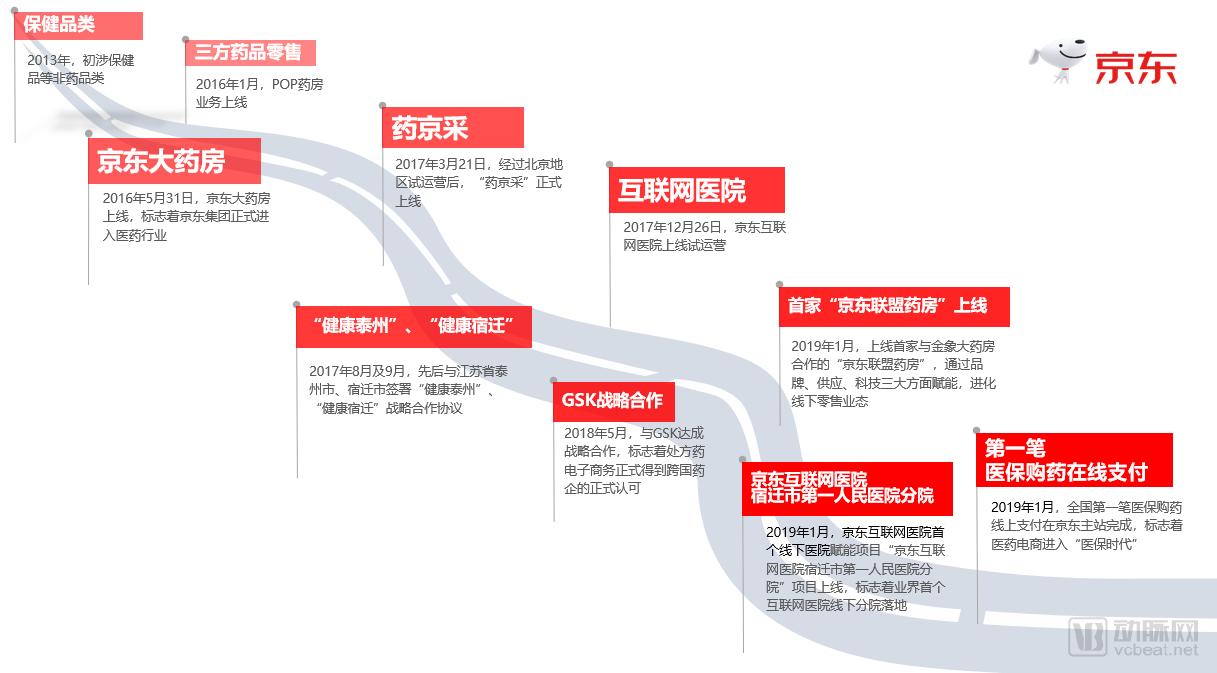
This product ecosystem has established a patient-centric internet healthcare platform that spans the entire medical care process and the full pharmaceutical industry chain. Its product growth lines are as follows:
In a previous interview, Jin Enlin, General Manager of JD Health City under JD.com’s Life Services Business Group, stated, “Our overarching strategy is fundamentally aimed at serving the government, promoting good governance, revitalizing the industry, and benefiting the public. By leveraging three key sectors—medical care, medical insurance, and pharmaceuticals—and offering approximately eight solutions, we serve local governments and medical institutions, thereby helping to realize the national initiatives advocated under the ‘Internet + Healthcare’ framework.”
With the establishment of JD Health, the company will gradually refine its “Internet + Healthcare” industrial layout, building upon its existing four business segments: pharmaceutical retail, pharmaceutical wholesale, internet healthcare, and Healthy Cities.
In comparison, the “Pharmaceutical Retail” and “Pharmaceutical Wholesale” segments are expected to remain largely unchanged, corresponding to the 2018 products “JD Pharmacy and Third-Party Platforms” and “Yaojingcai,” respectively.The names “JD Internet Hospital” and “Smart Healthcare” were changed to “Internet Healthcare,” and “Healthy City” was added.
As can be seen,JD HealthGreat importance has been attached to “Internet + Healthcare,” and the corresponding initiative—Internet Hospitals—has already been implemented, even outpacing the development of several other product categories.
JD Health has added “Healthy Cities,” which we believe is primarily driven by two reasons:
First, “Healthy Cities” is one of the key levers for achieving Healthy China.In recent years, the National Health Commission has vigorously promoted the development of healthy cities with Chinese characteristics, playing a positive role in advancing the Healthy China initiative.Various regions have successively introduced the “Healthy XX” initiative, such as “Healthy Chengdu” and “Healthy Zhejiang”;
Second, JD.com first entered the internet hospital sector in August 2017 by signing a strategic cooperation agreement with the Yinchuan Municipal Government. The joint development of “Healthy Yinchuan” also adopted a “healthy city” approach, leading to the establishment of the “JD Internet Hospital” in Yinchuan.
At this stage, the state is vigorously promoting “Internet Hospitals,” with major tertiary Grade-A hospitals actively entering the field. The implementation of measures across policy, approval, and regulatory frameworks has significantly accelerated industry development.
Therefore, among all of JD.com’s healthcare offerings, the “Internet Hospital” has emerged as a dark horse. In addition to the “JD Internet Hospital” established in Yinchuan, JD.com built another internet hospital in Suqian in January 2019, achieving a closed-loop integration of “medical services, pharmaceuticals, and medical insurance.” Its internet hospital operations have now penetrated core healthcare scenarios.
The advantages of JD.com in operating an internet hospital can be summarized as follows:
First, the JD.com platform has secured a certain position in the minds of consumers;
Second, JD Pharmacy has already become one of the largest online and offline pharmaceutical retail platforms, a capability that other internet hospitals do not possess;
Third, by leveraging the advantages of the JD.com platform, the influx of traffic and integration of resources have enabled JD Internet Hospital to achieve rapid development, earning strong recognition from doctors and medical experts;
Fourth, the true purpose of internet hospitals is to improve medical service efficiency by addressing the integration of online and offline services, thereby enabling patients to conveniently access consultations on a unified platform; JD.com aligns well with this scenario.
Fifth,JD.com is committed to integrating online and offline medical resources. In alignment with the national core policies of tiered diagnosis and treatment and the separation of prescribing from dispensing, JD.com collaborates with offline hospitals to connect all healthcare service scenarios, thereby addressing the challenges of difficult and costly access to medical care for the general public.
According to Zhu Wei, President and Deputy Secretary of the Party Committee of Suqian First People’s Hospital, the integrated connectivity of online and offline medical resources and services has provided greater assurance for the allocation of medical resources and hospital operations. In 2018, Suqian First People’s Hospital recorded 670,300 outpatient and emergency visits, 38,800 discharges, and 15,200 surgical procedures.
As a public tertiary general hospital, we see a large volume of patients daily, most of whom seek consultations for common illnesses, routine follow-ups, or chronic disease management, thereby consuming significant medical resources. After integrating with JD Internet Hospital, patients can complete initial consultations, follow-up visits, and chronic disease management online from home, allowing offline outpatient resources to be prioritized for patients with acute and critical conditions.
In terms of JD.com’s proprietary investment layout in the big health sector, incomplete statistics from the VCBeat database indicate that JD.com opened the door to medical investments after establishing JD Health in 2013. Over the past few years, it has invested in approximately 15 big health companies, as shown in the figure below:
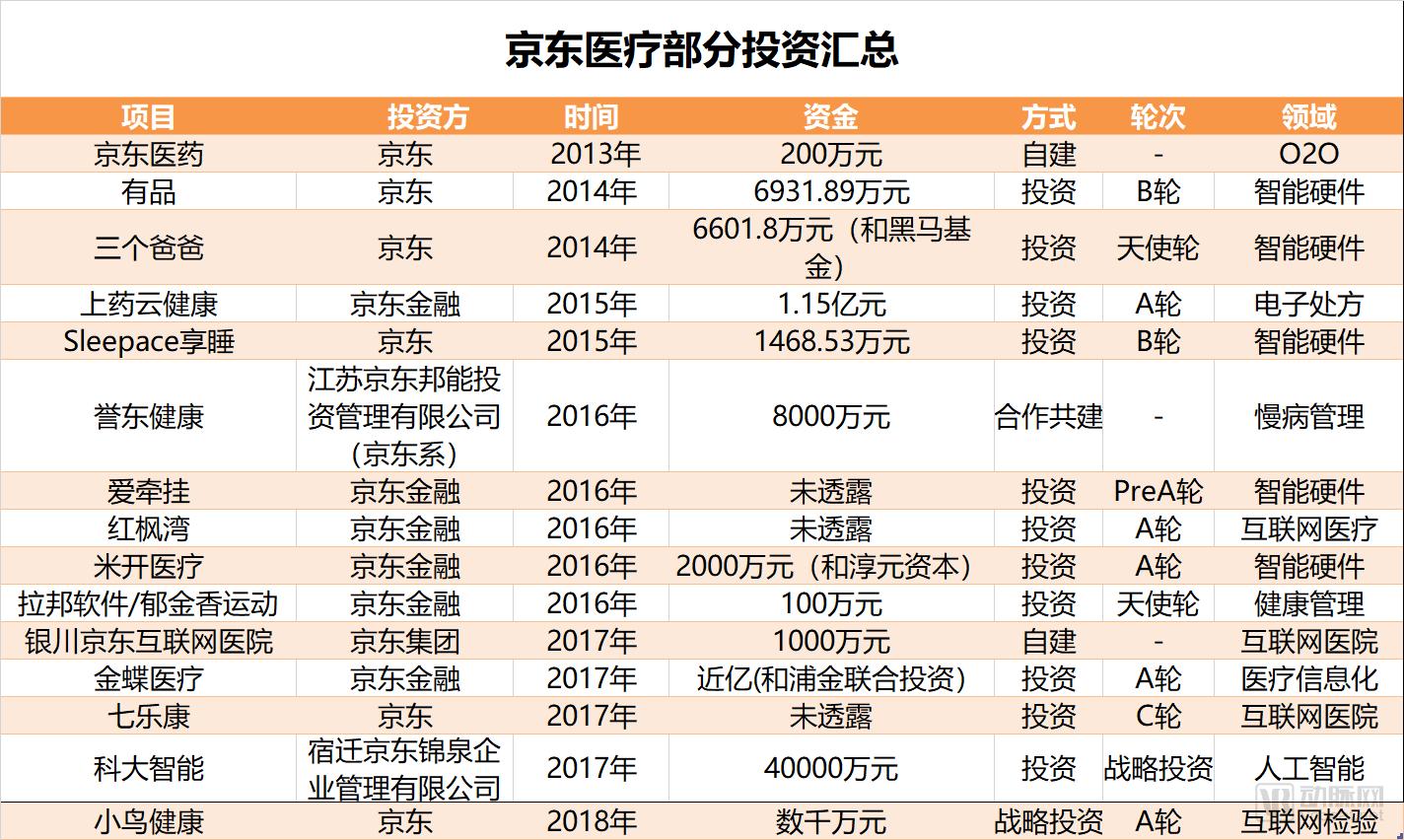
JD.com has entered the healthcare sector through four primary approaches: joint ventures, investment, self-built operations, and strategic investments. Among the invested companies, funding stages include Angel, Pre-A, Series A, Series B, Series C, and strategic investment rounds. Specifically, there are five companies at the Series A stage and two at the Series B stage.
These portfolio companies span a wide range of sectors, including smart hardware, electronic prescriptions, healthcare informatization, internet hospitals, online healthcare, and artificial intelligence. JD.com’s previous strategic initiatives in the broader health sector will facilitate JD Health’s subsequent establishment and refinement of its own ecosystem.
Notably, it has invested in CSIG (China Smart Grid), a company active in the artificial intelligence sector. CSIG focuses on the research, development, and application of products in the fields of industrial robots, service robots, artificial intelligence, electric power, and new energy. In 2017, the company raised RMB 400 million from Suqian Jingdong Jinquan Enterprise Management Co., Ltd. (with Liu Qiangdong as the actual controlling shareholder) through a private placement with matching fund-raising arrangement.
CSG has launched Health Advisor Robots and Medical Imaging Analysis Robots for the healthcare sector. By integrating machine vision, natural language processing, and wearable devices, the Health Advisor Robot captures user health data and leverages big data analytics to benchmark against relevant clinical indicators. This enables physicians to identify potential health risks at an early stage, facilitating preventive care. Furthermore, the robot can optimize treatment plans by analyzing current symptoms in conjunction with big data insights.
At the Second Digital China Summit, which concluded on May 8, 2019, Mao Qun’an, Director of the Department of Development and Informatization of the National Health Commission, announced that 19 provinces across China had established provincially unified telemedicine network platforms based on the internet or private networks. The “Internet+” medical insurance settlement services have been steadily advanced, with the medical insurance system integrated into the National Data Sharing and Exchange Platform, thereby enabling shared query services for designated medical institutions providing cross-regional healthcare.
In accordance with relevant arrangements, the National Health Commission will next focus on promoting the achievement of “hard targets,” such as ensuring that hospitals at Level II and above generally provide online services and that tertiary hospitals achieve internal information interoperability and sharing. Meanwhile, it will guide localities in accelerating the construction of regulatory platforms for “Internet + Healthcare,” strictly implementing the relevant standards and requirements stipulating that internet hospitals and internet-based diagnosis and treatment must rely on physical hospitals.
JD Health, which emerged at this juncture, aligns precisely with the direction in which the industry is making concerted efforts.Since entering the pharmaceutical industry in 2016, JD.com has adopted a “medical-pharmaceutical integration” strategy. Leveraging its strengths in brand reputation, user traffic, supply chain, and logistics, JD.com has established a business framework that covers the entire pharmaceutical industry chain—including retail, wholesale, and manufacturing—as well as the full spectrum of medical services spanning pre-diagnosis, diagnosis, and post-diagnosis stages. This enables the company to provide consumers with a closed-loop “medical + pharmaceutical” service ecosystem. With the emergence of JD Health and the further advancement of its operations, the company is poised to continuously penetrate core areas of healthcare. Consequently, the number of partners integrated into JD’s broader health industry ecosystem will continue to grow, offering substantial potential for future expansion.