

Can AI-Powered RNA Liquid Biopsy Unlock a Multi-Billion-Dollar Market?
Currently, the common methods for early diagnosis of tumors are tissue biopsy and genetic testing. Tissue biopsy requires slicing and sampling from the patient's tumor tissue during surgery, which not only causes pain to the patient but also carries the risk of stimulating further deterioration and development of the tumor. On the other hand, genetic testing for early cancer screening has become a highly competitive market in China. In practical applications, due to low entry barriers and the lack of industry-recognized guidelines, there may be issues such as poor testing quality, inaccurate results, unprofessional interpretation, and even blind pursuit of genetic test results.
KaiEr Bio focuses on the research and development of early cancer detection systems based on artificial intelligence and liquid biopsy. By detecting the expression levels of target genes in saliva and employing AI-based analytical methods, it identifies the occurrence of tumors and their tissue of origin. Unlike conventional genetic testing, KaiEr Bio’s assay utilizes RNA from saliva samples, offering the advantages of high abundance and ease of detection.
In-depth Analysis of Gene Expression Profiles from RNA to Predict Tumor Lesions
Early cancer screening holds immense market potential. According to forecasts by J.P. Morgan and Goldman Sachs, the global market potential for liquid biopsy is expected to reach $29 billion. Traditional blood tests are based on the detection of genetic mutations in circulating tumor DNA (ctDNA). In fact, ctDNA levels are typically higher in advanced or metastatic tumors but lower in early-stage or localized tumors. Meanwhile, due to the considerable distance between saliva and the lesion site, the concentration of biomarkers such as ctDNA in saliva is even lower than that in blood. Therefore, both blood-based and saliva-based ctDNA tests have limited utility in the early diagnosis of tumors.
However, studies have found that biomarkers released by tumors, such as growth factors, can induce changes in the salivary transcriptome. Therefore, the pathological status can be accurately determined by indirectly analyzing these changes in the salivary transcriptome. Building on this principle, Kaier Biology utilizes indirect biological information from saliva for disease screening. The company detects target gene expression using purified salivary RNA and various quantitative gene analysis technologies, and employs artificial intelligence to analyze and compare changes in the gene expression profiles of salivary cells, ultimately enabling the detection of tumors and identification of their origin.
Kair Biology employs RNA-seq technology for salivary transcriptome analysis and has developed Kair DeepMap. TMSystem: Enhance prediction accuracy through optimized training and validation of existing AI models. Currently, the company’s independently developed Kaier ShentuTM--The AI-based early cancer screening system has secured independent and comprehensive intellectual property rights and obtained the Medical Device Registration Inspection Certificate. The company has also established clinical research collaborations with Zhongshan Hospital and Ruijin Hospital, and is expected to obtain the Product Registration Certificate by the end of 2019.
Kai'er ShentuTMSystem—High Accuracy, Low Cost, Short Cycle
“Our products are characterized by high precision, low cost, and short turnaround times,” said Feng Xueyang, CEO and founder of Care Biotech, with pride. Saliva sampling is convenient, painless, and non-invasive, while avoiding the risk of blood-borne infections; Care ShentuTMThe RNA-based gene detection system achieves specificity and sensitivity of nearly or over 80% for early screening of various cancers; the testing cycle is typically 1–3 days, whereas conventional DNA sequencing-based early cancer screening products require 7–20 days. VCBeat has learned that Kaier Biology is one of the few companies leveraging AI technology to analyze transcriptomics, thereby significantly improving the accuracy of early cancer screening.
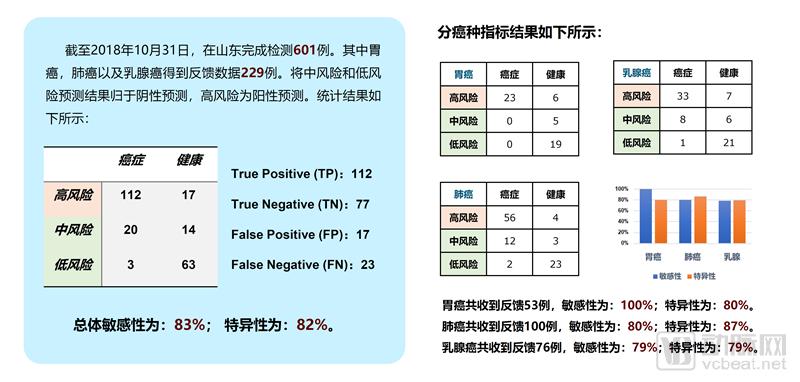
CareDeepTMTest Data (Shandong Region)
Kair Biology has conducted business activities with multiple Grade A tertiary hospitals in Jiangsu, Shandong, and Shanghai within the East China region. Users first order testing products at the hospital, then collect saliva samples under the guidance of physicians. The saliva samples are subsequently sent to partnered third-party clinical laboratories for RNA gene expression analysis. Finally, Kair Biology utilizes its deep tumor algorithm to generate Kair DeepMap insights based on customer requirements.TMCancer risk testing, with reports issued within five business days. Feng Xueyang revealed that in the future, Care Bio will build a 1,000 m2third-party clinical laboratories, meeting the annual testing demand of tens of thousands of patient visits.
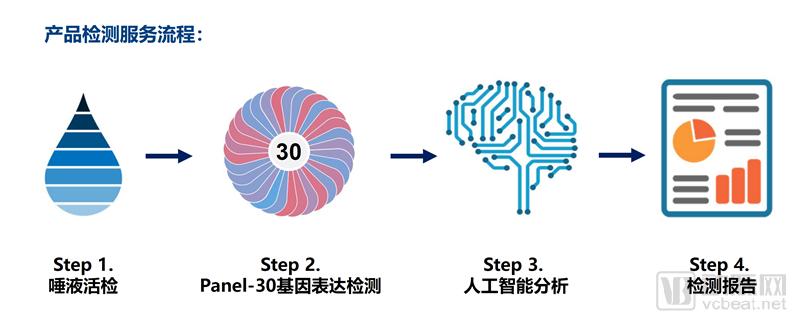
Product Testing Service Process
Startups leveraging RNA liquid biopsy for early cancer diagnosis have well-established precedents abroad. Nova Satra Dx, based in Singapore, has developed the NovoTect™ technology, which enables highly specific and sensitive detection of breast cancer subtypes by analyzing miRNA in blood. Pacific Edge (NZE: PEB), a publicly listed company in New Zealand, aims to provide innovative solutions for the early detection and management of cancer by measuring RNA and proteins in urine or blood.
Team and Collaboration
Kai'er Bio was established in December 2017, with its headquarters located in Nanjing, Jiangsu Province. The company has secured millions of US dollars in angel financing from ZhenFund. Kai'er Bio’s team possesses extensive expertise in product research and development, artificial intelligence architecture design, as well as marketing and sales. Dr. Feng Xueyang, the company’s CEO and founder, has over a decade of academic experience in bioinformatics, biotechnology, next-generation sequencing (NGS), and cancer research. During his tenure as a professor at Virginia Tech in the United States, Dr. Feng independently led his team in conducting more than ten academic research projects funded by the U.S. government.
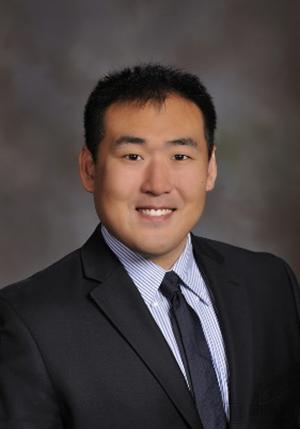
Dr. Feng Xueyang, CEO and Founder of Care Biologics
The company’s COO, Dr. Sheng Jiayuan, conducted a three-year postdoctoral research at Virginia Tech in the United States, focusing on bioinformatics and bioengineering.
Dr. Xu You, the company’s CTO, has previously served as head of engineering teams at world-leading IT companies such as Google, Fitbit, and Reddit, bringing over a decade of industry experience in big data analytics, artificial intelligence, and bioinformatics.
Furthermore, the majority of CareBio’s sales team members come from renowned biopharmaceutical companies such as AstraZeneca, Eli Lilly, and Roche, bringing with them many years of sales experience in the biopharmaceutical industry.
Kaier Biotech has also engaged in in-depth clinical research collaboration with Professor David Wong of the University of California, Los Angeles (UCLA). Professor Wong is a Fellow of the American Association for the Advancement of Science (AAAS), a UCLA Distinguished Professor Emeritus, and a leading scientist in the field of salivary diagnostics for oncology. He has published more than 230 scientific papers and holds 16 invention patents. Furthermore, Professor Wong led his team to discover 400 types of circular RNAs in human saliva for the first time, attracting widespread attention within the industry.
Regarding the future development of CareBiologics, Feng Xueyang stated that the company will submit registration applications for early auxiliary diagnostic products targeting gastric cancer, lung cancer, oral cancer, breast cancer, and other malignancies under clinical guidelines. In later stages, it will file for broad-spectrum cancer early detection products. The products will initially target B-end users such as hospitals and health examination centers, with future expansion to C-end users including mobile healthcare apps, insurance institutions, communities, and individuals.
Currently, the company is undergoing a Series A financing round of approximately tens of millions of RMB, with the funds primarily allocated to expanding production capacity and filing for NMPA approval.