

Johns Hopkins Medicine: Building a 22-Year #1 Ranked Innovation Ecosystem through Integrated Academia-Industry Collaboration
How to accelerate the transformation of scientific and technological achievements into real productive forces, thereby making them a major driving force for socio-economic development, has become a focal point of attention for academic and industrial communities both in China and abroad.
One approach is to integrate industry, academia, and research. In a broad sense, industry-academia-research collaboration refers to the mutually beneficial and complementary partnership established between higher education institutions and enterprises in areas such as talent development, scientific research, technological development, production and operations, resource sharing, information exchange, and personnel interaction.
Whether in China or abroad, this model has consistently remained highly popular in the healthcare sector.
As the Western country with the most developed market economy and the most perfected market system, the United States has a relatively well-established model of industry-academia-research collaboration. In the U.S. healthcare sector, the most representative example is arguably the Johns Hopkins Medicine.

Johns Hopkins University established its School of Medicine in 1893, which later evolved into Johns Hopkins Medicine, a premier academic medical system integrating clinical care, research, and education. Under the umbrella of Johns Hopkins Medicine, The Johns Hopkins Hospital ranked first among the best hospitals in the United States by U.S. News & World Report for 22 years and placed within the top three in the most recent 2018–2019 rankings. It is widely recognized in the United States as the birthplace of the academic medical model.
As the medical education and research branch of Johns Hopkins University, the School of Medicine shares a campus with the Johns Hopkins Hospital, the primary teaching hospital of the Johns Hopkins Health System. The Johns Hopkins University School of Medicine is an integral part of the Johns Hopkins Health System; physicians working at healthcare institutions such as the Johns Hopkins Hospital also engage in research and teaching at the Johns Hopkins University School of Medicine.
The university’s medical school was not only the first to mandate that medical students hold a bachelor’s degree, but also the first graduate school to admit female medical students and grant them equal rights with their male counterparts.
Johns Hopkins Medicine integrates academic and research entities, such as the Johns Hopkins University School of Medicine, with healthcare institutions like Johns Hopkins Hospital, anchored by industry-leading venture capital firms and the university’s intellectual property management center—Johns Hopkins Technology Ventures (hereinafter referred to as JHTV). Together, the School of Medicine, the hospital, and affiliated enterprises form an integrated ecosystem that combines industry, academia, and research.
| Johns Hopkins Medicine Structure | ||
| Institution | Functions/Branches | Action |
| School of Medicine, University | Medical Education | Cultivating Future Healthcare Professionals |
| Research Branch | R&D | |
| Hospital | Medical | Providing Medical Services to Patients |
| Teaching | Medical staff also serve as faculty members at medical schools. | |
| Scientific Research | Innovative Medical Technologies and Services | |
| Enterprise | Technology Transfer Team | Submit invention disclosures and technology licenses; initiate non-disclosure agreements, material transfer agreements, and substance transfer agreements. |
| Office of Corporate Cooperation | Establish corporate partnerships to bring scientific research achievements to market | |
| Fast Forward Innovation Incubation Center | Providing a makerspace for startups, investors, industry experts, academic researchers, and students | |
JHTV has three core functions: first, to provide licensing, patenting, and technology commercialization services for researchers and inventors at Johns Hopkins University; second, to support the development of startups both within and outside the university; and third, to actively connect with parties interested in leveraging university research or materials for academic or corporate activities.
To maximize the impact of Johns Hopkins University’s research outcomes and facilitate the translation of inventions and discoveries into accessible technologies, products, and services, JHTV is structurally divided into three units: the Technology Transfer Group, the Office of Corporate Collaboration, and the FastForward Innovation Incubator Center.
Technology Transfer Team (Technology Transfer)It aims to assess the commercial potential of inventions, provide advice on marketability and commercial policy issues, help guide patent applications, and promote the commercialization of scientific research achievements. Its primary responsibilities include submitting invention disclosures, managing technology licensing, and initiating non-disclosure agreements, material transfer agreements, and substance transfer agreements.
According to JHTV’s fiscal year 2018 report, in 2018, the Technology Transfer Office processed 463 invention disclosures, secured 150 new patents, and executed 138 new agreements, generating $16.5 million in licensing revenue. The number of patents increased by 20% compared to fiscal year 2017. There were 868 active technologies covered by U.S. patents, with a total of 2,864 U.S. and foreign patents. The office managed 4,594 material transfer agreements and assisted in the establishment of eight new companies.
Corporate Partnerships Office (Corporate Partnerships)Committed to building partnerships, we provide our industry partners with cohesive end-to-end services, bringing inventions and discoveries from Johns Hopkins Laboratory to market through strategic collaborations. Collaborations with Johns Hopkins University span numerous technologies and key therapeutic areas, taking various forms including master’s research agreements, individually sponsored projects, clinical trials, and education/training activities.
FastForward Innovation Incubation CenterIt is a coordinated set of resources, with members including tenants of the Innovation Center, virtual members holding Johns Hopkins technology licenses, and non-Hopkins entities that have completed a rigorous application process. In addition, FastForward assists startups in securing early-stage financing.
FastForward Innovation Incubator is the core of JHTV. With the support of JHTV’s FastForward Innovation Incubator, 157 startups have been incubated within Johns Hopkins University (JHU). Notably, nearly all of these 157 startups were founded or co-founded by research teams and student entrepreneurs from within Johns Hopkins University. Leveraging innovations across diverse markets ranging from healthcare and drug development to manufacturing and IT, FastForward startups are committed to bringing numerous life-changing technologies to market.
In 2013, Johns Hopkins University conducted a survey of leading innovation incubators, venture capital firms, and top enterprises within the healthcare industry to explore how to better support innovation and entrepreneurship. This study ultimately identified three key elements of an innovation ecosystem: space, services, and funding. Based on these findings, researchers formulated JHTV’s strategy to stimulate innovation.
Space
Space is a key element of JHTV’s continuously evolving ecosystem. Physical spaces foster economic activity and address practical challenges, enabling local businesses to devote greater resources to innovation and R&D.
In 2018, the FastForward innovation incubation center doubled its space and opened a second innovation center to support commercial tenants adjacent to Johns Hopkins University’s Homewood Campus. The different innovation centers of FastForward have distinct functions:
FastForward 1812Spanning 23,000 square feet, the center provides opportunities for startups, investors, industry experts, and leading academic researchers to meet, exchange ideas, collaborate, and grow. By the end of fiscal year 2018, it had incubated 21 startups.
FastForward R. HouseLocated on the Homewood Campus of Johns Hopkins University, the makerspace enables entrepreneurs—regardless of their affiliation with the university—to establish a local foothold for their companies through FastForward R. House.
FastForward U HomewoodIt is a student-centered innovation hub featuring workshops and entrepreneurial resources, including a makerspace managed by the Whiting School of Engineering, empowering students to develop ideas, launch ventures, and gain business insights.
FastForward U EastIt is the second student innovation center at Johns Hopkins University, featuring 3,200 square feet of office, collaborative, and meeting space. The center primarily provides students with opportunities for risk exploration.
Services
In addition to physical space, JHTV also provides educational and advisory services to support startups both within and outside Johns Hopkins University. JHTV primarily serves startups through the following platforms:
Social Innovation LabBy adopting a group-based learning model, innovators and entrepreneurs can support each other in developing their businesses.
Resident Mentor System (MENTORS-IN-RESIDENCE)Pair each FastForward member with one or more mentors who have successfully founded, sold, and invested in startups, enabling them to share their business and technical expertise with FastForward startups.
According to the fiscal year 2018 report, last year, JHTV’s 14 mentors collectively contributed 989 hours, delivering a total of 544 mentoring sessions. During the 2017–2018 academic year, JHTV provided course-based guidance to 44 teams, 21 of which each received additional funding support of $2,880.
U.S. National Science Foundation (NSF) I-Corps ProgramAs part of the National Science Foundation’s Innovation Corps network, this project aims to help researchers gain a better understanding of the target markets for innovative products and services through direct engagement with potential customers.
M-LabIn collaboration with MedImmune and AstraZeneca, the FastForward program pairs startups with functional experts to address critical launch challenges through real-time consultations with industry representatives.
JHTV also provides business and legal assistance to startups. In addition, there is a 12-week sales training program for digital health, biohealth, and life science startups, funded by the TEDCO Incubation Challenge, which offers support, mentorship, and access through their respective universities and affiliated institutions to the joint network of JHTV, Betamore, and UM Ventures.
Funding
JHTV helps innovators and entrepreneurs identify financing opportunities to bring their ideas to market, including early-stage translational research funds to support new R&D initiatives and startups. JHTV also assists university spin-offs in securing venture capital.
The Cohn Translational Engineering Fund provides early-stage funding to startups focused on translational research. In fiscal year 2018, the Cohn Fund provided $160,000 to support four projects at Johns Hopkins University in bringing laboratory research to market.
The Louis B. Thalheimer Translational Research Fund provides seed funding to faculty members at Johns Hopkins University to conduct necessary proof-of-concept, prototyping, and commercial feasibility studies, thereby translating their discoveries and innovations out of the laboratory.
To encourage investment, JHTV actively fosters relationships with top venture capital firms around the world, 16 of which visited the JHU campus in 2018 to identify emerging investment opportunities.
JHTV’s fiscal year 2018 report shows that in 2018, 31 startups at the FastForward innovation incubation center raised a total of more than $451 million in venture capital. Importantly, for the second consecutive year, nearly half of these funds remained in Maryland, demonstrating the growing strength of the local ecosystem.
| JHTV Innovation Ecosystem Composition | |
| Elements | Functions and Effects |
| Space | Fast Forward Innovation Incubation Center provides a series of maker spaces tailored for startups, investors, researchers, and medical school students, such as the Fast Forward R. House Maker Space and the Fast Forward U East Student Innovation Center. |
| Services | Through vehicles such as the Social Innovation Lab, mentor-in-residence programs, and the National Science Foundation (NSF) I-Corps program, we provide education and mentoring services to support startups both within and outside Johns Hopkins University. |
| Funding | Help innovators, entrepreneurs, and university startups identify funding opportunities to bring ideas to market, including early-stage translational research funds to support new R&D initiatives and startup ventures. |
External Collaboration: Uncovering the Commercial Potential of Scientific Research Achievements
In addition to managing three internal teams and providing support to startup entrepreneurs, JHTV also leverages the academic strengths of Johns Hopkins University to collaborate with leading companies in the healthcare industry. By channeling external corporate funding into Johns Hopkins University laboratories, JHTV facilitates translational pathways for research that may have a significant impact on society, particularly on human health.
Highlights of External Collaborations Include:
Celgene
As part of its collaboration with Celgene, Johns Hopkins University joined the Celgene Cancer Alliance alongside the University of Pennsylvania, Columbia University, and the Icahn School of Medicine at Mount Sinai. Established in 2016, this decade-long alliance unites four leading academic institutions with the shared goal of creating high-impact research programs to discover new cancer therapies.
Following the establishment of the alliance, Celgene Corporation entered into four public-private partnership agreements, paying each institution a total of $50 million for the option to negotiate future agreements for the development and commercialization of novel cancer therapies developed by the alliance. Should Celgene elect to participate and license the resulting technologies, each project could be worth hundreds of millions of dollars. In fiscal year 2018, two major projects at Johns Hopkins University were approved, both focusing on cancer suppression through epigenetics.
Bristol-Myers Squibb (BMS)
The five-year collaboration between Johns Hopkins University and Bristol Myers Squibb focuses on immuno-oncology, sponsored research, clinical trials, and laboratory equipment components, with the first batch of sponsored research projects currently underway. The partnership aims to identify response and resistance mechanisms in cancer patients receiving checkpoint inhibitor-based immunotherapy, including Opdivo (nivolumab) monotherapy, combinations of Opdivo and Yervoy (ipilimumab), and other investigational immunotherapies. Both parties will also explore several early-stage clinical trials, primarily focusing on, but not limited to, neoadjuvant immunotherapy intervention studies.
2017,Canon GroupToshiba America Medical Systems has installed its state-of-the-art Vantage Galan™ 3T MR research system at the CAIRS (Center for Advanced Imaging Research and Science) in the Johns Hopkins Technology Campus, located at 1812 Ashland Avenue. The collaboration aims to jointly develop world-class magnetic resonance imaging systems.
BayerThe five-year collaboration with Johns Hopkins University has entered its third year, during which the company has supported four joint research projects at the university’s Wilmer Eye Institute, as well as pharmacokinetic studies conducted by JHDD, aimed at developing treatments for retinal diseases. Two of these projects have achieved significant preclinical development milestones within Bayer, demonstrating the potential of these research avenues to achieve commercial success.
Johns Hopkins University andAbbVieCollaboration in oncology began in 2016, with six oncology projects signed. In addition to the field of oncology, cooperation between both parties in neuroscience has entered its second year, and exploration of future collaborative projects is ongoing.
GlaxoSmithKline (GSK)The company’s DPAc program enables researchers at Johns Hopkins University to collaborate with the company in translating innovative research into patient-benefiting therapeutics.
Entrepreneurs and technologies supporting Johns Hopkins University startups typically originate from within the university. Of course, the growth of these companies does not rely solely on Johns Hopkins University and its laboratories. When a technology requires commercialization, the university allows researchers to co-found companies with external entrepreneurs, bringing R&D to market and providing continuous technical support throughout the company’s development. This approach aims to achieve win-win cooperation while transforming current industry treatment paradigms.
Aduro BioTech, founded in 2000, is one of the earlier clinical-stage cancer immunotherapy companies spun out of Johns Hopkins Medicine. The company’s core technology originates from Johns Hopkins University. Its lead candidate is an immunotherapeutic regimen combining its proprietary CRS-207 with GVAX for pancreatic cancer, which targets metastatic pancreatic cancer and has received FDA Breakthrough Therapy designation. Currently, three of its products are undergoing clinical trials in humans.
Drew Pardoll, Chairman of Aduro’s Scientific Advisory Board, is affiliated with Johns Hopkins Medicine and serves as Director of the Cancer Immunology Program at the Johns Hopkins University School of Medicine. He is also the inventor of multiple immunotherapies, including the GVAX cancer vaccine and the Listeria monocytogenes-based cancer vaccine.
In 2013, Aduro announced a collaboration with Charles G. Drake, M.D., Associate Professor of Oncology, Immunology, and Urology at the Sidney Kimmel Comprehensive Cancer Center at Johns Hopkins University, to evaluate therapeutic approaches combining anti-PD-1 agents with one or both of Aduro’s vaccine technologies. These vaccine platforms are based on live, attenuated *Listeria monocytogenes* and Stimulator of Interferon Genes (STING) activating adjuvants.
The collaboration between the two parties aims to harness the body’s natural immune system. This partnership is currently conducting research in cancer indications and autoimmune diseases, with potential expansion into infectious diseases. Aduro’s STING pathway activator technology is designed to activate the STING receptor in immune cells, thereby generating a potent tumor-specific immune response. ADU-S100 (MIW815) is the first STING agonist to enter clinical development. It is currently undergoing Phase I clinical trials as a monotherapy and in combination with ipilimumab, as well as Phase Ib clinical trials in combination with the anti-PD-1 immune checkpoint inhibitor spartalizumab (PDR001). The company’s B-select monoclonal antibody platform comprises a portfolio of immunomodulatory assets under research and development, including the anti-APRIL antibody BION-1301.
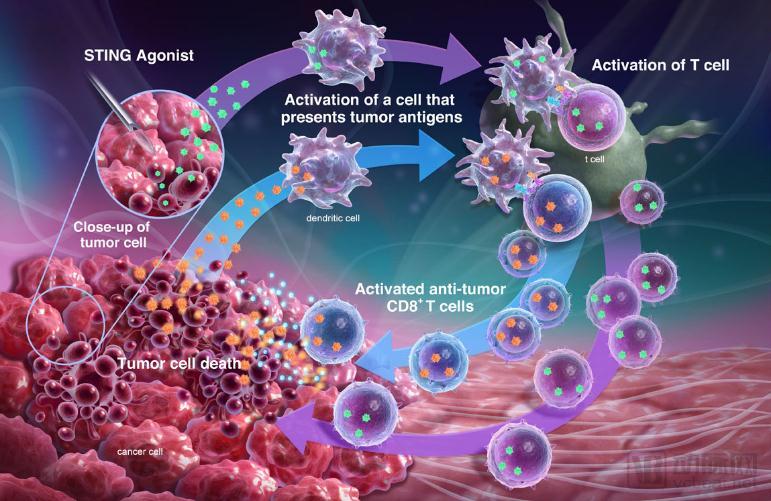
Image source: Aduro BioTech official website
With technical support from researchers at Johns Hopkins University, Aduro is collaborating with leading global pharmaceutical companies to expand its product and technology portfolio.
1. Aduro is collaborating with Eli Lilly to research, develop, and commercialize novel immunotherapeutic products for autoimmune and other inflammatory diseases.Aduro’s cGAS-STING Pathway Inhibitor Program aims to discover and develop inhibitors targeting the Stimulator of Interferon Genes (STING) pathway to modulate immune responses in various autoimmune-related diseases.
2. Aduro is also collaborating with Novartis to research, develop, and commercialize novel cancer immunotherapy products targeting the STING pathway.ADU-S100 is the first STING-targeted therapeutic agent to enter clinical development, and a clinical trial is currently underway to evaluate its efficacy in treating cutaneously accessible tumors, such as breast cancer, head and neck cancer, renal cell carcinoma, lymphoma, and melanoma.
3. Aduro Biotech collaborates with Merck to develop and commercialize a CD27 agonist antibody under a global licensing agreement.Merck & Co. has selected an anti-CD27 antibody, identified through Aduro Biotech’s B-Select monoclonal antibody technology, for clinical development.
In addition to pharmaceutical companies, Aduro also collaborates with academic institutions. The company is partnering with the University of California, Berkeley on its Immunotherapy and Vaccine Research Initiative (IVRI). This project combines UC Berkeley’s research capabilities with the company’s expertise in the discovery and development of immunotherapies to create new treatments for preventing and treating cancer, infectious diseases, and autoimmune disorders.
Since its establishment in 2000, the company has completed ten rounds of financing, raising a total of $177.7 million. Its investors include not only renowned investment firms such as Morningside Venture Capital and Fidelity International, but also leading corporations like Novartis. In April 2015, the company announced the completion of its initial public offering (IPO) and was officially listed on the NASDAQ Stock Market under the ticker symbol “ADRO.”
Currently, Aduro is collaborating with researchers at Johns Hopkins University, led by Drew Pardoll, to develop next-generation cancer therapies by combining GVAX, LADD, and cyclic dinucleotides across multiple cancer indications.
The integration of industry, academia, and research is a crucial component of the national technological innovation system. In China’s healthcare sector, this model exhibits its own characteristics but also faces significant challenges: certain technologies developed by universities and research institutions lack sufficient maturity and adaptability; some medical enterprises demonstrate weak sensitivity to market demands, and their capacity to absorb R&D outcomes and facilitate commercial translation requires improvement; furthermore, there is a deficiency in the establishment of industrialization “intermediary” departments within universities and research institutions, which generally lack the capability to build “bridges” for collaboration between academic/research entities and enterprises.
Through the lens of Johns Hopkins’ innovation ecosystem, we observe that scientific research transforms knowledge into technology, while enterprises identify societal needs and convert technology into capital. Strengthening the exploration of industry-academia-research collaboration models in the healthcare sector holds significant long-term value for optimizing resource allocation, reducing medical costs, improving service efficiency, and enhancing industry competitiveness.
Participants in the healthcare industry should perhaps focus more on how to facilitate the translation of technological innovations into tangible outcomes, delivering more products and services that can improve health status and quality of life.