

China Takes the Lead in 5G Healthcare Applications Amid US Conceptual Stage
Recently, the U.S. Department of Justice filed charges against Huawei Technologies Co., Ltd., its Deputy Chairwoman and Chief Financial Officer Meng Wanzhou, and others. In response, the Chinese side once again urged the United States to immediately revoke the arrest warrant for Ms. Meng. This detention case, which has captured the attention of millions of Chinese people, stems from 5G technology.
How Important Is 5G? As a technology that supports next-generation digital applications, 5G can power future smart cities and the digital economy. In addressing numerous technical, political, and policy challenges, countries that gain a first-mover advantage and successfully deploy 5G networks are likely to secure significant economic advantages over other nations.
On January 29, Wen Ku, spokesperson for China’s Ministry of Industry and Information Technology, stated that despite U.S. pressure on Chinese high-tech companies led by Huawei, China will continue to vigorously develop 5G technology based on the latest telecommunications standards. This clearly demonstrates that in the 5G rivalry between China and the United States, enterprises that achieve commercial deployment first are likely to seize a competitive market advantage.
In the healthcare industry, 5G also possesses the capacity to lead a revolution. In response, both China and the United States have successively launched explorations into 5G-based medical applications. And in this cold technological rivalry, China appears to have taken the lead...
First Physical Therapy Trial
In October 2018, at the Verizon 5G Labs, students and faculty from Columbia University’s Computer Graphics and User Interfaces Lab were experimenting with remote physical therapy enabled by 5G technology.
“5G may transform therapists’ clinical settings and the way patients access rehabilitation services,” said Professor Steven Feiner, Director of the Laboratory. “We have already conducted experiments using 5G connectivity, demonstrating that this is a viable approach.”
According to him, remote physical therapy may only be the tip of the iceberg in terms of 5G applications in surgery. With the acceleration of information transmission speeds, healthcare institutions will be able to provide patients with breakthrough solutions and rational treatment plans.
Experts at Verizon’s 5G Lab also envisioned the medical applications of 5G, suggesting that as network connectivity continues to improve, the next breakthrough may not come from research laboratories but from the front lines of patient care: hospitals.
5G-Enabled In-Hospital Robots (Logistics, Patient Guidance, etc.) Communicate and Coordinate Schedules, Allowing Busy Caregivers to Focus on Patients.
The First 5G-Based Medical System
In January 2019, Rush University Medical Center and Rush System for Health, both headquartered in Chicago, announced a partnership with AT&T to jointly explore the first standards-based 5G network deployment in a healthcare setting in the United States. Reportedly, 5G technology offers faster speeds and lower latency, supporting the extensive array of innovative technologies currently deployed by Rush across its health system.
Rush is also implementing AT&T’s Multi-Access Edge Computing (MEC), a cloud-based service. The AT&T MEC service will enable Rush to manage its cellular traffic through its local network and wide area network (WAN). This will allow Rush to better meet its needs for network communications and application processing, enhance various use cases within its systems, and help improve the patient experience.
5G is not merely an upgrade over 3G or 4G; it encompasses a variety of communication technologies, including cellular, Wi-Fi, and intelligent edge services. It can significantly boost transmission speeds, helping to unlock the full potential of applications such as distributed computing and Internet of Things (IoT) devices in healthcare. “We firmly believe that 5G is a game-changing technology,” said Dr. Shafiq Rab, Senior Vice President and Chief Information Officer at Rush. “Once fully implemented, it will enable us to better support hospital operations and deliver the highest-quality experience for both patients and hospital staff.”
According to Rab’s vision, physicians can conduct remote consultations or download large laboratory files within seconds. This future-oriented healthcare system, powered by a high-speed, low-latency IT network, facilitates rapid data exchange and enables clinicians to perform more detailed work from greater distances.
“This technology will increase access to care, even over long distances, while helping to reduce costs and improve efficiency. We are leveraging fast, reliable networks to provide support,” said Rab.
“Ultimately, the speed and ultra-low latency of 5G will transform all industries,” said Mo Katibeh, Chief Marketing Officer of AT&T Business. “Imagine hospital wards being intelligently managed, patients receiving care powered by artificial intelligence, and augmented reality being used to train medical students. It may sound like the future, but it is actually not that far off.”
Commentary: At present, the U.S. exploration of 5G in healthcare remains largely conceptual, with no substantive case studies emerging. It is expected that more specific scenario-based applications will emerge in the U.S. by mid-2019.
The First Hospital to Pilot 5G Telemedicine
In October 2018, at the 2018 Digital Economy Summit and Major 5G Technology Exhibition and Exchange Conference, Henan Mobile made a remarkable appearance under the theme “Yu Meets 5G: Within Reach,” showcasing its achievements in telemedicine within a mobile 5G environment.
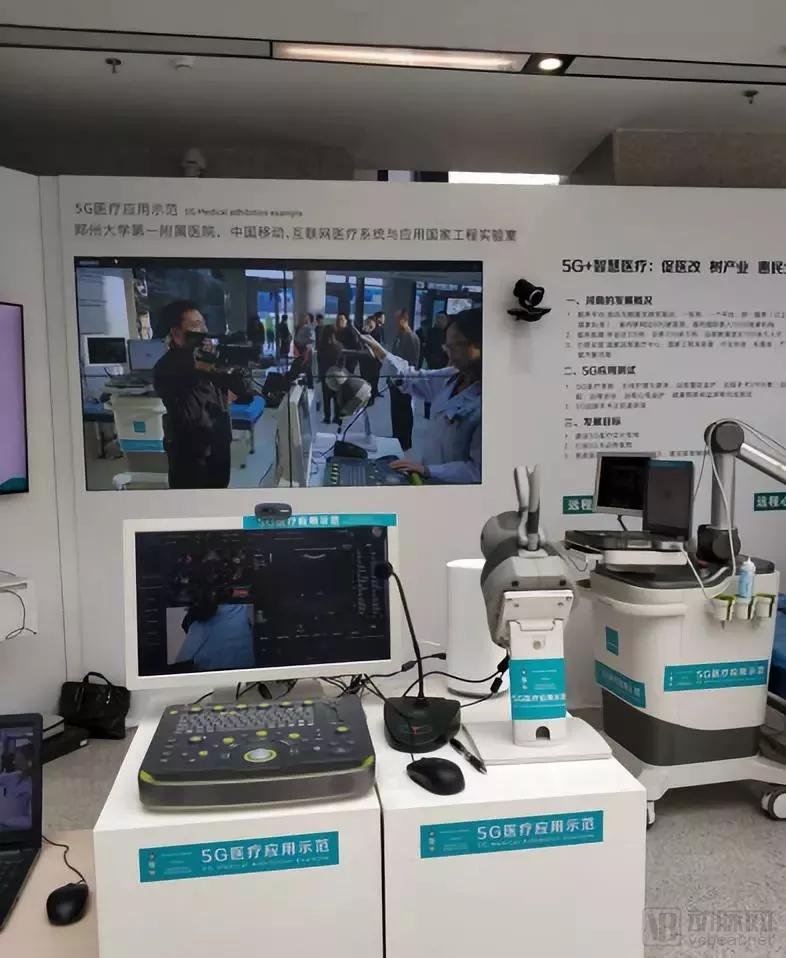
Mobile 5G Telemedicine Booth (Image Source: Sanmenxia Mobile)
It is reported that the 5G network construction currently being carried out by China Mobile Henan Branch and the First Affiliated Hospital of Zhengzhou University is underway. A total of 26 5G base stations are planned for the East and West Campuses of the First Affiliated Hospital of Zhengzhou University and the surrounding roads. Construction has been completed for two base stations at the East Campus and one base station at the National Engineering Laboratory for Internet Medical Systems and Applications (located at the West Campus) of the First Affiliated Hospital of Zhengzhou University. End-to-end service testing and applications have been completed within the National Engineering Laboratory of the First Affiliated Hospital of Zhengzhou University.
At the 5G Mobile Healthcare Application Demonstration Zone, staff from the Telemedicine Center of the First Affiliated Hospital of Zhengzhou University demonstrated cutting-edge telemedicine technologies to attendees, including remote consultations, remote ultrasound examinations, and mobile ward-round robots.
Professor Zhao Jie, Deputy Secretary of the Party Committee of the First Affiliated Hospital of Zhengzhou University and Director of the National Engineering Laboratory for Internet Medical Systems and Applications, stated that in the future, with mobile 5G technology, as long as there is a 5G signal, even people in remote rural areas can fully enjoy diagnostic and treatment services from experts at the First Affiliated Hospital of Zhengzhou University without leaving their homes.
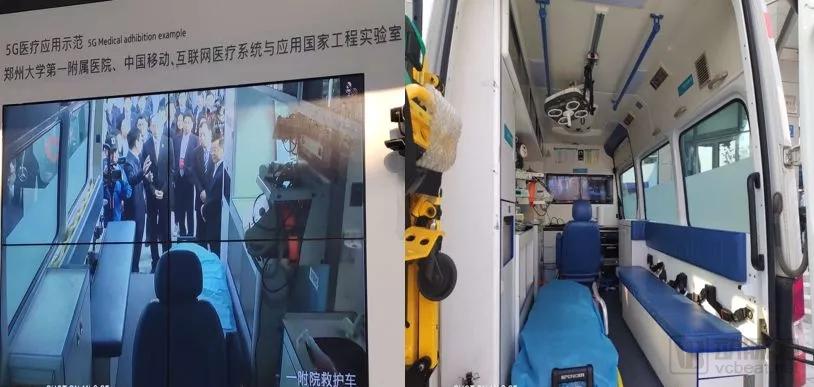
Mobile 5G Ambulance Remote Consultation (Image source: Sanmenxia Mobile)
Once the patient is aboard the ambulance, the legacy 4G connection often proves too slow. By leveraging mobile 5G technology, patient examination data and live scene footage can be transmitted rapidly and directly to the hospital. This enables specialists to review the patient’s medical records and issue diagnostic orders while the patient is still in transit, allowing for immediate testing upon arrival at the hospital. This approach significantly reduces pre-hospital emergency response time. In essence, boarding the ambulance becomes equivalent to arriving at the emergency center.
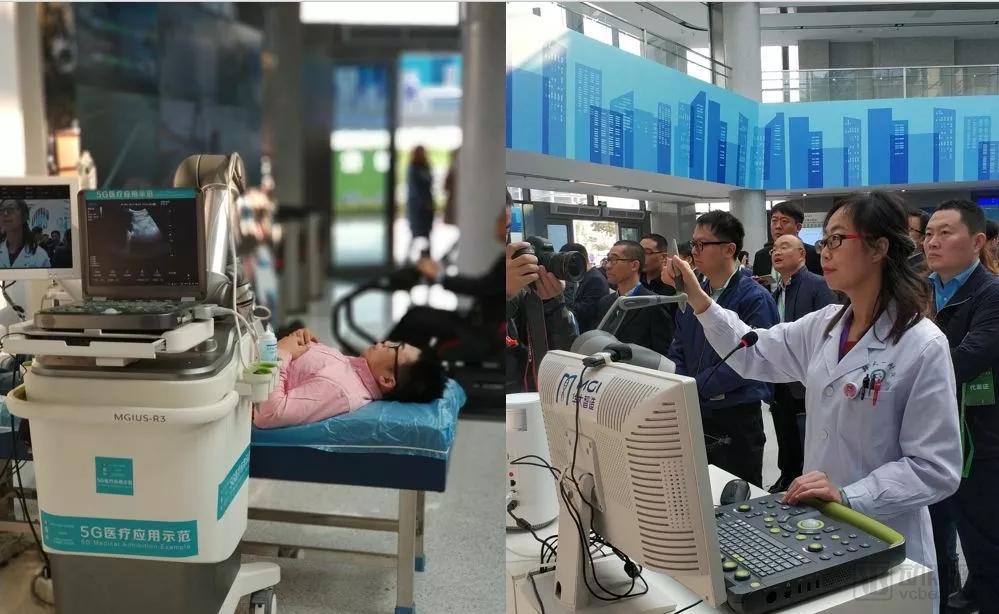
Remote B-Scan Ultrasound Based on 5G Networks (Image source: Sanmenxia Mobile)
Leveraging 5G technology, this compact wireless ultrasound probe functions as a control handle; by moving it up, down, left, right, or rotating it, clinicians can flexibly manipulate the robotic arm at the remote end of a telemedicine system. While patients lie on hospital beds in their hometowns, specialist physicians thousands of miles away gain a clear, comprehensive view of their physical condition. As a powerful tool for visualized precision medicine, as well as an effective instrument for rapid emergency assessment and preliminary screening, remote ultrasound and telemedicine help improve healthcare professionals’ work efficiency and diagnostic and therapeutic standards, while minimizing diagnostic errors and the resulting doctor–patient disputes.
In addition to remote ultrasound, wireless infusion is another cutting-edge technology in the 5G healthcare era.
Intravenous infusion is one of the most common clinical treatments. During the infusion process, patients often need to keep an eye on the IV bottle and must call a nurse immediately if infiltration occurs or the infusion is nearing completion. In the era of 5G healthcare, all this will become much simpler.
According to Chen Baozhan, a staff member at the Telemedicine Center of the First Affiliated Hospital of Zhengzhou University, wireless infusion systems utilize sensors and wireless alarms to monitor patients’ infusion progress. The system automatically alerts nurses when the infusion is nearing completion, thereby eliminating the need for patients to constantly watch their IV bottles or manually call for assistance.
In addition, the system can monitor infusion progress, rate, and status in real time, thereby standardizing processes such as infusion speed. Nurses can obtain a comprehensive overview of the infusion status across an entire ward at a glance on a single display screen.
The First 5G Remote Surgery
On January 19, the Suzhou Institute of Collaborative Innovation for Medical Robots announced that a Chinese surgeon had performed the world’s first remote surgical operation using 5G technology. The surgeon, located in Fujian Province, used a 5G network to control a robotic arm performing the procedure in a remote area 30 miles (approximately 48 kilometers) away.
Recently, Suzhou Kangduo Robot Co., Ltd., an enterprise incubated by the hospital, together with the Chinese People's Liberation Army General Hospital, Huawei Technologies Co., Ltd., and Fujian Mengchao Hepatobiliary Hospital, successfully performed the world’s first 5G remote surgical animal trial in Fuzhou, laying the foundation for 5G-enabled remote surgery.
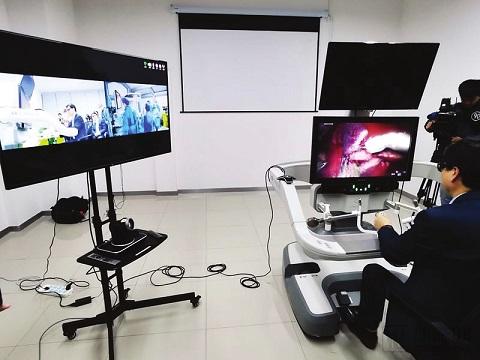
Image source: Suzhou Daily
During the procedure, at the console of the surgical robot located in the 5G laboratory of China Unicom Fujian Branch, Liu Rong, Director of the Second Department of Hepatobiliary Surgery at the Chinese PLA General Hospital, wore 3D glasses to remotely operate the domestically developed Kangduo laparoscopic surgical robot. He performed a hepatic lobule resection on an experimental animal at a hospital 50 kilometers away, while maintaining communication with the operating room via video terminal. The entire resection process took less than 10 minutes, resulting in a neat incision site with minimal bleeding. Surgical conditions were displayed in real time on screens at both ends, with extremely low operational latency. Postoperatively, the experimental animal’s vital signs remained stable.
Professor Du Zhijiang, Chief Scientist of the Kangduo Surgical Robot technology and Deputy Director of the Robotics Institute at Harbin Institute of Technology, stated that the success of this remote surgery trial will not only significantly advance the application and research of remote robotic surgery, but also holds greater significance in that future surgical robots equipped with 5G technology can extend the advantages of robotic surgery over longer distances. This will enable precise and timely surgical interventions for patients in remote areas, thereby promoting a more equitable and rational allocation of medical resources across China.
Moving forward, the hospital will deepen its collaboration with all stakeholders, leverage 5G technology to advance the development of regional medical consortium application scenarios based on various medical robots and digital medical devices, and establish pilot programs for medical robots, telemedicine, and mobile health.
Commentary: Compared with the United States, China has established clear use cases for 5G-enabled medical applications and has conducted successful trials in the revolutionary field of surgical robotics. It can be said that China holds a slight lead over the United States.
Seizing the First-Mover Advantage in 5G Healthcare
In 2001, a 68-year-old woman underwent a cholecystectomy at a hospital in Strasbourg, France. The surgeon performing the procedure was seated at a console in New York City, operating a three-armed robotic system located in France. Leveraging transatlantic fiber-optic connections, the lead surgeon was able to monitor the patient’s movements in real time on a screen. The surgery lasted 54 minutes, and the patient was discharged uneventfully two days later.
Hospital network technology is playing an increasingly important role in healthcare. However, due to the high demand for network bandwidth, telemedicine has seen few breakthroughs over the past decade—until the advent of 5G...
As some experts have stated, telemedicine is one of the most exciting fields in the world, but achieving true progress requires breakthroughs in network technology. This is why 5G has emerged as a game-changing technology. By increasing connection speeds and reducing latency, it empowers medical innovators to do what they do best: advance medicine.
2019 was, without a doubt, the year of trial commercialization for fifth-generation mobile communication technology (5G). The healthcare industry will benefit from 5G’s extraordinary capabilities, including ubiquitous coverage, Gbps-level data rates, and ultra-low latency in the range of 5ms to 30ms. In the near future, everyone will have access to timely and convenient smart healthcare services. However, as the 5G rivalry between China and the United States intensifies, the healthcare sector may no longer remain a sanctuary untouched by these geopolitical tensions.
References:
Sanmenxia Mobile: 5G Remote Healthcare Is Here! Making It a Reality for Experts Thousands of Miles Away to Diagnose and Treat You!
China Jiangsu Network: Surgical Robots from Jiangsu Enterprises Shine as the World’s First 5G Remote Animal Surgery Trial Is Successfully Conducted!
Verizon Official Website: How 5G Is Transforming Healthcare