

Prescription Drug New Retail: Strategic Early-Mover Advantage
Editor’s Note: This article is reprinted from PwC China, authored by Xu Jia, Cai Jingyu, and Qin Jiaxin. VCBeat has been authorized to republish it.
Since the State Council issued the "Key Tasks for Deepening the Reform of the Medical and Health Care System in 2016," which prohibited hospitals from restricting the outflow of prescriptions and encouraged patients to choose freely between purchasing medications at hospital outpatient pharmacies or at retail pharmacies with a prescription, a total of 11 provinces and municipalities across China have introduced relevant policies between May 2016 and May 2018 to explicitly encourage prescription outflow.
From 2017 to 2018, traditional pharmaceutical retail enterprises represented by A-share listed pharmacy chains, modern pharmaceutical distribution and information service companies represented by Shanghai Pharmaceuticals and Qingdao Baiyang, internet giants represented by Tencent and Alibaba, and investors represented by Hillhouse Capital all accelerated their expansion into the prescription drug retail sector, making prescription drug retail once again a focal point of the industry.
However, the market expansion and industry boom of prescription drug retail still face many challenges, mainly including:
Barriers Remain in Obtaining Prescriptions
The Medical Insurance Pooled Account Has Not Been Fully Opened to Retail Pharmacies
Pharmaceutical Companies Worry About the Return on Investment in the Retail Market
Pharmacies Struggle to Provide High-Quality Pharmaceutical Care Services
Despite the challenges, the separation of prescribing and dispensing remains the overarching direction of China’s healthcare reform, and the expansion of the prescription drug retail market is an inevitable outcome of this reform. Enterprises need to closely align with the policy direction of healthcare reform and make early strategic deployments to gain a competitive edge.
We believe that retailing prescription drugs is not merely a change in the location of drug sales. To tap into this market, pharmaceutical manufacturers and chain pharmacies need to collaborate with new business partners—such as information service providers, modern logistics and distribution networks, pharmaceutical care service platforms, and professional institutions specializing in patient and disease management. By adopting a patient-centric approach and actively cooperating with the government, they can build an innovative business model that adds value, enhances efficiency, and ensures safety. The future of the prescription drug retail industry may exhibit the following development trends:
Trend 1: A Few National, Open Prescription-Sharing Platforms Will Dominate the Pharmaceutical Retail Market
In the future, the wave of capital-driven pharmacy mergers and acquisitions will increase concentration in the retail market; large pharmaceutical information service providers, or even internet giants, may enter the fray by offering nationwide technology service platforms; for regulatory reasons, the government may favor prescription-sharing platforms open to all qualified retail pharmacies over proprietary systems dedicated to specific pharmacy chains.
Analogous to the fragmented development trajectory of consumer e-commerce, prescription-sharing platforms are likely to evolve into “public utility and open transaction platforms” that are built and managed by a few large enterprises, serve all medical institutions and retail pharmacies, and are subject to real-time data monitoring by health insurance regulators and market supervision authorities. The emergence and strengthening of the “public instrument” characteristics of prescription-sharing platforms will serve as a benchmark for the maturity of the prescription drug retail market.
Trend 2: Only retail pharmacies that meet national requirements are eligible to undertake the retail business of prescription drugs
Against the backdrop of tiered management for retail pharmacies, flagship pharmacies with strong patient service capabilities, fully staffed pharmacist teams, outstanding end-to-end cold chain management from factory to counter, and well-developed information technology systems may become scarce industry resources, positioning themselves as the vanguard in handling hundreds of billions worth of prescription drug retail business.
Pharmaceutical retail enterprises should seize this historic opportunity, upgrading and empowering traditional pharmacies in response to policy trends and shifts in medication structures, thereby preparing for future competition.
Trend 3: Profit Margins for Prescription Drug Retail Businesses Under Medical Insurance Reimbursement May Be Limited; Enterprises Need to Explore Sustainable Profit Models
Access to medical insurance resources is a prerequisite for the substantial growth of the prescription drug retail market. However, due to cost-containment pressures, medical insurance authorities are likely to require retail pharmacies to relinquish their autonomous pricing rights. Meanwhile, public hospitals, aiming to offload the management costs of outpatient pharmacies, are collaborating with retail pharmacies but are unlikely to pay high fees for such outsourced services.
Therefore, the future prescription drug retail business cannot be confined to the simplistic profit model of purchasing and selling pharmaceuticals; enterprises must explore sustainable and differentiated profitability models. Herein, a brief comparison is made among several existing models currently available in the market.
Mode 1: Bundle price-capped prescription drugs with price-elastic OTC medications, medical devices, and health supplements for joint sales.
Model 2: Integrate innovative services such as prescription routing, pharmaceutical delivery, and patient financing to secure national distribution or agency rights for new products from pharmaceutical companies as a differentiated competitive advantage, thereby generating revenue through distribution or agency operations.
Model 3: Focusing on oncology and rare diseases, it provides companion diagnostics, second medical opinions based on real-world data (RWD) and artificial intelligence (AI), delivery of novel and specialty drugs, and pharmaceutical care services, thereby establishing comprehensive whole-course patient management.
Trend 4: Reduce Operating Costs of Pharmacies and Improve Single-Store Operational Efficiency
Chinese pharmaceutical retail enterprises are grappling with the widespread pain point of low per-store revenue and profitability. Cost reduction, efficiency enhancement, and mergers and acquisitions have become inevitable pathways for future development. Some industry players have already undertaken extensive explorations in this regard, such as reducing the number of physical stores or controlling pharmacy leased areas, while establishing centralized pharmaceutical distribution warehouses in urban centers.
After prescriptions are obtained from partner hospitals, internet hospitals, and physical pharmacies, medications can be shipped directly from the central warehouse for home delivery or delivered to patients. This new model expands the range of available medicines while reducing store rent and operational costs.
Additionally, industry-leading enterprises have established intelligent business analytics systems that optimize future product portfolios and inventory plans for pharmacies by analyzing historical sales data of products and stores, thereby providing scientific guidance to enhance per-store revenue and profitability.
Trend 5: Incubating Corresponding Innovative Business Models Based on Prescription Drug Types to Meet the Needs of Pharmaceutical Companies
PwC research finds that not all types of prescription drugs are suitable for development in the retail market, and the needs of manufacturers vary by drug category. In the future retail prescription drug market, pharmaceutical companies will serve not only as suppliers of high-quality products but also as key partners in innovating pharmacy design and operational business models, while additionally being an essential payer in new business models adopted by pharmacies and healthcare data companies.
Therefore, gaining a deep understanding of and continuously meeting the needs of pharmaceutical companies is also one of the necessary prerequisites for future growth in the prescription drug retail market.
Primary Motivations for Different Types of Prescription Drugs to Enter the Retail Market
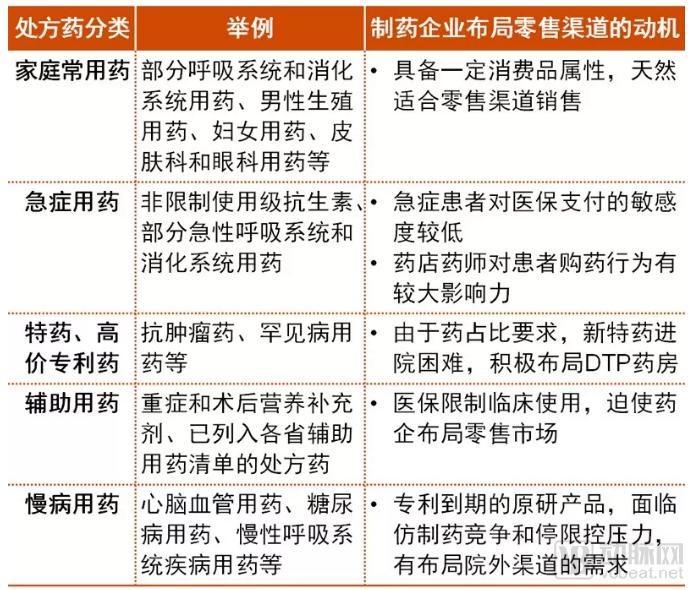
Source: PwC Analysis
Unlocking New Opportunities in the Prescription Drug Retail Market Requires Patient-Centric Strategies and Models. Pharmaceutical manufacturers, pharmaceutical distributors and retailers, medical information service providers, and internet giants must all break free from the constraints of existing business models to uncover unmet needs among government regulators, hospitals and physicians, patients, and payers.
On the premise of deeply understanding the interests and concerns of all stakeholders, construct a new business model characterized by multi-party collaboration, featuring information exchange, and grounded in supply chain management to support disease management or optimize patient experience. During the innovation process, avoid rashly claiming “disruption”; instead, adopt a collaborative mindset to share the vision of the future business model with all parties to garner greater support for driving industry transformation. Meanwhile, place high importance on the costs associated with adopting new technologies, and integrate retrospective analysis of the profit model throughout the entire project to ensure the sustainability of innovative development.
*This article is excerpted from PwC’s recently released report, “New Retail for Prescription Drugs: Early Deployment and First-Mover Advantage.” To access the full report, visit: https://www.pwccn.com/zh/pharmaceuticals/publications/retail-market-trends-of-prescription-drug.pdf